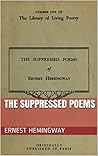
BOOKS: “The Suppressed Poems of Ernest Hemingway”

The suppressed poemsThe suppressed poems by Ernest Hemingway
My rating: 4 of 5 stars

Available online – Public Domain

I read this book because my curiosity was piqued by a reference to poems Hemingway published in Der Querschnitt, a reference that was made in a biography of Hemingway I’ve been reading recently (Forty-Three Ways of Looking at Hemingway by Jeffrey Meyers.) Five of the seventeen poems in the book are from Der Querschnitt. (Ten of the poems were published in a book entitled Three Stories and Ten Poems and a couple are odds and ends.)

The Der Quershnitt pieces are bawdy by 1920’s standards, though not particularly for today. The other poems can be a bit intense, dealing in subjects like death in war (Champs D’Honneur,) suicide (Montparnasse, and a curse upon literary critics (Valentine,) but tend to be a bit more refined (excepting Valentine. which may be the least elevated of the collected poems.)

The poems include a mix of lyric, free verse, and prose poem, though all are fairly short (the longest, The Soul of Spain, fits in three pages.)

My favorite was a short lyric poem entitled The Age Demanded, which considers the paradox of the 1920’s as a progressive age, restrained. I also found T. Roosevelt to be fascinating because in the act of critiquing Teddy Roosevelt, Hemingway (wittingly or not) gives us a bit of autobiography. (i.e.“And all the legends that he started in his life // Live on and prosper, // Unhampered now by his existence.”)

I give Hemingway more credit for saying interesting things by virtue of being bold than for saying anything in a particularly interesting way, but it’s enough to make these poems worth reading.

View all my reviews

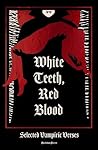
BOOK: “White Teeth, Red Blood” by Various

White Teeth, Red Blood: Selected Vampiric VersesWhite Teeth, Red Blood: Selected Vampiric Verses by Lord Byron
My rating: 5 of 5 stars

Publisher Site – Pushkin Press

This anthology gathers poetry with at least a vaguely vampiric theme. About half of the poets fit into the category of well-known to a general readership (e.g. Goethe, Byron, Coleridge, Tennyson, Yeats, Dickinson, Kipling, Baudelaire, Millay, etc.) and the others will be less familiar to most readers — either by virtue of being modern poets or having a body of work that didn’t age as well, on the whole. Even the pieces from familiar poets don’t tend to be among those artists’ most anthologized works by virtue of the specialized theme of the selection. Most of the pieces are older works, but there are modern poems included as well, and it follows that most of the works are rhymed / metered, with free verse mostly seen among the newest poems.

The twenty-nine poems in the anthology are arranged between three sections. The first is the longest part, taking up about 3/4th of the book, and consists of nine poems (including a few excerpts of book-length narrative poems,) all of long format. The second section includes eleven shorter poems (between one and a few pages long,) and the last section contains nine poems, most of which are quite short (as short as a quatrain.)

There is a brief introduction by Claire Kohda, but otherwise there is no ancillary matter. That was fine by me. There is no padding, and — even though there are fewer than thirty poems — the poems fill out the book because so many of them are long pieces or excerpts.

I enjoyed this book and its varied selection of poems. While I read poetry extensively and have read my share of vampire fiction, this was the first work I can remember reading at their intersect. This meant that, for me, there was a good amount of unfamiliar material (despite there being relatively few recent poems.) If you’re in the same boat, you’ll probably enjoy this anthology.

View all my reviews

BOOKS: “A Child’s Garden of Verses” by Robert Louis Stevenson

A Child's Garden Of VersesA Child’s Garden Of Verses by Robert Louis Stevenson
My rating: 5 of 5 stars

Amazon.in Page

Until recently, I was only acquainted with Stevenson as a novelist, but I had a powerful experience with his poem “The Hayloft” (included in this collection.) I was intrigued by how a poem written by a nineteenth century Scot could prove so nostalgia-inducing for me, having been a 20th century American farm-boy. So, I read the collection, and found that “The Hayloft” was only one of many examples that had such an effect. Others include: “Land of Counterpane,” “Block City,” and “Land of Nod.” The nostalgic power of the poems derives from the fact that Stevenson does a phenomenal job of capturing a child’s enthusiasm for play, and in that regard I’m sure the collection will resonate more broadly than just I, or even than just farm kids.

Afterall, there’s a lot of Stevenson’s experience that is dissimilar to mine. Besides his era and his nationality, his mentions of nurses, gardeners, and cooks is surely much different from my own upbringing, being devoid of household staff. But the book only needs to draw upon that love of play and imagination to take one back.

For a work from the nineteenth century, this collection of 50+ lyric poems has aged well. There is the occasional word like “gabies” or “whin” to send one to a dictionary, but those archaic or obsolete terms are rarities. Furthermore, the lyricism of the poems makes them easily read or sung.

I’d highly recommend this collection for poetry readers, particularly children or those looking to reexperience childhood.

View all my reviews

Alone in a Crowd [Couplets]

He sits alone. His barstool straight,
it faces forward - not askew.

The room is full, the music loud.
He stares through his half-empty brew.

He's oblivious to all else --
all alone in the human zoo.

POEM: Life Behind the Veil

Those who wished to see but not be seen
would sit and see the world through carved screens,
taking in the thriving market scenes,
watching hunched women sweep the streets clean,
vendors ladling curry from tureens,
pickpockets who thought themselves unseen,
and drunks who use walls as a latrine.

What’s worse about life behind the veil,
the sight of lives lived beyond the pale,
or knowing you live outside the tale?

BOOK REVIEW: A Choice of Comic and Curious Verse ed. by J.M. Cohen

A Choice of Comic and Curious VerseA Choice of Comic and Curious Verse by J.M. Cohen
My rating: 5 of 5 stars

Amazon page


This poetry anthology consists of works selected and arranged by J.M. Cohen with the overarching theme of light-heartedness. Some of the poems are outright funny, others are more quirky, corny, or tongue-in-cheek. This edition was originally published in the 1970’s, though there was apparently a preceding edition that was largely the same that dates to the late-1950’s. The poems are almost all metered and rhymed, in part because that was still the dominant mode of poetry when these works were first published, and also because metered and rhymed verse conveys a jocular tone. Forms associated with comedic delivery, such as the limerick, are well-represented.

The 450-plus poems by about 180 authors (actually many more owing to the fact that the biggest contributor by far is Anonymous) are arranged into 22 thematic categories that are clearly meant to be more whimsical than categorical. The poets include those who are most well-known for playful verse such as Ogden Nash, Lewis Carroll, and Edward Lear, but also light works by poets known for seriously toned work (e.g. Alexander Pope, John Betjeman, and W.H. Auden.) There are also plenty by authors known for mixing light and serious work, such as G.K. Chesterton, Robert Graves, and Hilaire Belloc. There are also a large number of poets who you’re unlikely to have heard of unless you’re a literary historian. Included in the collection are some widely anthologized works such as Belloc’s “Matilda,” Carroll’s “Jabberwocky,” and Aldous Huxley’s “Second Philosopher’s Song,” but there are a great many more that will be unfamiliar to most (and a few that may be familiar as graffiti on a restroom wall.)

I enjoyed this book. It turned me onto some poets with whom I’d been unfamiliar. The works included, as one would expect of light verse, are quite readable (though there are some outdated references here and there.) If you stumble onto a decently-priced copy, pick it up.

View all my reviews

A Conversation of Mutual Disenchantment

“I remember being born.”

“No. You don’t.”

“How would you know?”

“Well, let’s start from the assumption that you’re human…”

“I’d like to think so, but what are my options?”

“I don’t know. Humans don’t have that neural machinery at birth… So nothing from Earth remembers its birth.”

“And yet, I do.”

“Mightn’t you have cobbled together the scene from your mom’s stories, the family photo album, et cetera?”

“Nah! It’s too detailed. Feels too real.”

“I find your ignorance exhausting.”

“I find your certainty perplexing — not to mention irritating and slap-worthy.”

“Let’s agree to be mutually disenchanted.”

“Agreed.”

POEM: Free


What are you free to do or be?

Can you set out across an endless sea?

What deserts can your mind go roam

from which your fears won’t send you home?

Epictetus asked, “Are you free?”

Can you stand, while others flee?

Can you escape the default mode

that’s locked into your mental code?

Can truth change your way of seeing?

Are you sectless in the art of disagreeing?

POEM: To BE… Or Not

Copy of IMG_1580“What do you want to BE when you grow up?”

They ask you when you’re just a little pup.

So, what part of what I must BE,

is different from the me you see?

Dad thought, “the part that they’ll pay you for.”

Like an allowance for finishing a chore?

“Yes, young man, but you can safely assume, 

no one else will pay you to clean your room.”


Kids don’t think of being gainfully employed.


Which seems to make grownups quite annoyed.

At five, I wanted to be a cowboy.

“Son, there’s no jobs in that line of employ.”

That’s OK, then I’ll be an Indian.

“You’d have to be born that way, my friend.”

I wasn’t born a doctor, but you said that’s OK.

“That’s not the same, son, what can I say?”

I know what then, Dad, I’ll be the Batman!

“Come on, son, that’s not a feasible plan.”

You’re thinking Superman, Batman has no powers.

“Bruce Wayne by day, Batman at night, where’s the sleeping hours.”

You have a point there, you’ve got me stumped.

Thinking myself prematurely defunct.

POEM: Midnight Neon Glow

Caught in a midnight neon glow
Neurons firing in slo-mo
As blue and red dance on the wall
I felt the footsteps in the hall


A jagged game of cat and mouse
Ends, spied by a mattress louse
An ominous knock near at hand
Me, without the will to stand


This story started days ago
Me, without a need to know
Just a lackey in a suit
Who took a case from a coot


What’s in the case? You want to know?
Oh, they’re here. It’s time to go…