The space between

   this & that,

   us & them,

   then & now,

   now & later.

 The pregnant pause —
   a pause without cause —

 Just senseless nothing
   in between.

The space between
this & that,
us & them,
then & now,
now & later.
The pregnant pause —
a pause without cause —
Just senseless nothing
in between.
Nothing. My philosophy is that if I need technology to function flawlessly every second to keep me alive, I don’t need to be in that place.
I read the space
   Around the poem.
 It has no meaning,
   But says so much.
 It betrays a little secret
   That no reader ever learned
      Who was too concerned
        With what was written,
      While wholly inattentive
         To
         What
         Was
         Not.
Waking to a world in which
    Space & Time misbehave:

Shapes slump,
   Even melting into pools,
   Oozing to flatness, then
     Over the edge and
     Into nowhere.

Time moves in riverine fashion:
     Rushing in the chokepoints
     And lazing in the wide plains.
     Though still flowing
       Inexorably and unidirectionally.

The illusion tries
   To reveal itself,
     But who can understand...
How much would you pay to go to the moon?
Not one thin dime. I have no pressing need to go to a place without breathable quantities of oxygen for longer than I can hold my breath. If complex technology is required every millisecond to stay alive… well, I know where I’m not wanted.
I’ll leave it to the billionaires who have enough spare change lying around to fund personal space programs.
I’ll stick to gazing at it admiringly from afar.
 Life at the Extremes by Frances Ashcroft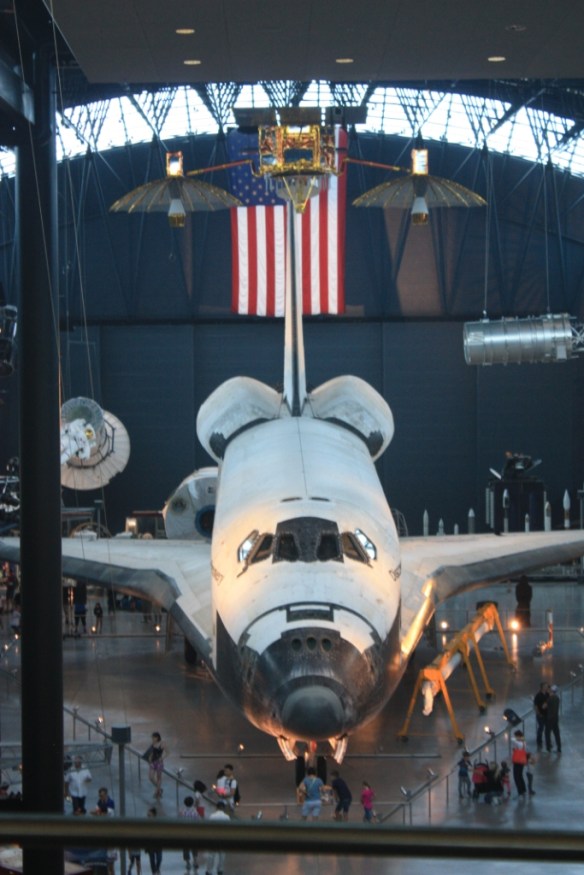
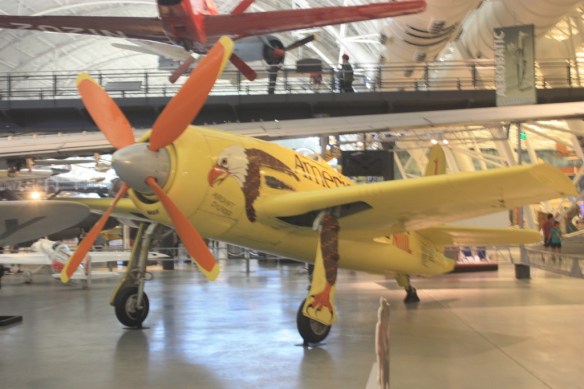
Space Shuttle Discovery; Taken on July 23, 2018 at the Udvar-Hazy Center of the National Air & Space Museum
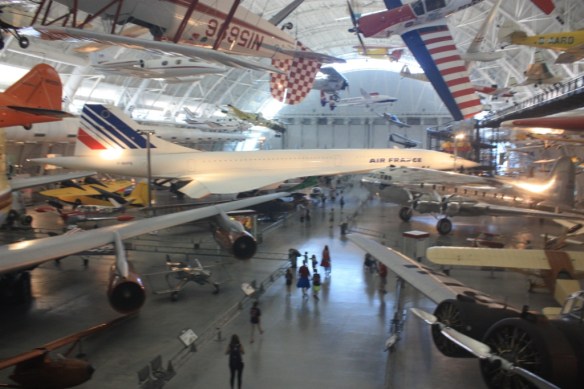
Main Hall; Featuring the Concorde
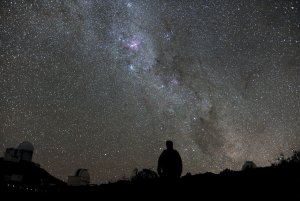
Source: European Southern Observatory (via Wikipedia)
Let me step up on my soapbox,
tell you about a paradox.
Said a scientist named Fermi,
“Why’ve no aliens made the journey
to bring us a nice fruit basket
or just tell us how fantastic
it is having us in the neighborhood.”
Scientists have racked their brains
considering competing claims:
“Life is hard and smarts is harder.”
“They can’t stock a trans-galactic larder.”
“They’ve come here, but are to small to hear.”
“They are shy, out of wisdom or of fear.”
Or, simply, “They all blow’d themselves to hell.”
I, too, have had reason to ponder
why aliens stifled the urge to wander
into our little neck of the wood,
and I fear we don’t come off so good.
What if, I ask you, heaven forbid
they think of us as the smelly kid?
Are we the seatmate who won’t shut up
about his robotic barbershop startup?
Do humans come across as the kind
to ask a stranger if they wouldn’t mind,
helping us move and antique armoire
or lending us their new flying car?
So when considering whether we’re alone of device or luck,
consider the competing hypothesis that we really suck.
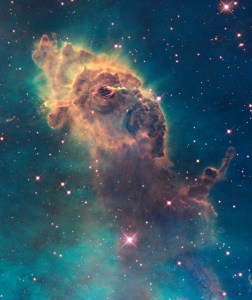
That speck of sand
that you can barely see
is a planet to the particle
that sits on either side of it,
awaiting a wave form collapse.
Your mind can’t roam out
to the tip of the spiral arm–
let alone to the leading edge
of space as it accelerates into…
5 billion years or 5,000,
it’s all the same to you.
And anything less than
a microsecond isn’t worth
being called time–
[though it’s half a life time for muonium.]
Such a tiny window
through which to seek
the sum of all knowledge.


 Tiger Riding for Beginners