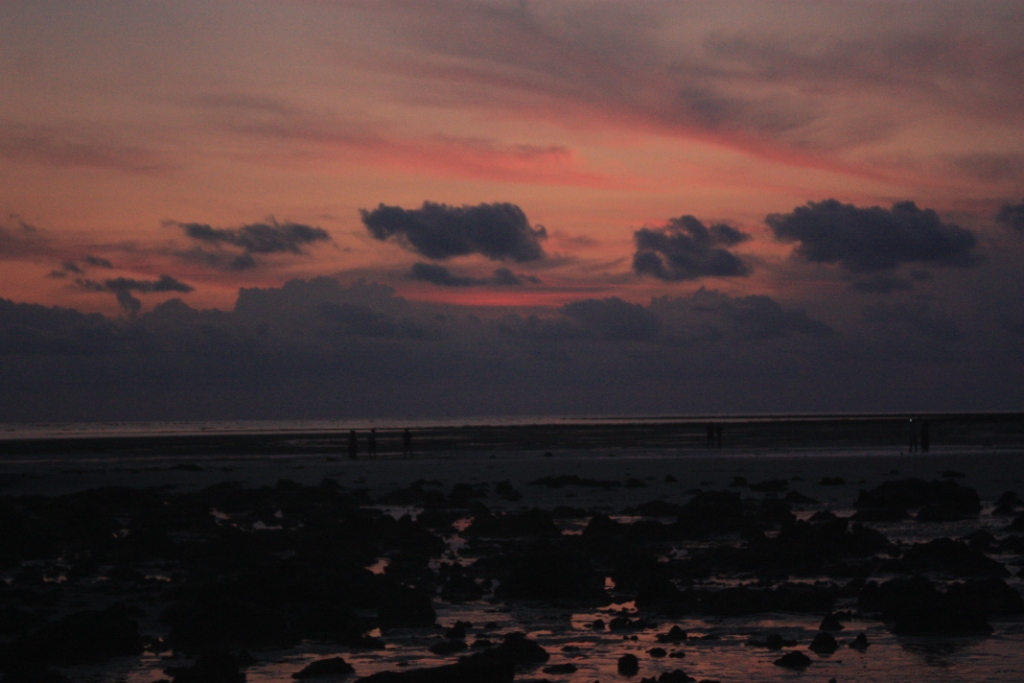
The evening winds are blowing out to sea,
and carry away all the woes of day.
You see the sway up in the waving trees
that give a sendoff to what's blown away.
The sea grows dark, and darkness envelops.
And sandy scents and fishy scents blossom.
And sounds of crashing waves seem to swell up,
as vision decides it will play possum.
Then stars - in veins - do shimmer between clouds,
the clouds one cannot see but can induce.
Now free from both the light and noise of crowds,
and all the human chaos and abuse.
Midst drifting shapes my mind is lulled to peace,
then all that is - both sea and wind - does cease...

Tag Archives: sleep
Red Panda [Haiku]
Full Moon [Haiku]

through bleary eyes,
i look out to see the moon,
then fall back to sleep
BOOK REVIEW: Immunity by Jenna Macciochi
Immunity: The Science of Staying Well—The Definitive Guide to Caring for Your Immune System by Jenna MacciochiMy rating: 5 of 5 stars
Amazon.in Page
This is a book about how to keep one’s immune system firing on all cylinders, and it reports on the scientific findings about how a range of lifestyle activities (e.g. exercise, sleep, and nutrition) impact upon the robustness of one’s immune response. The book was exceedingly timely, having been put out last spring in the early days of the pandemic [though I was delinquent in getting to my review until now.]
The book consists of just seven chapters, though they are substantial in length and extent of discussion of the respective topics. The first chapter offers a primer on the immune system, its components, and how it does its crucial job. This chapter also explains how vaccinations work, what autoimmune diseases and allergies are, and what role genetics (nature) and lifestyle / environment (nurture) play in immunity.
Chapter two investigates a range of topics at the nexus of lifecycle and immunity, including: differences between male and female immune responses, pregnancy and immunity, and the effects of aging and menopause on immune system activity.
Chapter three is about our intestinal microbiomes and immunity. If this seems like a strange topic to devote an entire chapter to, you probably haven’t been following the voluminous outpouring of research findings about how our helpful microbiological lifeforms are being shown to have a profound impact on all aspects of human health and well-being from mental health to, well, immune system robustness.
Chapter four explores how immune system activity is compromised by lack of sleep or poor-quality sleep. However, it also looks more broadly at how our immune system responds to the various cycles in which it finds itself — from the daily cycle of days and nights to the yearly seasonal cycle.
Chapter five considers the nexus of mental health and immune response. As was mentioned with respect to the gut, the connections between physiological activity and mental health are becoming ever more apparent – though there remains much to be understood.
The penultimate chapter is about fitness and physical activity and what is know about why exercise is so good for one’s immune response. Of course, there seem to be diminishing marginal returns (less benefit for a given additional workout) and even diminishing returns (negative outcomes) if one goes too crazy with one’s exercise regiment and doesn’t give one’s body adequate amounts of rest.
The final chapter is about the role of nutrition in immune system activity. The approach is very much accord with my own beliefs which are that if one eats right, there is little need for supplements, and no volume of supplements will save you from a poor diet. The emphasis is upon a high-fiber diet rich in plant nutrients and balanced to provide all necessary macro- and micronutrients, while debunking fads and dietary myths. There is discussion of many of the foods that are traditionally associated with immunity (echinacea, elderberry, turmeric, etc.,) and what claims seem to hold and which are unproven.
If you don’t know a lot about the science of healthy lifestyles, this book offers an additional benefit in that it approaches the topic from a quite basic level. That is, it provides a lot of background information that would be useful for a complete neophyte to understand the points about immune activity. So, for example, the author lays out rudimentary explanations of micronutrients or sleep cycles before getting into the relevant information about how these impact on immunity. Of course, the flip side is that for those who have studied this science, it may take some skimming because there is a lot of material that will probably be elementary to those who practice healthy living.
I found this to be an extremely beneficial book. Its focus upon what one can do to improve immune robustness makes it tremendously useful for the average reader. It presents the science without getting too deep in the weeds of detailed physiological activity. I felt the author did an excellent job of walking the line to produce a book that is useful, readable, and digestible.
View all my reviews
POEM: Hypnagogic Voices
I hear voices -- a cold burble of voices -- too dim and distant to extract meaning, too inexplicable not to inject a rationale, or a slate of reasons: -madness -conspiracy -expectation -the impulse toward void filling minds despise quiet, filling it with puzzling prattle, and making any hash of sound into cryptic natter, until sleep descends
POEM: Sleep [PoMo Day 8 – Rondeau Tercet]
In haunted hours, I wilt to sleep, and know that I'll be cursed in dreams. I'll drift upon Stygian streams at speeds between trickle and creep, listening for some distant screams. In haunted hours, I wilt to sleep, and know that I'll be cursed in dreams trapped down below the castle keep, until the King should come to deem me worthy of some healing dreams. In haunted hours, I wilt to sleep, and know that I'll be cursed with dreams, drifting upon Stygian streams.
POEM: Hypnagogia
I lie falling asleep —
purple Rorschach blobs
forming,
transforming,
& unforming
on the black field of my inner eyelids.
The veneer of reality felt thinner,
but my efforts to poke a finger through
shoved me back into the warm, soft reality of my bed.
[I’d so wanted to “Here’s Johnny!” my way into
an alternate dimension.]
And, once more, I’m a prisoner to reflexes
that snatch away subtle worlds.
POEM: Morpheus’ Shroud
Last night the drape was thin and billowy.
Dreams seen through the weep of a willow tree.
Shapes without texture, beings without plights.
A curtain of fog, turning days into nights.
I stood on a corner in the land of nod.
One not crossed in maps of men or gods.
And wondered whether I was found or lost.
Waiting in calm for a morrow tempest-tossed.
But morning light brought me no clarity.
BOOK REVIEW: Why We Sleep by Matthew Walker
Why We Sleep: The New Science of Sleep and Dreams by Matthew Walker
My rating: 4 of 5 stars
For a long time, the questions of why we sleep and dream remained unanswered — or answered speculatively in ways that proved without merit. One presumes the reasons are potent because there seems to be little evolutionary advantage in spending a third of one’s life unconscious of one’s environs and paralyzed (literally in REM sleep, but for all intents and purposes in NREM sleep as one can’t respond to changes in the environment without some part of one’s brain taking note of said changes.) The good news is that Matthew Walker’s book offers insight into what scientists have learned about why we sleep, why we dream, why we become so dysfunctional without doing both, and what it is about modern life and its technologies that has created an apparent crisis of sleep loss. Walker goes beyond the science to discuss what individuals and institutions can do to reduce the harmful effects of sleep deprivation.
The downside of this book is that it’s a bit alarmist, and in contrast to many books of this nature one doesn’t get a good indication of the quality of studies reported. Some pretty brazen claims are made and the reader doesn’t necessarily know if they are preliminary and unvalidated or if they are well established. Here, I’m speaking about the studies that try to isolate out the effect of sleep loss versus all other factors (which is a notoriously messy affair,) and not so much studies that report on the physiological effects of sleep and sleep loss (which I see less reason to not take at face value.) At any rate, any reader who doesn’t fall asleep as soon as his head hits the pillow and sleep straight through 7 hours and fifty-five minutes — waking 5 minutes before the alarm — is likely to feel doomed if they take this book too seriously. And if you ever engaged in shift-work (as I have) or had an intense travel schedule, you are likely to feel that your life is permanently and irretrievably wrecked.
I know this is a book on sleep, but I think it went a little too far in marginalizing all other elements of health and well-being. Walker said that he used to tell people that sleep, nutrition, and exercise were the trifecta of good health, but he ultimately concluded that sleep was more important because diet and exercise were adversely impacted by sleep loss. I don’t disagree that diet and exercise are harmed by sleep loss, but – of course – sleep quality is harmed by lack of proper diet and exercise as well. The author later discusses research confirming this two-way street. I, therefore, have no idea why he changed his initial balanced and reasonable view with one that suggests sleep is the 800-pound gorilla of health and well-being.
The book’s 16 chapters are divided into four parts. Part I (Ch. 1 – 5) lays out what sleep is, how rhythms of sleep are established / disrupted, how much sleep one needs, and how one’s sleep needs change throughout the course of one’s life. Part II (Ch. 6 – 8) explores the benefits of sleeping as well as describing the nature of the damage caused by lack of sufficient sleep. Part III (Ch. 9 – 11) shifts the focus to dreams, and delves into what they appear to do for us. The final part (Ch. 12 – 16) investigates the many ways in which modern life disrupts sleep from blue light in LED’s to arbitrary school and work schedules to cures that are worse than the ill (i.e. sleeping pills.)
There is an appendix that summarizes twelve key changes that an individual can make to get more and better sleep. There are graphics throughout the book, mostly line-drawn graphs to provide visual clarity of the ideas under discussion.
I found this book interesting and informative. I would recommend it for anyone interested in the science of sleep or how they might sleep better, with the exception of anyone who has anxiety about the state of his or her health and well-being. While I understand that Dr. Walker wants to drive changes regarding views and policies that have been wrong-headed or deleterious regarding sleep, I feel he went too far toward suggesting the sky is falling for anyone who gets less than a perfect night’s sleep every night of his life.
Sleep Haiku
eyelid weight
like snow accumulates
to avalanche
what world is this
where doors are portals
through space-time?
sleepless, and
processing drops to
dial-up speed
your meeting
is more sedating
than telling
the world blurs
walking insomniac
slows to zero