BOOK REVIEW: Crow with No Mouth: Ikkyu Translated by Stephen Berg

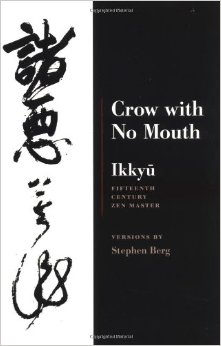
Crow With No Mouth : Ikkyu : Fifteenth Century Zen MasterCrow With No Mouth : Ikkyu : Fifteenth Century Zen Master by Ikkyu

My rating: 5 of 5 stars

Amazon page

Ikkyū Sōjun was the Howard Stern of Zen masters. Born in 1394, he lived through most of the 15th century. Ikkyū served as a temple’s abbot for less than two weeks before he quit in disgust, vowing to move into a red-light district—apparently he wanted to live among people he found more honest and less hypocritical. The Zen master despised the corruption and snobbery of monastic politics.

Crow with no Mouth is a collection of Ikkyū’s verse, which is largely in the Zen tradition–featuring natural subjects and simple wisdom in a sparse style. Of course, as per my comments in the preceding paragraph, there are a few poems on topics such as cunnilingus and debauchery—so it’s not what one would call a child-friendly collection (unless one enjoys explaining the sexual exploits of a lecherous monk to one’s child.) The more explicit poems may seem like a diversion from the Zen path, but perhaps not. Maybe Ikkyū offered them as a way to train the mind, to observe one’s reaction to shocking commentary as a means of changing one’s way of thinking.

A few of my favorite lines of a more traditional nature include:

-“you can’t make cherry blossoms by tearing off petals to plant; only spring does that”

-“sometimes all I am is dark emptiness; I can’t hide in the sleeves of my own robes”

-“it’s logical: if you’re not going anywhere any road is the right one”

-“the edges of the sword are life and death; no one knows which is which”

-“even in its scabbard my sword sees you”

-“a flower held up twirled between human fingers; a smile barely visible”

-“in war there’s no time to teach or learn Zen; carry a strong stick; bash your attackers”

Here are a few of those jarring lines that I mentioned above:

-“that stone Buddha deserves all the bird shit it gets”

-“all koans just lead you on but not the delicious pussy of the young girls I go down on”

-“ten fussy days running this temple all red tape; look me up if you want o in the bar whorehouse fish market”

-“my dying teacher could not wipe himself; unlike you disciples who use bamboo; I cleaned his lovely ass with my bare hands”

-“don’t hesitate get laid that’s wisdom; sitting around chanting, what crap”

-“who teaches truth? good/bad the wrong way; Crazy Cloud knows the taste of his own shit” [Crazy Cloud was Ikkyū’s name for himself.]

When he left the monastery, Ikkyū shredded the certificate that served as his monastic credential. Some of his students found it, and pieced it back together. That led to the following verse:

-“one of you saved my satori paper I know it piece by piece; you pasted it back together; now watch me burn it once and for all”

Ikkyū’s verse asks us to reevaluate what it means to be sacred or profane. The orthodox view would be that Ikkyū fell from the sacred life of a monk. However, Ikkyū tells us that one can degrade what is important by raising the wrong things to sacred status. Conversely, some of what we believe to be profane is just rooted in habitual and ill-reasoned ways of thinking.

I’d recommend this work for those who love the spare form of Japanese poetry, and who don’t mind a hard jolt to their psyche occasionally.

View all my reviews

READING REPORT: April 10, 2015

Ikkyu_Berg

I finished four books this week. That makes it sound like a big reading week, but two of the books were tiny and I was well into the other two at the start of the week. I will present them in the order in which I enjoyed them because they hit the great, the middling, and the awful. The best was Ikkyu: Crow With No Mouth, which is a poetry collection by an irreverent 15th century Zen monk. Given that this is a collection of Japanese short form poetry, you may have guessed that it’s one of the short books (as opposed to one that was half read.) [Full disclosure: some will find a few of the poems vulgar, and it’s probably not a collection you want your kids reading until they are of suitable age for graphic sexual description.] Among my favorite verses are:

you can’t make cherry blossoms by tearing off petals

to plant only spring does that


and

it’s logical: if you’re not going anywhere

any road is the right one

and

I live in a shack on the edge of whorehouse row

me autumn a single candle

or

the edges of the sword are life and death

no one knows which is which


HaikuHandbook

(Yes, I’m on a bit of a haiku kick lately. With my RCYT training in progress, I haven’t had a lot of time for more extensive reading or writing lately.) Unlike the previous book, this book on Haiku isn’t a poetry collection–though it does assemble a lot of great haiku, tanka, renga, and haibun as examples. However, this book is–as its subtitle suggests–about writing, sharing, and teaching haiku and related poetic forms. The book teaches one that five-seven-five syllable organization isn’t an essential element haiku,  but rather it should be considered the most readily abandoned and superficial aspect of this form. However, beyond teaching one what one really needs to know to construct haiku, the book offers a lesson plan for teaching haiku to school children and tells us how this Japanese poetry form went global.


Elements of fiction writing conflict & suspenseElements of Fiction Writing: Conflict & Suspense is my second read by Bell on writing. The first one was on plotting and structure. That first book must have been useful enough to get me to read a second. This book is divided in two parts, the first one on conflict and the second on suspense. (The first is much longer.)  In both cases, the chapters examine how the various elements of fiction (i.e. setting, plot, character, dialogue, etc.) can contribute to creating the much-needed characteristics of conflict and suspense. Bell uses a lot of example text to illustrate his points (mostly–but not exclusively–from commercial fiction), and this is a valuable feature of his guides.


wit&wisdom_yoda

This book was a stinker, and I can’t recommend it for anyone–though its saving grace is that it’s slim and thus only wastes a tiny bit of one’s time. What the author apparently did was to watch a Star Wars movie marathon and pull every Yoda line out and collect them together. This is a sad effort in two ways. First, while Yoda isn’t a lead in the movies (and, therefore, has a limited number of lines), there’s a vast canon of Star Wars books, and it doesn’t look like the author trolled any of them for quotes. Second, some of the lines are neither witty nor wise. Occasionally, Yoda has a line equivalent to, “take a left at the second light,” and the author includes such banal quotes. Furthermore, some of the quotes appear a second time in either reduced or extended form. Beyond all these complaints, the author doesn’t even take the time to put together meaningful front matter to tell the reader something interesting that they don’t already know, and thus doesn’t establish his worth in producing such a book. (Also, he doesn’t seem to know accepted protocol for writing quotes inside quotes–i.e. use of single quotes. Which I guess means he probably didn’t just cut and paste all the quotes because then they would have been grammatically correct.) He also could have at least provided told us which movie each quote was from. It’s a lazy effort. It succeeds spectacularly in being lazy.  If you’ve seen the movies (or have basic cable so that you can readily do so by way of one of the frequent Star Wars marathons) you’ll gain nothing from this book.


I bought three books during this week, but one of them was the aforementioned Yoda crapfest. On the other hand, one of these books I have high hopes for being both fascinated and educated by, and that’s Wired for Story. This book is about how our brains are evolutionarily optimized to the narrative form, and how one can use this fact to one’s advantage as a constructor of stories.

Wired for Story

The second book was a poetry collection that is on sale on Amazon entitled Love Alone. I must admit that I picked this book to meet one of my remaining requirements in the 2015 Book Riot Read Harder Challenge–nevertheless I have high hopes for this work.

LoveAlone


POEM: Climb

Kicked, I tip over the lip, and plummet down a well.


Falling, falling, screaming, and calling, toward the firelake of hell?


Thrashing and lashing, I hit the drink splashing, and sink to the inky deep.


Kicking and stroking, sputtering and choking, I claw at the well wall so steep.


Treading water, I curse the kicking rotter, who sentenced me too this fate.


Taking note, I consider what floats, and jettison my anger, fear, and hate.


They’ll just weigh me down, cause me to drown, and not on my side is the time.


There is no try, nothing but do or die, my only course is to climb.

BOOK REVIEW: Leaves of Grass by Walt Whitman

Leaves of GrassLeaves of Grass by Walt Whitman

My rating: 5 of 5 stars

Amazon page

There are a number of editions of this collection of poems, as Whitman apparently continued to revise it right up until his death. The 1855 edition is popular but there is a “Deathbed Edition” which–as the name implies–is the closest thing to a final draft that exists.

Back in the day (the late 19th century), this was considered racy and controversial stuff, and the collection got Whitman fired from is civil service job as well as a great many vitriol-filled reviews. Like the works of Emerson and Thoreau, with whom Whitman shared some beliefs, it was also controversial in that the poem put man at the fore and religion was shunted out of the picture. (Trust in yourself and don’t blindly follow anyone was still a heretical notion among many at the time.) This isn’t to say that Whitman eliminated spirituality from his work (any more than Emerson did), references to the soul are commonplace—but it’s a mystic spirituality. There were features outside the “prurient” and religious that angered many, such as Whitman’s shining of light on the barbaric institution of slavery. However, today Leaves of Grass is considered one of America’s greatest and most beloved works of poetry, and for good reason. It beautifully reflects an America that was changing, an America subject to a new era of ideas both from science and from distant lands.

It should be noted that this is a life’s work. If you are expecting a typically thin poetry collection, you will be in for a surprise. Leaves of Grass is of a page count normally reserved for histories and epic novels. The collection consists of 35 “Books” that are quasi-themed sub-collections of poems. Individual poems vary greatly with some being only a few lines and some running for pages. Most of the poems are free verse, though there are sections that display a meter (specifically iambic pentameter.) Free verse is poetry without meter or rhyme. If you didn’t know there was such poetry, you may want to work through your Doctor Seuss before you crack open a tome like this one.

There are a few themes that are repeatedly revisited. One idea that made the collection so controversial is that it exalted in the human form and the physicality of humanity. In recent years, a lot of discussion of this work revolves around whether Whitman was or wasn’t homosexual or bisexual. Not that it matters, but the fact is there is a dearth of information about what form of sexuality Whitman practiced—if any, but one can imagine why people wondered. Whitman writes descriptively about both the male and female forms, and was not shy about verse that suggested lying with this gender in one poem and the other in the next. The poem “I Sing the Body Electric” is probably the most famous example of Whitman’s discussion of the body.

However, perhaps the most striking theme is a celebration of America, both in its natural state and as it was shaped by the people who settled there. In multiple poems one sees long strings of description and exposition about the various states of the United States. Whitman paints pictures of the nation as a collage showing the variations among its constituent parts. To a lesser extent, he does the same for the world (e.g. see Book VI.)

I enjoyed this collection, although I will admit I read it a bit here and a bit there over a long time period. I, therefore, probably missed some of the depth of meaning coming from how the poems were arranged. Maybe someday I’ll have time to go back and read it once more. However, the beauty of this collection is that it’s so many different things. It meanders like a river, and peers overland with an eagle-eyed view. It offers scenes that are like a hard-boiled work of film noir and ones that are like Ansel Adams pictures. It’s not anti-god, but rather about the god within, or the god within the blade of grass. Leaves of Grass offers brilliant turns of phrase, bold descriptions, and always interspersed with the author’s personal philosophy.

View all my reviews

THE CLASSICS: The Waste Land by T.S. Eliot

The Waste Land (Illustrated Edition)The Waste Land by T.S. Eliot

My rating: 5 of 5 stars

Amazon page

It’s for good reason that this is considered one of the greatest poems of the 20th century. Eliot’s vivid verse paints a bleak landscape in language of beauty not seen in the poem’s imagery. It will come as no surprise that this work was penned during a dark time in the poet’s life, but it wasn’t just Eliot’s personal dark hour; for many, the wounds of World War I hadn’t yet scarred over.

This poem is divided into five sections, each with an artful title. The five sections of The Waste Land are: “The Burial of the Dead”, “A Game of Chess”, “The Fire Sermon”, “Death by Water”, and “What the Thunder Said.” Some consider The Waste Land to be a collection of five poems, but there is both language and theme that connects the various parts. For example, the following verse is contained in both the first and third chapter:

Unreal City,
Under the brown fog…

The poem contains many complex references to Arthurian legends and to a broad swath of literary canon. You can learn about that from individuals more erudite than I. I will suggest a simpler theme, and that is death—not just death, but death as an eraser of legacies and influence. Eliot refers to bone almost as much as he does death, and by the time one’s body is reduced to bones one’s influence on the land of the living is minimal—even for giants among men. When he’s not speaking of bones, he’s speaking of death of masses, also a form of anonymous death.

I will pick a few lines from each of the five sections to illustrate my point.


From “The Burial of the Dead”:
Unreal City,
Under the brown fog of a winter dawn
A crowd flowed over the London Bridge, so many,
I had not thought death had undone so many


From “A Game of Chess”:
I think we are in rat’s alley
Where the dead men lost their bones


From “The Fire Sermon”:
White bodies naked on the low damp ground
And bones cast in a little low dry garret
Rattled by the rat’s foot only, year to year.


From “Death by Water”:
A current under sea
Picked his bones in whispers


From “What the Thunder Said”:
After the agony in stony places
The shouting and the crying
Prison and palace and reverberation
Of thunder of spring over distant mountains
He who was living is long dead
We who were living are now dying
With little patience


I’m not saying that Eliot’s views on death and dying are great from a philosophical or psychological perspective—on the contrary, but as a work of poetry these words should be read by all.


Neither the version linked to in GoodReads nor on Amazon is the version I read. As far as I could tell by way of a hasty search, the Kindle edition I read no longer exists.

View all my reviews

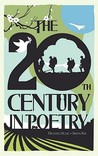
BOOK REVIEW: The 20th Century in Poetry Ed. Michael Hulse & Simon Rae

The 20th Century in PoetryThe 20th Century in Poetry by Michael Hulse

My rating: 4 of 5 stars

Amazon page

The 20th Century in Poetry is an anthology of over 400 poems written in the 20th century that take (often tenuously or symbolically) historical events as their prevailing theme. The poets included in this collection range from household names to those who’ll be well-known only to poetry lovers to a few obscure choices. Among the more famous poets included are: Rudyard Kipling, A.E. Housman, James Joyce, W.B. Yeats, D.H. Lawrence, Ezra Pound, Robert Frost, Carl Sandburg, T.S. Eliot, Langston Hughes, William Carlos Williams, A.A. Milne, Countee Cullen, Edna St. Vincent Millay, W.H. Auden, e.e. cummings, Dylan Thomas, Allen Ginsberg, Bob Dylan, Sylvia Plath, John Updike, Chinua Achele, Robert Penn Warren, and Seamus Heaney.

Read the title carefully, this isn’t a collection of the best or most popular poems of the 20th century. Many of the works included aren’t even among the best known works of poet authoring them—though there are a few exceptions (e.g. William Carlos Williams’ Red Wheel Borrow and Dylan Thomas’ Do not go gentle into that good night.) Having “clarified” this point, one should note that many of the poems aren’t written about 20th century events. In other words, they’re all written in the 20th century, and they’re mostly about (or around) historical happenings, but sometimes those happenings are from a much earlier time period. However, the editors could well argue that the decision to reflect back on ancient events at that particular time speaks to perceived corollaries in the contemporary era.

I remember reading the reviews on Amazon for this book when I was considering whether to purchase it. The few reviews were overwhelmingly positive, but there was one negative review. Now usually when there’s one negative review and several positive ones, one can dismiss the negative review as that of a curmudgeon—the same person who returns his or her steak three times because the cook can’t get it within one minute and half-a-degree of what that person has determined is the ideal state of cookedness. However, I gave this negative review the benefit of the doubt and read it. What I found was a well-reasoned and uncurmudgeonly explanation of why that person didn’t like the anthology. Still, I dismissed the review and bought it. While I’m glad I did, I can see that reviewer’s point.

What was said critique? It was that the entire anthology was bleak and depressing. At the time of purchase, I shrugged that off. It’s poetry. Of course, it leans to the dark and morose. Poets aren’t generally known for their cheery dispositions (Augden Nash, Dr. Seuss, and Shel Silverstein notwithstanding—and, of course, none of those individuals’ works is in this book.) There are times when the doom and gloom obviously strikes the right tone (e.g. poems about the Depression, the World Wars, and various genocidal atrocities.) However, the 20th century was not all war and holocaust; it was also a time of great advancements in science, technology, and quality of life. But even the best times of the 20th century are painted depressingly in this collection. To give an example, there are three poems about the moon landing and they all come across as works of petty douchebags. (I suppose the underlying sentiment was, “Why are we spending millions going to the moon when there are poets who can’t make a decent living moping about and painting word pictures of the world as seen through shit-colored glasses.)

As this book is proclaimed as an attempt to capture the history of an entire century through poetry, it’s worth pointing out that this is clearly an English language centric view of history. To be fair, the editors do go to lengths to include poems from both Indian (i.e. South Asian Indian) and African poets whose works were published in English.

The poems are arranged in 7 chronological parts: 1900-1914, 1915-1922, 1923-1939, 1940-1945, 1946-1968, 1969-1988, and 1989-2000. Anybody remotely familiar with the history of the 20th century should be able to tell what world events drove this particular delineation of timeframes. For readers who aren’t history buffs, one nice feature is that each part begins with a prose discussion of world events during said era.

I would recommend this book to individuals interested in poetry as long as they don’t currently suffer from depressive disorders.

View all my reviews

POEM: Midnight Neon Glow

Caught in a midnight neon glow
Neurons firing in slo-mo
As blue and red dance on the wall
I felt the footsteps in the hall


A jagged game of cat and mouse
Ends, spied by a mattress louse
An ominous knock near at hand
Me, without the will to stand


This story started days ago
Me, without a need to know
Just a lackey in a suit
Who took a case from a coot


What’s in the case? You want to know?
Oh, they’re here. It’s time to go…

POEM: At The Maw’s Edge

Chasm, toes curled over the edge,
seeking a simian grip.
But they are the piggies of a
little girl:
-bare feet
-rosy cheeked

She stands before a gaping maw
ripped in the world.
Staring vacantly,
eyes unable to penetrate the cloud.
She rubs her eyes with tiny fists.

The ashes will fall soon,
drifting to Earth like gray snow,
piling up in tomb-like silence.

Facebook Poems

Facebook
I.

How thrilling to learn
without delay
that now was to be
your laundry day.

Oh, how I waited
with bated breath
to hear if you’d hit
wash-day sudden death

Your posts banal?
Who would think?
You took us to
the wash-day brink…

never knowing if there’d be a Boxer Rebellion or a Brazilian Thong Crisis!


II.

“It’s Complicated”
are two words
often posted
but never heard
amid the complication.

1 + 1, easy as pie.
Calculus is “complicated.”
Are you in wedlock?
Or have you dated?
Is she human…oid?

It begs the question,
can a complication read
the words typed on
your daily feed,
and solve for x?

DAILY PHOTO: Crocodile at Peace

Taken in November of 2013 at the Mysore Zoo

Taken in November of 2013 at the Mysore Zoo

There is no smile
worn by a crocodile,
that’ll induce me to pet him.

There’s no grin,
neither wide nor thin,
that extends my treasured limb.

Save your beaming.
It looks scheming.
“No, I won’t go for a swim.”