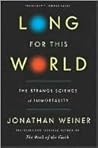
BOOK: “Long for this World” by Jonathan Weiner

Long For This World: The Strange Science of ImmortalityLong For This World: The Strange Science of Immortality by Jonathan Weiner
My rating: 4 of 5 stars

Author’s book site

This book considers the science around the question: will there come a day when human beings live forever (or at least considerably longer than we’ve achieved to date? — i.e. hundreds or thousands of years.) A secondary question, explored in the last of the book’s three parts, is should we want to?

It was a courageous decision to write this book because it focuses heavily on the ideas of one particularly controversial figure, Aubrey de Grey. And by “controversial” I don’t mean to the general public, a public which has limited understanding of the science involved, but rather a man who is controversial to many (perhaps, most) of his peers. Of course, with a Pulitzer under one’s belt, one can afford to take a few chances. (Weiner won in 1997 for The Beak of the Finch, a popular science work on evolutionary biology.) To be fair, Weiner does not present Grey’s ideas from the perspective of an acolyte. On the contrary, he is clearly skeptical and not shy about presenting the countervailing arguments put out by others in the gerontological field.

I can see several reasons why Weiner chose to focus on Aubrey de Grey. First, De Grey is an eccentric figure, and that makes for more interesting reading. Second, De Grey also takes the boldest possible stance on the topic (i.e. that there is no reason humanity won’t be able to overcome aging and death, given sufficient time and effort.) Finally, De Grey has a readily digestible roadmap for eliminating aging. De Grey identifies seven problems that must be solved, arguing that the last — i.e. defeating cancer — is the only one that will present a true challenge in the long run.

While I wasn’t converted to a belief that immortality is inevitable (and that wasn’t the book’s objective, though it may be de Gray’s,) the book does offer interesting food-for-thought, both on the scientific question of what it would take and on the philosophical question of whether we should want to.

If you’re interested in aging and mortality, I’d recommend reading this book.

View all my reviews

Immortal’s Limerick

There once was a wise Daoist Immortal,
Asked the secret to long life, he'd chortle:
"If you can stand masses
Who behave like asses
You're enlightened --
but better off mortal."

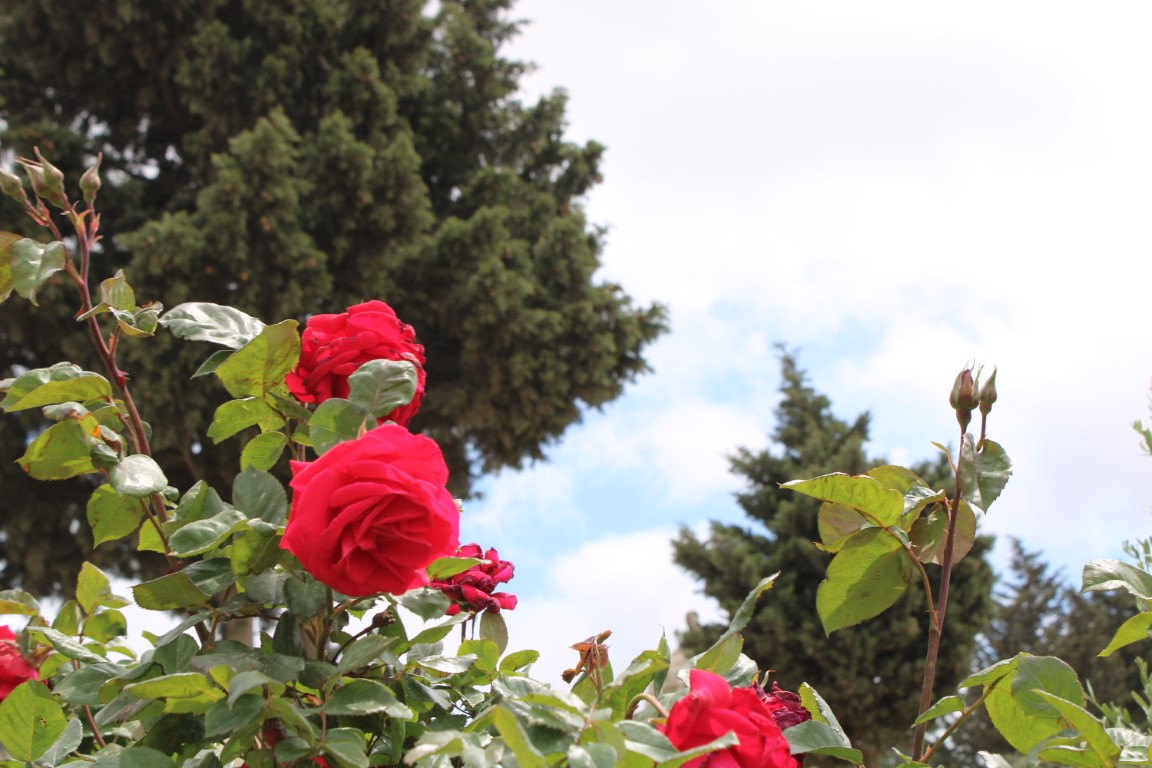
Pine & Rose [Lyric Poem]

An evergreen and a red, red rose:
One slowly, but dully, ever grows;
One springs to life only for a short time.
Lifespan pine and beauty rose, apposed?
And risk vice versa? One never knows!

PROMPT: Longevity

What are your thoughts on the concept of living a very long life?

As long as I’m of sound mind and capable body, I’m fine with it, but not at any cost. I’d rather shuffle off this mortal coil than drag out the suffering of immobility and / or dementia.

I think Atul Gawande’s “Being Mortal” is good required reading. Among other things, he talks about the smoke and mirrors of our species’s increased lifespan. (i.e. increased lifespan, yes, but too often at the cost of diminished quality of life through those additional years.)

BOOKS: Travels with Epicurus by Daniel Klein

Travels with Epicurus: A Journey to a Greek Island in Search of a Fulfilled LifeTravels with Epicurus: A Journey to a Greek Island in Search of a Fulfilled Life by Daniel Klein
My rating: 5 of 5 stars

Amazon.in Page

With the wave of renewed interest in Philosophies of Life lately, it’s nice to see a book that puts Epicurus at the fore. In a number of ways, I believe Epicurus was the most advanced of Ancient Greek philosophers, and yet he doesn’t get much attention compared to Plato, Aristotle, and the Stoics. (In part this is because the vast majority of Epicurus’s writings were lost, and in part it’s because little-“e” epicureanism [i.e. being culinarily hedonistic] has become much more familiar to people than big-“E” Epicureanism [i.e. a materialist philosophy that values pleasure, but not in so hedonistic way as to lose sight of virtue and the countervailing costs of pursing pleasure.] While adjectival forms have done a number on Cynicism and Stoicism as well, the former is – for all intents and purposes – dead and the latter has become much more well-known to present-day people from a pile of podcasts, books, and vlogs.)

I should point out that Klein doesn’t solely focus on the philosophy of Epicurus, he also tells readers what other schools of philosophy teach us about how to age well (and to not turn into a curmudgeon) — most notably: Buddhism, Stoicism, and Existentialism. That said, it’s fair to call Epicureanism the backbone of this book.

One who reads the title might wonder whether this is a pop philosophy book on aging or a travelogue. It’s definitely both, but the philosophy part dominates. I would call it 70/30 pop philosophy to travelogue (maybe 65/35.) The book uses the individuals Klein interacts with on Hydra (and elsewhere in Greece) as examples of how people age well, and in the process shows the reader [textually] a beautiful part of the world. But the core of the book is about philosophy as it pertains to such topics as play, perception of time, idleness, and changing views of spirituality.

I will warn the reader that, while the book offers many great thoughts for a philosophy of aging well, I didn’t agree with everything in the book. Klein contrasts his philosophy for living well into old age and for adapting one’s life to changing roles to the people he calls the “forever young” crowd. I wouldn’t put myself in the “forever young” category as I don’t believe I’m grasping at youth and all its blessings and pains. However, I suspect Klein would put me in that group because I work out intensely, watch what I eat / manage my vices, and am trying to work things so that my heart explodes while I’m still physically and mentally capable — i.e. before I become decrepit or senile. My point is, I’m not sure Klein’s dichotomy is that useful or reflective of reality, and that being health-conscious should necessarily be contrasted with enjoying the pleasures of age. [Truth be told, I’d say the biggest driver for people being more health-conscious into old age is seeing earlier generations live longer, but with a decreased quality of life through that period of increased longevity — See: Being Mortal by Atul Gawande.]

Still, overall, the book is quite readable and offers much excellent food for thought, and I’d recommend it for anyone who is interested in moving into advanced age in a way that isn’t misery filled.

View all my reviews

BOOK REVIEW: Superhuman by Rowan Hooper

Superhuman: Life at the Extremes of Our CapacitySuperhuman: Life at the Extremes of Our Capacity by Rowan Hooper
My rating: 4 of 5 stars

Amazon page


There are mounds of books out on the science of maximum human performance, be they on mind-hacking, sports & exercise science, or some combination thereof as applied to a particular pursuit. Hooper creates his niche by way of a broad and varied selection of topics, including: language learning, singing, running, achieving longevity, and sleeping. For the reader who is interested in the topic of how top performers in a given domain achieve that supernormal performance, it makes for an interesting read. However, it may leave some readers scratching their heads as to who the book is aimed at. It should be noted that several of the topics addressed are of much more broad-ranging appeal than those I mentioned (e.g. focus / attentiveness, bravery / courage, and resilience.)

The book is divided into three parts on “thinking,” “doing,” and “being,” respectively. The four chapters in the first part investigate the heights of intelligence, memory, language, and focus. The chapter on language deals with how some people are masterful polyglots, speaking many languages, as opposed to the harder to investigate question of how someone becomes William Shakespeare. Throughout the book, there is a mix of stories and interview insights from those who are peak performers as well as discussion of what scientific studies have found. The former makes up the lion’s share of the discussion, and the central question with of science is how much of peak performance is genetic and how much is built.

Part II, on doing, has three chapters, exploring the topics of bravery, singing, and running. This is where one really sees the book’s diversity. Books like Amanda Ripley’s “Unthinkable” address the question, among related questions, of why some act heroically, and there are a huge number of books on how to be the best runner or singer one can be, but not a lot of books take on all three questions in one section. The book on singing focuses on opera singers who belt out their tunes largely sans technology – i.e. there’s no Milli-Vanilli-ing L’Orfeo. The chapter on running gives particular scrutiny to endurance running.

Part III investigates why some people live longer, are more resilient, sleep better (or do well with less sleep,) or are happier. Since Buettner’s “National Geographic” article on “blue zones” (i.e. places where a disproportionate percentage of the population live well beyond the average human lifespan,) there’s been a renewal of interest in what science has to say about longevity. As mentioned, the chapter on sleep covers the topic from multiple vantage points. Everyone needs sleep, but some perform best with ten or more hours of sleep while others are extremely productive on four hours a day, and some can cat-nap periodically through the day while others need a single extended and uninterrupted period of sleeps. Wisely, Hooper doesn’t simply take on the question of why some people are happier than others in the book’s last chapter, but rather he asks the more interesting question of why some people who have every reason to be morose (e.g. paralyzed individuals) manage to be ecstatically happy.

The book has a references section, but there isn’t a lot of ancillary matter (i.e. graphics, appendices, etc.) It’s a text-centric book that relies heavily on stories about Formula-1 racers, opera stars, ultra-marathoners, and other extraordinary individuals while investigating the subject matter.

I enjoyed this book. I am intensely interested in optimal human performance across a range of skills and characteristics. So, I guess when people inevitably ask who the book is directed at, it’s directed at me and others with this strange fascination. If you have that interest, it’s for you as well.

View all my reviews