PROMPT: Disagree

Daily writing prompt
What public figure do you disagree with the most?

These days? Trump — hands down. Beyond a few of his stated policy objectives, there is more and more I disagree with every day. (I emphasize “stated” because there is so little that’s coherent in his actions to prove he is really interested in advancing said objectives.) For example, I do agree that the swelling deficits (budget and trade) are something that should be treated as unsustainable. I’m not of the “a current account deficit is just a capital account surplus, so turn that frown upside-down” ilk. However, erratic and untargeted tariff policies that hurt successful sectors (e.g. agriculture and services) and which will only put the toothpaste back in the tube (bring [human] factory labor back to the US on a huge scale) by crashing the US into Third World status are not the way.

I disagree with this inexplicable monomaniacal obsession with heavy industry, while injuring those sectors that have done well in recent decades.

I agree with… Powell, that there is a high chance of stagflation if the Fed takes a loose money stance. The problem is… Trump. Ordinarily, it would be good to dump some money on an economy that is struggling. But the problem is that Trump is like a salesperson that would like to sell customers something, but he also enjoys chasing them around the store with an axe. The problem is that people and companies don’t make big purchases when they are afraid and the future is uncertain. (This is why even getting investment in robotic factories isn’t happening.) There’s uncertainty because of the tariffs. There’s uncertainty about whether companies will have to pay bribes to Trump, personally. There’s uncertainty about whether the legal and institutional frameworks that have so long made America an appealing place to invest and innovate will survive. So, if the Fed injects money but consumer confidence and investment are flat because of said uncertainty, then that money will be purely inflationary. [Remember, inflation is too much money chasing too few goods. More money needs to meet more demand for stuff.]

I disagree that one can have one’s cake and eat it, too. Specifically, tariffs need to be either for revenue generation or for policy negotiations, they can’t be both, but Trump talks like he doesn’t understand this. If tariffs are going to be the new primary source of government income, they need to bring in money sustainably. If they are a negotiating tool to lever policy, you need to be ready to negotiate them away in return for your own objective wins.

I definitely disagree with the ignoring of Supreme Court decisions. It’s particularly disconcerting to see him ignore 9 – 0 decisions, which means that even his own appointees could not find a hairsbreadth of wiggle room in the law by which his actions could be viewed as lawful.

I disagree with picking a raft of pretty-idiots / talking-heads for positions that require high levels of emotional intelligence and — you know — intelligence intelligence. If it weren’t for the fact that America has the most awesome and professional military in the world, I’d be especially afraid that Hegseth was going to destroy it. But while I think the US Military will be around long after he’s gone, I’m suspect he will have done damage to morale and operational efficiency.

I disagree with favoring dictators over longtime allies. [While I would agree that it’s good that Europe is taking on more of the burden of their own defense, I’m concerned that trashing relations to do so will not prove a sound approach.]

I disagree with all the attempts to play from the Putin-Orban Populist Dictators’ Playbook.

While I’m not at all averse to seeing cuts to the Federal bureaucracy, I do disagree with — you know — firing people before you understand what they do and whether it’s critical to health and safety, the necessary conduct of governance, or oversight against fraud and abuse.

I disagree that one should talk about making loophole end-runs around Constitutional prohibitions.

But, I ramble on…

PROMPT: Power

Daily writing prompt
If you had the power to change one law, what would it be and why?

That no individual would have the power to unilaterally change any law.

Because if we all had the power to change one law it would be chaos, like in “Bruce Almighty.”

“The quality of mercy is not strained” by William Shakespeare [w/ Audio]

The quality of mercy is not strained;
It droppeth as the gentle rain from heaven
Upon the place beneath. It is twice blest;
It blesseth him that gives and him that takes:
'T is mightiest in the mightiest; it becomes
The throned monarch better than his crown;
His sceptre shows the force of temporal power,
The attribute to awe and majesty,
Wherein doth sit the dread and fear of kings;
But mercy is above this sceptred sway;
It is enthroned in the hearts of kings,
It is an attribute to God himself;
And earthly power doth then show likest God's
When mercy seasons justice.
Therefore, Jew,
Though justice be thy plea, consider this,
That, in the course of justice, none of us
Should see salvation: we do pray for mercy;
And that same prayer doth teach us all to render
The deeds of mercy. I have spoke thus much
To mitigate the justice of thy plea;
Which if thou follow, this strict court of Venice
Must needs give sentence 'gainst the merchant there.

From The Merchant of Venice (Act IV, Scene I.) Spoken in a court of law by Portia while she is disguised as a lawyer, Balthazar.

PROMPT: Law

Have you ever unintentionally broken the law?

Unintentionally, intentionally… there are a lot of laws, and some of them are, quite frankly, ridiculous. I would not have been able practice the martial arts that contributed so much to my personal growth and development if I had complied with all the state weapons laws of the various places I have lived. Unlike guns (speaking about the US here) which have a big lobby and voter block, the martial arts community is small and those who practice systems with weapons are a sliver of that. This means that any time some random yahoo does something nefarious with a nunchuck or samurai sword, the weapon gets banned without a moment’s thought for those who have benefited from practicing historical traditions that include said weapons.

I recognize the law as an instrument to prevent people from harming others through violence, fraud, etc. Also, to set common standards necessary for safety – i.e. rules of the road. I do my best to conduct my life in such a way as to not injure or adversely impact the lives of others. I would do this as an ethical matter regardless of the laws, but believe in the value and necessity of many laws.

However, like H.D. Thoreau, I believe there are laws on the books that it’s our moral duty to disregard. For example, if we don’t have liberty within our own skin, there is really no way in which we can be said to be free.

PROMPT: Power

If you had the power to change one law, what would it be and why?

It would be whatever law gave one person the power to unilaterally change a law. That would be a terrible thing.

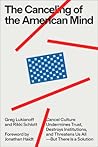
BOOKS: The Canceling of the American Mind by Greg Lukianoff & Rikki Schlott

The Canceling of the American Mind: Cancel Culture Undermines Trust and Threatens Us All―But There Is a SolutionThe Canceling of the American Mind: Cancel Culture Undermines Trust and Threatens Us All―But There Is a Solution by Greg Lukianoff
My rating: 5 of 5 stars

Amazon.in Page

This book presents an in-depth exploration of cancel culture in its many varied manifestations, from both the left and the right of the American political spectrum. The biggest part of the discussion is with respect to the educational system, and particularly higher education. Sadly, this is because the institutions that used to be among the most formidable bulwarks of free speech, expression, and academic freedom have increasingly become untenable to multiple points of view. (The authors point out that there have been more dismissals of faculty members for cancel culture speech and expression issues than there were during the McCarthy era for political stance.)

However, the book doesn’t restrict itself to education, but also investigates cancelations in journalism, publishing, the scientific community, standup comedy, and the medical and psychiatric communities. The authors also present cases of the effect that wokeness and other expression limiting activities are having in these areas. One of the most disturbing revelations to me was the role of wokeness in psychotherapy and the negative effect it may have on people getting the help they need.

The book presents a series of cases in detail to advance the discussion. It also has a couple chapters that examine the tactics that are used to apparently “win” debates by silencing / demoralizing the opposition while avoiding any actual contest of ideas. The authors go through tactics favored by the Right as well as those by the Left. (Though it’s clear that, in a race to the bottom, both sides adopt the approaches of the other side that seem to be effective. e.g. the Left is getting into book banning (historically a Conservative tactic) and the Right is getting into cancelling and shout-downs (usually Progressive tactics.)) I think it was smart to have two authors, one from the left and one from the right, in order to help ensure balance in the project. That said, as the Left has been in the cancel culture vanguard, they come up more often.

Some have called this a sequel to “The Coddling of the American Mind,” with which it shares a co-author, Greg Lukianoff. I don’t know that I’d think of it that way. While it does address some of the same issues as background, psychology and child development are not at the fore in this book (Jonathan Haidt – the other co-author of “Coddling” is a psychologist,) but rather are the legal, cultural, and political issues.  

This is probably the most important book I’ve read this year (and, being late November, it’s likely to retain that status) and I’d highly recommend it for all readers.

View all my reviews

BOOKS: How Long Can the Moon Be Caged by Suchitra Vijayan & Francesca Recchia

How Long Can the Moon Be Caged?: Voices of Indian Political PrisonersHow Long Can the Moon Be Caged?: Voices of Indian Political Prisoners by Suchitra Vijayan
My rating: 4 of 5 stars

Amazon.in Page

It’s no secret that the Gandhian pluralistic vision for India has been taking some hard knocks under the current administration (and the rise of Hindu nationalism that it represents,) but it’s also not as widely and intensely discussed as it could be. This book represents an attempt to make the stories of dissident political prisoners more widely heard.

For that attempt, I would give it high marks, but the execution is problematic. The middle part of the book does a reasonably good job of telling the stories of these individuals. However, the book comes across far too much like a reference book than a journalistic account for much of its length — particularly in the beginning and at the end. The beginning has a long bullet point account of relevant events that I’m sure is meant to give readers an idea of the scope of the problem, but it also sterilizes the information. At the end there are letters and a chapter that consists entirely of data. Letters can be fine, but they aren’t the most evocative way to convey these stories because they contain a good deal of information that is extraneous to the author’s point, and thus the message is diluted.

I do wish supporting evidence was turned up and gratuitous statements turned down a bit. In other words, I assume the government could present a counter-narrative that these are not just dissenters voicing unpopular opinions but rather individuals actively engaged in subversive operations. Granted, the prominence of poets, the ill, and the elderly does make it hard to believe these are some sort of guerrilla warfare masterminds. True, there is a challenge in disproving a negative that makes it hard to prove a person has done nothing wrong.

At any rate, it’s a book I’m glad I read, and I did learn about the issue, but I wish the execution had been better. Maybe that’s for another book.

View all my reviews

BOOK REVIEW: Identity: A Very Short Introduction by Florian Coulmas

Identity: A Very Short IntroductionIdentity: A Very Short Introduction by Florian Coulmas
My rating: 5 of 5 stars

Amazon.in Page

This book explores the slippery metaphysical concept of identity — not only as it’s presented in philosophy, but also in psychology, law, politics, anthropology, and literature. It begins with individual identity and expands outward to encompass gender, political, socio-economic, and linguistic identities. The aforementioned slipperiness of identity stems from the fact that we all have an intuitive grasp of identity that could be leading us astray. It tends to make us believe that aspects of identity are inherent features of the universe, when – in fact – they may be arbitrary designations – in which case, a given criterion or classification of identity may be chopped up in different ways than a given culture happened to glom onto.

I learned a great deal from this Introduction, and feel it was well organized and presented. How we see various dimensions of group identity (as well as how we weight them) has a lot to do with our social tensions and strife, and the issues around identity are worth dissecting — despite the fact that it might seem like a dry academic topic at first blush.

If you’re interested in learning more about identity, selfhood, and how various group identities feature in an individual’s overall identity, this book is worth investigating.


View all my reviews

BOOK REVIEW: Free Speech: A Very Short Introduction by Nigel Warburton

Free Speech: A Very Short IntroductionFree Speech: A Very Short Introduction by Nigel Warburton
My rating: 5 of 5 stars

Amazon.in Page

Get Speechify to make any book an audiobook

This concise guide outlines the debate on the perennially precarious issue of freedom of speech and expression. What factors (if any) should determine whether speech is restricted or not? Only when harm will be done to other individuals or to society at-large? Under a set of predefined conditions designed to advance societal harmony, or, perhaps, jingoism?

Some of the most interesting discussions in the book involve questions of whether any individuals or entities should have special privileges vis-a-vis freedom of speech? Historically, religions have claimed to be beyond criticism, but even as blasphemy restrictions have been softened (or applied equally to minority as well as majority religions,) there are still other groups seeking special status. For example, should a renowned artist who produces something that would otherwise violate public decency standards be able to publicly display said work because it has some redeeming artistic merit? (One can imagine the challenge presented by this question, given the inherently subjective nature of “artistic merit.”)

The book generally describes two or more opposing stances on any given issue, almost ensuring there will be points with which one agrees and others with which one doesn’t. I found the book thought-provoking, which led to a couple interesting realizations. For one thing, while I’ve been dismayed about how some groups are trying to carve out sacred spaces in which they are beyond criticism, challenge, or even [the nebulous] “being offended,” I was reminded that this is nothing new, and that whether it’s royal families or “the Church” there’s always been some group who wanted “freedom from” offense, challenge, or critique. It’s just a question of which groups make said demands that’s changing. For another thing, while I’m generally about as close to a free speech absolutist as one sees, I did learn that there is one question on which I don’t take the most pro individual liberty stance (in part because I didn’t recognize it as part of the debate.) The issue in question is copyright protection. There are those who argue that access to knowledge should be free and unimpinged, and that – furthermore — this would advance creativity. [I don’t really understand this stance as it seems to assume that creators of intellectual property will work even harder if they don’t get paid, but that’s a discussion for another time.]

If you’re interested in questions of free speech, particularly as they pertain to religious beliefs, pornography, and the changing state of intellectual property, you may want to read this book.


View all my reviews

DAILY PHOTO: Lawyers’ Row in Kandy


Taken in Kandy in May of 2015

Taken in Kandy in May of 2015

IMG_0340