BOOK REVIEW: The Taiheiki trans. / ed. by Helen Craig McCullough

TaiheikiTaiheiki by Helen Craig McCullough
My rating: 3 of 5 stars

Amazon page

Let me be blunt, “The Taiheiki” isn’t a book you pick up to read a gripping story. While it’s considered a work of fiction, it reads like a history. In some sense, it is a history. It does follow the broad brush strokes of the events in Japan in the early 14th century. However, there are way too many characters to keep track of, or to remember who is on the side of whom, or even to know whether a given individual is worth remembering or whether they’ll soon die an ignominious death. If you don’t believe me, here are the words of the book’s translator and editor, “In short, the ‘gunki monogatari’ [the war tales of which ‘The Taiheiki’ is one] are not great literature. But the best of them are worth reading.”

I agree with McCullough’s point about these books (and this one in particular) being worth reading, but I would add an “if.” “The Taiheiki” is worth reading, if you have an interest in medieval Japan, samurai, or civil war life. The time period in question was fascinating, and it was characterized by war and intrigue. The Hōjō clan was ousted. (They were the military clan that administered the government.) A compromise had been in effect in which the mantle of Emperor was to be alternated between two opposing lines. However, an ambitious Emperor Go-Daigo refused to relinquish the title, and this led to a war between the courts. It’s a story of both warriors of legendary loyalty (most famously, Kusunoki Masashige) and those of shifting loyalties.

While the book is too fractured to form a clear and interesting story overall, that doesn’t mean it isn’t filled with intriguing episodes of battles, espionage, siege warfare, and even the occasional ghost or goblin story. There are many interesting individuals that are dealt with in sufficient detail to make them intriguing—the aforementioned Kusunoki Masashige stands out among them. The book offers insight into the medieval Japanese mind and to some degree the modern mind as well. There are discussions of philosophy and strategy worked into the narrative that help one to understand from whence the individuals were coming.

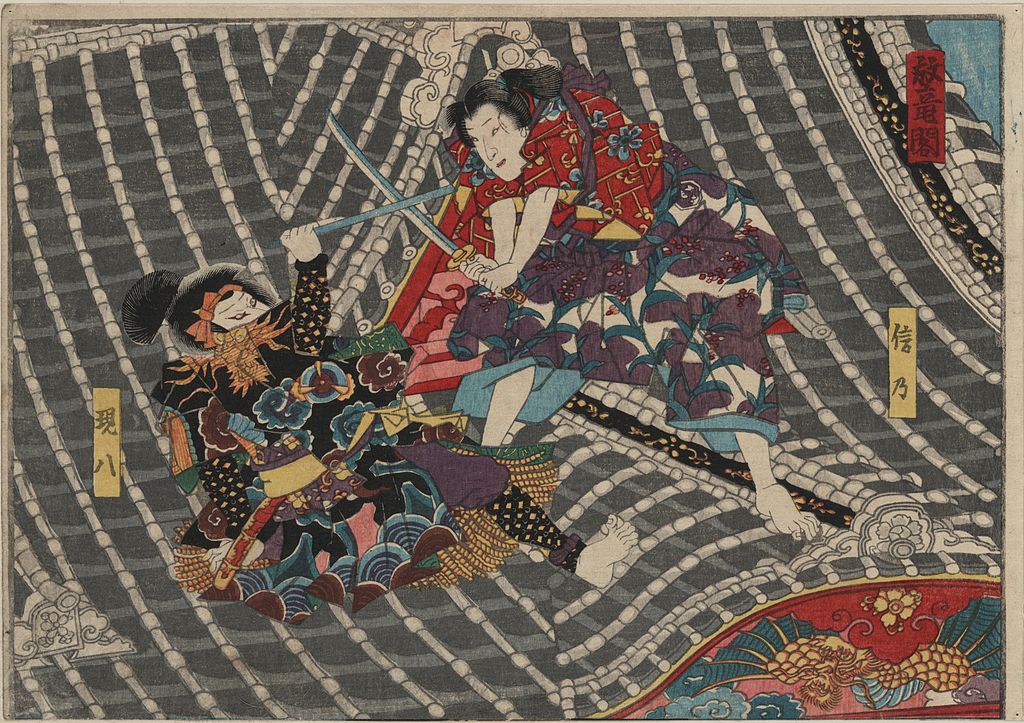
The book has a few features that help non-expert readers. The first is an extensive introduction written by Dr. McCullough that serves to provide background for the book and the era in which it took place. The second is frequent footnoting. There are also several plates of artworks and photos interspersed throughout the book. These help the reader visualize the environs and how these individuals would have looked.

If you have an interest in medieval Japan, in samurai, in ninja, or even in pre-modern war generally, I’d recommend this book. (If you’re looking for a gripping tale of intrigue set in 14th century Japan, not so much.)

View all my reviews

BOOK REVIEW: Ninja: A History by John Man

Ninja: 1,000 Years of the Shadow WarriorNinja: 1,000 Years of the Shadow Warrior by John Man
My rating: 3 of 5 stars

Amazon page

The author, John Man, isn’t the first historian to fall for the siren call of ninja history only to plummet into a catch-22, but he’s the one I’m reviewing right now. So, while his book isn’t exceptionally bad, it’s tremendously flawed in a manner common across ninja histories. What is said catch-22? On the one hand, ninja excite the imagination and a half-way decent book on them is sure to sell. On the other hand, there’s very little known about the ninja. If the myth of the ninja is an elephant, the ninja as we truly know him is a grasshopper. [So much so that the first Westerner to write such a history, Stephen Turnbull, has now spun 180, proposing that the ninja never existed but were purely a post-Warring States construct.] While it would seem that Turnbull goes too far given the existence of manuals and vague mentions, what we don’t know about are the nitty-gritty details of ninja missions and those are the stories that the reader desires but which time and the ninja’s legendary secrecy have put forever beyond our reach.

What is in the book? If not tales of ninja stealing into castles to abscond with information or to assassinate an enemy General, and the effect of those actions on the outcome of wars? First, there’s a lot of information that is already widely available in other English language books, such as the influence of Sun Tzu’s chapter on espionage on the birth of the ninja (probably spurious given the centuries in between) and description of the seven types of disguises. Second, there’s a lot of general Japanese history that is necessary to some degree as background, but at some point one realizes the author has ventured beyond background into padding. Finally, speaking of padding, about a third of the book by page count (cleverly disguised as only three chapters) occurs long after the end of the ninja. Don’t get me wrong; some of the World War II material is fascinating, but it’s as if one were reading a biography of Blackbeard and—all of a sudden—one finds oneself reading about a Somali hijacking of container ships in 2011. (Even while you are fascinated, you can’t help but feel that you’ve been the victim of bait-and-switch.) In short, the book has a lot of repetition and padding, and not much that’s both new and on topic. (One of the reasons that I didn’t give the book too low a rating is that if it’s the first book you are reading on the subject, it’s readable and interesting.)

There’s one more flaw that comes from the dearth of information. The author cites everyone and anyone who has said something interesting on the subject, but we don’t really know how reputable said sources are. Some may be sterling and others full-of-shit. It’s easy to say something fascinating about the ninja; it’s much more difficult to say something that’s true and fascinating.

So what does the book do right? It’s well written in terms of being readable and offering frequent mind candy. The author does challenge a few statements as he reports them. My last paragraph may have led one to believe that Man just shot-gunned information out there, but he actually takes a suitably skeptical view for addressing such a murky topic. The problem is that we don’t know how serious to take claims he refutes or those he appears to endorse because he’s not an expert in the field. He is an Asianist historian with a list of books that is all over the map. [I did see just one factual error in which he refers to the companion sword of a samurai as a tanto. A tanto is a dagger, the companion to the katana is the wakizashi. But I don’t know how big of a deal to make out of that sin as I can’t say that I noticed any others (not that I necessarily would as I’m no expert either.) On the other hand, a little fact checking…]

If you’ve never read a history of the ninja before, you’ll probably find this one interesting. If you’ve read the other books out there, it’s less clear that you will. However, I did find the discussion of Iga no Ran (the battle of Iga, a campaign meant to crush the ninja of Iga) to be intriguing. At any rate, as long as you realize the last one-third of the book is off-theme and are alright with that, you should find it palatable.

View all my reviews

BOOK REVIEW: A Tale for the Time Being by Ruth Ozeki

A Tale for the Time BeingA Tale for the Time Being by Ruth Ozeki

My rating: 5 of 5 stars

Amazon page

A struggling novelist named Ruth finds a watertight package containing a Hello Kitty lunchbox washed ashore on an island off the coast of British Columbia. Ruth’s initial assumption is that it’s debris from the March 11, 2011 tsunami that scoured a large swath of coastal eastern Japan out to sea. However, her husband, Oliver, who has more expertise in these matters, tells her that it’s unlikely that the box could cross the Pacific so quickly and that it would be jettisoned out of the currents that consolidate plastic rubbish into large debris fields like the Great Pacific Garbage Patch. When the lunch box’s contents turn out to include a teenage girl’s journal and a number of letters, it seems as though the mystery might be solvable.

The journal is written by a Japanese girl in turmoil named Nao. Nao grew up in American, her father working for a Silicon Valley computer firm until he lost his job. A major factor in Nao’s depression is that she has to return to her ethnic homeland of Japan as a stranger. Her formative years were spent in America, and she is out-of-place in Japan and—as a result—she falls victim to vicious bullying. Furthermore, her father is unable to find a job in Japan and becomes suicidal. The household has to tighten its proverbial belt because Nao’s father, Haruki #2, isn’t working and Nao’s mother has limited earning potential. (FYI: the “#2” refers to the fact that Nao’s father had an uncle for whom he was named who’d been a scholar forced to serve in a kami kaze squad during the war.)

Nao also becomes suicidal, but she is firm in her conviction that she will not fail like her father has done on two occasions. There’s one thing that she must do first and that’s to pen the story of her great-grandmother Jiko. Jiko is a centenarian Buddhist nun and the family matriarch on Nao’s father’s side of the family. Nao stays a summer with Jiko, and the old nun in all her wisdom becomes an anchor in the girl’s tumultuous life. With a level of narcissism appropriate to a teenager, Nao ends up telling us a story that’s more autobiographical than an account of Old Jiko.

A Tale for the Time Being interweaves two storylines. One line is Nao’s journal entries and letters from the lunchbox. The other line is Ruth’s journey as she reads the journal and becomes obsessed with discovering more about Nao and her family members. Eventually, Ruth’s investigation turns up information about Haruki #1 and Haruki #2 that Nao apparently didn’t know, and that both Ruth and the reader hope the girl will learn. Nao comes to idolize Haruki #1 in part because he was committed to his fate as a kami kaze. It’s not that she believed in the kami kaze objective (she identifies more as American than Japanese), but she sees Haruki #1’s commitment in contrast to her father’s behavior. Nao’s myth about her great-uncle turns him into a counterpoint to the father that she loves but thinks a pathetic loser. In a way, this novel is a cautionary tale about drawing conclusions about the virtues and vices of others without knowing their whole story.

Ozeki does a great job of creating characters multi-dimensional enough for us to become intrigued by. Just as Ozeki has her same-named secondary protagonist, Ruth, sitting on the edge of the seat wanting to find out what happened to Nao and her family, we—too–are pulled into that mystery. The challenging approach of weaving Ruth’s story into the journal’s contents works well.

Ozeki hints that there may be something supernatural about the world in which her characters inhabit. There’s a member of a species of crow that shouldn’t be on the American side of the Pacific who shows up at about the same time as the lunch box. Also, we can’t tell whether some of Nao’s stories are the wishful delusions of a tormented girl or whether they reflect some kind of subtle magic. It’s a similar approach to that of other literary fiction authors such as Haruki Murakami.

I’d recommend this novel. It’s gripping and readable.

View all my reviews

The Jujutsu Murders, Plus Some Brain Science

Jujutsu

Imagine you’re a detective in Edo Period Japan (1603-1868), and you’re told to investigate a case in which three highly-trained practitioners of one of the most well-respected jujutsu schools have been stabbed to death. Each of the three bodies has only one mark on it–the lethal stab wound. The wound is on the right side of the abdomen in all three cases. There are no signs of a prolonged struggle, despite the fact that each of the three had many years of training and none of the men was an easy victim. The stabbings happened independently, and there were no witnesses to any of the killings. So, who or what killed these three experts in jujutsu?


Nobody knows who killed them, but a rigid approach to training contributed to what killed them. As you may have guessed, the killer took advantage of knowledge of the school’s techniques, i.e. their “go-to” defense / counter-attack for a given attack. It’s believed that the attacker held his scabbard overhead in his right hand, and his weapon point forward in a subdued manner in his left. All three of the defenders must have instinctively responded to the feigned downward attack as the killer stabbed upward from below with the unseen blade.


It’s a true story. I read this account first in Jeffrey Mann’s When Buddhists Attack. That book offers insight into the question of what drew some of the world’s deadliest warriors (specifically, Japan’s samurai) to one of the world’s most pacifistic religions (i.e. Buddhism–specifically Zen Buddhism.)  Mann cites Trevor Leggett’s Zen and the Ways as the source of the story, and Leggett’s account is slightly more detailed.


This story intrigues because it turns the usual cautionary tale on its head. Normally, the moral of the story would be: “drill, drill, drill…”


Allow me to drop some brain science. First, there’s no time for the conscious mind to react to a surprise attack. The conscious mind may later believe it was instrumental, but that’s because it put together what happened after the fact and was ignorant of the subconscious actors involved. (If you’re interested in the science of the conscious mind’s stealing credit ex post facto [like a thieving co-worker], I refer you to David Eagleman’s Incognito.)  Second, our evolutionary hardwired response to surprise is extremely swift, but lacks the sophistication to deal with something as challenging as a premeditated attack by a scheming human. Our “fight or flight” mechanism (more properly, the “freeze, flight, fight, or fright” mechanism) can be outsmarted because it was designed to help us survive encounters with predatory animals who were themselves operating at an instinctual level. (If you’re interested in the science of how our fearful reactions sometimes lead us astray when we have to deal with more complex modern-day threats, I refer you to Jeff Wise’s Extreme Fear. Incidentally, if you’re like, “Dude, I don’t have time to read all these books about science and the martial arts, I just need one book on science as it pertains to martial arts,” I just so happen to be writing said book… but you’ll have to wait for it.)


So where do the two points of the preceding paragraph leave one?  They leave one with the traditional advice to train responses to a range of attacks into one’s body through intense repetition. Drill defenses and attacks over and over again until the action is habitual. This is what most martial artists spend most of their training effort doing. A martial art gives one a set of pre-established attacks or defenses, and it facilitates drilling them into one’s nervous system.


Of course, the astute reader will point out that the three jujutsu practitioners who were killed had done just what was suggested in the preceding paragraph, and not only didn’t it help them but–arguably–it got them killed. I should first point out that the story of the three murder victims shouldn’t be taken as a warning against drilling the fundamentals. As far as their training went, it served them well.  However, there’s a benefit to going beyond the kata approach to martial arts. One would like to be able to achieve a state of mind that once would have been called Zen mind, but–in keeping with our theme of modern science–we’ll call transient hypo-frontality, or just “the flow.” This state of mind is associated with heightened creativity at the speed of instinct. (If you’re interested in the science of how extreme athletes have used the flow to make great breakthroughs in their sports, I’d highly recommend Steven Kotler’s The Rise of Superman.) Practicing kata won’t help you in this domain, but I believe randori (free-form or sparring practice) can–if the approach is right.

Blinders (Literal and Figurative) in the Martial Arts

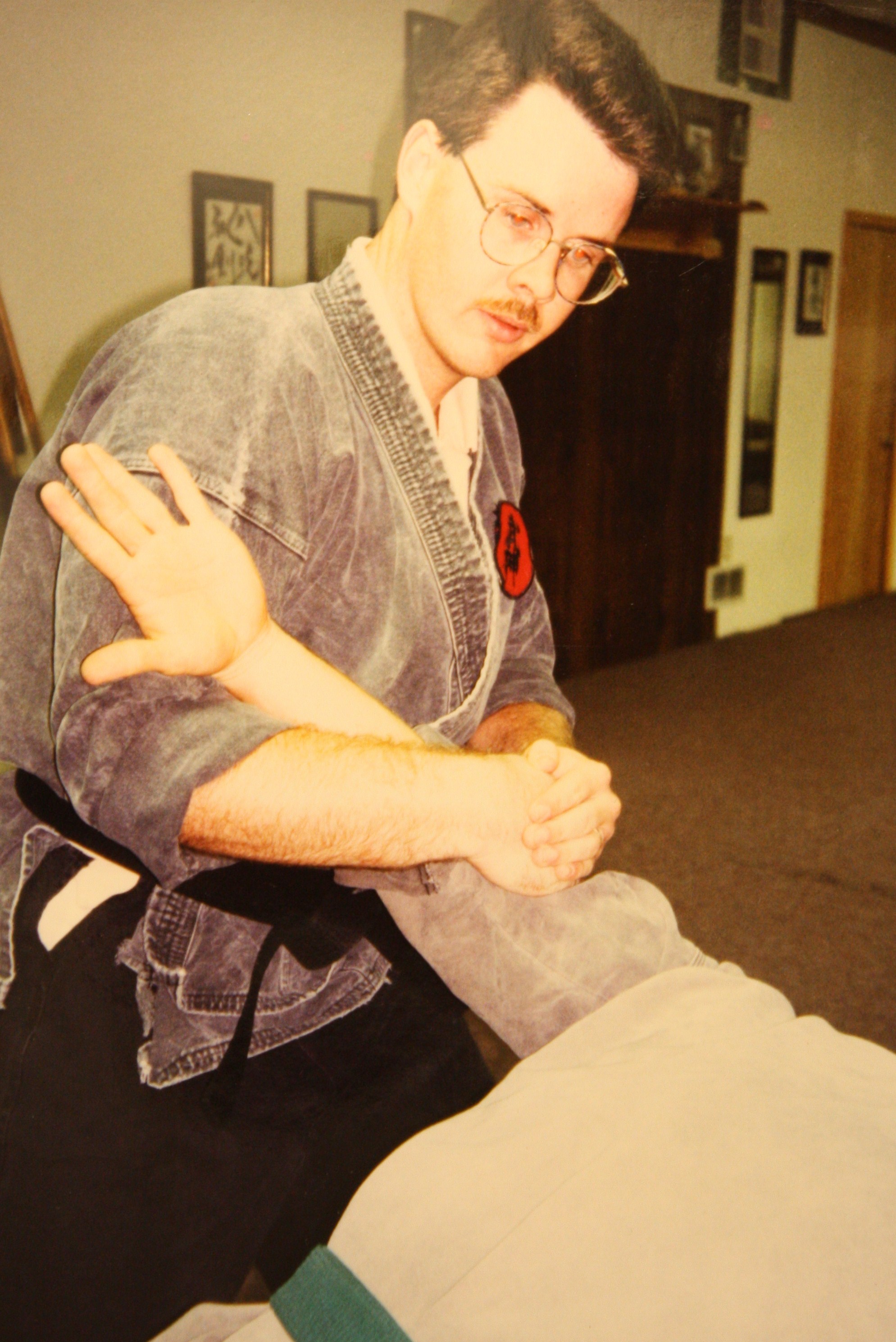
IMG_2553Many years ago I was training at a dōjō that had a practitioner who was a teacher for the blind. He requested that we put together a self-defense workshop for his students.  (If you’re wondering what kind of evil jackass would attack a blind person, rest assured that—sadly–such a level of jackassitude exists in the world.) The request presented an intriguing challenge. How does one adapt techniques that are premised on being able to see what the opponent is doing? Or maybe one shouldn’t adapt existing techniques but rather start from square one?


In preparation for working up a lesson plan, the person that asked for the workshop briefed the black belts. We learned that very few of the blind students lived in complete darkness. Instead, they displayed a wide range of different visual impairments. He even brought a large bag of goggles that simulated various impairments so that we could train in them to better understand what would or wouldn’t work with different types of impairment.


There were goggles that had funnels over the eyes such that one could see two little circles clearly while the rest of the world was black. There were others that had a complete field of view, but had translucent tape over the lenses so that everything was reduced to fuzzy blobs—as if one were looking through Vaseline. There were lenses that had a crackle effect such that one could only see veins of area clearly. There were goggles with no peripheral vision, and ones with only peripheral vision. He also had some goggles that blacked out the world entirely. Completely blind individuals may not be as common as one would think, but they certainly exist. Putting on any of the goggles was disorienting at first. A couple of the black belts even got vertigo or nausea when they moved around too quickly.


Now imagine what it would be like if one had always had the goggles on, that it was the only worldview one had ever known. Furthermore, imagine that everyone you interacted with on a daily basis all wore the same variety of goggles. You wouldn’t see it as an affliction or a limitation. To you, your view of the world would be full and complete. You would engage in behaviors that might seem odd to an outsider with unobstructed vision (e.g. sweeping your hands around in big arcs, turning your head at unusual angles, or calling out into the “darkness”), but these behaviors wouldn’t seem odd to you because you’d know it as natural behavior for someone who experienced the world as you did.  Because everyone you dealt with would see the world in the same way, it wouldn’t occur to you to think about whether there was another way to behave.


The preceding paragraph serves as an analogy for culture. One’s own culture is often invisible, especially if you don’t get outside of it much. All the people around you confirm your belief that you’re seeing the world as it is and behaving in the only natural and normal way imaginable. Sure, you may notice other people’s cultures—their skewed worldviews and the anomalous behaviors that result– but that’s because they do “strange things.” Still, some individuals will maintain that their culture doesn’t display any of the “odd” ways of behaving that more “exotic” cultures do.


But it does. Every culture is a mix of the good, the bad, and the ugly of how a people goes about living in the world given their cultural blind spots and skews. It includes collective coping mechanism for dealing with fears of uncertainty, and those are often the ugly side of culture. They encourage ingroup / outgroup separation, as well as primitive and superstitious approaches to dealing with those events, people, and behaviors that are out of the ordinary.


It’s easy to display double standards when one is blind to culture. I will give an example from my own life. It’s only been since I’ve been living in India (and traveling in Asia) that I’ve become aware of how many people are upset by Westerner’s secularization of Eastern religious / spiritual symbols and imagery. That’s a mouthful; so let me explain what I mean by “secularization of Eastern symbols and imagery.” I’m talking about “OM” T-shirts / pendants, bronze Buddhas, Tibetan thanka paintings, mandalas  (on T-shirts or posters), miniature shrines, or tattoos that are purchased because they are trendy, aesthetically pleasing, or vaguely conceptually pleasing without any real understanding of the tradition from which they came or intention of honoring it.


Granted it’s easy to miss the above issue if you’re a tourist because: a.) Many of said Eastern traditions practice a live-and-let-live lifestyle that make their practitioners unlikely to be confrontational about such things (in contrast to  practitioners of Abrahamic traditions (i.e. Judaism, Christianity, or Islam.)) b.) There are merchants in every country who are willing to sell anything to anybody for a buck, and so there are vast markets for tourists that offer up these symbols and images in droves.


It still intrigues me that it once caught me off guard that there were Hindus, Buddhists, Jains, etc. who were dismayed by the secularization of their traditions. I’m agnostic, but I was raised in a Christian household. Therefore, I can imagine the animosity aroused by the following conversation.


A: [Wearing a simple crucifix [or Star of David or crescent & star] pendant on a chain.]

B: Hey, A, I didn’t know you were Christian [or Jewish or Muslim]?

A: Because I’m not.

B: But you’re wearing a crucifix [or other Abrahamic symbol] pendant?

A: Oh, yeah, that. That doesn’t mean anything. It just looks cool. It’s kind of like the Nike swoosh.

B: [Jaw slackens.]


Now replace the crucifix with an “OM” shirt, and an inquiry about whether “A” is Hindu. Does it feel the same? If it doesn’t, why shouldn’t it?


Every martial art represents a subculture embedded in the culture of the place from which it came.  [Sometimes this becomes a mélange, as when a Japanese martial art is practiced in America. In such cases the dōjō usually reflects elements of Japanese culture (e.g. ritualized and formal practice), elements of American culture (e.g. 40+ belt ranks so that students can get a new rank at least once a year so they don’t quit), and elements of the martial art’s culture (e.g. harder or softer approaches to engaging the opponent.)]


The way that culture plays into a country’s martial arts may not become clear until one has practiced the martial arts of different countries—particularly in their nation of origin. While my own experience is limited, I have practiced Japanese kobudō in America (and extremely briefly in Japan), Muaythai in Thailand, and Kalaripayattu in India. I’ll leave Muaythai out of the discussion for the time being because I can most easily make my point by contrasting Japanese and Indian martial arts.  The Japanese and Indian martial arts I’ve practiced each reflects the nature of its respective culture, and they couldn’t be more different.
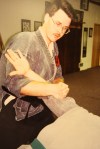
 

IMG_4525What are the differences between the Japanese and Indian martial arts I’ve studied? I’ve been known to answer that by saying that the Japanese martial art rarely uses kicks above waist level, while in Kalaripayattu if you’re only kicking at the height of your opponent’s head you’ll be urged to get your kick up a couple of feet higher.  What does that mean? The Japanese are expert at stripping out the needless and they work by paring away excess rather than building difficulty. The impulse of the Japanese is to avoid being showy. KISS (Keep It Simple, Stupid) appeals to the Japanese mind. (Except for the “Stupid” part, which would be considered needlessly confrontational and gratuitously mean-spirited.) There’s a reason why Japanese martial arts don’t feature prominently in global martial arts cinema. They don’t wow with their physicality; efficiency is at the fore.
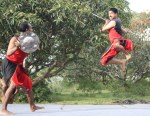
 

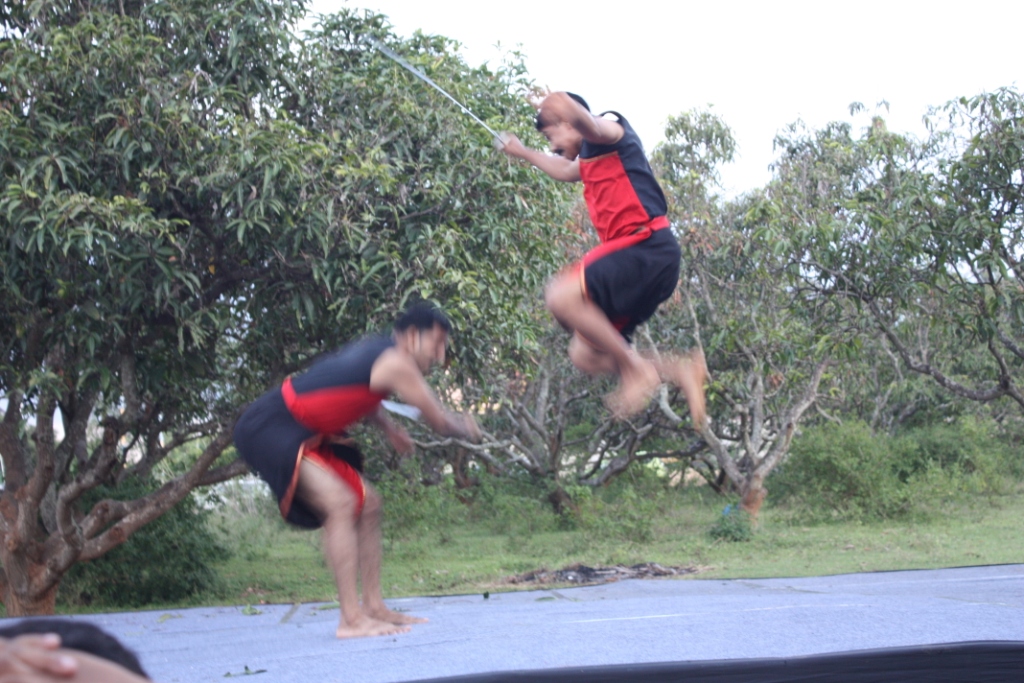
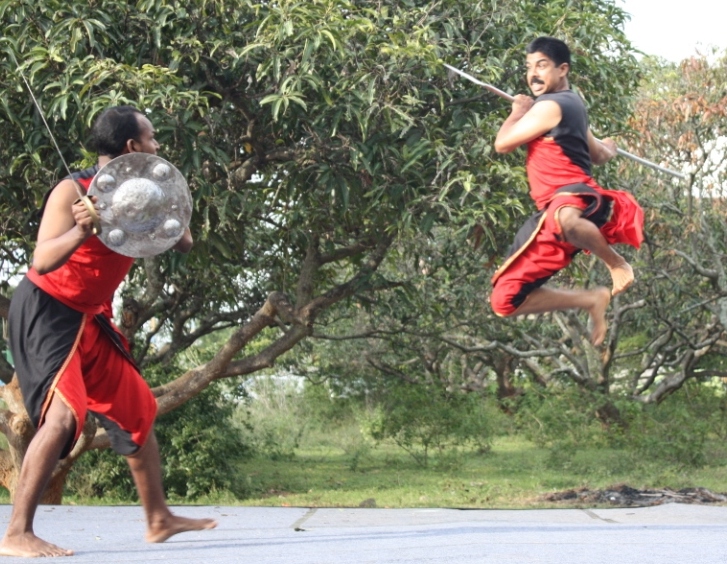
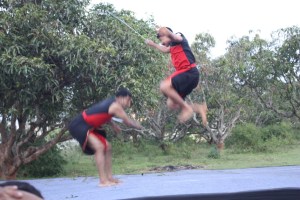
IMG_2246On the other hand, Indians are a vastly more flamboyant bunch, and Kalaripayattu is extremely impressive to watch and in terms of the physicality required to perform the techniques.  The Indian art isn’t about simplifying or cutting away the unnecessary. One has to get in progressively better shape as one advances to be able to perform techniques that require one leap higher, move faster, and be stronger. The Indian art isn’t about paring away excess, it’s about making such an impressive physical display that the opponent wonders whether one is just a man, or whether one might not be part bird or lion.


It might sound like I’m saying that the Japanese martial art is more realistic than the Indian one. Not really. Each of them is unrealistic in its own way. It’s often pointed out that the Japanese trained left-handedness out of their swordsmen, but that’s only one way in which Japanese martial arts counter individuation.  Given what we see in terms of how “southpaws” are often more successful in boxing, MMA, and street fighting, eliminating left-handedness seems like an unsound tactic at the individual level. There are undoubtedly many practitioners of traditional Japanese martial arts who can dominate most opponents who fight in an orthodox manner, but who would be thrown into complete disarray by an attacker who used chaotic heathen tactics. Consider that the only thing that kept the Japanese from being routed (and ruled) by the Mongolians was two fortuitous monsoons. The samurai were tremendously skilled as individual combatants, but the Mongolians could—literally—ride circles around them in warfare between armies. Perhaps, a more relevant question is whether Miyamoto Musashi would have defeated Sasaki Kojirō if the former had followed all the formal protocols of Japanese dueling instead of showing up late, carving his bokken from a boat oar, and generally presenting a f*@# you attitude. Who knows? But as the story is generally told, Musashi’s disrespectful and unorthodox behavior threw Sasaki off his game, and it was by no means a given that Musashi would win. Some believed Sasaki to be the more technically proficient swordsman.


All martial arts are models of combative activity apropos to the needs of a particular time, place, culture, and use.  And—as I used to frequently hear in academia—all models are wrong, though many are useful. (Sometimes, it’s written: “All models are lies, but many are useful.”)


[FYI: to the readers who say, “The martial art I practice is completely realistic.” My reply: “You must go through a lot of body-bags. Good for you? I guess?”]

BOOK REVIEW: Crow with No Mouth: Ikkyu Translated by Stephen Berg

Crow With No Mouth : Ikkyu : Fifteenth Century Zen MasterCrow With No Mouth : Ikkyu : Fifteenth Century Zen Master by Ikkyu

My rating: 5 of 5 stars

Amazon page

Ikkyū Sōjun was the Howard Stern of Zen masters. Born in 1394, he lived through most of the 15th century. Ikkyū served as a temple’s abbot for less than two weeks before he quit in disgust, vowing to move into a red-light district—apparently he wanted to live among people he found more honest and less hypocritical. The Zen master despised the corruption and snobbery of monastic politics.

Crow with no Mouth is a collection of Ikkyū’s verse, which is largely in the Zen tradition–featuring natural subjects and simple wisdom in a sparse style. Of course, as per my comments in the preceding paragraph, there are a few poems on topics such as cunnilingus and debauchery—so it’s not what one would call a child-friendly collection (unless one enjoys explaining the sexual exploits of a lecherous monk to one’s child.) The more explicit poems may seem like a diversion from the Zen path, but perhaps not. Maybe Ikkyū offered them as a way to train the mind, to observe one’s reaction to shocking commentary as a means of changing one’s way of thinking.

A few of my favorite lines of a more traditional nature include:

-“you can’t make cherry blossoms by tearing off petals to plant; only spring does that”

-“sometimes all I am is dark emptiness; I can’t hide in the sleeves of my own robes”

-“it’s logical: if you’re not going anywhere any road is the right one”

-“the edges of the sword are life and death; no one knows which is which”

-“even in its scabbard my sword sees you”

-“a flower held up twirled between human fingers; a smile barely visible”

-“in war there’s no time to teach or learn Zen; carry a strong stick; bash your attackers”

Here are a few of those jarring lines that I mentioned above:

-“that stone Buddha deserves all the bird shit it gets”

-“all koans just lead you on but not the delicious pussy of the young girls I go down on”

-“ten fussy days running this temple all red tape; look me up if you want o in the bar whorehouse fish market”

-“my dying teacher could not wipe himself; unlike you disciples who use bamboo; I cleaned his lovely ass with my bare hands”

-“don’t hesitate get laid that’s wisdom; sitting around chanting, what crap”

-“who teaches truth? good/bad the wrong way; Crazy Cloud knows the taste of his own shit” [Crazy Cloud was Ikkyū’s name for himself.]

When he left the monastery, Ikkyū shredded the certificate that served as his monastic credential. Some of his students found it, and pieced it back together. That led to the following verse:

-“one of you saved my satori paper I know it piece by piece; you pasted it back together; now watch me burn it once and for all”

Ikkyū’s verse asks us to reevaluate what it means to be sacred or profane. The orthodox view would be that Ikkyū fell from the sacred life of a monk. However, Ikkyū tells us that one can degrade what is important by raising the wrong things to sacred status. Conversely, some of what we believe to be profane is just rooted in habitual and ill-reasoned ways of thinking.

I’d recommend this work for those who love the spare form of Japanese poetry, and who don’t mind a hard jolt to their psyche occasionally.

View all my reviews

The Tongue-Cut Sparrow: A Japanese Folktale

800px-Tree_Sparrow_Japan_Flip[This is a well-known Japanese folk tale. There are many versions and translations of it, but the gist of the story remains the same from one to the next.]

Once upon a time, an old man was married to a shrew. The couple lived in the countryside on the edge of a mountain forest. They had no children, but the man befriended one of the sparrows that resided in the adjacent forest. The old man fed the sparrow, offering whatever he had to the small bird.

Over time, the man and the sparrow grew almost inseparable. However, one day the man had to go into town to buy provisions. It may have been that the man chose that particular day for his errand because his horrid wife was most ill-tempered on laundry days, and that was a laundry day.

While the husband was away, the sparrow came around. Seeing a pile of starch, the sparrow pecked at it. Infuriated, the old woman snatched up the bird in one hand and a scissors in the other, and she snipped part of the bird’s tongue out. Then as she tossed the sparrow free, she said, “Away with you. That’ll teach you to get into my starch.”

The bird flew deep into the mountains.

When the husband returned, he inquired as to whether his wife had seen the bird. The sparrow was usually around the homestead at that time of day.

The hag proudly told the husband of her actions and how she’d punished the insolent bird.

The old man lost no time in trudging out into the forest to try to make sure his friend was alright. He called out to the sparrow, but there was no response. He feared his wife had wounded the bird even more than she’d boasted. Eventually, exhaustion forced the old man to give up his search. He prayed that the little bird would be alright, but he couldn’t keep looking for it.


A couple of years later, the  man was foraging for mushrooms in the forest when he ran into the sparrow. The sparrow invited the man back to his home.

The sparrow offered the man food, refreshments, and even accommodations as they took several days to catch up on the events of each other’s lives. The sparrow now had a family and was doing well.

After a few days of catching up, the old man decided that he must get back, but he promised to come back around to visit occasionally. (The sparrow was reasonably reluctant to visit the man at his home with the vile woman around.) The sparrow family offered the old man a choice of parting gift, they presented two woven baskets. The baskets appeared identical, but one was light and the other was heavy. The old man didn’t feel deserving of a gift, but he took the lighter basket. He had to take one to avoid offending his host, but he didn’t wish to be greedy.

When the man got home, he was berated by the shrew for being away so long. She then interrogated him about the new basket. The man told his wife the entire story, including about how the sparrows offered him two baskets, and how he’d taken the lighter one.

His wife snatched the lid off of the basket and investigated its contents. She found that the reason the basket was so light was that it contained just a few precious jewels and several gold coins. By weight it wasn’t much, but its value was considerable.

The wife thought, Hm. I’ll go visit the sparrows. I’ll make a little apology for snipping at the bird’s tongue, and when they offer me my parting gift, I’ll be smart enough to take the heavy basket. Just imagine the riches it must contain.

The wife tricked her husband into giving her directions, saying she wanted to make a heartfelt apology. She then went to visit the sparrow family. She made a half-hearted apology for injuring the sparrow, claiming she’d only meant to scare him but the scissors had gotten away from her. The meeting was awkward and the sparrows were relieved to have the woman going on her way.

They offered the woman a choice of parting gifts as well. The woman lifted both baskets. Just as her husband had said, one basket was light and the other was heavy. She lugged the heavy basket up on her back, and without even saying her good-byes she sped toward her home as quickly as her legs would carry her. She had fantasies  about what she would do with her new-found wealth.

It wasn’t long before she needed a break because the basket was heavy and her legs weren’t used to such a burden. Standing on the forest trail, the couldn’t resist peaking at her riches.  The woman tugged the lid off and dove her head into the mouth of the basket to see what precious jewels, gold, and silver would greet her. However, what lurched out was an evil ogre, enveloped in a mist of demon spirits.

Clutching her chest, the old woman had a heart attack in the face of the horrific contents of her basket, dying where she had stood.

Tsukahara Bokuden Defeats a Braggart

[Note: There are many versions of this story, and these events have even been attributed to other warriors. The tale was likely passed around orally before it was written down myriad times in myriad different ways (most famously in the Kōyō Gunkan.) The details of the story aren’t important; it’s the overall moral of the story and that remains the same from one version to the next.]

Bokuden Boat

Tsukahara Bokuden listened to the braggart nauseating the ferry passengers with graphic details of his “exploits.” Bokuden would have happily ignored the young samurai, but the cocky youth seemed eager to take offense at the lack of interest in his tales of hacking people to bits and was looking for a fight. The other passengers on the boat were all commoners: an elderly man who was probably a craftsman or a small business merchant, and a mother with her young child.

“Do you doubt me? Do you have the audacity to call me a liar,” The young man said, having not received a suitably enthusiastic response to his stories. And he stood, one hand on his scabbard and the other brushing his sword’s hilt.

Tsukahara Bokuden said, “Easy, young man. No one is calling you a liar. These good people are just not used to such bloody stories.”

The young samurai turned to eye Bokuden, who had appeared to be napping in the back earlier. The braggart asked, “And who are you to challenge me?”

“I didn’t challenge you. I merely explained these people’s lack of enthusiasm for your yarns. But if you must know, I am Tsukahara Bokuden,” he replied, hoping his name might give the bragging samurai pause. Bokuden was well-known, having traversed Japan in musha shugyō (sometimes related to the European “knights errantry,”musha shugyō was a time in a samurai’s life–particularly in times of relative peace–when he traveled the land engaging in matches with individuals from other schools to increase his skill and notoriety–i.e. if he didn’t get killed, which was not uncommon, even when the fight was with wooden swords.)

“I’ve never heard of you. What’s your style?” the cocky samurai asked.

“Mine is the School of No-Sword,” replied Bokuden.

“I’ve never heard of that school, but it sounds weak,” the braggart said.

“I assure you, the technique is quite powerful,” Bokuden said.

“Are you suggesting that you could defeat me with this so-called ‘no sword’ technique?” the braggart said, his hand tightening on his scabbard.

“I said nothing of the sort. I would just like to enjoy the remainder of the ferry ride in peace,” said Bokuden.

“Are you scared to have a match to see who’s style is better?” the cocky youth asked.

“Not in the least, but I see no benefit in it either,” Bokuden replied.

“I’ve had enough of your lip, old man, prepare to defend yourself,” said the young samurai.

Bokuden sighed, “If you insist upon a match, let us at least do so where these good people’s lives will not be in peril. Surely you’ll agree that it would do no great honor to the samurai class if we were to injure or kill innocent bystanders.”

At this the braggart just harrumphed, “Who cares, but I’ll take you on wherever you wish.”

Tsukahara Bokuden said to the oarsman, “Sorry to trouble you, but would you mind diverting to drop us on that outcrop so that we can spare these people the swinging blades.”

The oarsman was readily agreeable. He didn’t want two samurai fighting on his ferryboat any more than Bokuden did.

He rowed them to a stony outcrop that jutted up out of the water. The uneven rocky ground wasn’t ideal for a match, but it would spare the other passengers and would provide a challenge.

When the boat’s bow ground up against the rock, the young samurai jumped out, twisting around in air, and landed on the rock. The braggart held his scabbard and hilt at the ready for a swift draw. The young man was eager to do battle, and it was clear that he was annoyed with Tsukahara Bokuden’s slow movement. The older swordsman took out both of his swords and asked one of the passengers to hold the swords. The oarsman and the passengers were surprised by this disarming behavior, but they’d heard him call his school the “school of no-sword.”

Tsukahara Bokuden then moved up to the boat’s bow as if preparing to move ashore.

“Might I borrow your oar, young man?” Bokuden said to the oarsman. The oarsman nodded and handed Bokuden the long oar with two hands, and with his head bowed. The general assumption was that the older samurai wanted to stabilize the boat against the rock so he could pass ashore smoothly.

Taking the oar, Bokuden drove one end into the outcrop, and grabbed the other pushing the boat away from the rock. The boat glided out from the rock in an accelerating fashion.

Lunging toward the water’s edge, the perplexed braggart called out, “What on earth are you doing, old man?”

To which Bokuden replied, “I’m defeating you with the school of no sword.”

By the time the young samurai could remove his swords and tug away his outer garment, Bokuden had rowed out to deep waters and returned the oar to the oarsman.


BOOK REVIEW: The Book of Ninja [The Bansenshukai] Trans. by Anthony Cummins and Yoshie Minima

The Book of Ninja: The Bansenshukai - Japan's Premier Ninja ManualThe Book of Ninja: The Bansenshukai – Japan’s Premier Ninja Manual by Antony Cummins

My rating: 4 of 5 stars

Amazon page

The Bansenshukai is a 17th century manual of ninja tradecraft and fieldcraft compiled by Fujibayashi Sabuji. If you’re doing related research or are a geek about historic warriors and / or spies, you’ll likely find this book intriguing–and parts of it even fascinating. However, it’s important to note that this translation’s title The Book of Ninja may conjure up expectations of stories of derring-do and assassinations set in medieval Japan. This isn’t that book. This book contains an extensive discussion of morals, guidance as to how commanders should employ ninja, how to don a disguise and impersonate your way into enemy territory, technical discussion of how to infiltrate long-obsolete fortifications, insight into how to pick medieval Japanese locks, and instructions for how to make torches and rope ladders. This book won’t teach you how to be a ninja. (a.) I suspect no book could do that, b.) This one holds back a lot of secrets, and c.) Most of the information is obsolete from a practical stand point. (However, it’s likely to have many ideas of a strategic or philosophic nature that one might find thought-provoking.)

Why is this book important and interesting (though–as I’ve suggested–some of its content seems patently boring)? We live in an era of information overload, and it’s difficult to fathom how little is truly known about the ninja of medieval Japan. We live during a time in which even the most secretive agencies document everything always (even if they sometimes manage to shred or burn that information.) In their heyday, the ninja weren’t big on writing down true and interesting information for fear it would fall into the wrong hands. Lack of documentation and false documentation were key elements of security. There are only a few manuals like this one in existence, and the Bansenshukai is considered by many to be chief among them by virtue of being the most extensive. (FYI- The other well-known manuals are the Shoninki and the Ninpiden, both of which also have English language translations available. Beyond these manuals, there are some surviving familial scrolls.) It should be noted that these manuals were written after the warring states period (though before the Meiji Restoration) when there was a fear that this information might be lost precisely because it was historically conveyed via word of mouth. And, it should be noted, throughout the work there are frequent statements to the effect of “there is an oral transmission”—meaning that key parts haven’t been written down and are only to be taught in person by hands-on instruction.

The Bansenshukai is organized into 22 volumes. The first volume is background and introductory information. The second and third volumes are more philosophical, dealing with achieving the “correct mind,” the former dealing with morality and the latter offering perspective on life and death.

The fourth through seventh volumes are designed to educate military commanders about how they might get the best use of ninja.

The next group of volumes (8 – 10) cover Yo-nin, which is the act of infiltrating enemy territory in the open through use of disguise and deception. The Japanese term yo is the same as the Chinese term yang, or sunny side—as opposed to yin (in in Japanese) which means the shady side. So these volumes offer advice for operating out in the open—in the light of day, so to speak. The previous volumes are contrasted with the next set of volumes (11-15), the In-Nin, which deals with covertly breaking into enemy houses and castles. Together the Yo-nin and In-nin chapters are likely to be the most interesting to the general reader–excepting the last of these (vol. 15, which deals with lock picking.) While I said that this book isn’t full of stories of legendary exploits, I don’t mean to suggest Fujibayashi didn’t use vignettes to reinforce his points (there are plenty of them)—just that these stories aren’t told to entertain but to educate.

The next two volumes are entitled Tenji I and Tenji II, and they discuss what the author considered the opportunities bestowed by heaven. The first of these chapters is mostly Chinese astrological hokum in painful detail. The second is a primitive primer on meteorology—which I suspect is a mix of good and bad advice based on the science of that time and place. (These people were exceptionally observant but the product of superstitious times, and so one can imagine fact and fiction being muddled together.) At any rate, I found the second chapter to have some quite interesting information of which I’d like to know more about the veracity.

The final set of volumes are on ninja tools (i.e. ninki.) These include chapters on climbing tools like rope ladders, water crossing devices like inflatable seats, breaking and entering tools, and many recipes for incendiary and explosive materials. Like the chapter on locks and lock picking, these chapters will mostly be of value to individuals with a heavy interest in the history of technology—with a particular focus on Japan and / or East Asia. In many ways the ninja were by necessity technologically advanced by the standards of that time in Japan’s history (keeping in mind that because of literally centuries of war, Japan wasn’t at the cutting edge of a spectrum of technology in the 17th century as they are today—though they made swords that at least rivaled if not surpassed those anywhere else in the world, but swords were on the way out or passé by that time in many places.)

There’s an additional text on strategy that forms an appendix to The Bansenshukai. To the front, there’s an explanation of Japanese locks of the time, written by a historian of such minutiae. There’s also front matter by the translator, providing valuable background material. Each chapter is heavily endnoted. These endnotes are generally explanatory in nature. While the text is quite readable given its era, there’s much that requires further explanation. Sometimes the notes elaborate on a statement in the text and sometimes they suggest that an explanation is unknown—either way that information can be quite beneficial. The graphics are simple drawings (I believe they come from the original text), and in some cases they wouldn’t be useful without the explanation of the text.

One will note a heavy Chinese influence in The Bansenshukai. There are frequent references to Sun Tzu and many of the vignettes use to illustrate points involve tales from China—though there are also many that feature Japanese warriors as well—e.g. Kusunoki Masashige, a samurai famous as a paragon of loyalty but who was also known for his use of ninjutsu and unconventional tactics, features prominently throughout the work—though it’s unknown how many of these tales are fact and how many legend.

If you’re still curious about the contents of this book after hearing what it is and isn’t, I’d highly recommend it. There’s a lot of thought-provoking information in the book, and if you’re doing research on the subject this book is essential reading. I should also point out that while I’ve suggested that much of the information is obsolete in the modern era, it’s not all so. There are some interesting perspectives on strategy, tactics, philosophy, and ethics in this book. [Plus, if you want to be the office ninja, it’s a must-read along with Machiavelli’s The Prince.]

View all my reviews

BOOK REVIEW: The Pyjama Game by Mark Law

The Pyjama Game: A Journey Into JudoThe Pyjama Game: A Journey Into Judo by Mark Law

My rating: 4 of 5 stars

Amazon page

Mark Law’s book contains two types of book in one volume, unified by the theme of judō. On the one hand, it’s a microhistory of the martial art and sport of judō–and, no, it’s not redundant to say the martial art and the sport because while these aspects overlap they aren’t identical. On the other hand, the book presents a personal account of Law’s experience as a judōka who began his practice at the ripe age of 50. The two elements of the book are interwoven together, and aren’t forced into distinct sections by the book’s organization. The history is obviously organized in a chronological fashion, but personal accounts are peppered throughout, and sometimes stories appear in history chapters.

As a history of judō, Law begins with the pre-history of the art in its ancestor martial art of jujutsu, he travels through the arts influence on off-shoots like Sambo and Brazilian Jujutsu, and he examines how the art has contributed to mixed martial arts—the 800 pound gorilla of present-day combative competitions. Particular emphasis is given to Kanō Jigorō’s role as founder of the art and the evolution of judō as an Olympic sport. Interestingly, besides founding Kodokan Judō, Kanō’s other claim to fame was in being the first Asian member of the International Olympic Committee (IOC). However, he never saw judō become an Olympic event, and—ironically–at least a few among those close to him doubted that Kanō would’ve been pleased with his art’s inclusion in the international games.

While Japan dominated judō when the sport first entered the domain of international competition, it wasn’t long before there were a number of other countries including the Netherlands, Russia, the United Kingdom, France, Cuba, and Korea that were producing first-rate judōka. Law devotes considerable discussion to the global blossoming of this sport, including entire chapters on some of the more prominent nations. The book discusses the double-edged sword that Japan faced. On one hand, the Japanese were heart-broken when other nations started beat them at their own game. On the other hand, it was clear that this had to happen for the sport to retain a global following. (Otherwise, the sport might have gone the way of baseball—being pulled out of the Olympics because only a handful of North American, Caribbean, and East Asian nations had any interest in it.

There are also chapters on women’s judō, a development that no doubt faced a good deal more misogyny than many sport’s bi-genderifications. There’s always been resistance to encouraging women’s participation in combative activities—even judō, a martial art whose dangerous edges were supposed to have been rounded off through rules, equipment (e.g. sprung flooring), weight classes, and close monitoring. Law discusses the hard fought evolution of the women’s side of the sport.

As a personal narrative, Law talks about the lessons he learned from training in judō and from testing for rank—an arduous process that requires beating other rank-pursuers in randori (free-form grappling, i.e. the grappling version of sparring.) Many of these lessons will be familiar to anyone who has practiced a martial art (e.g. while it’s more intimidating to fight someone who’s much more experienced in the art, it’s usually vastly more safe—both because senior players are more in control of their bodies and because they have less need to prove anything—i.e. they won’t injure an opponent to protect a fragile ego), but much of this discussion is specific to the culture and practice of judō.

If you’re interested in the history and development of judō, I’d recommend this book. I found the book to be at its most interesting when it addresses the history and globalization of the sport. However, those who haven’t practiced martial arts may find Law’s personal insight to be useful—particularly if you’re considering taking up judō and all the more if you intend to take it up past mid-life.

It should be noted that—judging by the identical table of contents and subtitle—this book was also released under the title Falling Hard: A Journey into Judo. The book does is annotated and provides references. Law is a journalist, and the niceties of that discipline are followed throughout.

View all my reviews