PROMPT: Historical Figure

Daily writing prompt
If you could meet a historical figure, who would it be and why?

If babel fish existed or I could have access to a fluid translator, then perhaps Drukpa Kunley, (or, alternatively, Hanshan or Ikkyu,) because I would like to know how that level of freedom is achieved (and whether it’s all it’s cracked up to be.)

If I was on my own for language, maybe Thoreau or Whitman. (For largely the same reason.)

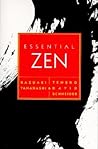
BOOKS: “Essential Zen” ed. by Kazuaki Tanahashi & David Schneider

Essential ZenEssential Zen by Kazuaki Tanahashi
My rating: 5 of 5 stars

Google Books Page

This is a collection of short writings (poems, koans, and prose excerpts) on Zen Buddhism arranged into loosely themed sections. The writings tend toward the artistic, creative, and metaphorical, with relatively few straightforward descriptions of technique or philosophy. The writings range from those of Chinese and Japanese monks who lived hundreds of years ago to present-day poets and Zen practitioners. Among the more frequently drawn from sources are: Hanshan, Ikkyu, Dogen, Ryokan, Hakuin, Gary Snyder, Robert Aitken, Seung Sahn, John Daido Loori, Thich Nhat Hanh, and Peter Levitt. But there are many others, including some who have only a single piece included.

There’s a substantial “Notes” section that gives source, translation, and — in some cases — background information. Most of the translations (both Japanese and Chinese) are by the editors, Kazuaki Tanahashi and David Schneider. There are illustrations, but they are all ensō (circular brush paintings) and related forms.

This is a highly readable and insightful collection of short writings, and I’d highly recommend it for individuals interested in Zen or Eastern Philosophy more generally.

View all my reviews

“Above the blossoms sing the orioles” by Han-Shan [w/ Audio]

Above the blossoms sing the orioles:
Kuan kuan, their clear notes.
The girl with a face like jade
Strums to them on her lute.
Never does she tire of playing --
Youth is the time for tender thoughts.
When the flowers scatter and the birds fly off
Her tears will fall in the spring wind.

Translated of Burton Watson in: Cold Mountain: 100 poems by the T’ang poet Han-Shan, New York: Columbia University Press, p. 22

Hanshan 131 [w/ Audio]

During thirty years since my birth
I've hiked thousands of miles,
seen green grass converging with a river
and red dust rising at the frontiers,
searched in vain for immortals and elixirs,
studying books and histories.
Today I've returned to Cold Mountain.
I lie back in a stream, washing out my ears.

Translation: Barnstone, Tony and Ping, Chou. 2005. The Anchor Book of Chinese Poetry: From Ancient to Contemporary. New York: Anchor Books.

PROMPT: Holiday Invention

Invent a holiday! Explain how and why everyone should celebrate.

Mad Saints Day. In honor of all the crazy sages throughout history (e.g. Hanshan, Diogenes the Cynic, Ikkyu, St. Isadora, Drukpa Kunley, Nasreddin, Milarepa, William Blake, etc.)

It’s celebrated by violating some societal convention that doesn’t have direct adverse health and safety consequences (This is not “The Purge.”) Of course, violating even the most absurdly arbitrary societal convention will cause many people to freak out, so the other element of celebrating Mad Saints Day is just getting the f@$& over it.

BOOK REVIEW: Cold Mountain: One Hundred Poems by the T’ang Poet Han-Shan

Cold Mountain: One Hundred Poems by the t'Ang Poet Han-ShanCold Mountain: One Hundred Poems by the t’Ang Poet Han-Shan by Hanshan
My rating: 5 of 5 stars

Amazon.in page


This brief collection gathers one hundred poems from the T’ang Dynasty poet Han-Shan. Most of the poems included consist of a single eight-line stanza of unrhymed verse of varied meter. [With a few exceptions that had more or fewer lines (often four or twelve.)] I do like that they didn’t pad out edition that I read with a lot of inane babble [as publishers are want to do when a volume is on the thin side.] Part of the reason that they may not have done so is that there is virtually nothing known about the author. It’s not even known whether there was a Han-Shan (i.e. as opposed to a group of people whose poems were anthologized under one name.)

The poems reflect Taoism’s disdain for pretension, authority, or scholarship for scholarship’s sake. Many of the poems reflect Zen sensibilities (which became entwined with Taoist sensibilities.) That is to say, like Zen koan, they seek to interrupt the tendency to overintellectualize matters. That said, in places the poems take a bit of a mocking attitude toward Buddhism. Nature plays prominently among the poems. And some of the poems are humorous or irreverent.

There are footnotes that are helpful in explaining verse that references teachings and events that would have been known to Han-Shan’s readership back in his day, but which most individuals who aren’t experts on Chinese folklore, literature, or religious teachings wouldn’t be likely to get, otherwise.

I enjoyed these poems tremendously. While I can’t say how they related to the original text, the translations were — on their own – works that conveyed wit and wisdom. I’d highly recommend this collection for poetry readers.

View all my reviews