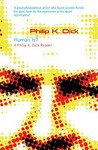
 Human Is?: A Philip K. Dick Reader by Philip K. Dick
My rating: 5 of 5 stars
Amazon page
This is a collection of 20 of Philip K. Dick’s short stories written between 1952 and 1973 that explore what it means to be human. Dick waxed philosophical on the question enough that a large collection could be assembled that examines humanity from many fascinating angles. While the age of these stories (and their Cold War taint) might make them seem obsolete, there is more than one way in which this collection is extremely relevant today.
First, artificial intelligence (AI) seems to be on everybody’s mind of late, and several of these stories feature machine intelligence as a means to understand what makes a human in a world in which there are other intelligent entities (in a similar vein, alien intelligence is also considered.) Second, Dick also asks us to consider the reality of a fictitious character who is alive in the minds of many and who might have more impact on the world than any living being. In our current phase of the information age, in which merchants of [dis-]information are becoming adroit at manipulating information and misinformation for their own desired effect, this seems a more crucial question than ever. Finally, there remains the age-old unresolved question of whether there is some x-factor beyond biology (i.e. a soul) that separates humanity from other forms of intelligence. While this is an old question, the fact that most people still believe there is a “soul” (by whatever name it’s called), even if most scientifically-minded people don’t see any reason to think so, means that it will continue to be a question with potential societal ramifications.
A sub-theme across these stories is the Cold War undercurrent of anxiety that the world could be turned into a dystopian wasteland at any moment. (In most of the stories, it already has been.) Again, if one can look past the references to the Soviet Union being cast as foe in many of the stories, one will find that the stories and the emotional zeitgeist aren’t as faded as they might at first seem.
The stories include some that movie-goers unfamiliar with Dick’s writing will know from Hollywood cinema (e.g. “Second Variety” (movie title: “Screamers,”) “Paycheck” (an eponymous film with Ben Affleck,) “Adjustment Team” (movie: “The Adjustment Bureau,”) and “We Can Remember It for You Wholesale” (i.e. both “Total Recall” movies.) But it also includes some deep cuts and lesser known stories.
1.) Beyond Lies The Wub: The crew of a ship is divided over whether to make an intelligent alien a prisoner or dinner.
2.) The Defenders: Owing to high radiation in the wake of nuclear war, humans are living underground, leaving the war-fighting to AI machines. A group of military men make an expedition to the surface only to get a big surprise.
3.) Roog: A dog is more than the family pet they think him to be, it’s secretly a guardian against the Roog.
4.) Second Variety: The Cold War went hot and the US built AI metallic creatures to fight the Soviets. The problem arises when these intelligent machines developed their own ideas, building androids because a robot that looked human could get into the midst of humans for better killing. The Soviets – after taking heavy losses – discover from serial number placards on androids that variety 1 is a wounded soldier and variety 3 is an orphan boy, begging the question of what is the Second Variety? When Americans end up among the last survivors, the question becomes essential for them as well.
5.) Impostor: Police take a man into custody who they believe to be an android with a dead human’s consciousness loaded into it, along with a bomb that could do tremendous damage. Of course, the man thinks they’ve got it all wrong.
6.) The Preserving Machine: A scientist builds a machine to preserve music, which he believes is at risk of being lost to future generations, but ultimately he learns that life always adapts and changes in unanticipated ways.
7.) The Variable Man: In a world in which decisions are made based on statistical models, the decision to go to war is in gridlock because the odds of winning stay close to 50/50. When a man from the future with a gift for repairing devices shows up, he upsets the apple cart by making the models unstable.
8.) Paycheck: A gifted engineer gets his memory wiped as part of a deal with a huge firm so that he cannot disclose any secrets about the top-secret high-tech project he was working on. He’s irked to find out that before his memory was wiped he asked for an envelope full of odds and ends in lieu of his lucrative paycheck. However, after being picked up by police, he soon realizes that the junk in the envelope was actually a well-thought out collection of useful items – if he can figure out how to use them.
9.) Adjustment Team: In a world in which a heavy hand has to periodically make major societal adjustments without people knowing, one man unwittingly becomes witness to these secret machinations. (Like “Paycheck,” the movie uses Dick’s concept without sharing the same character details and story details. However, I’d say “Paycheck” is closer to the story than is this one. However, it’s worth reading both because neither is exactly like the movie.)
10.) The Father-Thing: What if aliens could take over the consciousness of a loved one? How soon would one recognize the difference, if your father looked just like your father, but his behavior became a bit… off?
11.) Foster, You’re Dead: The “Keeping Up with the Joneses” mentality is a central theme in this story. A son wants one of the latest high-tech bomb shelters both because of Cold War anxiety, because it would be cool for a boy to have a subterranean lair, and because would be a prestige signal. The dad, however, is reluctant to get caught up in keeping up with the Joneses.
12.) Human Is: A scientist, who happens to be married to a woman who finds him cold and distant, is body-snatched while he’s away on assignment on a different world. His wife is the first to recognize her husband has been replaced, but does she want the original back?
13.) The Mold of Yancy: This story is about a soft dystopia, but instead of Huxley’s vision of people being plied with drugs and free and easy sex, these subjects are kept docile by the folksy wisdom of a beloved character who’s a complete fiction (unbeknownst to everyone.) Everybody wants their kids to grow up in the mold of the great war hero, Yancy. [Note: Even with all the AI stories, this may be the most apropos for today’s world, information used to manipulate people’s behavior without any threat of force.]
14.) If There Were No Benny Cemoli: Like “The Mold of Yancy” this story explores the question of what it means to be human by considering the fictitious person as a societal touchstone. If you can make people believe in a person who isn’t, and to change their behavior accordingly, what have you created?
15.) The Days of Perky Pat: In a post-apocalyptic wasteland, people are passionately into playing a game which revolves around a character named “Perky Pat.” In a way, she is a surrogate for who they were before war transformed the world. What will happen when they expand out to play members of a neighboring enclave who have a similar “Connie Companion” game?
16.) Oh, to be a Blobel: In a war against an alien race, a former spy was genetically altered to appear like the enemy species. After the war is over, he discovers that he can’t be stably turned back to human form. He will revert to the amorphous form of a Blobel for several hours per day, and stressors risk causing spontaneous transformation. As he will never be able to be married and have children with a human woman – who would have him – a solution is suggested whereby he will marry a former Blobel spy who turns into a human form for several hours per day.
17.) We Can Remember It for You Wholesale: A white-collar worker, Douglas Quail, who wants to go to Mars, decides to go to a memory-implant clinic that can provide him with a vivid detailed memory of a vacation to Mars. But when they try to implant said memory, it’s discovered that he isn’t who he – or the company — thought.
18.) The Electric Ant: A man who thought he was human finds out that he’s actually an android. The identity crisis that follows causes him to contemplate suicide.
19.) A Little Something for Us Tempunauts: There’s an accident with the first American crew of time-travelers, putting them into a closed time loop (i.e. like the movie “Groundhog Day.”) The question of the meaning of life in this story revolves around the unclear question of whether the tempunauts are alive or dead.
20.) Pre-Persons: In a future dystopia, abortion isn’t only legal; the age until which it can be carried out has been extended to 12. There are forces in society who rail against the government doctrine that a soul is attained precisely on one’s twelfth birthday, but that minority is considered to be the lunatic fringe.
This is an exceptional collection of stories, offering plenty to consider about the meaning of being human. Dick takes on the questions from several angles with a level of creativity only he could. I’d highly recommend this book for readers of science fiction or those who enjoy philosophical fiction.
View all my reviews
Share on Facebook, Twitter, Email, etc.