After the Quake [Haiku]

post-quake scaffolds,
on the ancient temples,
teach impermanence

BOOK REVIEW: Buddhist Ethics: A Very Short Introduction by Damien Keown

Buddhist Ethics: A Very Short IntroductionBuddhist Ethics: A Very Short Introduction by Damien Keown
My rating: 5 of 5 stars

Amazon.in Page

Most people, if they know anything about Buddhist ethics, have heard of the Eightfold Path (right + view, intention, speech, action, livelihood, effort, mindfulness, and concentration.) However, just knowing that can lead to the impression that Buddhist ethics are blurry and that it’s all a matter of doing as one pleases within one’s personal interpretation of rightness. This concise guide offers an overview of the Buddhist ethics and morality, focusing on issues of global and modern interest (as opposed to those issues only of interest in places where Buddhism is practiced or at the time in which Buddha was teaching – i.e. issues like abortion, vegetarianism, war, suicide, and cloning and not subjects like caste, traditional family roles, etc.)

The first two chapters present a broad overview, and the rest focus on particular ethical issues. I found the second chapter beneficial; it asks how Buddhist ethics fit in the categorization scheme employed by Western Philosophy. I considered it useful even though the answer was that Buddhist ethics aren’t neatly contained by this way of thinking, but rather can be seen as a mix of multiple approaches. (e.g. Buddhism has sets of precepts – ala deontology, has a karmic doctrine that is arguably consequentialist, and, also, has elements similar to the virtue ethics of ancient Greece.)

Chapters three through eight investigate specific issues: animal rights and environmental ethics (ch. 3,) sexuality and gender (ch. 4,) war and violence (ch. 5,) abortion (ch. 6,) suicide / euthanasia (ch. 7,) and upcoming technologies that will change what it means to be alive and conscious (i.e. cloning, artificial intelligence, cryogenics, and CRISPR.) As with chapter two, there’s often no tidy answer. For one thing, the author tries to contend with what is common across various sects, and this is often reflected in the laws of countries, laws which are only partially informed by Buddhist philosophy. Also, it’s not like the Buddha had anything to say on many of these issues, which either weren’t issues (e.g. cloning) or were considered radically differently (e.g. gender.) Still, one does get an idea of how these questions relate to ideas such as karma and dharma, and how contemporary Buddhist thinkers might begin to consider them.

One will note that there are ethical territories that aren’t addressed (e.g. justice / punishment, ethics of governance, business ethics, etc.,) but a brief guide needs filters, and this one chose to focus heavily on modern, individual ethical questions of broad international interest.

If you’re looking to better understand Buddhist ethics, this book is worth reading.


View all my reviews

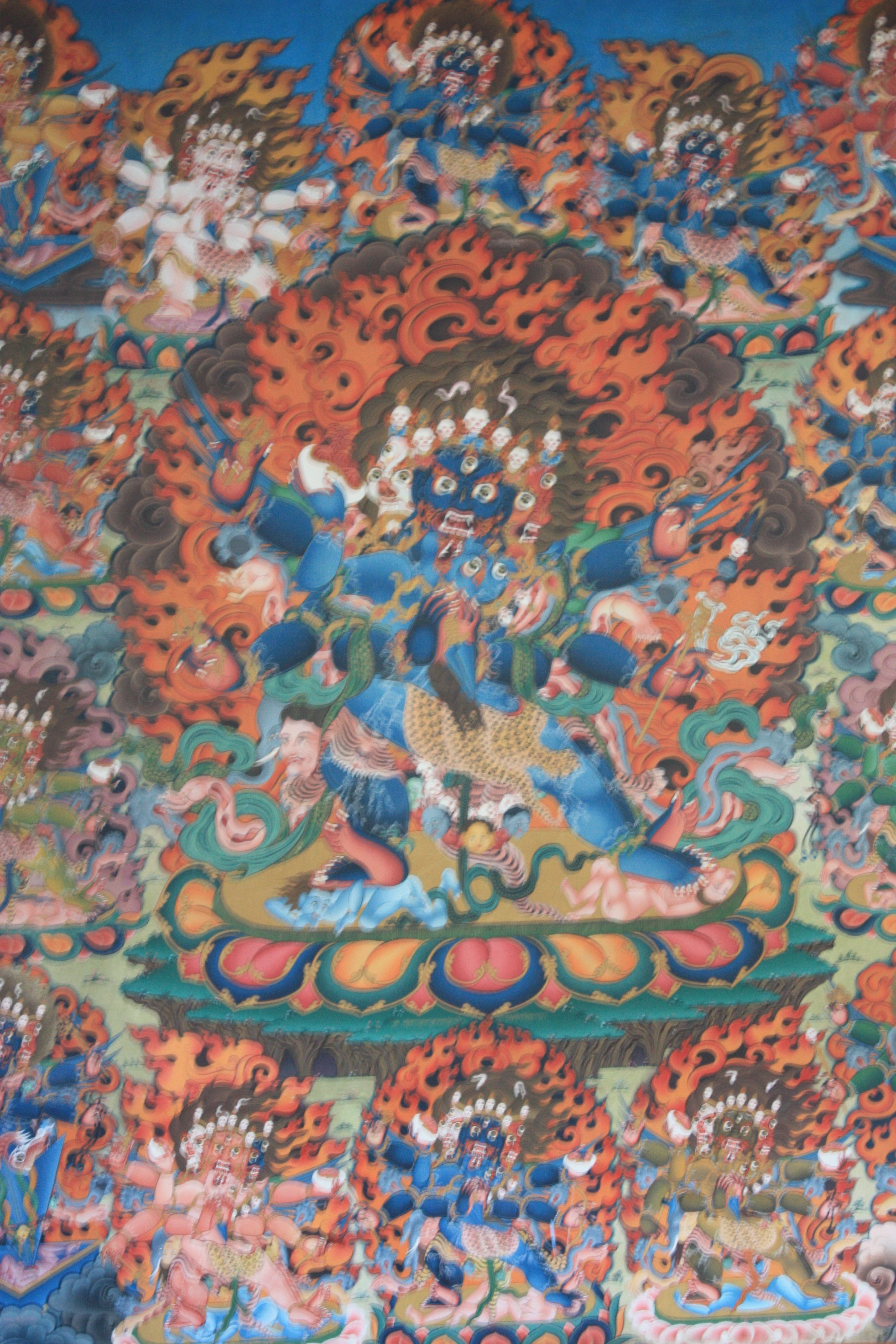
DAILY PHOTO: Patan Museum, Lalitpur

Taken in Patan (Lalitpur) in May of 2018

BOOK REVIEW: The Seven Basic Plots by Christopher Booker

The Seven Basic Plots: Why We Tell StoriesThe Seven Basic Plots: Why We Tell Stories by Christopher Booker
My rating: 4 of 5 stars

Amazon.in Page

This tome could’ve been two or more books (or, alternatively, could’ve been heavily edited into one book that stays on task.) The book’s first part contains the book that the reader expects to find. It’s that section that proposes that historically (e.g. pre-20th century) all popular stories fit into one or more of seven plot categories, each of which has a specific purpose. Part I clarifies the nature and purpose of these plot types. The seven plots are: 1.) overcoming the monster, 2.) rags to riches, 3.) quest, 4.) voyage and return, 5.) comedy, 6.) tragedy, and 7.) rebirth. While one might niggle about whether all the various myth, folklore, plays, epic poems, etc. of previous centuries can be categorized by seven plots (or some other number — bigger or smaller,) this first part isn’t particularly controversial. From “Beowulf” (overcoming the monster) to “Hamlet” (tragedy,) most of the stories one might think of probably do lend themselves to such categorization.

Where the book gets controversial, not to mention convoluted, is from Part II onward. Part II delves more deeply into the ideas of Jungian psychology upon which Booker (like Joseph Campbell) hangs his ideas about story. Now for my own controversial views. First, I think Jungian psychology is pseudo-scientific nonsense that should never be used in the treatment or understanding of the mind. While Freudians and Jungians have a big conflict with each other, I think they’re similarly useless. They both start from a laudable view that there is an unconscious mind and we should seek to better understand it. But then, instead of trying to objectively understand the workings of the unconscious mind (granted, it’s a terribly challenging task given our inability to witness the subjective mental experience of others,) each psychiatrist decided to furnish the unconscious mind with his own pet provocative scheme – Freud’s being centered on sexuality [particularly of an infantile nature] and Jung’s being more mystical, but neither man seemed to stop and think about whether said pet scheme could be defective and not universal.

Now, having said that, I don’t find it so objectionable that Booker (and Campbell) use Jung’s ideas for evaluating the fantasy realm of story. Jung’s archetypes may be a perfectly logical way for a writer to think about their characters, about symbolism, and about building nightmare realms. Therefore, I wasn’t that put out by the Jungian focus of the book – despite my lack of belief in the validity of Jungian psychology as a means to understand the mind or to treat mental illness. Still, it does reflect a mindset that is Booker is frozen in, a particular era and approach to psychology that creates many a blindspot in the author. Parts III and IV are about how plot is dead because writers have dared to go off book and abandon the purposes presented them by the titular “seven basic plots.”

Long story short: if you thought that Jung was the bee knees and that mid-20th century views on gender, art, and meaning were the truth, the whole truth, and nothing but the truth, then you may love this book. (At worst, you might find it rambling in places, but it often rambles intriguingly.) If you thought Jung was more a mystic than a psychiatrist, and that the approaches to art from recent decades are as valid as those that came before, you may hate it. I, personally, found a book that contained many interesting ideas, but also found that they were usually deep in the weeds (or maybe – more aptly – encrusted in the ice by which this book’s framework is frozen in time, a time that by no means represented the height of human understanding.)


View all my reviews

Lump of Color [Haiku]

drab winter forest.
all is in earth tones,
but one orange lump

DAILY PHOTO: A Heritage House in Dubai

Taken in May of 2017 in Dubai

BOOK REVIEW: The Stories Behind the Poses by Raj Balkaran

The Stories Behind the Poses: The Indian mythology that inspired 50 yoga posturesThe Stories Behind the Poses: The Indian mythology that inspired 50 yoga postures by Raj Balkaran
My rating: 4 of 5 stars

Amazon.in Page

Released: July 26, 2022

Yoga practitioners will be aware that — while some posture names are banal, straightforward descriptions (e.g. Utthita Hasta Padangusthasana, or “standing hand-to-big toe pose –”) many others invoke animals, sages, or deities for historical, mythological, or symbolic reasons. As this book’s title suggests, it presents the mythological backstories for fifty yoga postures. The vast majority of these fifty poses are common ones that will be readily familiar to most Hatha Yoga practitioners, though a few are advanced or obscure and aren’t likely to come up in your run-of-the-mill studio class. (And a couple may be familiar to some individuals by another name.)

The book is cleanly organized with five sections (Shiva poses, Vishnu poses, Devi / goddess poses, God story poses, and sage poses) each containing writeups for ten poses. Each pose is presented via colorful artwork in the Indian style (typically with the deity or sage in question performing the posture.)

I found the entries to be well-written and clear (Hindu Mythology can be extremely complicated and some authors get lost in the weeds by including too much minutiae or unnecessary details, but that wasn’t the case here.) The full-page artistic renderings of the poses are also clear and tidy, such that anyone familiar with the pose should readily recognize it.

The one thing I think could have been done better (though probably not without messing up the aforementioned clean organizational scheme) would be to cut some of the redundancy in the stories. In a few instances, the same story appeared in multiple chapters. To the author’s credit, these weren’t just copy / pasted, they were written uniquely, sometimes with additional information or a different focus. Still, it was a bit distracting to find myself in the middle of the same story and wondering whether I’d zoned out or lost my place. This might have been dealt with by putting multiple poses with one story and not repeating the tale one or more times. For example, the stories about Vasisthasana and Visvametrasana are inherently coupled, and the poses might be as well. (Perhaps even referencing the fact that the story had already been told might have been helpful and less distracting.)

All-in-all, I thought this book did a fine job of presenting the myths and relating them to the postures. I learned a great deal from reading the book and would recommend it for yoga practitioners and those interested in Hindu Mythology.


View all my reviews

“Anguish” [Haiku]

“Anguish” by August Friedrich Albrecht Schenck (1878)
mother bleats a cloud,
standing over its dead lamb --
ringed by a murder