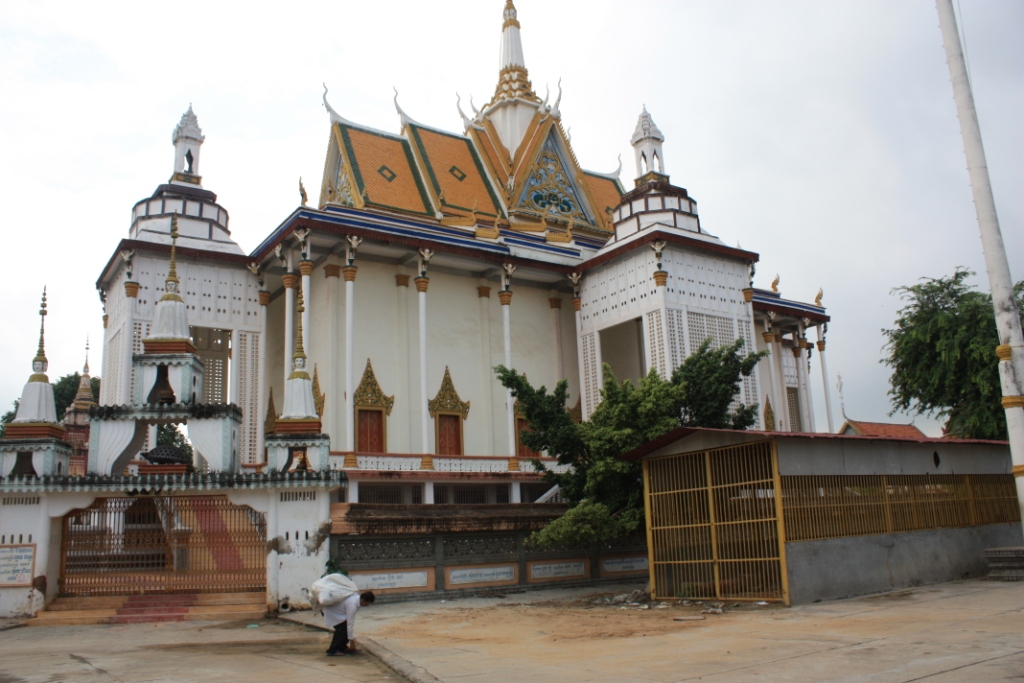
This Wat is located between the Russian Market (Toul Tom Poung Market) and the Tuol Sleng Genocide Museum in south Phnom Penh. The three sites can easily be visited together. I recommend the Genocide Museum last as it can drain one’s enthusiasm.
BOOK REVIEW: The 120 Days of Sodom by Marquis de Sade
The 120 Days of Sodom by Marquis de Sade
My rating: 1 of 5 stars
This book was listed in one of those “500 Books One Must Read” lists. Maybe it was “1,001 Must-Read Books.” However large the number, I think it was wrongly included. But it was free in e-book form (or nearly so) and so I figured: “I love free and I like edgy, so what’s not to enjoy.” Besides, this book has been banned many places around the world and there’s nothing that makes me want to read a book like it being banned. Plus, how many authors have such profound impact on the language as to have their names raised from that status of proper noun to common noun and adjective (the Marquis de Sade being from whence the word sadism, or “delight in cruelty,” is derived.)
Now the natural inclination of people seeing the uncomplimentary fashion in which I present this novel will be to think that I’m just a vanilla guy who found the work morally objectionable and that tarnished my view. It’s true that the scat, pedophilia, rape, and—in the latter chapters—homicidal mania rampant throughout the book are not my cup of tea. I, therefore, may not be able to convince you that I could have found the book appealing if it presented the same content in a more skillful manner. [I can’t imagine such a book being “enjoyable,” but I can imagine one that would be “engrossing.”]
However, I intend to convince you that there is a great deal that is unappealing about this book that has nothing to do with the subject matter. I firmly believe that, regardless of one’s ability to stomach the substantive content, one will still find the book to be an utter disappointment. [It should be noted that many people will find the book is more effective in the horror genre than the erotica genre—which isn’t to say that it succeeds in either.]
The synopsis is that four wealthy and prominent men take a harem of 46 individuals (boys, girls, men, and women) to a remote retreat to both have their way with them and, ultimately, snuff most of them out. The four men spend their time listening to tales of debauchery and sadism as told by a couple of prostitutes and then emulating the acts in the aforementioned stories.
Now, you may say, “What would keep 46 people from overwhelming four men—rich and powerful as they may be—and regaining their freedom?” Well, that’s the first problem with the book. It’s true that many of the victims aren’t adults, but enough are to make a rebellion workable. We are never told why this should work, and in this way the book is just a bunch of crude juvenile fantasies that fail the credulity test. A Bishop or President tells someone to drink acid or kill their own kin, and we are just supposed to accept that they would do it without question. The book sets up no tension. It really is the fantasy realm of an impotent man with delusions of grandeur.
The organization of the book is in five parts corresponding to the months / partial months that make up the 120 days mentioned in the title, and the storytellers tell progressively more vicious tales as the book progresses. The first couple parts don’t involve much violence and the acts described aren’t much different from what one might find in a book like The Story of O, except for the tonnage of poo in the Marquis’ stories. Having compared this to Réage’s work, let me say that it’s not just the poo that makes Sade’s work inferior, it’s also the lack of insight into the mind of the characters. (Part of the problem is that there is a vast cast of victims that have no dimensionality to them.) We see O’s reluctance, anger, pain, and transformation, but get none of this in The 120 Days of Sodom.
As the book progresses, it degrades further into lists of acts of debauchery and cruelty that all seem to blend together into a tepid bowl of poo. The Marquis de Sade wrote this work in prison and it really comes off as an outline of acts of violence he dreamt up out of the frustration of impotence. A well-written work that wanted to explore this situation would pick a few particularly evocative acts from the list and would form them into a coherent story with multi-dimensional characters and a narrative arc. This book is just a list of cringe-worthy acts written out tersely, but they don’t induce a cringe because none of it feels real because we get no insight into characters and the four leads are just supermen who get to do whatever they please without any realistic opposition.
If you read this book, read it out of interest in the historical persona of the Marquis de Sade. If you’re reading it as erotic literature, you’ll probably find it to be a disappointing series of premature ejaculations that just tries too hard to list the most disgusting and objectionable acts imaginable. If you read it as horror, you’ll have to read through a couple of chapters of stuff that’s just disgusting–but not particularly scary, and then when you get to the horrifying part it’ll just be a machine gun blast of little tales with inadequate description to be truly gripping.
Needless, I think the greatest act of cruelty ever committed by the Marquis de Sade was getting people to read this horrible book—maybe that was what he was after.
DAILY PHOTO: The Unofficial Slogan of Phnom Penh
DAILY PHOTO: Colonial Phnom Penh
THE CLASSICS: The Waste Land by T.S. Eliot
My rating: 5 of 5 stars
It’s for good reason that this is considered one of the greatest poems of the 20th century. Eliot’s vivid verse paints a bleak landscape in language of beauty not seen in the poem’s imagery. It will come as no surprise that this work was penned during a dark time in the poet’s life, but it wasn’t just Eliot’s personal dark hour; for many, the wounds of World War I hadn’t yet scarred over.
This poem is divided into five sections, each with an artful title. The five sections of The Waste Land are: “The Burial of the Dead”, “A Game of Chess”, “The Fire Sermon”, “Death by Water”, and “What the Thunder Said.” Some consider The Waste Land to be a collection of five poems, but there is both language and theme that connects the various parts. For example, the following verse is contained in both the first and third chapter:
Unreal City,
Under the brown fog…
The poem contains many complex references to Arthurian legends and to a broad swath of literary canon. You can learn about that from individuals more erudite than I. I will suggest a simpler theme, and that is death—not just death, but death as an eraser of legacies and influence. Eliot refers to bone almost as much as he does death, and by the time one’s body is reduced to bones one’s influence on the land of the living is minimal—even for giants among men. When he’s not speaking of bones, he’s speaking of death of masses, also a form of anonymous death.
I will pick a few lines from each of the five sections to illustrate my point.
From “The Burial of the Dead”:
Unreal City,
Under the brown fog of a winter dawn
A crowd flowed over the London Bridge, so many,
I had not thought death had undone so many
From “A Game of Chess”:
I think we are in rat’s alley
Where the dead men lost their bones
From “The Fire Sermon”:
White bodies naked on the low damp ground
And bones cast in a little low dry garret
Rattled by the rat’s foot only, year to year.
From “Death by Water”:
A current under sea
Picked his bones in whispers
From “What the Thunder Said”:
After the agony in stony places
The shouting and the crying
Prison and palace and reverberation
Of thunder of spring over distant mountains
He who was living is long dead
We who were living are now dying
With little patience
I’m not saying that Eliot’s views on death and dying are great from a philosophical or psychological perspective—on the contrary, but as a work of poetry these words should be read by all.
Neither the version linked to in GoodReads nor on Amazon is the version I read. As far as I could tell by way of a hasty search, the Kindle edition I read no longer exists.
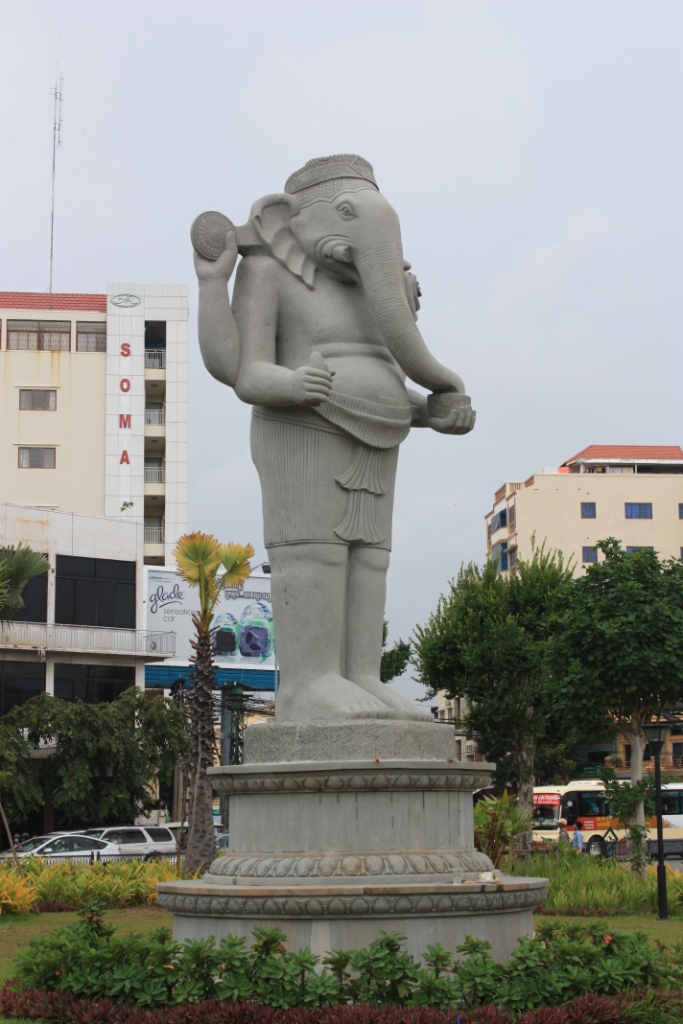
DAILY PHOTO: Cambodian Ganesh
An estimated 95% of Cambodians are Buddhist, and Buddhism has been the dominant religion since the time of Jayavarman VII (i.e. the late 12th century.) This begs the question, why might one see a statue of a Hindu deity in a public space in Cambodia’s capital city?
If you’ve visited Angkor, you know that Hindu imagery abounds. This is because before Jayavarman, the Khmeris were Hindu. In a great early act of recycling, Vishnu sculptures became Buddha sculptures by decree. (In what is–as far as I know–a coincidence, many Hindus believe that Buddha [Siddhartha Gautama Buddha] was an avatar, or incarnation, of Vishnu.)
This still doesn’t explain why a relatively new sculpture of Ganesha would reside in present-day Phnom Penh (Phnom Penh is not as old as Angkor, and by the time it was founded Buddhism was dominant.) Just as contemporary taxi and auto-rickshaw (tuk-tuk) drivers in India display Ganesha in appeal to this “remover of obstacles,” 10th century maritime traders did the same. This desire to court the favor of the remover of obstacles has continued on into the modern-day.
It’s an interesting commentary on how cultures never interact without getting some of their chocolate into the other culture’s peanut butter and vice versa (for those who have no idea what I’m talking about, that’s a reference to an old Reese’s commercial and not some dark coded message.)
DAILY PHOTO: Kuala Lumpur City Centre Park
Tok Sen: Massage by Mallet
I’m sure you’ll agree that nothing says relaxation like a massage delivered via a mallet and chisel. Actually, you probably wouldn’t agree with that at all, but I intend to convince you otherwise.
In the beginning of May, I attended a two-day workshop on Tok Sen, which is an age-old Thai system of bodywork that is delivered with a khone (a wooden mallet) and limb (a wooden wedge.) The name “tok sen” can be divided into the onomatopoeia tapping sound “tok” and the word for energy lines “sen.” In the past this method largely found favor with Thai farmers and others who had sinewy bodies. However, today it’s often combined with Thai Yoga Bodywork (TYB) to deliver treatment to people without steel band like muscles.
This art is not particularly well-known. I can guess why. As in the practice of a martial art, when one inserts a tool (weapon) between giver (attacker) and receiver, the comfort level on both sides initially drops a bit. In the martial arts, the armed practitioner becomes concerned about the increased ease with which he might inadvertently injure his training partner. This isn’t only because weapons are designed to compound damage, but because the feedback through the tool is less. Of course, the receiver has good reason to be more concerned as well. This is one reason why many martial arts don’t introduce students to weaponry until they’ve developed considerable skill in unarmed practice. I’m sure it’s why a much longer course in Thai Yoga Bodywork is generally a prerequisite for learning Tok Sen.
So the natural question is, why add an element of risk—even if it’s a minimal or imagined risk? Tok Sen adds versatility to one’s practice. One can save one’s thumbs in a way that doesn’t sacrifice precision. The usual way to avoid “thumb fatigue” is to use hands-free methods that use elbows, knees, heels, etc. Those other implements can be ideal. However, none of them hit as narrow a target as does one’s thumbs. With Tok Sen, one can opt for the chisel edge or the round end depending upon the target area, and when one is using the chisel edge one can orient it for best effect.
Also, believe it or not, the “tok” sound of the tamarind or teak wood has a bit of a relaxing timber when done with a practiced rhythm.
For massage recipients, not only is Tok Sen pleasant, but it makes a great story that will impress one’s friends. I mean, let’s face it, a cool story is a part of the reason why some people get moxibustion and acupuncture. And cool stories are all of the reason anybody gets “fish massages” and “snake massages”—neither of which offer therapeutic value beyond exfoliation and goosing the sympathetic nervous system (i.e. inducing temporary terror), respectively. So, cowboy up and give it a try. You can take a selfie and tell everybody how you toughed it out.
For masseuses and masseurs, it’s easier to control the pressure on the limb than one would think, and as long as one has the experience to know where and how the muscle lays it’s unlikely one will injure the recipient.
Here is a video that will show better what it’s like.