Take in the summer of 2011 in Hungary.
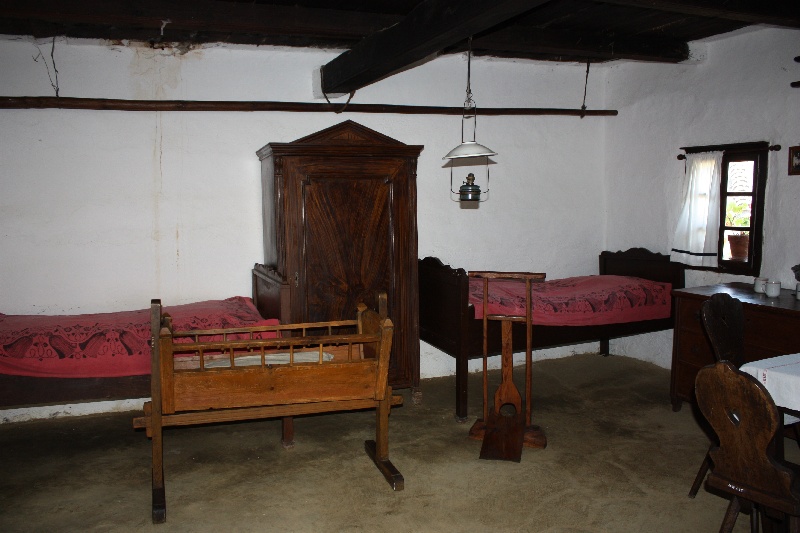
These were taken at a homestead restoration in Western Hungary in the area called the Őrség. This is how one might have lived in the late 18th century.
Take in the summer of 2011 in Hungary.
These were taken at a homestead restoration in Western Hungary in the area called the Őrség. This is how one might have lived in the late 18th century.

Taken Friday the 13th of June in 2014 in Bangalore.
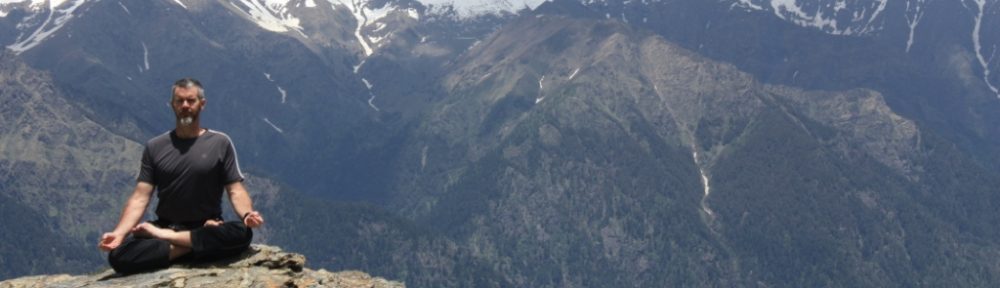
I haven’t been traveling much lately (or even getting far beyond commutes to the yoga studio, kalari, etc.) so I’m resorting to posting pics of what I’m doing in my day-to-day life as Daily Photos. The past few days I’ve been refreshing my training in the side, prone, and seated sequences of Thai Yoga Bodywork (Nuad Bo Rarn) at the Inner Mountain School of Healing Arts.
This photo is taken at the end of the seated sequence as a series of percussive actions are applied to the back.

Taken June 12, 2014 in Bhuvaneshwarinagar.
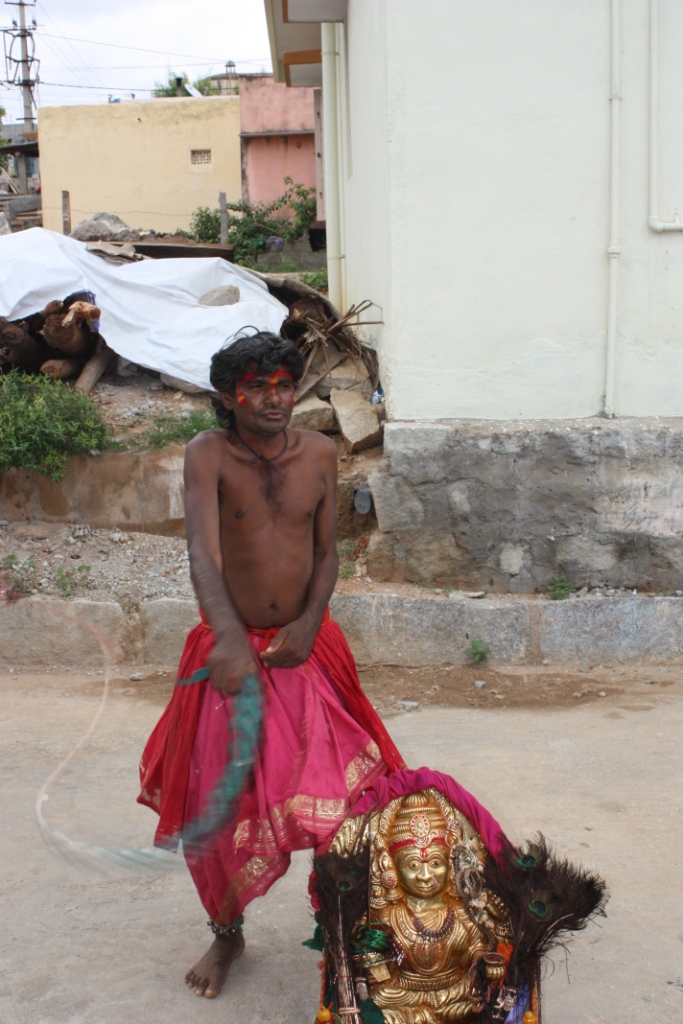
From the “only-in-India” files, here are a couple of photos a of a man who travels door to door whipping himself–or rather pretending to–with the accompaniment of a bongo soloist–to make it groovier, I presume. The lower photo is mid whip-crack, and the top one gets the bongoist in the picture.
For a nominal tip you can take their picture. It’s interesting–to say the least. I thought self-whipping was unique to some Catholic (e.g. Opus Dei) and Islamic sects, but you learn something new ever day. It’s a little out of character in a religion that advocates non-violence (against self as well as others) but as has been said many times, “The one thing you can say about India upon which everyone can agree is that everything and its opposite is true of India.”
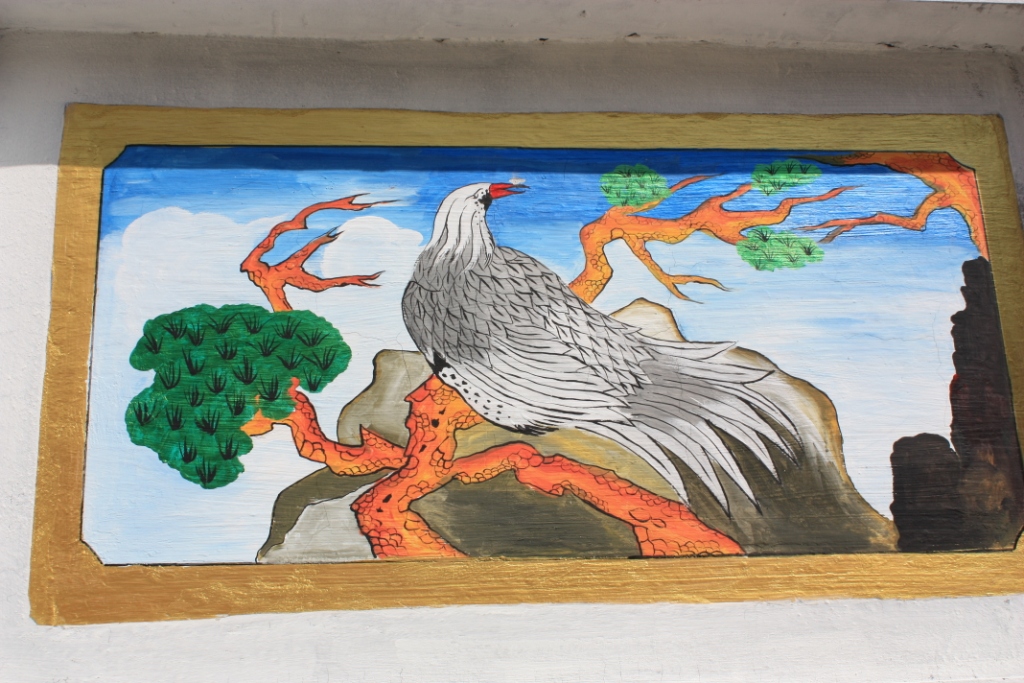
Taken in January of 2014 in Phuket Town
 Yoga Sutras of Patanjali by Charles Johnston
My rating: 4 of 5 stars
There are about a billion editions of Patanjali’s The Yoga Sutras. The one I got was a free or very cheap on Kindle, and is, therefore, probably not the best edition. I don’t know that the Kindle version I got still exists because it included a supplemental essay by Swami Vivekananda that the version I linked to on Amazon doesn’t. However, the translation is the same, and is by Charles Johnston.
For many old works, the edition might not matter too much, but for Patanjali’s Sutras it matters a great deal. First, there’s the issue of the quality of the translation. Beyond that, however, is the question of the analysis. The Yoga Sutras are extremely brief, consisting of only 196 aphorisms. Owing to the terse brevity of the Sanskrit language, many of these aphorisms are only a few words long. That means that there isn’t a high degree of precision in the language of the Sutras, and, consequently, there’s a great deal of room for misunderstanding and misinterpretation. It’s for good reason, therefore, that most editions are 90% or greater commentary on Patanjali’s words.
The Sutras are typically divided into 4 chapters (this convention apparently came well after Patanjali wrote them.) The first section lays out the objective of yoga. The central notion is the need for Chitta Vrtta Nirodha, which basically means to transcend the fluctuations of the mind. Patanjali’s point is that the problem faced by mankind is that people’s minds are run amok. There is a need for some system to facilitate correction of all this monkey-mindedness. That’s where Chapter 2 comes in.
The second chapter lays down an outline of Ashtanga Yoga, which is the eight-fold path of Raja Yoga (i.e. Royal Yoga). While modern-day people tend to think of yoga only as pretzel-like physical postures, that’s just one of the eight limbs of yoga. The eight limbs are: commandments (yama), rules (niyama), postures (asana), control of breath (pranayama), withdrawal of the senses (pratyahara), concentration (dhanara), meditation (dhyana), and liberation (samadhi.)
It’s interesting to note that the limb that many think of as yoga, i.e. the postures, is one of the most briefly covered. Most famously, Patanjali says in Ch.2, Sutra #46, “Sukham Sthiram Asanam” (i.e. postures should be stable and effortless.) The massive body of asana that developed in Hatha Yoga were initially just a means to give one the ability to sit still for a long periods of time comfortably enough to get one’s mind in order.
The third chapter talks a little bit about the last three of the eight limbs (i.e. concentration, meditation, and liberation.) However, the bulk of this chapter is devoted to the supposed magic powers that yogis claimed to have had as a result of their work on improving their minds. For skeptics and scientifically-minded individuals (e.g. yours truly), this is where the Sutras take a silly turn. The translation in question came out in 1912, and it’s clear that rationalism was already gaining hold and magic was getting to be a harder sell. I suspect that was the reason for the inclusion of Swami Vivekananda’s essay entitled “The Powers of the Mind”—to capitalize on the gravitas of the renowned yogi to convince people that chapter 3 isn’t bunk.
The fourth chapter wraps up the book neatly–discussing karma and the liberation of the karmic cycle achieved through the state of higher consciousness called samadhi.
If one has more than a superficial interest in yoga, it’s pretty much obligatory to read some edition of Patanjali’s The Yoga Sutras. I didn’t find this edition to be devastatingly poor, but there seems to be a consensus among reviewers that it’s not among the best translations / commentaries.
I would recommend that one read some version of these sutras, be it BKS Iyengar’s Light on the Yoga Sutras of Patanjali, Swami Vivekananda’s edition, or Swami Satchidananda’s version. I don’t have any experience with these other editions, though I have read works by BKS Iyengar and Swami Vivekananda, and found works by both to be well-written and clear. Notwithstanding the parts about magical superpowers, the book does provide a lot of food for thought, and in nice bite-sized pieces.
 Hellboy: The Midnight Circus by Mike Mignola
My rating: 4 of 5 stars
Hellboy meets Something Wicked This Way Comes. In this issue, Hellboy—as a boy—runs away from the BPRD (Bureau for Paranormal Research and Defense) and stumbles upon a circus that operates only through the wee hours of the morning. An acknowledgement of Ray Bradbury suggests that the use of a creepy, nocturnal circus of the netherworld was not a coincidence but a purposive homage.
The comic also borrows elements of the story of Pinocchio, which is explicitly referenced in the story line.
The comic is well-written and drawn. Those who don’t like it will likely find their dislike rooted in the comic’s ending. The title character doesn’t have a great deal of agency—i.e. he has little influence on the resolution of the story arc. That said, given that Hellboy is a boy in this issue and that his upbringing as a human boy by the Professor is credited with his ability to refrain from regression to his demon-like nature, there’s not a lot that he could probably do without straining credulity.
I enjoyed this book.

Taken in January of 2014 in Patong, Phuket.
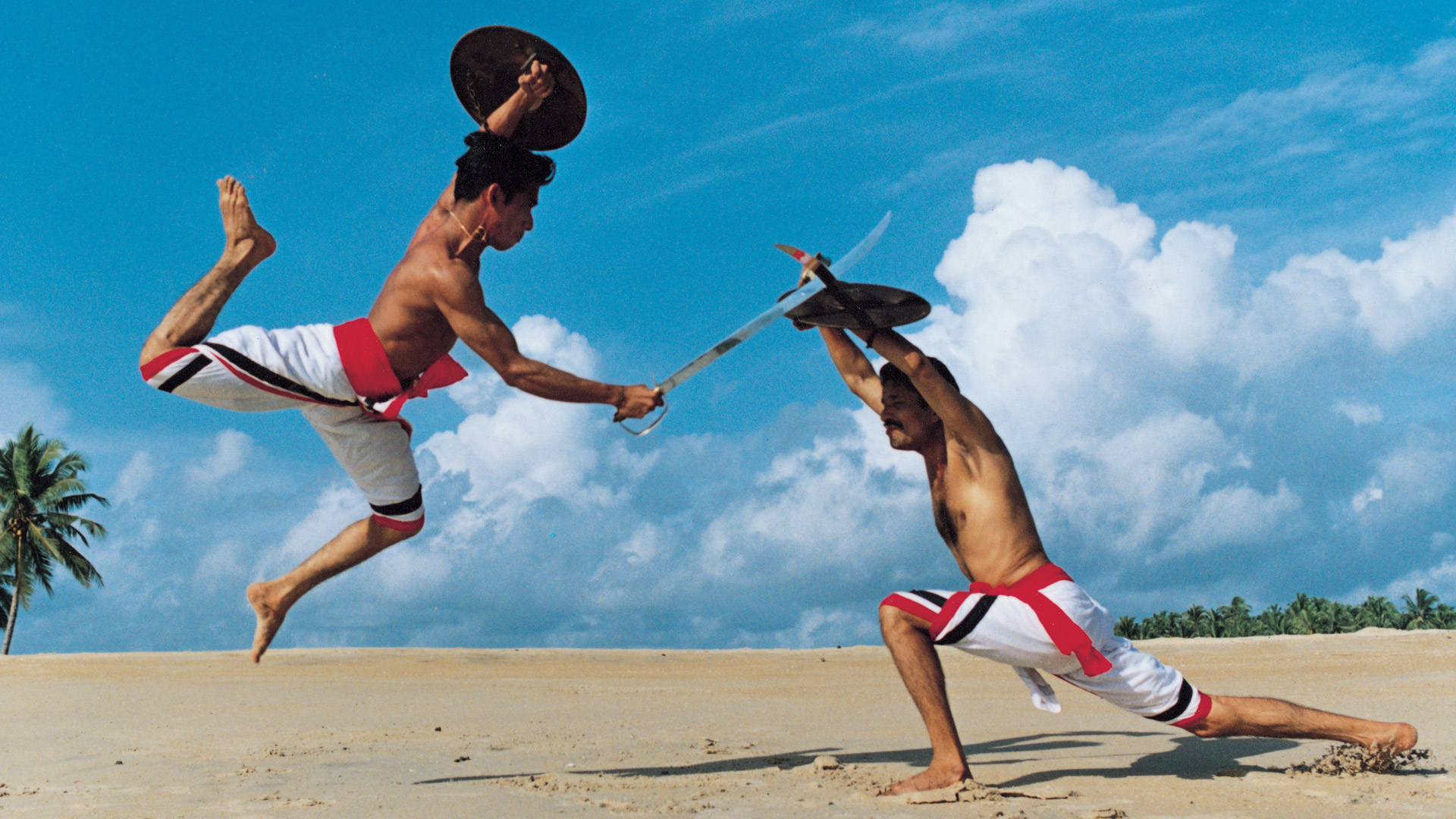
Source: The Kerala Tourist Office
Outside of India, Kalaripayattu isn’t a household name like karate, kung fu, or judō. However, within India, this homegrown martial art is a source of great pride. It’s said to be one of the few indigenous martial arts that survived into modernity (with unbroken transmission, i.e. without a period in which no one was diligently practicing it.) Some consider it to be the mother of Asian martial arts (for reasons I both address and critique in an earlier post.) It’s a mainstay of Bollywood (and non-Bollywood Indian cinema—yes, there is such a thing) and makes frequent appearance in dance performances and plays.
I’ve been attending Kalaripayattu classes for the past 4 or 5 months. While this hardly makes me an expert on the subject, it does give me some insight into the art beyond reading or watching videos. I’m also able to make comparisons to other martial arts–one in which I have an extensive background, and others with which I also have limited experience. I’ve, therefore, put together a collection of answers to questions I’ve been asked as well as others that I can imagine being asked.
Pre-Question Question: “Kalaripayattu” is a long name, can I call it by something shorter?
Answer: Kalaripayattu is often just called “Kalari.” Note: “Kalari” also refers to the place where the martial art is practiced (i.e. not unlike the words “dōjō” or “training hall”.) If someone refers to “the kalari” or “a kalari” they’re probably talking about a physical location, whereas if they say “Kalari”– without an article—they’re likely talking about the martial art.
As an aside, a kalari, historically speaking, has a precise design approach and dimensions. It’s dug into the ground so that from the outside the building can look like it’s for Hobbits, but inside its ceilings are adequate even for the long weapons used in the art. This method presumably began in an attempt to reduce the effect of the south Indian sun. Of course, in modern times, kalari take many forms (e.g. the kalari I attend is on the 3rd or 4th floor of a building.)
Q1: The most common question is, “Kalari? So, what’s that like?” [In this case, the questioner wants to know what classes are like.]
Answer: My stock answer to what classes are like is that if one imagines a class which includes yoga, modern dance, and a hard style of Okinawan Karate, one wouldn’t be far off.
Of course, most people have a tough time imagining such disparate elements in a coherent class, so I’ll describe what a typical class (at least at the beginner level) is like. Each hour-and-a-half class can be divided into five parts. The first is warm-ups, which consist mostly of joint articulations, dynamic yoga poses, and—lastly—leaping drills. Warm-ups may also include those old martial arts mainstays, running laps and side-to-sides (facing one direction and moving to the side without crossing one’s feet.)
The second section is a series of leg exercises, which are mostly kicks done on alternate legs in laps up and down the kalari. These get more challenging as one progresses. The highest level that I currently practice involves going into scissors splits (Hanumanasana) as one does these laps.
The third section is animal poses or movements (depending on one’s level.) One does animal poses in the first level. Now that I’m in the second level, I’m doing animal movements, which involve movement repeated up and down the length of the kalari. I believe there are more challenging versions of the animal movements in the subsequent level(s.) There are eight postures and eight basic movements that are designed to emulate animal behavior.
The fourth section is stretching. This involves a series of yogasana (yoga poses) and core work common to yoga.
The final section involves what in Japanese arts might be called kata (memorized forms–or set sequences of strikes and kicks) and striking drills.
Q2: The second most common question is, “Kalari? So, what’s that like?” This sounds like the exact same question, but in this case the inquisitor is asking what the martial art is like, more generally. [I blame the modern educational system and Twitter for this lack of clarity in language.]
Answer: The answer to the first question gives one a little insight into this question as well, but I’ll expand upon it. First, Kalari is a comprehensive combative system. That mouthful just means that it involves unarmed striking, grappling, and a range of weapons. This should come as no surprise as any martial art that predates sport martial arts is likely to be comprehensive. (In combat, one has to be well-rounded because one can’t plan on a combatant sticking to protocol.) Oddly, we think of “mixed martial arts” as the latest craze, but arts that specialize in either striking or grappling are the new kids on the block.
Second, I have read that the warriors in the area of present-day Kerala (i.e. where Kalari developed) didn’t use armor, and—in a related fact—tended to use weapons that were faster and were employed with greater agility than in other parts of India where armor was more common–as well as, the heavier weapons needed to be lethal against armored opponents .
Third, besides including wide-ranging unarmed and weaponry techniques, Kalari has a massage and medicinal component that has been handed down along with it. Readers familiar with either the Japanese and Chinese forms of acupressure massage (Shiatsu or Tui Na, respectively) and either Kobudō or Kung fu, will not be surprised to learn that the same vital points that are manipulated in massage in one way are exploited in martial arts in another. In Kalari, these points are called marma.
Q3: Who practices Kalari, and for what purpose?
Answer: At the risk of angering some readers, Kalari has little value for either self-defense or for preparing for combative sports (beyond the choreographed competitions that are Kalari-specific.) Because these two objectives are among the most common reasons for learning a martial art, it’s often asked what type of person practices Kalari and what do they hope to get out of it?
It looks to me like practitioners fall into three categories. First, there are those who want to get fit. Kalari succeeds tremendously in this regard. If one practices diligently, one will likely see growth in flexibility, cardio-vascular stamina, agility, and both core and extremity strength. (To be frank, this fitness building is why I said that Kalari has “little value for self-defense” rather than saying that its techniques are “of less value than randomly thrashing about in a fight.” One’s physical capacities rise considerably, and that might serve one even if the motions that are drilled into one’s body have no pragmatic value in fighting a skilled opponent—except in surprising them with one’s flamboyantly acrobatic but excessively expansive and vulnerable motions. I’ll also note that there’s a degree of fearlessness that results from training with metal weapons—even choreographed movement with unsharpened metal weapons—that shouldn’t be ignored as a potent benefit if one were ever to have to fight an advanced Kalari practitioner.)
[For those who haven’t seen Kalari and think I’m being excessively douche about its combat ineffectiveness. Below is a video of a couple of very athletic and skilled Kalari performers, and you can ask yourself–in your heart of hearts–if these moves seem likely to be effective against a focused and experienced opponent who has done a lot of free-form sparring.]
Second, there are dancers and performers who want to impress with the martial moves of Kalari. Hopefully, I can make amends to those who I’ve offended in the preceding paragraphs. While someone employing Kalari techniques would likely be thrashed to within an inch of his or her life if they employed them against someone using Krav Maga, Systema, or even Muay Thai, on stage Kalari moves are far and away more impressive to watch than any of the aforementioned systems. Kalari makes for a great show. The things superheroes do in movies aren’t very realistic either, but we “oooh” and “aahh” when we see them.
Third, there are people like me who are interested in the art in a scholarly sort of way from a historical, cultural and /or movement interest. I want to see what this system has in common with other martial arts, and to think about how it might have evolved. I should point out that I suspect that Kalari was at some point much more pragmatic as a combat system (and correspondingly much less thrilling to watch), and that it evolved to a new purpose over time. This same thing could be said of many arts that evolved into sports or entertainment enterprises (e.g. many forms of Kung fu are also unlikely to gain one success in a fight, but are nonetheless beautiful to watch. Also, I don’t know whether Capoeira evolved away from combat effectiveness or was born that way, but it certainly got there somehow.) One can also learn about movement in a generic way that might be applied in ways that can be useful.
Q4: Is Kalari a unified art or an umbrella term? (To make this clear, consider the word “karate.” If someone says that she studies “karate,” one really knows very little about the art that person studies. However, if one says he studies Isshin-ryū Karate or Shōtōkan Karate, then one might know what that person’s training really looks like.)
Answer: As I understand it, there are two different styles encompassed in Kalari. The northern style is called Tulumanadan, and the southern style is Vadakanadan. By “northern” and “southern” we’re talking about the northern and southern parts of the southwest tip of India, i.e. what is present-day Kerala, but which includes parts of other states–such as Karnataka. I don’t know how much variation is contained in each of those two styles.
Q5: How fit do I have to be to join Kalari training?
Answer: Like any physical activity, you certainly don’t need to be able to do what you see the advanced practitioners doing when you start. There’s a gradual build up from simple movements to ones that are more challenging. There is also, some allowance for one’s (temporary and permanent) physical limitations–because we are all different and have our own unique set of strengths and weaknesses.
Having said that, if someone apparently non-athletic asked if they should sign up, I’d probably suggest they first take a few yoga classes of a challenging nature (e.g. Power yoga, Hatha Vinyasa, or Ashtanga Vinyasa.) The Kalari classes will ask every bit the same of one’s flexibility and core strength, and substantially more of one’s extremity strength and stamina.

Taken in March of 2014 in Madikeri
We decided that the “socket” in this equine’s anatomical correctness–so to speak–was for insertion of a flag pole. Which seems mildly inappropriate and–given the horse’s sly stare and broad grin–more than a little creepy. Perhaps that was not the intention at all, but one has to assume there’s a reason he wasn’t given “the Ken doll.”
 The 20th Century in Poetry by Michael Hulse
My rating: 4 of 5 stars
The 20th Century in Poetry is an anthology of over 400 poems written in the 20th century that take (often tenuously or symbolically) historical events as their prevailing theme. The poets included in this collection range from household names to those who’ll be well-known only to poetry lovers to a few obscure choices. Among the more famous poets included are: Rudyard Kipling, A.E. Housman, James Joyce, W.B. Yeats, D.H. Lawrence, Ezra Pound, Robert Frost, Carl Sandburg, T.S. Eliot, Langston Hughes, William Carlos Williams, A.A. Milne, Countee Cullen, Edna St. Vincent Millay, W.H. Auden, e.e. cummings, Dylan Thomas, Allen Ginsberg, Bob Dylan, Sylvia Plath, John Updike, Chinua Achele, Robert Penn Warren, and Seamus Heaney.
Read the title carefully, this isn’t a collection of the best or most popular poems of the 20th century. Many of the works included aren’t even among the best known works of poet authoring them—though there are a few exceptions (e.g. William Carlos Williams’ Red Wheel Borrow and Dylan Thomas’ Do not go gentle into that good night.) Having “clarified” this point, one should note that many of the poems aren’t written about 20th century events. In other words, they’re all written in the 20th century, and they’re mostly about (or around) historical happenings, but sometimes those happenings are from a much earlier time period. However, the editors could well argue that the decision to reflect back on ancient events at that particular time speaks to perceived corollaries in the contemporary era.
I remember reading the reviews on Amazon for this book when I was considering whether to purchase it. The few reviews were overwhelmingly positive, but there was one negative review. Now usually when there’s one negative review and several positive ones, one can dismiss the negative review as that of a curmudgeon—the same person who returns his or her steak three times because the cook can’t get it within one minute and half-a-degree of what that person has determined is the ideal state of cookedness. However, I gave this negative review the benefit of the doubt and read it. What I found was a well-reasoned and uncurmudgeonly explanation of why that person didn’t like the anthology. Still, I dismissed the review and bought it. While I’m glad I did, I can see that reviewer’s point.
What was said critique? It was that the entire anthology was bleak and depressing. At the time of purchase, I shrugged that off. It’s poetry. Of course, it leans to the dark and morose. Poets aren’t generally known for their cheery dispositions (Augden Nash, Dr. Seuss, and Shel Silverstein notwithstanding—and, of course, none of those individuals’ works is in this book.) There are times when the doom and gloom obviously strikes the right tone (e.g. poems about the Depression, the World Wars, and various genocidal atrocities.) However, the 20th century was not all war and holocaust; it was also a time of great advancements in science, technology, and quality of life. But even the best times of the 20th century are painted depressingly in this collection. To give an example, there are three poems about the moon landing and they all come across as works of petty douchebags. (I suppose the underlying sentiment was, “Why are we spending millions going to the moon when there are poets who can’t make a decent living moping about and painting word pictures of the world as seen through shit-colored glasses.)
As this book is proclaimed as an attempt to capture the history of an entire century through poetry, it’s worth pointing out that this is clearly an English language centric view of history. To be fair, the editors do go to lengths to include poems from both Indian (i.e. South Asian Indian) and African poets whose works were published in English.
The poems are arranged in 7 chronological parts: 1900-1914, 1915-1922, 1923-1939, 1940-1945, 1946-1968, 1969-1988, and 1989-2000. Anybody remotely familiar with the history of the 20th century should be able to tell what world events drove this particular delineation of timeframes. For readers who aren’t history buffs, one nice feature is that each part begins with a prose discussion of world events during said era.
I would recommend this book to individuals interested in poetry as long as they don’t currently suffer from depressive disorders.