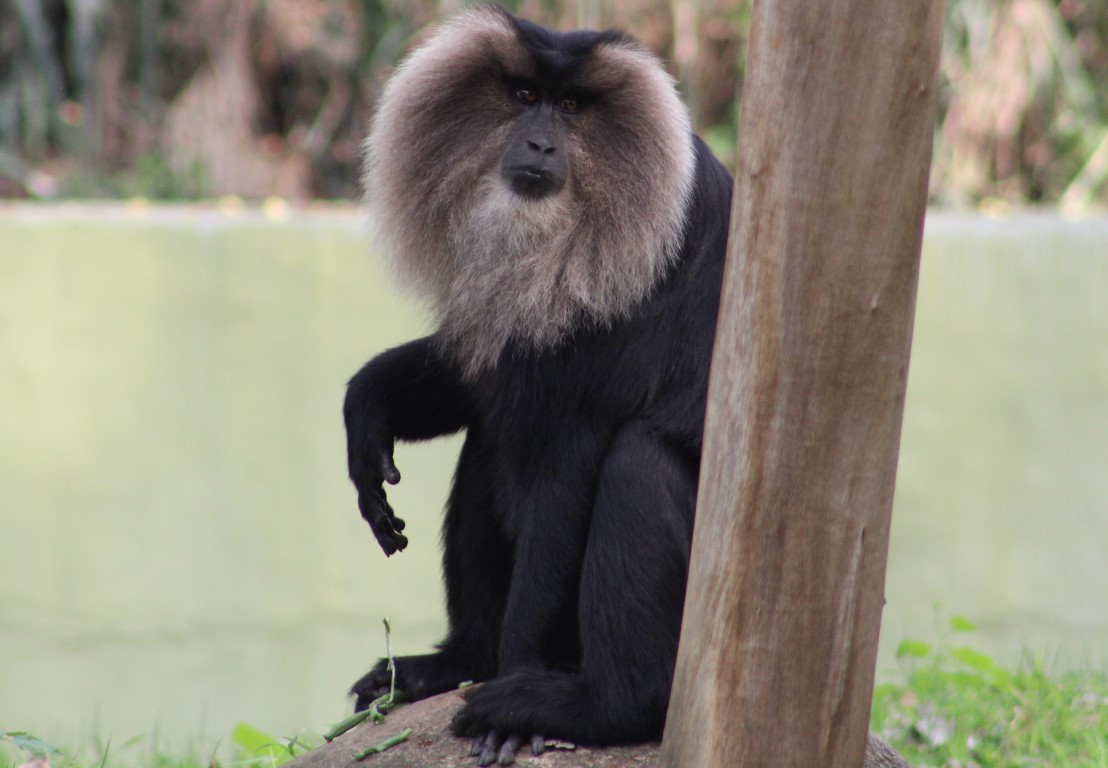
I came upon a Lion-tailed Macaque,
  And was instantly taken aback.
 Sure, its tail was lion-like, but what's weird
  Is that namers didn't call upon that beard!

I came upon a Lion-tailed Macaque,
And was instantly taken aback.
Sure, its tail was lion-like, but what's weird
Is that namers didn't call upon that beard!
A for Albatross:
   "An Albatross around one's neck" is usually used by those who never read the opium-addicted Romantic's poem, and -- more importantly -- who don't have the foggiest what an "albatross" is.

B for Birds [and Bees]:
   If you were really taught about "the birds and the bees," you are NOT prepared to have sex.

C for Cat:
   A "cat nap" is a short sleep. I had a cat. It slept eighteen-hours a day, usually for several hours at a time. [Also, "'til the cows come home" means when you put the feed out. They will reliably show up. If your cows are coming home late, that's on you.]

D for Duck:
   Re: "having your ducks in a row." Baby ducks naturally follow in a line. If you're having to man-handle your ducks into rows, you should learn wu wei - the Taoist principle of effortless action.

E for Elephant:
   If there's "an elephant in the room," it is definitely not a good time to talk matters over. Get the hell out, now!

F for Fish:
   "Fish out of water" may be fine, but -- to be fair -- "man in water" is just as accurate. A little waddling Gentoo Penguin could outswim Michael Phelps in the 400m and be finishing its kipper snacks while Phelps was still slogging through his first length. And Phelps is among the fastest our species can put in water. If the average human were dropped in the ocean, he'd thrash around until he got a lungful of water and died...and that's a kilometer offshore.

G for Goose:
    With respect to a "wild goose chase"... fun fact: if you chase a goose, it might well chase you back. I once read a book on the most dangerous animals (for humans) and, to my surprise, the goose was in it. They don't kill many, but they put their fair share of people in the hospital with beak-cracked shins.

H for Horse:
    So, about "straight from the horse's mouth." If you got your information from a talking horse and are proud that it was 'right from the source,' you might want to consider cutting your acid blotters into smaller pieces.

I for Indian:
    Not sure how the term "Indian burn" came to be, but I've lived in India for almost a decade and have never known anyone to induce a friction burn by twisting the forearm of another person. You may be saying, "Well, it's meant as in, 'Native American burn.'" But I still don't see any evidence for that. [Don't get me started on 'Indian giving' as an insult against someone who has the gall to want their stolen shit back.] Now, if you called it the "shitty little American schoolboy burn," that -- I would totally buy.

J for Jackal:
    Jackals are, like anyone who's ever eaten at McDonald's, opportunistic omnivores, but to make them out to be the exemplars of "exploiting situations' is a bit harsh. For example, did you know a Jackal won't cheat on its spouse, even when an opportunity falls right in its lap.

K for Kangaroo:
    I don't know who came up with "kangaroo courts" but I don't think we know enough about marsupial jurisprudence to cast aspersions upon the Kangaroo legal system. I think it is -- like many instances on this list -- simply deflecting.

L for Leopard:
   Why would a leopard even want to change its spots? Certain humans (frequenting the Wal-Mart) go to great lengths to appropriate leopard spots. If they are fashionable for a plus-sized woman's stretch pants, why would the leopard think any differently.

M for March Hare:
   They say "mad as a March Hare" because March is mating season. I think the saying should be "Horny as a March Hare." Alliteration intact.

N for Nightingale:
   I suspect ninety-nine percent of those who use "sings like a nightingale" couldn't pick a nightingale's song out of an audio lineup of bird noises.

O for Oyster:
   "The world is your oyster" is supposedly a great thing. But when I elaborate by saying, "The world is your slimy raw foodstuff that has a twenty percent chance of making you vomitously ill," it doesn't sound like a good thing.

P for Pony:
    We need to stop people from bitching about the fact that their pony only knows one trick. It's a fucking pony. You should be grateful it knows the one trick.

Q for Quail:
   To "quail at ______" means to be timid in the face of some stimulus. I don't think it's particularly fair. If you were considered a delicacy, you'd be a bit skittish, too.

R for Rat:
    If you "smell a rat," it's definitely dead, and -- ergo -- will not be plotting against you.

S for Sheep:
    I shouldn't have to point out that a "wolf in sheep's clothing" is completely naked.

T for Turkey:
    A "Turkey voting for Christmas" is said to be acting against its own interests, but since everybody eats turkey for Thanksgiving and many people have ham for Christmas, I'd say the turkey knows exactly what it's doing. Even if it's one of the unlucky Christmas turkeys, it still got another month of living. Hell, there are humans who rack up million-dollar medical bills for the same outcome.

U for Underdog:
   The first use of the term "Underdog" was in 1859, long before the cartoon from my youth. Is there an "Uber-dog" or an "Overdog?" How did this even enter someone's mind?

V for Viper:
   "A nest of vipers," is another bit of anthropomorphizing. The premise of the idiom is that it's a group of nasty people getting together. Whereas the snakes in a viper's nest are as likely to be as good as any.

W for Weasel:
    When someone uses ambiguous words to obscure their meaning, we say they're using "weasel words." But as far as I can see, weasels have the good sense to keep their mouths shut. (Unlike those secret-betraying horses.)

X for XYZ:
   People say, "for XYZ reasons" when they mean for an extensive list of reasons that no one seems to know.

Y for Yak:
   Somehow, we use "yak" for the act of being relentlessly chatty, and -- once again -- I must say that I've found yaks to be less than gabby.

Z for Zebra:
    "A zebra can't change its strips." See: "L for Leopard."
 Methuselah’s Zoo: What Nature Can Teach Us about Living Longer, Healthier Lives by Steven N. Austad
 Nature Is Never Silent: how animals and plants communicate with each other by Madlen Ziege
 Drunk Flies and Stoned Dolphins: A Trip Through the World of Animal Intoxication by Oné R. Pagán
 Empire of Ants: The Hidden World and Extraordinary Lives of Earth’s Tiny Conquerors by Susanne Foitzik
My rating: 5 of 5 stars
Out: May 6, 2021
In love with our own grandeur, most humans don’t give a thought to the magnificence of other species, and this is particularly true of ants. People use ants as their go-to being to fill in the SAT Analogy “Gods are to Humans as Humans are to ______________.” When we want to explain how some more capable entity (be it a god, a trans-galactic alien species, or an advanced artificial intelligence) is more likely to kill us through indifference than through maliciousness, we draw upon the image of an ant about to be crushed under the boot of a person who’s just going about his day, harboring no ill-will towards his six-legged neighbors.
This book will roll back that smug attitude, impressing the reader not only with all the little-known but intriguing behaviors of ants, but also with the range of skills employed by ants that we humans have always thought of as our unique bailiwick – e.g. city building, agriculture, slavery, war, and communication of complex ideas.
The book consists of fourteen chapters and a brief epilogue. The introductory chapter not only prepares the reader to be more impressed by ants, it also explains how crucial ants are collectively to our ecosystems. Chapter two explores the ant caste system in much more detail than the usual queen / worker / drone distinction, and it also explains how sex is determined in a manner quite different than that to which we are used. Chapter three continues an extensive discussion of reproduction that was begun in the previous chapter.
Chapter four dives into what might be called the governance of ant colonies. That may sound grandiose (and, in some sense, it is) but we are talking about huge populations living in a relatively small space. While sci-fi might have one imagining the queen ruling with an iron first while all others act as mindless automatons, the truth is very different, and – in fact – after establishment of the nest, the queen leaves the the thinking business altogether. Chapters five and six investigate the subjects of communication and navigation, respectively. Ants have a tremendously varied set of chemical emitters and receptors, allowing them to communicate a wide range of messages with great clarity. They also communicate through physical contact. Anyone who has ever seen a line of ants in convoy probably suspects that ants must be skilled at getting where they need to go and back. This chapter explains the methods by which ants achieve this purposeful motion, from chemical signals to navigation by the sun to – in some cases – an internal magnetic compass.
Chapter seven takes the reader into the realm of ant militaries, elucidating how they hunt, bivouac, and carry out the various tasks required of them. Chapter eight introduces the question of how colonies (that can be on par with human cities with respect to population) feed everyone, and gives special attention to leafcutter supply chain logistics and in-colony fungiculture. Chapter nine examines the lives of tree-dwelling ants. In this chapter, we learn that not only do ants engage in activities we think of as human; some also perform activities we associate with other species – such as silk weaving. Chapter ten continues the book’s examination of ant agriculture by explaining how some ants keep aphids as livestock [the aphids consume leaves and excrete sugars as a waste product because there is far more of it than they need for their own purposes.]
While chapter seven indicated how ants share some of the less palatable habits of humans – specifically, war, chapter eleven delves into some of the downright loathsome activities these insects share with our species – including: enslavement and theft. Chapter twelve identifies some of the threats to ant health and well-being, including tape worms and fungal parasites. You may have read about the fungus that can hijack an ant’s nervous system to turn it into a zombie (Ophiocordyceps camponoti-floridani,) eventually the fruiting body of the cordyceps pops out of the ant’s head to release spores (after the fungus has “driven” the ant high up into a tree from which the spores can be widely distributed.)
Chapter 13, entitled “The Path to World Domination,” is largely about how invasive species have come to take over in many parts of the world. This includes fire ants, which the Spanish (unwittingly) hauled from Mexico to the Philippines, from which the insects were dispersed all over the world via trade routes. While — throughout the entire book — intriguing ant behaviors are mentioned, the final chapter collects together a group of particularly unlikely skills that are witnessed among ants. My favorites were ants that could glide back to tree trunks when knocked off a limb, as well as another species that could catapult themselves through the air.
The book is well-illustrated, employing both drawings and color photographs. The photographs are particularly useful for showing some of the stranger species and – in a few cases – behaviors that can be difficult to visualize. There is an extensive “further reading” section that is organized by chapter.
“Empire of Ants” provides a fascinating look at an underappreciated species. Just as Peter Wohlleben’s “The Hidden Life of Trees” changed the way I looked at trees, this book changed the way I see ants. I’d highly recommend the book for anyone interested in the natural world.
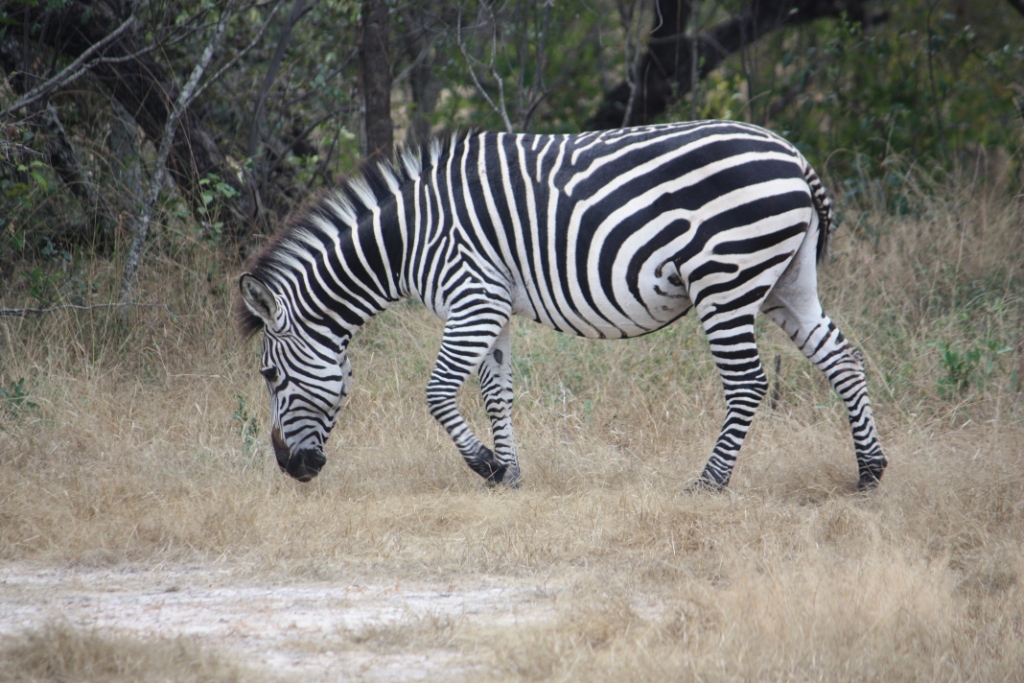
Taken in April of 2017 in Mosi Oa Tunya (Victoria Falls) National Park

Chobe National Park, Botswana
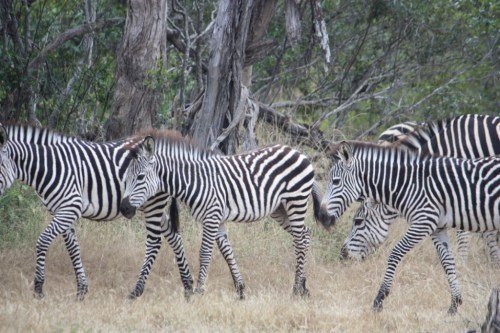
I heard a person — looking at a solitary zebra — say, “That is horrible camouflage! How is it not extinct?”
The answer is found by looking at zebras in a group. When they run in a herd, it becomes impossible for a predator to distinguish one from another. Heads merge with hindquarters merging with a shoulder. They become an amorphous monochromatic cluster with nothing to bite onto.
 Body Heat: Temperature and Life on Earth by Mark S. Blumberg
My rating: 4 of 5 stars
I picked up this book for an odd–and potentially disconcerting–reason. I sweat when I work out. I know that everyone sweats while active, but for me it’s preternatural. It’s at a level that has the potential to be a superpower, if I had any control of it. I’ve finished muaythai sessions with the ring floor looking like it’d rained inside—granted Thailand takes humidity to its heights, but still. I was hoping to gain some insight into what this anomaly was all about. After reading the book, I can’t say I have any greater insight on the issue. However, having lived in the tropics for over three years now, I’ve recently begun to notice that my level of sweating seems normal—at least within a range acceptable for our species.
There are nine chapters. The first examines the basics of heat. While the examples are zoological, the substance is largely what one would study in an introductory physics class—sans the math. Chapter 2 dips more into the biology, considering the various ways in which organisms achieve an ideal temperature. The third chapter explores the role that temperature plays in impregnation, gestation, and genetic information transfer.
Chapter 4 explains how various creatures work internally to create a comfortable temperature. It’s related to chapter 2, but the second chapter deals more with external regulation, i.e. animals’ interaction with their environments. Besides explaining the human need to control the brain’s temperature, chapter 4 explores how birds who keep their feet in chilly water manage to keep from getting hypothermia. In the next chapter, Blumberg considers various ways in which animals fight the cold. There’s an extended discussion of Brown Adipose Tissue (BAT)–a fat that is particularly useful in generating heat–that was interesting.
Chapter 6 raises an intriguing question: should one take fever reducer when one develops a fever? Obviously, a fever can become so high that one needs to combat it, but here we’re talking about a fever of a level that won’t cause any long-term harm. Chapter 7 discusses a range of heat related topics including the connection between spiciness and the feeling of heat and the evolution of language related to heat, but the chapter is mostly about the thermal dimension of sex.
Chapter 8 is about how our body regulates fat so that it can be used both as an energy reserve and as insulation, and what can go wrong with the process. The final chapter addresses the thermal dimension of sleep. If you’ve ever woken up soaked in sweat or chilled, it may have occurred to you that our thermal regulation doesn’t work as usual through sleep.
There is a point in the Introduction that reads as though the author is calling Tibetan Buddhists monks charlatans, and that seems both harsh and offensive. However, I’m willing to give him the benefit of the doubt that he used an example in unfortunate juxtaposition to his charlatan comment—which is well taken. He’s referring to monks who wrap themselves in wet sheets in subfreezing conditions. His point is that it’s not a suspension of the laws of physics that the monks don’t end up with hypothermia—true enough. The monks’ point is likely that it’s a tremendous challenge to be able to maintain a tranquil mind under such conditions, which I would argue is true as well.
There are only a few graphics, and they consist of tables, line drawings, and photos. There is an extensive bibliography that is organized by chapter.
The Kindle version of the book that I have has some formatting irregularities. However, they didn’t really detract from the reading experience, and will probably be corrected in newer editions. [But it wasn’t an ARC, so the formatting should have been finalized.]
I found this book to be interesting, and I learned a lot from reading it. It’s an important topic, but for many it won’t be a subject that one thinks of learning about in isolation. If you are interested in finding out more about the many ways in which animals (humans included) are influenced by temperature, I’d recommend you give this book a look.


 Tiger Riding for Beginners