Part I can be read here.
Part II can be read here.
[Notes: a.) Sorry, I meant to do this in three installments, but this one was getting long.
b.) For the best reading experience, assume all of the continuity gaffes in the dream sequence are on purpose and intended to convey the capricious and surreal nature of a dream—most of them are ; ) .]

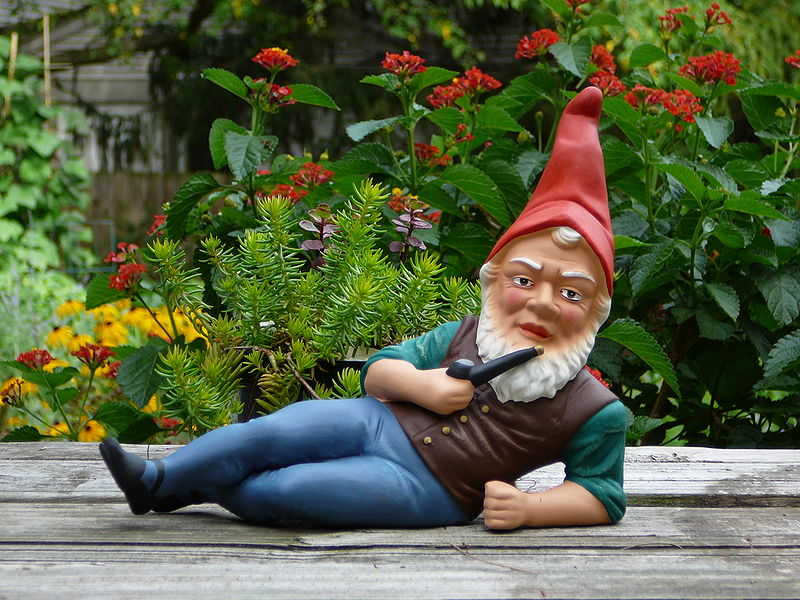
Attribution: Colibri1968
I cringed when I heard my voice on tape. I always thought I sounded sexier, less like Ferris Bueller’s teacher. But what brought on the nausea was hearing me describing events of which I had no recollection. It was difficult to fathom that such drama could unfold in my dreams without me having any memory of it.
I should take a step back to say that I’d sought therapy immediately after returning home to find the scowling gnome. It was a decision made after a sleepless night. I didn’t dare destroy the scowling gnome for fear I’d end up with a glowering golem in my front yard when I next came home.
Logically, I recognized two possibilities. The first was that someone was playing an elaborate hoax upon me. I couldn’t figure out how, but this was what I wanted to be true. But watching the tape repetitively had given me no clue about how the trick could be perpetrated. The vanishing gnome and the self-propelled gnome were tricks worthy of David Copperfield. The second possibility was that I was out of my mind— but in a manner that was localized to my front yard. That was equally hard to explain. The therapist was my attempt to explore all options, but I didn’t tell her the details.
My therapist said hypnosis would be a good idea, presumably because she’d just gotten her hypnotherapy license and needed the registration fee to pay for itself. As you might suspect, I was skeptical. Lying on a brown leather divan, fingering the brass upholstering rivets along its edge, I listened to fantastic words spew from my own voice as she played the tape back for me.
I’m standing in front of a mammoth mansion made of rough, gray stones. It looks like a castle—like something out of Bram Stoker’s Dracula. It’s dark out, but yet I can see. It’s as if the moon is shining bright, but yet it’s dismally overcast. So much so that I feel like I could jump up and touch the thick, gray clouds. I’m staring at an ornate carving on the door. It’s an elaborate mountain scene. How can I see it? There’s no porch light. Something is wrong here.
I don’t want to go inside, but inexplicably I know I have to. I hear bleating and cowbells. Turning around, I see a herd of goats strolling up the drive. I’m curious about the goats for a moment before a T-rex-like monster darts its head out of the tree line and clenches one of the goats in its jaws. The T-rex’s teeth puncture the goat like a bite into a wonton, and the beast shakes its head from side to side until the goat stops thrashing. I want to save the other goats, but even more so I don’t want to be eaten.
I watch the T-rex; he doesn’t seem to notice me; his chin is covered in crimson. The T-rex looks at the flock of goats like one might look at a box of sampler chocolates, searching out the most desirable morsel. He raises his head, sniffing the air, twisting his thick neck to point his face toward me, and then he begins to run at breakneck speed towards me. I realize that I am the last solid milk chocolate in a field of dark chocolate-covered marzipan.
I spin around and, losing all sight of politeness, begin to twist frantically at the doorknob. The cold, metal knob cuts into my palm, but doesn’t budge. I pound on the door with my fists.
“One moment, Sir.” A voice replies dully from inside. How he knows I am a sir, I don’t know.
“Help me. Please hurry.” I’m too scared to turn and look at the lurching beast, but I hear its footsteps getting closer as the tremors they create run together. I shake the door knob frantically, but the door doesn’t so much as rattle— it’s like a solid piece of wall.
I shut my eyes. I’m sure that the T-rex is now within lunging distance, and in a nanosecond I will feel agony followed by whatever lies beyond agony. I tense up, awaiting my demise. The tremor of a loud thud reverberates up through my feet. I stand there a minute in shock before realizing that all is silent.
I turn around to see the T-rex lying on its side, a gash torn through its throat. There’s a man, a knight, cleaning a large broadsword with a piece of cloth. He discards to cloth and it disappears into thin air. The knight wears chainmail armor under a tunic that has a red and green crest on the chest. I can’t make out the detail in the crest, though I’m looking right at it. It’s as if it has been pixilated, like news stations do to faces when they are talking to an endangered witness or basic cable does with boobies in movies.
“Thank you.” I say, adding, “Who are you?”
“I… I am your protector.” The knight says, looking himself over as though he were surprised to see that he is dressed thusly.
“Do I still need protection?”
“Probably. That remains to be seen.”
The door opens, and I find myself loomed over by a man who is tall, gaunt, and sallow. His black coat has tails like maestros, but there’s a small towel draped over one arm. I conclude that he’s a butler. I turn around to look for my protector, the knight, but he’s not there. Neither is the T-rex.
I turn back, almost surprised to see that the butler hasn’t abandoned me. He speaks, “Right this way, they are waiting for you.” He makes an ushering gesture with his hand as he steps aside inside the foyer.
I eagerly enter, still afraid the wounded T-rex might be around the corner. I start to ask a question, but pause when I realize that the servant’s unusual gait is due to the fact that he is stepping over vipers that are slithering across the rough stone floor. I can hear their hissing, but it doesn’t seem I should be able to.
I stop, petrified, but the butler turns and waves me forward with what I recognize as uncharacteristic urgency. I walk onward slowly and with great care. I step over the black, shiny snakes, and they seem to take no notice of me. When I finally reach a snake-free patch of floor, I look around. The ceilings are high, and the windows are about two stories up. The moonlight breaking through the windows illuminates a row of gargoyles. I stare at them. I’ve never seen gargoyles on the inside of a building.
As I walk, looking upward, I suddenly feel a panic attack as it occurs to me that I might step on an errant snake. Just as I level my gaze, I run straight into the butler, who has come to a stop. Dust flies off his coat, which had earlier seemed impeccably clean.
“Pardon.” I say.
He glowers at me.
I ask, “Who’s waiting for me?”
He turns and walks silently onward. I can’t tell whether he is hostile or indifferent.
We walk past rusty suits of armor, each with a halberd, pike, or battle-axe positioned beside it as if it were being held upright. It occurs to me that there might be men in those suits, men who could swing those implements of death at will. I moved closer to the giant butler.
Soon we are at the head of a stone staircase that spirals downward. It’s lit with flickering gas lamps. As we descend, it gets darker and the mustiness becomes more pungent. At the bottom of the staircase, I’m ushered through a large oaken door that is shaped like an inverted heraldic shield, which is to say flat on the bottom and coming to a point at the top. The butler leads me up onto a stage.
I look out into the auditorium and see the room is packed, but every audience member is wearing a goat’s head mask. It’s only then that I feel the cold air on my skin and notice that I’m completely naked. As if that weren’t bad enough, I realize that I have no idea what I’m supposed to speak to the creepy goat-man audience about. It’s like showing up to a test and realizing you forgot to crack the book. There’s no podium to hide behind, just a skinny mike stand center stage and a barstool that’s near the far wing of the stage. I approach the stool and notice that there’s a small remote on it. Turning around, I discover the bright white screen, and notice a harsh light is shining on to it. I consider doing shadow puppets to amuse the audience. They are now grumbling.
Instead I snatch up the remote and advance the slide, figuring that maybe I can wing the talk. Maybe it’s a topic that I know about, such as shadow puppetry. The audience is now laughing, and that doesn’t feel good when one is standing naked at the front of the room.
The first slide reads, “HOW TO GET AWAY WITH MURDER.”
I don’t have any particular expertise on this subject, and am a little dismayed that someone would choose me to deliver such a lecture. I figured there must be a mistake.
The knight strides across the stage, but he is no longer dressed as a knight, now he wears the same tux and tails as the gaunt butler. He extends a large overcoat out in front of him as a gentleman would hold a coat for a lady to slip into. I awkwardly wriggle into the coat and button a few strategic buttons. Now I just look like a flasher, which is—oddly enough— vastly preferable.
I whisper to the knight, “Do you know what I’m doing here? What am I supposed to talk about?”
“Furk wants to plant a murderous seed in your mind, but you should not let him.” The knight-butler says.
The audience stops laughing and grumbling, and makes a bleating sound like “mehhehhehhe!” I assume that this is the sound a goat makes. I consider whether the angry goat sound is preferable to laughter or not.
I turn back to my self-proclaimed protector, but he has once again vanished into thin air. A bell rings and it gets quiet as a grave and I know that I am supposed to start talking.
Keeping in mind the words of the knight-butler, I begin, “Obviously, this is not to be taken literally.” I gesture to the projected slide. “You shouldn’t commit murder, and you can never count on getting away with it.”
The stuttered goat cries become louder and louder. I don’t know how I’ve inherited knowledge of the emotional lives of goats, but somehow I know they’re getting angrier.
I continue, “I mean, imagine that I shoot a person,…”
A chorus of goaty cheers rises up.
“I’ll always be caught and punished.”
The audience turns on me.
Stalling, I advance the slide. In big block letters, it reads, “HOW TO DECIDE WHO YOU SHOULD KILL!” and then a subtitle in smaller letters, “sometimes it’s harder than you think.”
I couldn’t help myself, my notoriously ill-timed sense of humor came through, “Some key questions that you might consider are: Is your potential victim a lawyer, a bureaucrat, or a teenager? Does your victim contribute to society, or is he or she a politician? Would killing that one person lead to the need to kill again, as in the murder of a member of a boy band?” I notice that while I am amusing myself, I am whipping the crowd into a frenzy. The fun dissolves as I see myself as a warmongering dictator, stirring up hatred among a frothy-mouthed constituency.
I say, “I’m kidding, of course, one shouldn’t murder anyone.”
They turn on me once again. This time they’re really raging, as if I had led them on with my little joke. There’s a moment of stillness before the crowd charges the stage. I turn to run, but don’t know where to go. I look over my shoulder, and– as the first few of the audience members leap onto the stage— I can see that they have actual goat heads, not goat masks.
I freeze, but then I’m yanked by the arm. I turn to see the knight-butler, but now he’s dressed in a police uniform. He says, “Come with me; you are in grave danger.”
I’m pulled behind a curtain that skirts the back of the stage, and I see there is another door shaped like an inverted heraldic crest. I move through it. The police officer shoves it closed. A couple hooved appendages get caught in the door, but he slams his body into them and then lets up just enough for the wounded goat-men to retract their injured forelimbs. As they do, he closes and bars the door. There’s clawing, scratching, and knocking from the other side of the door.
The policeman lights one torch off another, and hands one to me. I don’t know how either of the torches materializes. The corridor extends into the distance farther than the torches illuminate. It looks like a sewer tunnel, but the stone floor is only damp, as are the walls. Beyond the torch light lies an inky shadowland that is only held at bay by the precarious, flickering light. We march into that claustrophobic unknown.
“Who is Furk?” I say, remembering the man’s earlier words.
“Furk is the one bringing you this nightmare. He is one of your yard gnomes,” the policeman says.
“Who are you?”
“I’m another gnome.”
“Why is one gnome trying to kill me and another to save me?”
“That’s a long story.”
“Was Furk the gnome by my driveway?”
“No that was me.”
“Should I wake myself?” It doesn’t come as a surprise to me that I’m dreaming. Maybe I knew it all along.
“Unless you intend to never sleep again, that won’t solve your problem.”
“What if I get rid of the bad gnome?” I ask.
As we quicken our pace, he answers, “You won’t remember to do that when you wake up. We are in the deepest recesses of your subconscious mind. It is a part of your mind that you are not aware of on a conscious level at all.”
I stop. “Wait a minute, if this is a dream, it doesn’t matter what happens—particularly if I’m not even going to remember it.”
“Unfortunately, that’s not so. Future behavior and moods often originate in the subconscious. Haven’t you ever been in a bad mood for no apparent reason, or, alternatively, been happy for no good reason?” he says, stopping for just a moment.
We resume walking, and I say, “I guess I have.”
From behind me, I hear a series of loud thuds. It sounds like they have a battering ram. I turn to look over my shoulder but can’t see the door anymore. We quicken our pace again. Soon I hear splintering. The policeman breaks into a sprint. I follow suit. I soon get winded and can’t figure out why I need air in a dream. More than burning lungs, it feels as if there is a belt tightening around my chest.
The imagined belt tightens further as I hear the echoed clack of hooves on the cobblestones down the corridor.
“You need to try to thin the herd.” The policeman says.
“What?”
“Only one of those goat-men is Furk, the rest are all projections of your mind. Furk may have conjured them, but they are dependent on your mind.” He says without breathing hard in the least.
“Oh, cool.” I say, and I stop and turn toward the onslaught of goatmen pursuing down the pitch black corridor. I concentrate. I will them to disappear. The hooves keep coming, unabated.
When the first faces break into the torch light, I turn and run, screaming, “It didn’t work. It didn’t work.”
“Yeah, I didn’t think it would.” The policeman says, his voice well ahead in the inky distance; he never stopped – some protector.
“What do you mean… you… didn’t think… it would?” I said, gasping as I ran hard to close the gap.
“This part of your mind is like a river that runs underground below your property, just because you own it doesn’t necessarily mean you can stop, or divert, it at will.” The protector says. He is not winded at all.
A door lies ahead. If we can just get through it, I can catch my breath. It occurs to me that I have no idea what will confront us on the other side of the door. Maybe there’s something worse than a flock of goatmen. The hoof clomps sound as though they are closing on us.
The two of us shoot through the door, slamming it shut, putting our backs up to it. Wherever we are, it’s bright. The sunlight assaults my eyes. I squint, trying to glean something about our new environs. The nameless police impersonator produces a heavy wooden beam that fits into metal hardware on the doorframe to form a bar. How he conjures such items, I don’t know. We are supposedly in my mind, and yet I seem impotent.
“So why did you tell me to try to eliminate them if you didn’t think I could?”
“It was worth a try.”
We are at the base of a hill in grassy prairie lands, the knee high grass is tousled by a breeze. At the top of the hill is a big oak tree, it’s perfectly shaped and stands strong, the iconic tree of life. I turn around and the door from whence we emerged is nowhere to be seen.
“Are we safe here?” I ask.
“It’s your mind.” He responds.
We instinctively walk toward the tree. The ground shakes. The earth splits open. I am falling.
TO BE CONCLUDED (this time for real)
Share on Facebook, Twitter, Email, etc.








 Tiger Riding for Beginners