BOOK REVIEW: Gitanjali by Rabindranath Tagore

GitanjaliGitanjali by Rabindranath Tagore

My rating: 5 of 5 stars

Amazon page

Get Speechify to make any book an audiobook

Gitanjali is the most well-known work of the Bengali polymath Rabindranath Tagore. Tagore was the first non-European winner of the Nobel Prize for Literature (1913.) While Gitanjali is a work of poetry, Tagore didn’t restrict himself to this form, but also wrote stories, novels, plays, and music.

Gitanjali translates to “Song Offerings” and while the English version is a translation, it was translated by Tagore himself. Thus, there is no need to wonder whether the translator got it right or injected too much of his own worldview into the process.

This collection of 103 poems (the original Bengali has 157)displays both beautiful language and thought-provoking sentiments. This may be why the work is so beloved and stands the test of time.

I’ll share a few of my favorite passages:

“The child, who is decked out with prince’s robes and who has jeweled chains round his neck loses all pleasure in his play;…” -Poem VIII

“O fool, to try to carry thyself on thy own shoulders! O Beggar, to come to beg at thy own door!” -Poem IX

“On the day when the lotus bloomed, alas, my mind was straying, and I knew it not.” -Poem XX

“On the seashore of endless worlds children meet.” -Poem LX

“In the moonless gloom of midnight I asked her, ‘Maiden, what is your quest, holding the lamp near your heart? My house is all dark and lonesome,– lend me your light.’ She stopped for a minute and thought and gazed at my face in the dark. ‘I have brought my light,’ she said, ‘to join the carnival of lamps.’ I stood and watched her little lamp uselessly lost among lights.” -Poem LXIV

“And because I love this life, I know I shall love death as well.” -Poem XCV

The edition I have, which is published in India by Rupa Press, contains Tagore’s Nobel Prize acceptance speech as well. (The Amazon page I’ve linked to shows the edition that I read, but the cover shown above is a different version. The poems are all the same because Tagore self-translated, it is only the supplemental matter that is different.)

I highly recommend this collection of poems.

View all my reviews

Mindfulness Meditation: Why be Mindful?

IMG_0430“Why be mindful?” That was the question asked to the group assembled at the Thubten Lekshey Ling Tibetan Buddhist meditation center on Sunday.

We had just completed a couple of rounds of mindfulness meditation. We’d been told that there are four themes of mindfulness meditation, but there can be variations on each. First, there is mindfulness of the body. This was the first type of meditation that we practiced. It isn’t about recognizing the body as an object so much as a field of perceptions.

Second, there is mindfulness of one’s feelings or sensations, in other words, mindfulness of the outside world as perceived by our sense organs. We did a meditation in which we were mindful of sound in particular. The key, we were told, was to hear everything–even the sound of silence. “Listening to the sound of silence” may sound like an oxymoron, but it makes sense as one experiences it. When one thinks in terms of hearing sounds, one begins to actively try to “catch” a sound. One may even try to anticipate sounds, particularly sounds in series–like a roofer using a nail-gun on a nearby roof. This active listening, rather than hearing, is not what one wants.

We also did a mindful eating/tasting exercise. We ate a tiny bit of snack mix. The whole processing taking many times what it normally does to shovel a bit of snack into one’s mouth and wolf it down. The food was raised to one’s face, experienced, placed in one’s mouth, experienced, chewed, experienced, and swallowed.

Third, there is meditation on the mind. That is, one watches one’s thoughts. We didn’t do one of these meditations. However, I’ve tried it in the past, and I find this particularly difficult . Watching thoughts go by as if they were rising bubbles or logs floating on a river suggests a division between the observing mind and the thought-producing mind. Recognition of the thought intrudes upon it, and this becomes a whole new line of thought.

Finally, there is meditation on emotion. We did not do one of these in this session either.

Our final meditation was another type of meditation on the body, but it was a moving meditation. We walked and experienced the motion of the body as it moved through the room. I particularly enjoyed this.

However, before the last meditation, we discussed this question of “why be mindful?” I had my own ideas, which I shared. Others had their own ideas, some closer and others farther from my own thinking, but all thought-provoking and valid.

My own thoughts were two-fold. First, mindfulness allows one to be more stable and grounded. Fear is about the future and anger and sadness are about the past. In the present one is neither afraid nor fearful. Second, by being mindful, we can come to see problems before they tumble out of control. We can catch our angry thoughts and dissect them before they do us harm. We can recognize the subtle problems with our bodies before they come full-blown ailments.

Of course, as a martial artist, I had always thought in other terms about mindfulness. There’s no time at the speed of combat to consciously recognize and consciously respond to attacks, one must be mindful to have any hope of surviving a surprise attack.

BOOK REVIEW: Know Your Mind by Sri Sri Ravi Shankar

Know Your MindKnow Your Mind by Sri Sri Ravi Shankar

My rating: 4 of 5 stars

Sri Sri Ravi Shankar is an Indian guru headquartered in Bangalore, India. In addition to his work as a spiritual leader, he heads up an organization called the “The Art of Living,” which has both a philanthropic mission and a role in spreading knowledge of yoga. Among his most important accomplishments is the development of a breathing technique for helping to attain greater emotional well-being. However, he may be most broadly known for occasional appearances on television programs such as those of CNN International.

The slim volume K(no)w Your Mind contains a series of short chapters, many of which are partly in Q&A form–coming from talks he has given internationally. The common theme of these discourses are how one can understand one’s mind and learn to live in a way that maximizes happiness.

Sri Sri’s approach is quite mainstream when compared to more controversial gurus such as the late Bhagwan Shree Rajneesh (i.e. Osho.) There is little that would raise hackles of most people. It proposes nothing magical–though Shankar supports belief in some, broadly defined and mystical, deity. His approach doesn’t rely on said deity. The book is essentially just about training the mind to look at the world in a different way.

One example that the author uses in various permutations is that people dwell on the negative. As he says, “When you are healthy, you never ask the question, ‘Why am I healthy?’When you are sick you say, ‘Oh, why am I sick?'” Similarly he mentions that, if someone tells us they like us we don’t question it, but if they tell us they hate us, then we do.

When asked how to avoid stress, he states flatly that one shouldn’t avoid it, but rather learn hope to cope with it more effectively.

On the positive side, the book conveys a lot of good information in a highly readable format. Shankar explains the mind with humor and occasionally with a parable or narrative to help make the lessons more memorable.

However, if one is looking for a systematic approach, one won’t so much find that here. It’s clear that this is a series of snippets from talks combined together. If that’s what you’re expecting, then it shouldn’t be a problem. However, if one is expecting a step-by-step guide, this book may not suit one. Occasionally it’s helpful if on has some yoga terminology in one’s head like samadhi or pranayama, but context should make the meaning clear.

I’d recommend it for someone looking for food-for-thought on bite-sized pieces on issues like memory, emotion, and mindfulness.

View all my reviews

DAILY PHOTO: Ramakrishna Math

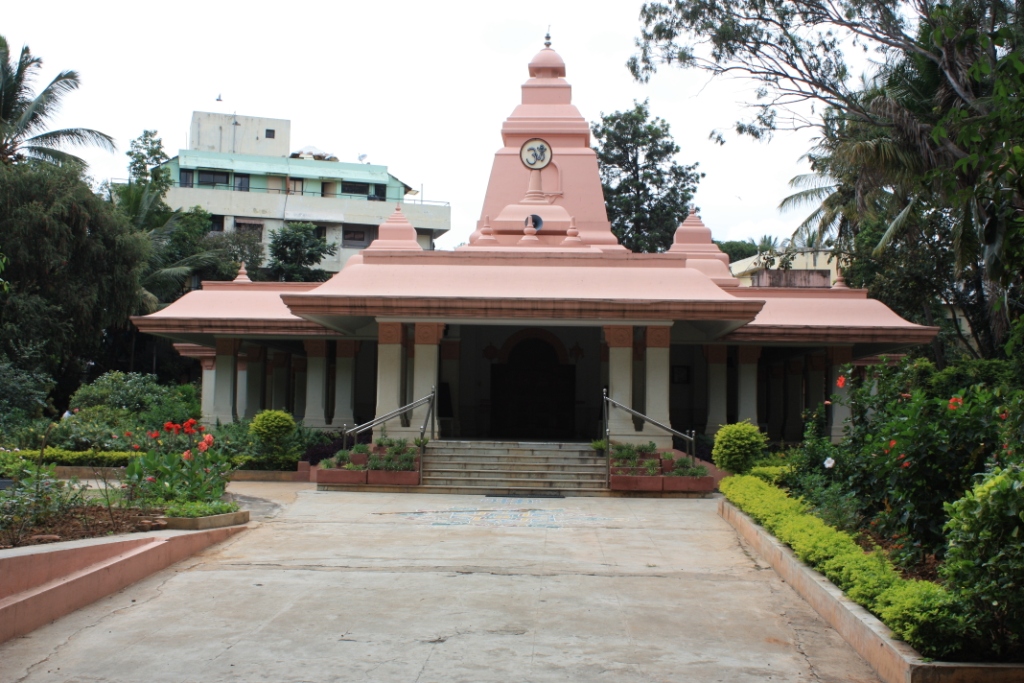
Taken September 30, 2013 in Bangalore

Taken September 30, 2013 in Bangalore

This small campus of buildings in the Halasuru neighborhood of Bangalore is dedicated to the teachings of Sri Ramakrishna. Ramakrishna was a holy man from Bengal who lived from 1836 to 1886. The Bangalore chapter is one of several associated with this non-secular monastic order. The order was actually begun by Ramakrishna’s lead disciple, Swami Vivekanada. Vivekanada is most well-known as the individual who introduced Yoga to the West, and particularly the US, back in the 19th century.

With a motto of “Liberation of oneself and service to mankind,” the order both facilitates personal growth through yoga classes and meditation sessions, and also has a major philanthropic thrust.

Picture Your Unhappiness in its Underwear

I was writing some six-words on Smith Magazine the other day. I do this now and again as an exercise to get the creative juices flowing. There are a series of themes, and I try to write in as many of them as I can in less than 20 minutes, writing in a free form, stream of consciousness style.

When I got to the category HAPPINESS the first six-word to jump to mind was: “Picture your unhappiness in its underwear.” This one drew a nice response, which began me thinking about whether this advice might have actual merit–as opposed to being a non-nonsensical statement that might at best function as a Zen koan.

As I thought about it, three legs of the stool came to mind.

1.) Have a sense of humor. Anger and sadness have a hard time taking hold if one can manage a good laugh. I’ve found that being able to dance personal tragedy into comedy has been a great coping mechanism. One does have to be conscientious about not becoming a snarky person. One risks beginning to see the world through a crap-colored lens just as a means to comic fodder (or from a martyrdom complex.)

Perhaps even if one can’t formulate humor, one can still use laughter. There’s a system called laughter yoga that is based on the belief that you can create the same range of physiological responses from “forced” laughter as one does from spontaneous laughter. It’s a sort of chuckle pranayama (breathing exercises.)  While I don’t know much about the system, I can believe that it has merit based on what I’ve read about human emotions.

2.) Lay the source of your unhappiness bare. This sounds simple enough. One must know what is making one unhappy in order to turn that frown up-side-down.

That being said, human beings have an astounding ability to attribute all negative happenings in their lives to external factors. Like politicians, we like to take responsibility for what is going right (regardless of whether we are responsible or not), and we love to place the blame for failure firmly elsewhere (even it it’s mostly our fault.) This may be an evolutionarily-hardwired coping mechanism, but it can keep one in the doldrums.  If one continually says, “He makes me so mad” or even, “His actions make me so mad,” then you’re forfeiting control over your emotional state. Jerks and bitches might be an intermediary cause of unhappiness, but ultimately one’s own perceptions and responses lead to the negative emotional state.

This is where the hard work of mind training comes into play. Instead of being swamped by negative thoughts, one has to recognize them early, find the root cause, and recognize that our desire to for things to be a certain way is ultimately what makes us unhappy. We may want people to think we are smart or beautiful, and intimations to the contrary (whether intended or not) make us fume.

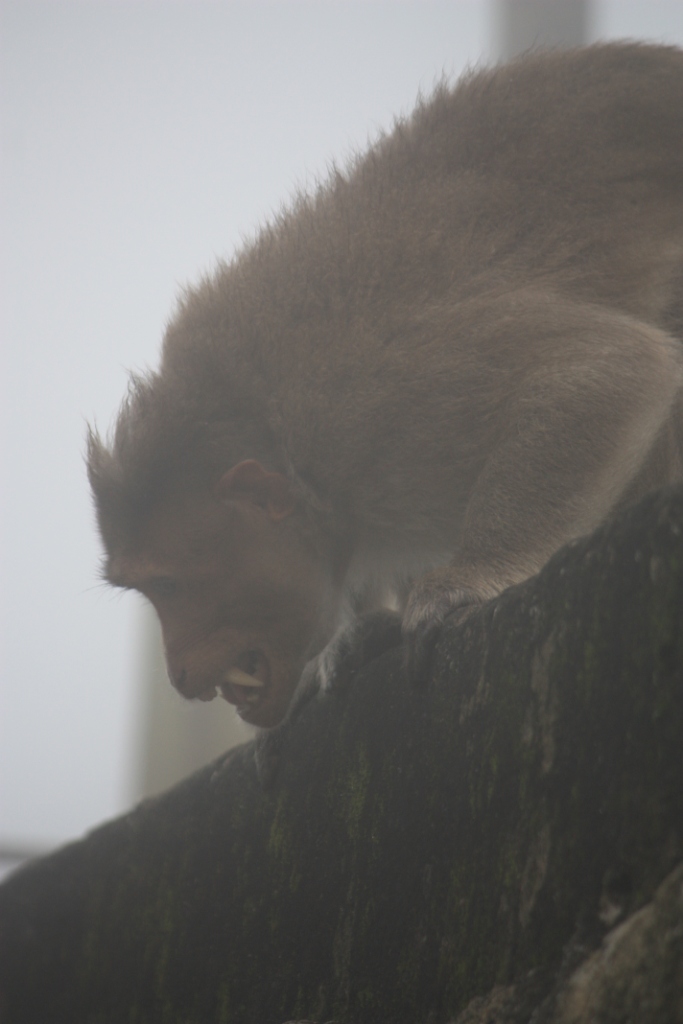
Don't be an angry monkey!

Don’t be an angry monkey!

One of the few things I remember explicitly learning in high school was about what our psychology teacher called a “gestalt of expectations.” Like most ideas one remembers though only taught once, I remember it because it had a memorable story attached to it. The story goes like this: “A man is driving through the desert in the American southwest. Now, out in the southwest, gas stations can be few and far between. So the man runs out of gas, and realizes that the station he passed 20 miles back is his safest bet because–contrary to what he had thought– the next one going forward might be another 50 miles.  So he starts walking. It’s hot. He’s hungry. He’s thirsty, and only has some lukewarm water that’s getting hotter by the minute. The backs of his hands and his face are getting sunburned. He starts thinking about how the little two-pump gas station is going to gouge him. He realizes he’s desperate, and so he figures the attendant is probably going to sell him gas at $6 a gallon, a bottle of cold water for $8, and don’t forget the jerrycan at $20.  These thoughts and the heat keep making him madder and madder. Finally, he gets to the station, and the attendant comes out and say, ‘Oh my, Mister, you must have had a horrible time.’ And so the man on the verge of heat-stroke punches out the attendant, a kid who only wanted to help him out.” Once one starts attributing one’s unhappiness to external sources, one can easily mis-attribute unhappiness because one thinks one knows what is in the minds of others, when really one doesn’t.

3.) Unhappiness, like standing around in one’s underwear, is–at most–a temporary state. As Taoists have been known to suggest, one’s darkest hour is a time to rejoice, for surely it will  get better from there. The only way one can remain in a perpetually unhappy state is to carry it with one long past its time. Just like the only way that can always be rained on is if one carries around a complicated mechanism with a showerhead and tank and keeps refilling that tank so that the shower never runs out. Otherwise, the dry season will come eventually.

Slow Down and Savor the Instant Karma

Our tenant moved into our house and we still have a couple of days until we fly to Bangalore. So I’m living in a hotel in a densely populated part of town. Today, I made a trip to the supermarket. Almost every spot in the parking lot was full. I was  leisurely trolling the lot when I spotted an available spot. The spot was near the periphery of the lot–i.e. distal to the store, but I’m never opposed to a little walk.

I noticed a truck at the other end of the aisle gun its engine. The driver had probably been looking for a spot for a few minutes and was in a hurry. Though he had about eight cars between himself and the spot, and I merely two, I stopped and let the scowling, elderly man race into the spot. Having nowhere urgent to be until my Friday morning flight, I saw no need to sweat it. Once he was parked, I moved forward cautiously.

Wouldn’t you know it, as I was getting to the end of the aisle, a lady backed out of the end spot nearest the store. I checked to make sure that it wasn’t reserved for the disabled, pregnant women, or the employee of the month, and– seeing no competitors for the spot– I drove in. As I was getting out of the car, the scowling man shot me an icy stare. I don’t think he was angry with me, but, rather, he was convinced that the universe was against him. I imagine that he was thinking that guys like me get all the luck. He’s right. Of course, if he’d have stopped to let me take the first spot, he would have gotten the closer one–then we’d both be guys who get all the luck.

Eulogy for Sonny

Sonny was a stray who hopped up into my lap one day as I was reading on the back porch. He petted himself against me, and moved in shortly thereafter. He was between kitten and cat then, and so we estimate his age was approaching 12 when he left us.

Being a gruff, introverted stoic, I realize that I am an acquired taste as a friend. I have few non-contextual friends: that is, friends outside of a common endeavor such as a workplace or a school. Not that there’s anything wrong with friendships born of a common workplace or pastime, but Sonny’s out-of-the-blue arrival created a special fondness. That was Sonny’s nature.

He was a little dirty at first. A tiny notch in his ear–one that would be made symmetric later in life, marked him as a fighter as well as a lover. All about the love in the home, but ready to scrap to defend his adopted lair at a moment’s notice.

The books said his breed wasn’t inclined to be lap cats, but—being a cat—Sonny didn’t read much. And, therefore, he would spend hours curled into a torus on my lap, until my legs fell completely asleep and I had to stumble through pins and needles to refresh his throne.

Sonny developed a growth in his head. It was removed and biopsied, and then once more. Though Sonny’s Chi was strong, each time his nemesis grew back with greater ferocity. He fought it quietly and calmly. Making no complaints; demanding no sympathy. He was unflappable.

Sonny was a bundle of virtue: patient, kind, forgiving, strong, and stalwart. If the religions that believe in transmigration of souls are right, Sonny has earned the right to be whatever the hell he pleases in his next life.  He was a Bodhi-cat-va, helping us to eliminate stress and teaching us how to accept upset.

Your gentle head-butts will be missed. Your popcorn bowl conformity will be missed. You, my friend, will be missed.

We never knew where Sonny’s scars and nicks came from, but I imagine it quite like that of Neil Gaiman’s The Price

Drunk, Narcissist, or Buddha: What Kind of Writer Are You?

IMG_0173I read a story in The Guardian the other day entitled “What drives writers to drink?”  It was actually an edited excerpt from a book by Olivia Laing entitled The Trip to Echo Spring: Why Writers Drink.

I found this piece fascinating despite the fact that the title question seemed readily answered with another question, “In what other occupation must one regularly, repeatedly, and thoroughly get punched in the soul in order to succeed?” Writing is a personal act, and no piece of writing that is read escapes the assault of criticism, invited and uninvited, which ranges from sagacious to ridiculous.

One somehow has to find the courage to wade through what feels a lot like attacks on one’s intellectual self in order to discover what is useful and what is not. If one summarily rejects all criticism and advice, one will neither grow nor is one likely to be published. If one accepts all criticism as having merit, one may find a psychiatric ward in one’s future–and one is likely to remain unpublished. So the trick is to be able to answer the question, “What within this writing is genuinely bad?”

The problem is that it feels like the question is, “What about me is flawed?” It’s like holding a mirror up to the core of one’s being and noticing that you have some rot.

How do writers do this? There are probably innumerable approaches, but three common ones come to mind. The first is the one thoroughly addressed in Laing’s book; that is, some writers self-medicate. The article references a quote by Tennessee Williams, “…you felt as if a new kind of blood had been transfused into your arteries, a blood that swept away all anxiety and all tension for a while, and for a while is the stuff that dreams are made of.”

A second unhealthy approach is to reject any assertion that contradicts one’s perfection. In other words, be a narcissist. These are the writers who meet each and every piece of criticism with statements like, “you just don’t understand what I was trying to do there, my misspelling was actually a clever commentary on the zeitgeist of 20th century Armenia.”

The narcissists have the advantage not becoming clinically depressed by the constant rejection and criticism that is a life of writing. The downside is that they have to live in a world in which everyone else on the planet is ignorant and incapable of recognizing brilliance when it’s shining in their faces, and that is depressing in its own way. Only a few in this group manage to get published, and they do so through a combination of being truly great and, at least early on, being willing to tarnish their awesomeness by accepting some editorial suggestions.

The third approach is the one that we should all aspire to, but it’s a bitch getting there. In the title I used “Buddha” as a code word for the enlightened approach. What is the enlightened approach to dealing with rejection and criticism? First, one must realize that equating one’s writing and one’s self is illusory, and that criticism of one’s work isn’t criticism of self. Before any writer gets to the point of submitting works to agents, editors, or publishers someone along the line has told one that one’s writing is good. This fatal compliment causes one’s self-worth to become entangled in one’s writing.

Second, one must develop a confidence that isn’t rooted in external validation. In less pretentious words, one mustn’t feel it necessary to be loved by everyone with whom one comes into contact. This is hell if one’s entire life is writing. The value of published writing is inseparable from how it’s received. My only suggestion on this point is to find something else in one’s life that allows one to build self-confidence. For me, this has been martial arts. Sure there are usually rank tests, which are about validation from one’s teacher. However, what it really comes down is whether one experiences success in training and sparring. If one sees some success, the rank starts to be irrelevant to one’s confidence. I think outdoorsmanship is another such skill– for those less scared of bears than being beaten ugly with a stick. There are few activities in which other’s evaluation of one is ultimately irrelevant, but those are the activities with which one should seek to balance one’s writing.

If anyone needs me I’ll be guzzling Bourbon and contemplating how the publishing industry is run by poop-weasels.

BOOK REVIEW: A Search in Secret India by Paul Brunton

A Search in Secret IndiaA Search in Secret India by Paul Brunton

My rating: 4 of 5 stars

Amazon page

A Search in Secret India is a travelogue by Paul Brunton as he wondered through India in search of sages. In the process, he found a number of masters of body, mind, and both. However, he finds these individuals as rare nuggets in a sea of frauds.

Brunton states up front that he won’t waste time with any of the blatant frauds or suspected frauds, but he does devote space to a number of the more impressive ones. Impressive either by way of a large following or artfulness of technique. He also finds individuals he doesn’t know what to make of. These individuals appear to have impressive otherworldly skills, but skills that he can neither reconcile with known scientific understanding nor uncover as hoaxes despite his best skeptical inquiry. Given Occam’s Razor, he seems to be left suspecting that these are masters of illusion, but he maintains skepticism of his skepticism. A prime example of this is a Yogi who seems to be able to conjure any scent upon request.

Brunton also runs across individuals who are able to do amazing things that are inconsistent with his knowledge of the world, but which his exhaustive investigations leave little room to dispute. For example, there is one yogi who can completely cease his respiration for a seemingly impossible length of time, and who resumed breathing not with a gasp but with a slow, calm series of breaths.

As suggested above, this book is really an attempt to analyze India’s spirituality through the lens of Western logical and scientific approaches. The author is a Brit and the book was first published in the 1930’s. His worldview is consistent with that status. While Brunton would like to master his own mind, he is unwilling to let himself be duped.

There is another side to this juxtaposition of East and West. The yogis and gurus with which Brunton comes into contact often have trouble grasping the Western mindset (there is one notable exception.) What these wise-men have difficulty understanding is why a people, like the British, devote so much time to mastering the external world (and with a great measure of success it must be added), but put so little effort into mastering or understanding the self. Most of the gurus appreciate that a Brit is taking an interest in the spiritual and yogic ways of India, but with their own skepticism. They find Westerners materially rich, but bankrupt of the mind. They find the Brits strong, but lacking the supple power that yoga introduces.

After completing his travels, it seems the book is set to draw to an end. However, Brunton realizes that while there were a number of skilled individuals that he came across in his travels,there is one that stands out as someone he should not miss an opportunity to learn more from. Therefore, instead of getting on a steamer back to England, he returns to South India to a man called the Maharishee in order to find out if the guru will take him as a student. The last couple chapters describe his time under the Maharishee’s tutelage as well as under one of the guru’s most advanced students. The Maharishee is a sage the likes of which Brunton has not seen in all his travels. The guru has the humility to say that he cannot teach Brunton anything, but instead can only show him some things that he learned on his own journey.

If there is a lesson for those who would like to follow in Brunton’s footsteps, it seems to be that there is an inverse relationship between how easy a guru is to find(/how eager a guru is to talk to one) and the level of skill of that teacher. In almost all cases, Brunton had to take great initiative and steer off the beaten path to find the true masters. On the other hand, most of the individuals who were easily found, and eager to talk, were just con men.

I recommend this book for those interested in development of the mind and body.

View all my reviews