BOOK REVIEW: The Alchemist by Paulo Coelho

The AlchemistThe Alchemist by Paulo Coelho

My rating: 3 of 5 stars

Amazon page

This is a short and simple book. Its premise can be summed up as “follow your dreams and all will work out.” It’s about a shepherd boy from Andalusia in southern Spain who yearns to travel. He sells his flock and sets out to do just that. Over the course of the book, he crosses North Africa from Gibraltar to the pyramids of Egypt and back. Along the way he faces many setbacks and barriers, but his willingness to adopt a positive attitude and roll up his sleeves and get to work allows him to overcome these obstacles. As he travels, mysterious guides and mentors–most notably the title-roled Alchemist–show up along the way to induce him to keep going rather than giving up.

As with The Coroner’s Lunch, which I reviewed a couple of reviews back, there’s a supernatural component to this book that seems superfluous. First, the supernatural element doesn’t add much to the story. Second, to my mind, if you are trying to sell the notion that you can make your dreams come true (in this self-helpy sort of way), having your character live in a world of magic detracts from that message. The take away for the reader may be, “Sure, the shepherd boy could do it, he lives in a world in which people can turn lead into gold. In my world, bound by laws of thermodynamics and whatnot, things are not so simple.”

You will note that my middling rating is anomalous. Having skimmed through reviews of this book, I found they were overwhelmingly divided between 5 star and 1 star reviews. It’s rare for one to see the same book being cast both in the best and worst book role by various readers. However, that seems to be the case for this book. Some people adore this book and consider it life-changing. Others think it’s oversimplified tripe for granola-munching potheads and/or six-year olds. I suspect that Coelho is quite pleased. I know—as a writer—if you can’t get someone to love your book, you want them to despise it. Mediocrity doesn’t put one in good stead for building readership. Hate is a passionate response; it means the book struck some kind of chord. Clunkers are remembered just like perfect melodies; it’s the so-so performances that vanish into the background—or the bargain bin.

Unlike the lovers and haters, I found this book to be just alright. It presents some good ideas, but not novel ideas, and it does so in a clear but not brilliant way. It wouldn’t hurt to read it as it’s very short and highly readable.

View all my reviews

BOOK REVIEW: The Golden Sayings of Epictetus by Epictetus

The Golden Sayings of EpictetusThe Golden Sayings of Epictetus by Epictetus

My rating: 4 of 5 stars

Amazon page

Epictetus was a slave-turned-philosopher who was born in Hierapolis and famously lived in Rome until Emperor Domitian banned philosophers from the city. Like Socrates—who Epictetus quotes and refers to frequently—we would know nothing of the thoughts of Epictetus if it were not for one of his enthusiastic students, Arrian, who compiled his mentor’s teachings.

Epictetus was one of the Stoics, philosophers who believed that one should be unmoved by the situations and conditions handed one by the universe—for such things are beyond one’s control. While the word “stoic” has come to mean emotionless in the colloquial, the philosophy might better be summed up by the Serenity Prayer.

God, grant me the serenity to accept the things I cannot change,
The courage to change the things I can,
And the wisdom to know the difference.

In other words, one must not be made unhappy by what one cannot change, and one must strive towards self-improvement (changing the things one can) through intense discipline.

As the title suggests, the book consists of a collection of numbered sayings, some are pithy sentences and others are full paragraphs, but few are as long as a page. After the body of the text there is a collection of fragmentary sayings. Some of these “fragments” pack a whollop in themselves, such as, “Give me by all means the shorter and nobler life, instead of the one that is longer but of less account.” This is a central idea in Stoicism–that fear of death is the cause of many of man’s worst features.

Lest giving up one’s anger and fear of the unknown seem too daunting, Epictetus does advocate a gradual approach to self-improvement. He says that if one can at first say that one went a day without anger, one is on the path. As long as one works in the direction of saying it has been a week and then a month without anger.

As intimated above, Epictetus shows a great admiration for Socrates and applauds the elder philosopher for accepting that which he didn’t know and for his continual struggle to be a better man.

While the Stoics are often perceived as hard people, it should be noted that some of Epictetus’s ideas echo those of Mahatma Gandhi and other pacifist leaders. He praises the ability to forgive, not just letting a transgression go, but not allowing one’s mind to become fixated on perceived slights. Epictetus also echoes the notions read in Indian works such as the Bhagavad-Gita when he says, “Reward! Do you seek any greater reward for a good man than doing what is right and just?”

Epictetus shows his wisdom in suggesting that people lead others by example and not by trying to force them into changing their ways.

I think everyone should read this brief work of wisdom.

View all my reviews

BOOK REVIEW: The Sayings of Confucius by Confucius

The Sayings of ConfuciusThe Sayings of Confucius by Bc- Bc Confucius

My rating: 4 of 5 stars

Amazon page

There’s no one more firmly associated with Eastern wisdom—particularly in the form of aphorisms that fit nicely onto a fortune cookie—than Confucius. This is a book of such aphorisms.

I must admit, I’m not a wholehearted devotee of the Chinese philosopher, and am more likely to side with the Taoist sages who mocked Confucian ideas at every turn. In short, I’m not a big fan of the Confucian idea of societal hierarchies based on some elements of society accepting being infantilized in exchange for the protection and goodwill of others. It’s not just that I’m a youngest child that causes me to ask, what if the younger brother is smarter?

Once one gets beyond what is probably Confucius’s best known teaching—the five relationships—one sees a great deal of solid wisdom that even a Taoist would be hard pressed to refute.

Many of Confucius’s sayings aren’t novel or unique. Like Socrates, Confucius advocates knowing what one doesn’t know—which implies accepting that there are things one doesn’t know and not acting like one knows it all. (A common enough vice in modern times as in ancient.) Like the Indian sages, Confucius emphasized that one shouldn’t chase fame or act out of a desire for the fruits of one’s actions. Like the Stoics, Confucius said, “A gentleman knows neither sorrow nor fear.”

One of the most quoted sayings in this work is, “A gentleman should be slow to speak and quick to do.” This contains two bits of wisdom rolled into one: a.) Think before you say something stupid. b.) and, Get off your ass and do it, already. Of course, Confucius also produced an early (if not the earliest) formulation of what is usually called “The Golden Rule.) Confucius say, “What I do not wish done to me, I likewise wish not to do to others.”

I think everyone should read this short book of even shorter sayings.

View all my reviews

BOOK REVIEW: If You Meet the Buddha on the Road, Kill Him! by Sheldon Kopp

If You Meet the Buddha on the Road, Kill Him: The Pilgrimage Of Psychotherapy PatientsIf You Meet the Buddha on the Road, Kill Him: The Pilgrimage Of Psychotherapy Patients by Sheldon B. Kopp

My rating: 4 of 5 stars

Amazon page

If Kopp’s title seems gratuitously bellicose and totally inappropriate for a book about psychotherapy, you may not recognize that it’s a quote from the 9th century Zen (Chán) Buddhist master, Linji Yixuan. In reality, the quote isn’t bellicose and is quite apropos of Kopp’s message. Linji was just saying that if one collects sacred cows, one is unlikely to be liberated from delusion and find a quiet mind. Kopp’s primary point is that patients tend to deify their therapists, thinking of therapists as people who can “fix them.” In reality, the therapist is a flawed human who can only help guide the patient on a personal pilgrimage. However, when patients find out that the therapist isn’t a sage who can make them feel better as if by magic without any real change on the patient’s part, they become disillusioned and the wheels can roll off any progress they may have made.

Pilgrimage is the central metaphor of Kopp’s book. The psychologist uses an interesting approach, without which I doubt I would have read this book. He uses pilgrims of classic literature as models. The second, and by far the largest, part of the book lays out the various paradigms of pilgrim. The use of works like Gilgamesh, Macbeth, Don Quixote, Dante’s Inferno, Kafka’s The Castle, and Conrad’s Heart of Darkness makes for a work of interest to more than just psychotherapists. Kopp skillfully employs the wisdom of both the Eastern and Western worlds, often in pithy stories that have been around for centuries.

In addition to all the well-known tales that Kopp relies upon, the latter part of the book has some interesting personal stories from when Kopp was working as a therapist in a prison.

I think this book offers some intriguing food for thought regardless of whether one is either a psychotherapist or a psychotherapy patient.

View all my reviews

BOOK REVIEW: The Bhagavad-Gita Translated by Barbara Stoler Miller

The Bhagavad GitaThe Bhagavad Gita by Anonymous

My rating: 4 of 5 stars

Amazon page

The Bhagavad-Gita is a philosophical poem, the title of which is translated as “Song of the Lord.” It’s often read as a stand-alone work, but it’s included in the sixth book of longest known epic poem, entitled the Mahabharata.

In The Bhagavad-Gita, Krishna teaches the warrior-prince Arjuna about sacred duty (dharma.) The setting is the battlefield at Kurukshetra as a war is about to get underway. Arjuna asks his charioteer, Krishna, to halt the vehicle between the opposing armies. Arjuna is struck with a crisis of conscience. He doesn’t want to fight and kill the men on the opposing side–some of whom are related to him by blood and others of whom are well-respected elders. Arjuna can see no virtue in the war.

Krishna, after briefly mocking what he describes as Arjuna’s newly developed cowardice, goes on to offer his explanation of why it is that Arjuna should fight. The first argument is that nobody really dies because consciousness is reborn. This makes sense if you believe in reincarnation… otherwise, not so much. A concise restatement of this argument is presented in the 11th teaching: “I am time grown old, creating world destruction, set in motion to annihilate worlds; even without you, all these warriors arrayed in hostile ranks will cease to exist. Therefore, arise and win glory! Conquer your foes and fulfill your kingship! They are already killed by me. Be just my instrument, the archer at my side!”

Another of Krishna’s argument is that if Arjuna fails to fulfill his duty he will be thought less of by others. This is an odd argument to make as Krishna makes a more compelling case for ridding oneself of ego, whereas this seems to be saying that one should put what others think of one above doing what one believes is right. That sounds a lot like succumbing to ego rather than eliminating. In the 12th teaching, in fact, Krishna tells us that the best of men are “Neutral to blame or praise…” This suggests that perhaps one shouldn’t be moved by what others will think of one.

At the core of Krishna’s argument is that one cannot escape the Karmic cycle by engaging any acts but those that are selfless. Like the reincarnation argument. One may find this logic compelling or not depending upon whether one believes in Karmic theory. Karma is the idea of cause and effect. If you do good, you’ll receive good effects and if you do bad you’ll experience bad effects. Ultimately, however, the goal is to break free of the Karmic cycle and, in theory, the only way to do that is to engage in acts that are selfless—hence doing your sacred duty. If your driver isn’t God, it’s not entirely clear how you know what your sacred duty is, at least not by way of this work. (Presumably, God talks to kings and princes, and kings and princes tell the unwashed masses what they are supposed to do. If you happened to have already done away with such a system—as most of the planet has—you may have trouble with this logic.) However, if one takes the lesson to be that one should not be consumed with personal gain when one acts, one has an argument of more general appeal.

Another argument is that devotion to God is all important, not a man’s actions in any absolutist sense. From the 9th teaching, “If he is devoted to me, even a violent criminal must be deemed a man of virtue, for his resolve is right.”

It should be noted that Krishna delivers a number of lessons beyond the need to comply with one’s dharma, and, in my opinion, many of these ancillary lessons are more compelling than Krishna’s explanation of why Arjuna must fight.

One such lesson is to concern oneself with the journey and not the destination. Krishna states it as such, “Be intent on action; not the fruits of action…” Furthermore, there are a great many teachings that will be familiar to Buddhists, such as the need for non-attachment and moderation.

The poem contains lessons of Samkhya (e.g. discussion of the three gunas) and Yoga. It describes concepts from the three original forms of yoga (predating yoga as a fitness activity by centuries): those being of action yoga (karma yoga), knowledge yoga (jnana yoga), and devotional yoga (bhakti yoga.) While The Bhagavad-Gita predates the formulation of eight limbs of yoga as described by Patanjali, it does address certain among them in varying detail. Early on, it speaks about pratyahara—withdrawal from the senses—in considerable detail. There are also references to pranayama (breath/energy control exercises) and most of the yama and niyama are listed among the virtues in the latter part of the teachings. Of course, samadhi (liberation / yoga’s 8th limb) is a central concept in this work.

While The Bhagavad-Gita remains widely cited and relied upon for guidance to this day, it’s not without its controversial elements. In the fourth teaching, Krishna explains how he created the caste system. Of course, Krishna might not have intended it to be the stain it became.

The Miller translation that I read has a few nice ancillary features. There is an introduction that offers background and context for those who have little knowledge of Indian history or mythology. There’s also a glossary that goes into detail about terms that are frequently used in the work. It’s not that there are Sanskrit words mixed into to the text. The glossary explains what the English words should be taken to mean in the context of the Hindu worldview.

What is most intriguing, however, is the afterword which is entitled, “Why Did Henry David Thoreau Take the Bhagavad-Gita to Walden Pond?” Of all the thinkers that have cited The Bhagavad-Gita, the use of Thoreau and Emerson as examples raises intriguing questions. The Thoreau of Civil Disobedience and the Emerson of Self-Reliance would seem to be as far from the message of The Bhagavad-Gita as possible. Krishna is telling Arjuna to ignore his conscience, and just do what God tells him to do—be a selfless instrument of destruction. Thoreau and Emerson both preached that one’s conscience should always be one’s ultimate guide. Thoreau went to jail because he refused to pay taxes that would support the war with Mexico. I suspect Krishna would say to Thoreau, “Hey, I’m throwing this war, and you’d damn well better do your part.” However, there are ideas in The Bhagavad-Gita that work with the American Transcendentalist philosophers. The idea of removing self-interest and egotism as a way to eliminate delusion before one makes one’s own decision is a consistent suggestion.

I have mixed feelings about The Bhagavad-Gita. Like many (most?) sources of religious doctrine, I think the central message of The Bhagavad-Gita is just another means by which to keep the masses under the control of an elite—and, specifically, fighting the wars of the royalty. However, I–like Thoreau and Emerson—also see a great deal of insight into how to be a better person in this poem.

I think The Bhagavad-Gita is worth a read, regardless of how you may ultimately feel about its message. It offers a concise summary of key ideas in Indian philosophy and psychology. It will give one a better understanding of the Indian worldview, and may teach you something about how to live in the process.

View all my reviews

BOOK REVIEW: Warrior Pose by Brad Willis / Bhava Ram

Warrior Pose: How Yoga (Literally) Saved My LifeWarrior Pose: How Yoga (Literally) Saved My Life by Brad Willis

My rating: 5 of 5 stars

Amazon page

It may strike one as hokey that this book has one author, but two names on the byline. But, it’s apropos of an autobiography describing the fundamental transformation of a man.

Part I is the story of Brad Willis, a journalist on the rise. Willis goes from stumbling into a reporter job at one of the smallest markets in the country to being the Asia bureau foreign correspondent for NBC (National Broadcasting Corporation, one of the largest American television networks.) There’s no mention of yoga in this part of the book. It’s the story of a driven journalist covering major world events. Willis made a name for himself reporting from Soviet occupied Afghanistan in the 80’s. He tells harrowing tales of covering the drug war in Latin America, the Desert Storm Gulf War, and human trafficking in Thailand. He was also one of the few American journalists to visit North Korea. There was nowhere he wouldn’t go for the story, and he took serious risks along the way. His highly driven nature is the one point of consistency throughout the book. Willis is not a man to do anything half-assed, be it following a story or pursuing the yogic path.

Then Willis’s world was torn asunder by health problems, and this is the subject of the second part of the autobiography. First, a fall caused a hairline fracture in one his vertebrae that became crippling when Willis refused to take time off from work or to do anything for it. He couldn’t be diverted from his on-the-go foreign correspondent’s pace. Considering the dangerous places Willis traveled, it’s ironic that he initially broke his back on vacation at a Caribbean resort while closing a window during a storm. When the deterioration of his vertebrae made work untenable, he underwent a surgery that failed and left him “permanently disabled.”

Then Willis was diagnosed with a cancer in his throat that spread from his tonsils into lymph nodes. On top of the ailments themselves, Willis’s health rapidly declined because he became dependent on painkillers and other prescribed medications, and—against advisement—he began to drink alcohol in conjunction with these meds. Not only did he become hooked on the medications and alcohol, he became dependent on a back brace, a cane, and a lethargic lifestyle that kept the body from healing itself. Yoga is only briefly mentioned in passing in this part of the autobiography.

The third part is about Willis’s transformation into the yogi Bhava Ram, and his successful battle against cancer. After an intervention that resulted in drug rehab, he was referred to a pain center at Scripps that employed alternative therapies. (As an aside, the book is in part an indictment of a healthcare system in which this Pain Center both helped many people and was completely unsustainable because insurance companies could reject claims on the basis of the treatments being unconventional—but because it was staffed by medical professionals it was too expensive for most people to afford without insurance. Willis points out that there was never a rejection of any claim for any of the expensive medications or surgery that failed to helped him, but the Pain Center that put him on the road to good health went under due to failure to pay.) The Pain Center was the key to his turn around. After progressing with physical therapy, biofeedback, and—most uninsurable of all—Jin Shin Jyutsu, Willis is introduced to Yoga.

The final part charts Willis’s pursuit of yoga both through a series of teachers as well as any books that he can get his hands on. He voraciously reads up on the subject, and begins a sadhana (personal practice) that is marked by all the drive he had earlier given to his journalism career. The practice starts out rough. His muscles have atrophied, his spine curved, and he gained a tremendous amount of weight on a steak, potato, and beer diet mixed with a sedentary lifestyle. However, over the period of a couple of years, well beyond when he had been told he would be dead, he transforms his body and his mind through an intense daily practice and an adjustment of his world view.

I’d recommend this book for anyone. It will definitely be of interest to yoga practitioners—though don’t be surprised that yoga doesn’t come into play until the final quarter of the book. It could also benefit individuals with serious health problems as a way to reconsider how they approach health and treatment. Willis points out that falling into the role of victim was one of the main killers. He inherited a bad situation through an accidental fall and a case of cancer that he believed was attributable to his experience in Iraq (i.e. related to depleted uranium shells.) However, it was only when he stopped gorging on food, alcohol, and self-pity that he made a turnaround.

Even if I wasn’t interested in yoga and alternative approaches to healing, I would’ve found this to be an intensely engaging read. Willis’s journalism career gave him a unique insight into some of the major world events of the 1980s and 90’s. Willis builds lines of tension and sustains them. One wonders what will happen to his marriage to a woman who married one man (a confident and successful foreign correspondent in Hong Kong) and found herself in a marriage with another—first a lethargic addict and then a man who sunk himself hook-line-and-sinker into to the yogic lifestyle. One wonders whether his cancer remission will hold. One wonders whether he can keep clear of the pain meds and stick to the life of a yogi. I haven’t read a book that caught me this much by surprise in some time. I hadn’t heard of this book before I bought it, and didn’t have particularly high expectations (it was on sale on Kindle or I probably never would have picked it up), but I quickly became hooked.

View all my reviews

TODAY’S RANDOM THOUGHT: Yoga, Mirrors, & Proprioception

OLYMPUS DIGITAL CAMERAThis morning a yoga teacher I’ve studied with posted this article on her Facebook feed. It’s by an Indian yogini who moved to the U.S., and it offers five differences between the practice of yoga in India and in America.

It occurred to me that one additional difference that’s frequently commented upon is that mirrors are ubiquitous in American yoga studios, but a rarity in Indian studios.

There are many possible explanations of this point of divergence. Among the more cynical interpretations is that when yoga spread internationally it was never explained that there are no asana (postures) whose drishti (focal point of gaze) is the reflected “bootilicious”, yoga-panted backside of other students.

The explanation one is likely to hear, however, is that a student needs mirrors to be able to see whether his or her alignment is correct. Sounds logical? Actually, it’s lazy in the same way as saying, “I wanted to know what Lord of the Flies is about, so I rented the movie.” (Read the damn book.)

Yes, looking in the mirror will give one instantaneous feedback, but it won’t help one develop the bodily awareness that’s a huge part of the value of yoga. One should be seeking to enhance one’s proprioception. That’s a fancy way of saying, “know where your parts are.” Proprioception is defined as:  “the ability to sense the position, location, orientation, and movement of the body and its parts.” The body has a built-in ability to determine where one’s various parts are in space and whether said parts are straight or crooked. One may not realize this because one may have poor proprioception… because one looks in the mirror instead of closing one’s eyes and listening to what one’s body has to say.

TODAY’S RANDOM THOUGHT: “That” Doesn’t Make You So Mad

Source: Avengers Movie

Source: Avengers movie

“That makes me so mad!” One hears it all the time. It has to be among the most commonly uttered phrases in the realm of emotional experience. And, of course, it’s completely and utterly wrong. Your anger is a wholly contained neurochemical response. To credit something external with your anger is to grant that person or thing power over you–to enslave yourself. (Stoic philosopher, and former slave, Epictetus was known to piss off gentlemen citizens by asking them if they were “really free.”)


This isn’t to say there isn’t just anger.  However, think about what emotions are. Our emotions are a system evolutionarily evolved to allow us to make decisions with limited or no information. Without emotions our species, if we ever came to be, would have likely become extinct by way of “paralysis by analysis.” We know that happens to people who have neurological damage that keeps them from experiencing emotion. You might think they would become cold and rational Mr. Spocks, but the defining characteristic of such people is that they become paralyzed by indecision. It turns out that we make a lot of decisions with limited information or from an inability to determine a clear winner by way of facts and reason. Emotion plays and important role in those cases.


Chances are that if your immediate gut reaction to something is anger, you probably haven’t worked out a rational argument for your preference. If one has a clear line of reasoning rooted in fact, anger isn’t necessary to justify a position or decision. If your gut reaction to something is emotional, see whether you can  noodle out a rational reason before you swing into too rash an action…. unless the crosstown bus is careening at you.


TODAY’S RANDOM THOUGHT: Narrow Escapes

IMG_1330


Every living soul exists by virtue of an ancestor who narrowly escaped death. Someone in your family tree refused to quit during an onslaught by predators, as war raged on ceaselessly, or while clinging to the side of a cliff.

That potential now remains dormant.

TODAY’S RANDOM THOUGHT: Be the Change

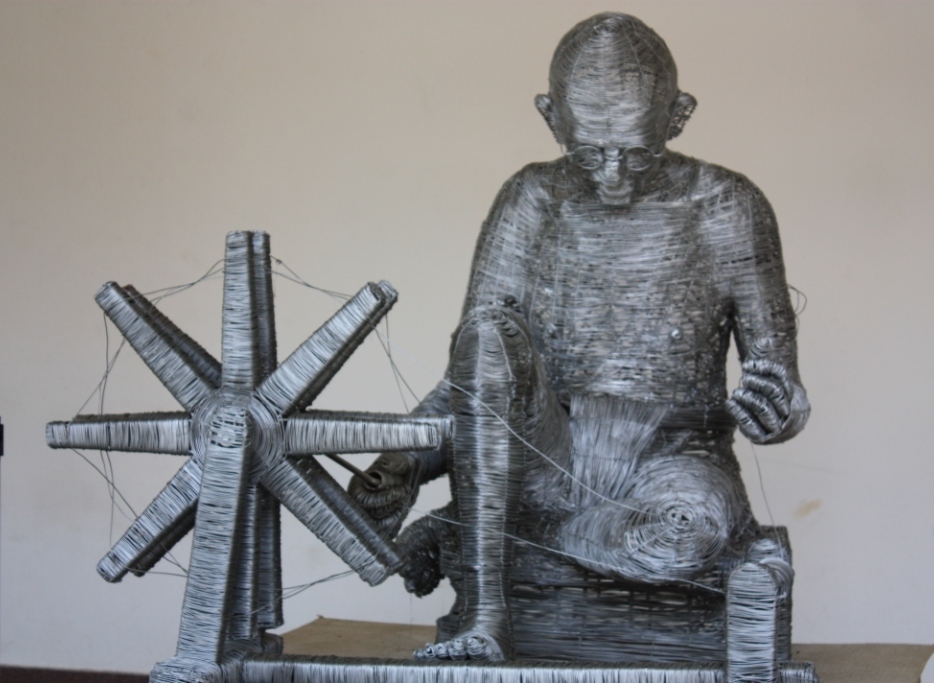
IMG_1501Gandhi is credited with saying, “Be the change you wish to see in the world.”

That’s powerful phrasing. It’s much more effective than, say: “Nag your friends until they’re the change you desire.” It’s also far more potent than: “Write your legislator to draft a new bill so that we all have to be the change you wish to see.”

It’s powerful because it acknowledges that–whatever else you do–you have to set a good example by doing what you think is right. Even if that”s painful and lonely. It’s powerful because it’s bold.

That’s why it sticks in the mind. I once read an entire book by a well-known billionaire who made his fortune in foreign currency arbitrage. I was underwhelmed by the book and the character of the author, and don’t even remember the title because I remember thinking the title should have been: “Why It Should Be Illegal to do What I Did.” This individual came to believe it was morally repugnant to upset the economies of entire nations to make a quick buck, but the lure of making that buck was too great for him to stop without the threat that someone would put him in jail for it. In other words, instead of living by the motto of “be the change,” he lived  by the motto of “If I don’t do it, someone else will.”