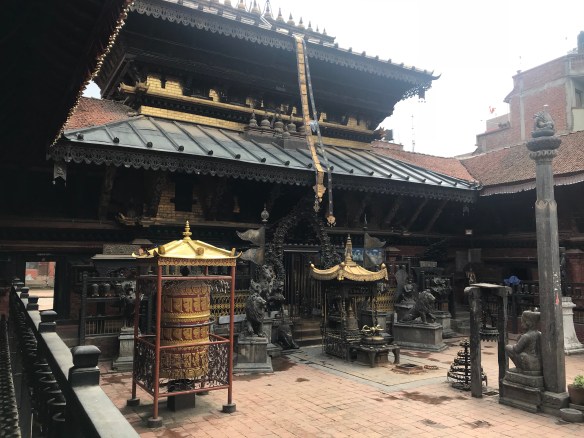
Taken on May 4, 2018 in Patan, Nepal.

Taken on May 4, 2018 in Patan, Nepal.

Pilgrimage: A Very Short Introduction by Ian Reader
My rating: 4 of 5 stars
Reader compares and contrasts the ways and motives of pilgrims around the world, from Muslims on hajj to Elvis fans going to “Graceland, Graceland, in Memphis, Tennessee” [name that tune.] The author’s specialization is Japanese pilgrimages and so trips such as the circuit around Shikoku’s eighty-eight Buddhist temples are well-represented among the examples used. However, he also visits and revisits popular Hindu pilgrimages such as Kumbh Mela and Amarnath, Christian pilgrimages to Lourdes and Santiago de Compostela, and even secular pilgrimages to locations such as the Vietnam War Memorial.
The book consists of six chapters. Chapter one offers a fly-over of the topic in the context of it being a worldwide phenomena. Cultures from around the world engage in similar behavior when it comes to spiritual travel. Chapter two investigates forms, themes, and meaning in pilgrimage, and how they vary across different religions. This helps one define the topic and differentiate pilgrimage from similar activities – to the degree that that can be done. Chapter 3 delves into the pilgrimage as a search for the sacred, and it uses many examples from around the world to consider the varying perspectives.
Chapter 4 reflects upon the differences in modes of transport, motivations, and how the latter influences the former. Obviously, technology has radically changed the face of pilgrimage. There usually remain purists who wish to continue in the old ways (i.e. traveling mostly on foot) and others who’d just as soon use jet airplanes and air-conditioned buses. This leads to conflicts in the pilgrim community where walkers see those who travel in comfort as lacking commitment, and those who travel in comfort may see the old-schoolers as hikers who are more interested in walking than praying.
The penultimate chapter examines pilgrimage as a form of tourism. While it may be considered sacrilegious to some to equate the two activities, they certainly share in common not only the activity of travel but also such behaviors as the collection of souvenirs (e.g. relics, scrolls, and amulets.) The final chapter looks at how pilgrimage has spread into the secular domain with war memorials, nature trails, and the birth or death homes of popular personages from politics or entertainment.
The book contains many monochrome photos and a “further reading” section in the back.
I found this book to be interesting. As a secular traveler who often crosses paths with pilgrims, I was fascinated to gain insight into their head-space and to reflect upon the role that religion and spirituality played in the dawn of travel.
The Way of the Bodhisattva: A Translation of the Bodhicharyavatara by Śāntideva
My rating: 4 of 5 stars
A bodhisattva is one who achieves enlightenment but sticks around to help others pursue the path. Shantideva was a Buddhist monk who lived [mostly] in the 8th century in the part of India that is today in the state of Bihar. Shantideva’s lesson on how to be a good bodhisattva is delivered via 10 chapters of verse, mostly in four-line stanzas. This instructional poem makes up almost 240 pages of the edition of the book put out by Shambhala as translated by the Padmakara Translation Group, and the rest is front matter, appendices, notes, and a bibliography.
The chapters of Shantideva’s poem are: 1.) The Excellence of Bodhichitta (lit. “enlightened mind”); 2.) Confession (fear is a major theme in this statement of modesty); 3.) Taking Hold of Bodhichitta; 4.) Carefulness (discussion of what to avoid.); 5.) Vigilant Introspection (on the need to keep one’s attention concentrated, and to not let the mind roam.); 6.) Patience (on not being focused on self, but on all those suffering.); 7.) Diligence (on avoiding hedonism and being industrious.); 8.) Meditative Concentration (avoidance of getting caught up in the material / physical world.); 9.) Wisdom (karma, illusion, and, particularly, the illusion of self.); 10.) Dedication.
As mentioned, there’s a lot of ancillary matter in this edition of the book. There’s a forward by the Dalai Lama, an extensive introduction (which is helpful as even a modern translation requires background), three appendices (a brief biography, a discussion of equalizing self and other, and a meditation on exchanging self and other), notes (which are also necessary give the nature of a 21st century global reader spoken to by an 8th century Indian monk), and a bibliography. There are no graphics (except a single line-drawn panel) but none are needed.
I had mixed feelings about this work. There was a great bit of wisdom, and the meditation described in the final appendix (based on Shantideva’s discussion) seems to be tremendously valuable. One the other hand, there was a lot of degradation and abasement of the physical body. Granted, I know that Shantideva is talking to an audience of primarily monks and he’s trying to keep them from being horn-dogs or otherwise being distracted by physicality. However, I’m always turned off by those who fail to recognize the tremendous awesomeness and beauty of the human body. There’s also the pessimism. Buddhists are often accused of being pessimistic. Starting with an opening statement of “life is suffering,” this might not be a surprise. Of course, Buddhists counter by saying that they aren’t pessimistic because they are offering a solution to the fact that life is misery, to which non-Buddhists tend to say, “Yes, but the defining characteristic of life need not be agony in the first place.” I won’t weight in on that debate, but the reader should be prepared for a certain dismal tone here and there.
I found this book to be loaded with food for thought. The introduction and notes are extremely beneficial, and this is one of those few cases in which they don’t just feel like padding to hit a desired page count. The verse is readable, and can be understood by a general audience.
I’d recommend this for those interested in Buddhist philosophy.
Modern Buddhism: The Path of Compassion and Wisdom – Volume 1 Sutra by Geshe Kelsang Gyatso
My rating: 4 of 5 stars
This is the first book in a three-volume overview of Buddhism that is available for free (or for the minimum Kindle book price on Amazon.) The book is written by a Tibetan Buddhist scholar-monk, and, therefore, emphasizes the Mahayana approach and specifically that of the Gelug school. (I’m a neophyte, but I don’t think this book goes into so much detail as to be controversial among Tibetan Mahayana Buddhists, but if you are thinking you’ll learn about, say, Zen or Theravadan Vipassana, not so much.) The theme of this volume is an overview of the Limram, which is a sutra describing the path to enlightenment.
The book is divided into four sections. The first offers a broad overview of Buddhism with particular discussion of the Kadam Lamrim (the specific sutra discussed) and Kadampas (which is the name for an individual who pursues practice of the Kadam Lamrim.) The other three sections describe the information needed by an initiate, middling practitioners, and advanced practitioners, respectively.
The section on persons of initial scope (i.e. initiates) emphasizes the need to recognize the limited scope of a human life, to reflect upon one’s imminent death, and to consider the importance of avoiding lower rebirth.
The section on persons of middling scope echoes the four noble truths. They are discussed by way of the four questions: 1.) What one should know? 2.) What one should abandon? 3.) What one should practice? And 4.) What one should attain? In essence, it suggests one understand suffering, the path to is cessation, and that one follow that path.
The largest section, by far, is the portion on individuals of great scope. It is divided into four parts. The first part describes the need to revise one’s approach to love by taking oneself out of the center and practicing loving-compassion for those that one doesn’t know. The second subsection outlines the six perfections (giving, moral discipline, patience, effort, concentration, and wisdom) and the importance of each. The third section is about emptiness and truth. The final section is a brief description of the Lamrim practice.
There are a small number of line drawn illustrations of important figures in the tradition. There are no notations, citations, or ancillary material.
I found this book to offer a concise overview of the subject of Buddhism—specifically from the perspective of the Gelug tradition of Tibetan Buddhism. While there are some historical stories, such as those drawn from the life of Milarepa, the book is not designed to be entertaining reading. It’s a straightforward transmission of knowledge. In that regard it does a fine job, it’s clear and concise.
I’d recommend this book for one who’s interested Tibetan Buddhism, but one should be aware that it’s not a nonsectarian overview of Buddhism as the title might suggest to a reader.
How Enlightenment Changes Your Brain: The New Science of Transformation by Andrew Newberg
My rating: 5 of 5 stars
This book busted me over the head with some profound food for thought. I’d been skeptical of the notion of Enlightenment. [Note: the authors distinguish big-E Enlightenment as a permanent and substantial brain change, in contrast to the little-e enlightenment which is just a momentary epiphanies or insight—a number of which may precede the big-E Enlightenment.] It’s not that I disbelieved that some people had life-changing and / or perspective-changing experiences, but rather that such events represented permanent change. My skepticism was influenced by the many gurus who have been said to be Enlightened, but who behaved to all appearances like petty, materialistic douche-bags. It’s not that I couldn’t believe that these teachers achieved some momentary heightened state of consciousness during their youth, but—if they had—they clearly couldn’t maintain it under the pressure of being idolized. I’d, therefore, come to think that life is a perpetual struggle to try to be a better version of oneself, and backsliding can and will happen at any moment. This book, however, suggests there is a possibility for permanent brain changes. [Though Dalberg’s “Absolute power corrupts absolutely” seems to still apply.]
Andrew Newberg is a neuroscientist who has made a career out of conducting brain imaging studies of people engaged in various spiritual, religious, and meditative activities. His co-author is a psychologist, Mark Robert Waldman, who works on applying neuroscientific understanding to positive psychology. In this book, the two examine what Enlightenment is from a neuroscientific standpoint and then try to cull the common features across a population of cases of Enlightenment / enlightenment. Discovering the common elements of Enlightenment is no easy task. While it seems everybody is theoretically capable of achieving Enlightenment, it also seems that the experience is different for everybody and the collection of systems (religious, spiritual, and secular) by which it’s pursued is vast. However, the authors present a five-step outline by which readers can prime themselves to achieve Enlightenment, and it can be personalized depending upon one’s beliefs (or lack thereof—Enlightenment occurs among agnostics and atheists as well as religious practitioners) and background.
The book consists of 12 chapters divided among three parts. Part I (Ch. 1 to 5) lays the groundwork for readers to understand what Enlightenment is, how it feels, how it’s experienced between people with radically varying belief (and disbelief) structures, and it presents a model of human awareness that is crucial to the later discussion. Part II (Ch. 6 to 9) considers what happens in the brain during various practices by which individuals advance towards Enlightenment. Concepts like unity, surrender, and belief are explored in detail. Part III (Ch. 10 to 12) describes the process by which readers can pursue Enlightenment for themselves. If one is inclined to chart one’s own path, versus adopting an existing program, one has all the insight and tools to begin constructing one’s personal method by the time this section is complete.
The book has graphics as necessary (e.g. brain diagrams) that largely consist of line diagrams. There is an appendix that consolidates tools and resources, and the book is annotated by chapter.
I found this book to be both interesting and potentially beneficial to readers who take it beyond a popular science book and into the realm of self-help. The authors do a great job of navigating the waters between religion and science. Obviously, they are scientists and are agnostic about that which cannot be proven, but they don’t question other people’s beliefs and–if anything–error on the side of being open-minded. Still, I suspect that there will be religious types offended by the very notion that all humans are biologically primed to achieve this heightened state. It should be pointed out that the book could be supremely useful for such individuals because it points out the need to engage in exercises to challenge one’s most closely held beliefs. (Those with less mental flexibility and capacity for tolerance seem to be less likely to achieve Enlightenment.)
I’d recommend this book for anyone trying to figure out how to be the ultimate version of oneself.
Nagaland feels like a country unto itself. Not like Myanmar (which it’s not.) But, also not like India (which it is, technically and legally.) Neighboring Assam and Manipur feel like India with a Tribal twist, but not Nagaland. It feels Tribal to its core.
Among the factors that contributes to this is that almost 90 % (88.1%) of it’s population is Christian. For some reason, the missionaries found this piece of the planet fertile ground. Buddhism has no presence in Nagaland at all, which is one of the things that makes it seem quite different from the SE Asian countries, which it bears a resemblance to in a number of ways (e.g. racially, architecturally, etc.)
But religion is just part of it. If you were to go by attire or what music is playing in the cafe (K-pop, US pop, and local music inspired by the aforementioned) one would be more likely to guess one was in Southeast Asia. And if you were to go by cuisine, you’d have no idea where you were. It’s not remotely like Indian cuisine except that the favored snacks are those of Ladakh and Sikkim [i.e. Tibet-esque; momos and noodle soup.] Still, it’s not like SE Asian cuisine excepting that steamed rice is a part of every meal and the pungent smell of fermented yam leaves (anishi) is a smell similar an odor I’ve encountered in Thailand. (But I see no reference yam leaves in Thai cuisine, so I suspect in Thailand its something else that’s fermented to create said smell.)
Hindu temples are ubiquitous throughout India, but in Goa they tend to be overshadowed by massive Christian churches and cathedrals. (Despite the fact that Christians only make up about a quarter of the Goan population while Hindus make up about 2/3rds.) This was one of the more prominent Hindu temples we saw. It’s located in Old Quarter.
Hindu Myths by Anna L. Dallapiccola
My rating: 3 of 5 stars
Having moved to India, we picked up this book to try to wrap our heads around the vast Hindu pantheon and the myriad myths involving them. There are a huge number of tomes on the subject of Hindu mythology, but far fewer concise commentaries that look useful. We were always on the lookout for a book that would offer a sort of “Hindu Mythology for Dummies” –the quick down-low, if you will.
I can’t say that this book clarified the topic. However, I’m not sure any book could. Hindu mythology is a subject of enormous scope, while being defiant against reducibility. I was about to compare it to the challenge of writing a concise book for neophytes on quantum mechanics, but then I realized that such a book could probably be done much more effectively. For as strange as the world behaves at a subatomic scale, there’s a means to order the story and to simplify it in a way that leaves intact the gist. Along with dry descriptions of ordinary sounding events, one reads stories like that of the deity that popped out of another’s belly-button on giant lotus flower. That’s when the myths become hard to imagine–if one hasn’t been hitting the psilocybin.
That said, I did learn some interesting elements of myth from reading Dallapiccola’s book, and I think it has as effective an organizational scheme as one can hope for. After an Introduction that exposes the reader to Vedas, Puranas, and the Hindu trilogy (Vishnu, Shiva, and Brahma), there are three chapters that revolve around creation, preservation, and destruction. [For those unfamiliar, those three deities map to those processes—Brahma the creator, Vishnu the preserver, and Shiva the destroyer.]
After those three, there are another three chapters. Chapter four deals with myths about delusion, and in addition to describing Vishnu’s role in delusion (maya) it tells a couple of tales (the story of Madhu and Kaitabha, and the story of King Harishchandra.) Chapter 4 discusses the topic of grace and describes the birth of the Ganga, tells the tale of Arjuna and the Hunter, the story of Vishnu and Prahlada, and then offers a bit of insight into Shaiva saints, temple myths, and animal devotion. The last chapter is a brief overview of Hindu Mythology in modern times—especially its inclusion in popular culture.
There is a map (i.e. an India map showing major cities and crucial historical sites) and many pictures throughout the book. The pictures include photos of sculptures as well as reproductions of paintings that are of the deities and key mythical events. As far as ancillary features go, there is a half-page “Further Reading” section and the book is indexed.
This book is only 80 pages, and offers a quick overview. Whether it hits the most crucial material, I can’t rightly say. As I mentioned, there are some interesting tidbits in the book. I’d recommend it for someone looking for a quick overview. However, one should note that there are books that are more oriented toward story and less toward a scholarly level of precision in language that may be more useful for one—depending upon one’s needs.
The Devils of Loudun by Aldous Huxley
My rating: 5 of 5 stars
In 1634, a parish priest named Urbain Grandier was tortured to exact a confession that he’d engaged in sorcery and made a pact with the devil. There was plenty of reason to believe that Grandier was a less than virtuous fellow (e.g. that he knocked up the teenage daughter of his best friend in Loudun), but no evidence of the crimes that he was actually accused of–and that the Church insisted he cop to despite his steadfast denials. However, there was some potent circumstantial evidence in the form of a case of mass hysteria by members of a convent of Ursuline nuns that was attributed to demonic possession at the time.
Huxley tells this fascinating story in great detail. At some points, perhaps too much detail. The writing style can come across as pretentious, needlessly complicated, and slow-moving at times. (For example, there are frequent quotes and snippets of poetry in French–and a few in Latin—and many of these were not translated to English in the edition that I read. Apparently, the assumption was that the reader would have a basic competency in these languages.) However, when it comes to the climax of the story, the book is as gripping as they come. Having been presented with great insight into Father Grandier, we know him to be a deeply flawed man. He’s like the priests and bishops of a Marquis de Sade novel, lecherous and libertine. Yet, he manages to become a sympathetic character as he shows virtue of sticking to his guns in denial of being in league with Satan long after the truth of his vices has been admitted. In essence, when juxtaposed to his inquisitors, he becomes the lesser of two evils.
I also don’t fault that Huxley delves into analysis, because there is a fascinating question at the heart of the event—one that deserves to be batted around. What made this group of nuns behave in such an un-nun-like fashion? There was writhing, foul language, wardrobe malfunctions, etc. Today, it’s impossible for a rational skeptic to write these events off as demonic possession. However, while the Mother Superior, Sister Jeanne of the Angels, clearly had an axe to grind against Grandier (for issues regarding organizational leadership and not so much for womanizing the townies), that also seems unsatisfactory as a cause for these sisters to behave as they did. There have been a number of cases of pretended possession, but generally these were individuals—e.g. Martha Broissier. There seems to be some fascinating psychology at work in this case.
The book is arranged in 11 longish chapters, largely following a chronological progression of events. The edition that I have has some interesting appendices as well as a bibliography. There isn’t much in the way of graphics, but as the book reads like a novel one doesn’t expect there to be.
I’d recommend this book for those who are interested in history or psychology. It’s fascinating in both domains. While I thought the book could have been a little clearer and more concise, it’s still quite readable and the heart of the story is highly engaging. I was also reading the book as a general interest reader. A scholarly reader might appreciate Huxley’s thoroughness more.