Watchable Monsters [Free Verse]

They were written into 
the lives of ancients,

written into the oldest
stories,

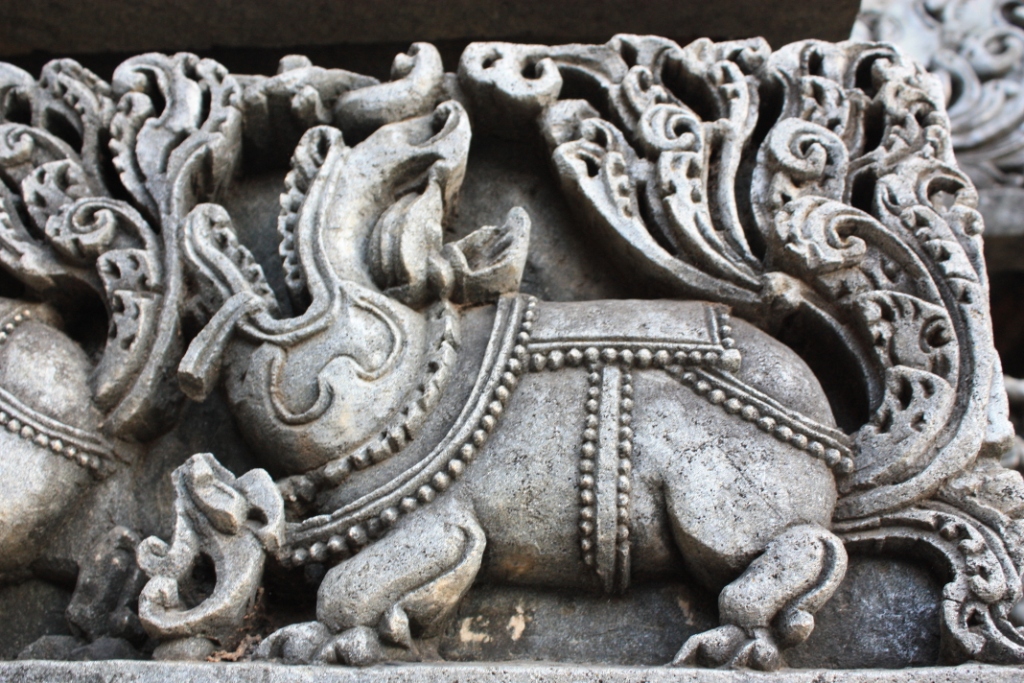
carved into cave
& temple, alike.

These beasts terrorized
and defended --
sometimes both
at the same time.

Towering stacks of hours
were lost to the
beastly crunch of their teeth.

Early peoples tried 
feeding bleating creatures 
to these intermediate beasts --
these watchable monsters:

 one's too scary to chase,
but too still to run from.

But they were as relentless
in their non-hunger
as they were in inspiring
long chains of possibility.

Diabolus [Sestina]

I woke up seeing stars up in the sky,
a blanket brightly twinkling above.
But I could only guess just where I lie,
and knew no better from what place I fell.
And for a moment I was lost in stars,
and felt the vastness I'd been cast against.

What was it that I had rebelled against?
What got me tossed from beyond vaulted skies?
Was it that I tried counting all the stars?
Or that I turned my focus from above?
Can I return some day from whence I fell?
Or is it best to stay right where I lie?

You may think I tell myself perfect lies,
that I'm angry with those I've sinned against.
But I'm not sure my exile was a fall,
and I'm not sure I lived beyond the sky.
What of the freedom not seen far above?
What of the beauty seen amid the stars?

For now, I reside in the field of stars.
Where passersby told stories full of lies,
and I have no love for the far above.
It's just a place that I once raged against.
They preach earth and water and endless skies,
but not a thing is here that never fell.

It's all matter that spiraled as it fell
that formed this platform amid blazing stars.
A vacuum beyond mountain, sea, and sky.
But I remember that's the greatest lie -
the one that I had always railed against.
That meaning lie in words like "far above."

That word is laden with judgment: "above."
And where's the gravity by which I fell?
Can puny bodies be so pulled against
where exist so many colossal stars?
So many obstacles between us lie,
and so much nothing before reaching sky.

There's no "above," only a field of stars.
And no one fell; that's just a peoples' lie.
Nothing stands against me - no endless sky.

BOOK REVIEW: The Medea by Euripides [Trans. Gilbert Murray]

The Medea of EuripidesThe Medea of Euripides by Gilbert Murray
My rating: 5 of 5 stars

Amazon.in Page

Project Gutenberg

This tragedy follows up the myth of “The Golden Fleece.” That hero’s journey culminated in three trials which Jason (of Jason and the Argonauts) must complete in order to acquire the golden MacGuffin. Jason succeeds in large part because (arguably, entirely because) Medea, daughter of the fleece’s owner, i.e. King Aeetes, gives Jason some potions to make the trials a cinch. She does this in exchange for Jason’s everlasting love.

And, herein, lies the heart of this play’s conflict. Jason – like many heroes of Greek Mythology – is kind of a jerk. In flashing forward to the beginning of this play, we find Jason has traded Medea in for a younger and higher stature wife (i.e. a princess whose father doesn’t despise and disown her). [Note: Technically, Medea may not be married to Jason because of legalities, but she did bear him two boys.] To add insult to injury, Jason’s new father-in-law (King Creon) insists that Medea and her two boys be exiled, effective immediately.

What makes this play so fascinating is that we have sympathy for Medea’s plight, but then her inner monologue turns to the nuclear option she will employ – killing Jason’s new princess-wife and, more disconcertingly, her own children. Medea goes back and forth about her plan, showing reluctance to kill her boys, at least. So, the reader (viewer) ends up finding Jason loathsome because he steadfastly refuses to accept any blame for how poorly things have gone, but – on the other hand – he’s being more reasonable. (i.e. He talks kindly and isn’t murdering anyone.) It’s a fascinating reflection on the battle between rationality and passion.

I’d highly recommend this play. It’s a short and straightforward story, but it does present a great deal of food-for-thought.


View all my reviews

BOOK REVIEW: Angels: A Very Short Introduction by David Albert Jones

Angels: A Very Short IntroductionAngels: A Very Short Introduction by David Albert Jones
My rating: 5 of 5 stars

Amazon.in Page

This book offers an overview of angels in the Abrahamic religious traditions (i.e. Judaism, Christianity, and Islam.) [It does take a quick dip into angel-like beings from other religious traditions – e.g. Hindu and Parsi – but generally comes down on the side of it doing a disservice to everybody to equate such beings across mythological traditions – with the possible exception of the New Age angel which is predominantly an offshoot from Abrahamic mythology.] The book considers the evolution of theological thinking on angels: how they’ve been portrayed in art; what they are [made of;] what their purposes are (i.e. messengers, healers, guardians, warriors, etc.;) and, occasionally, how they play into popular culture.

I took away a great deal from this book. For example, I learned about the differences between the djinn of Islam mythology and demons of Judeo-Christian mythology, and the theological underpinnings of this difference (i.e. Muslims do not believe angels have free will, and thus angels can’t be fallen, and so the djinn are a separate entity altogether [rather than being fallen angels.]) I found the book to be readable, interesting, and balanced in its approach to the topic. If you’re looking to learn more about how angels (and related beings, e.g. fallen angels / demons) have been treated by thinkers of various ages, without getting deep into the minutiae, this is a fine book to consider.


View all my reviews

BOOK REVIEW: After Lambana by Eliza Victoria & Mervin Malonzo

After Lambana: A Graphic Novel: Myth and Magic in ManilaAfter Lambana: A Graphic Novel: Myth and Magic in Manila by Eliza Victoria
My rating: 5 of 5 stars

Amazon.in Page

Out: May 10, 2022

This urban fantasy takes place in a Manila where magic exists and mythological creatures live. The story follows two young men as they travel around the city. The two seem to be new and casual friends. One is an ordinary human (Conrad) though with a terminal illness that seems not of this world, and the other is an expat from the magic realm (Ignacio) who’s going to great efforts to help Conrad. The hook is the question of why this casual acquaintance seems so important to the too-cool-for-school Ignacio. Conrad seems to be along for the ride as a distraction in his last hours, but Ignacio has an objective – benighted as it may be. The story unfolds to reveal what’s really happening and to offer backstory.

I love works that incorporate mythology and folklore, and think it’s a wise move for writers of speculative fiction because there’s such a rich and engaging field of stories and characters / creatures – all ripe for the picking. This is particularly true of a mythology, such as that of the Philippines, that isn’t widely known and, thus, offers a whole slate of creatures and alternate worlds with which most readers aren’t familiar. In this book, Filipino mythology is most prominently seen via the “Sirena,” which bear some resemblance to Greek Sirens – except being in the form of mermaids (though able to walk on legs under certain conditions.) I think more could have been done with Filipino Mythology, though there are a few other magic elements in the book that may or may not have mythological origins.

In found this to be a compelling story, and the art was colorful, while still capturing a little noir feel for late night Manila. If you’re interested in speculative fiction graphic novels, this one is worth investigating.


View all my reviews

BOOK REVIEW: The Good Man Jesus and the Scoundrel Christ by Philip Pullman

The Good Man Jesus and the Scoundrel ChristThe Good Man Jesus and the Scoundrel Christ by Philip Pullman
My rating: 5 of 5 stars

Amazon.in Page

Pullman tells the story of Jesus’s life from manger birth to the birth of the religion that flowed from Jesus’s crucifixion, with two major deviations from the gospel accounts. First, in this book, Mary gave birth to twins: one healthy, disciplined, and charismatic [Jesus] and one stunted, bookish, and with grand designs [Christ.] Second, the book tells the story in a way which requires no miracles or magic.

The reason for complicating the story with twins is to be able to split apart two confounding entities. Jesus represents the traveling preacher that most people find appealing and admirable. He’s compassionate, non-judgmental, simple (in the sense of eschewing wealth and glory,) and is a great storyteller. Christ represents the path that Christianity would come follow — one of billionaire evangelists, manipulative missionaries, and the Spanish inquisition – as well as, less intentionally, the Crusades, witch hunts, and pedophilic priests. That said, “scoundrel” status is only realized at the story’s end when Christ plays the Biblical role of Judas. Even then, Christ is conflicted and thinks he’s acting in accord with the directions of an angel.

While most of the events described will be familiar (in some form) to those acquainted with the New Testament stories, there’s an ongoing sub-plot between Christ and “the stranger,” a mysterious character who has an interest in seeing Christianity blossom, if in its imperfect form.

This book is part of a series on mythology called the Canongate Myth Series that features numerous renowned authors.

I found this take on Jesus’s story to be compelling and thought-provoking. I’d highly recommend it, except for those who take their Bible stories very literally and get riled by such writings.

View all my reviews

BOOK REVIEW: The Complete American Gods by Neil Gaiman; Adapted by P. Craig Russell

The Complete American Gods (Graphic Novel)The Complete American Gods by Neil Gaiman
My rating: 5 of 5 stars

Amazon.in Page

Out: September 28, 2021

This is the graphic novelization of Neil Gaiman’s brilliant story “American Gods.” The tale begins with the protagonist, Shadow Moon, being released a few days early from his prison sentence to attend the funeral of the wife whom he has been longing to see. On the flight home, he sits next to a gregarious man named Wednesday who offers him a job and who knows way too much about Shadow. While Shadow initially rejects the offer, Wednesday is relentless. When Shadow finally gives in, he’s introduced to a world where nothing is as it seems, a world of gods, demi-gods, and folklore heroes.

The premise is simple, but magnificent. America is a hard land for gods. The country’s melting pot nature makes for so many old gods: Native American gods, Norse gods, African tribal gods, pagan gods, Hindu gods, Slavic gods, etc. Then there are the new gods like “technology” and “media.” Comparing the average American’s screen time versus time in church or in prayer, it’s not difficult to tell which side is winning the war for the affection and attention. Still, the new gods exist in an ephemeral landscape. So, Wednesday is going around trying to build support among old gods for a war between the old and new gods — no easy task as a self-confessed con man.

It’s been a while since I read the novel, but this adaptation felt true to my recollection of the original story. It seems closer to the original than, say, the Amazon Prime series (which I also enjoyed, but which often diverges, particularly to build out some of the secondary characters’ arcs.)

This is definitely worth a read, whether you’ve read the novel or not. The artwork was well-done, and I highly recommend it.

View all my reviews

BOOK REVIEW: Hanuman by Anant Pai

Hanuman (1)Hanuman by Anant Pai
My rating: 4 of 5 stars

Amazon.in page


This comic book is one volume in a huge collection of graphic depictions of Indian mythology (not only Hindu, but also Buddhist, Jain, secular folklore, etc.) Having lived in India for the better part of a decade now, I must admit that, sadly, my understanding the country’s mythology and folklore is not up to snuff. In my defense, I have often found that my Indian friends tend to have a varied and or tenuous grasp of the subject, a given person might know about some story or deity in considerable detail, but know virtually nothing about others – even if they are relatively popular tales. It’s just such a huge and disparate collection of stories that only experts are capable of both a breadth and depth of understanding of the topic. Even those books that attempt to simplify, making the subject comprehensible to a layman, often get bogged down in the vast number of characters and stories. Having stumbled upon this series on Amazon Prime, I thus decided to change tack and take in Indian Myth and Folklore in the chewable (if child-centric) bites offered by these comic books.

This book tells the story of the monkey-god, Hanuman, particularly his role in the story told in the “Ramayana.” If one is looking for a broader story than that, you may be disappointed. Anyway, this tale seemed like a good place to start because I already knew the story, at least in broad brush strokes. Thus, I had some basis for comparison of how this series tells the story. In a nutshell, the story revolves around the conflict between Rama and Ravana. Ravana has absconded with Rama’s wife, Sita, and is holding her hostage at his stronghold in Lanka, attempting unsuccessfully to woo her. (Though the latter part is not addressed, herein.) Hanuman enters the scene because he allies with Rama, and the monkey-god is sufficiently superpowered to leap the sea from coastal India to Sri Lanka. Hanuman, therefore, goes to Ravana’s territory to reconnoiter. When discovered, Hanuman makes a daring (if mischievous) escape to report back to Rama. The monkey-god then plays a crucial role in Rama’s battle against Ravana.

The only part of the story that I remembered from before that wasn’t addressed was the bit about Rama wrongly accusing Sita of infidelity and her response. I suspect this was primarily because the story is directed at children, and marital unfaithfulness was considered to be too intense of a topic. However, it might have also been the case that this bit of the story was deemed to be too big a can of worms to open in a Hanuman-centric telling of the story.

I enjoyed the book. With superpowered characters and heroic deeds, it’s not all that much different from the superhero tales of modern comic books – which, themselves, are sometimes rooted in varied mythologies. The art is simple and clear (if a bit dated in approach,) and I found the text surprisingly devoid of the clumsy exposition that has historically plagued comic books. If you’re interested in taking in mythology and folklore in bite-sized chunks, it’s worth checking this one out – particularly if you don’t mind that some simplifications are made to make the story more kid-friendly.

View all my reviews

BOOK REVIEW: The Hero with a Thousand Faces by Joseph Campbell

The Hero with a Thousand FacesThe Hero with a Thousand Faces by Joseph Campbell
My rating: 4 of 5 stars

Amazon.in page


This book was written to explore the intriguing cross-cultural similarities between various heroic mythological and folk tales from around the world. However, it’s had a second life on writers’ bookshelves because it nicely explains a story arc, commonly called “the hero’s journey,” that serves as one of the most popular approaches to narrative plotting. Many of the most celebrated works of fiction and film, from “Alice’s Adventures in Wonderland” to the first “Star Wars” movie, explicitly follow the hero’s journey arc. Campbell draws examples from a wide range of traditional hero stories. These involve central figures who must leave their familiar life in the world they know in search of some objective or change that they will bring back to their everyday life. Campbell doesn’t stick to well-known systems of mythology — such as Greek, Norse, Egyptian, and Hindu — but delves into small and less well-known tribal stories from Africa, Latin America, indigenous North America, and other far-flung lands. [That said, he does pull heavily from the world’s major religions, as well as from the most broadly known systems of mythology – e.g. Greek Mythology.]

The book is divided into two parts. The first of these parts is the one that will be of greatest interest to writers and other storytellers because it describes the hero’s journey story arc in great detail and using a variety of traditional stories. Part I is divided into four sub-parts and – within them – eighteen chapters. The first three sub-sections each investigate about a-third of the seventeen stages of Campbell’s monomyth, i.e. his name for the hero’s journey. [It should be noted that there’s no claim that all heroic myths contain each and every one of these elements, but only that if one wants to capture the bulk of all heroic stories, one needs to consider some formulation of each of these categorizations.] The first subpart consists of the five stages that take the hero from his work-a-day world into the new world [that is typically of a supernatural nature.] These stages include: a.) the call to adventure; b.) refusal of the call; c.) the supernatural aid or guide; d.) crossing the first threshold [into the supernatural / foreign world]; and e.) the belly of the whale (i.e. being swallowed into the unknown / self-annihilation.)

The second sub-part is called “Initiation,” and it covers the six stages within this strange, new world — including the attainment of the hero’s objective. This section begins with a “road of trials” to challenge the hero. This maybe the stage most associated with the heroic journey in the popular mind. The other stages of initiation include; meeting / marriage with the goddess (i.e. mastery of life,) temptation by a woman, atonement with the father, the elevation to an enlightened or divine state, and the ultimate boon (e.g. immortality or a great bounty.) [The middle portion of this section is where Freudian influence is most intensely felt.]

The third sub-part is about the hero’s return trip back to the familiar world. This section also includes six chapters including: 1.) refusal to return; 2.) the magic flight; 3.) rescue from without; 4.) crossing the threshold into the regular world; 5.) as a master of both worlds; 6.) with freedom to live. This idea that the hero returns not only with a great boon but as a master of two worlds is central to the hero’s journey.

The final sub-part / chapter recaps the entire process in a restatement and summary. Given the complexities and wide variation of the matter at hand, this is beneficial. This section opens with a helpful diagram that summarizes and depicts the stages of the hero’s journey in a cyclical format.

The second half of the book, Part II, takes a step back to look at the cosmogonic cycle — i.e. looking at mythological approaches to the story of the universe from its origin to destruction, though still with special focus on heroes. Again, Campbell finds many consistent elements among a broad and disparate collection of cultures and religions. Part II also features four sub-parts, this time including twenty chapters. The first sub-part (6 chapters) focuses on the origin of the universe. The four chapters of the second sub-part delve into mythology surrounding virgin birth among heroes, which is much more widespread than the well-known Christian story of Jesus’s birth. The third sub-part considers the lifecycle and varied roles of a hero, starting with the origins and childhood of the heroic figure, ending with the hero’s demise, and in between examining a number of the facets of a hero including: warrior, lover, leader, redeemer, and saint. The final subpart discusses how mythology and folklore treat the world’s end.

This book has many pages devoted to front- and back-matter including an introduction, a prologue, an epilogue, and an annotated bibliography. There are graphics throughout. Besides the explanatory diagram mentioned earlier, these are mostly renderings of artworks depicting events in mythological stories.

The broad sourcing of myths is necessary to tell the tale that Campbell sought to convey – i.e. that there are common narrative elements seen among varied cultures that had little to no interaction. With regard to one’s reading experience, the inclusion of myth and folklore unknown to most readers is a mixed bag. On one hand, it ensures that everyone – except perhaps professors of Mythology and Folk Studies – will learn about new stories and cultural traditions. On the other hand, it’s not always readily apparent what Campbell’s point is when he launches into a myth or folk story because it’s frequently done without any preemptory remarks that would clarify said point. This can make for some clunky reading in which one has to reflect and reread — as if reading a textbook as opposed to a popular work. This book sits near the edge between popular and scholarly reading. The reading isn’t terribly dense, but it does jump around from myth to myth in a way that presumably felt logical to the author but isn’t always readily so to a neophyte reader.

One quickly notices that Campbell was heavily influenced by Freudian ideas that haven’t weathered scholarly scrutiny well over the past several decades. It’s hard to be too critical about this as, when the book first came out in 1949, Campbell wasn’t alone, by any means. And, more importantly, Freud’s influence only really undermines certain ideas about what undergirds mythological tales. It doesn’t adversely impact the central argument that there are these common story elements across a diversity of cultures. In the chapter on “Woman as Temptress” one will see the most explicit examples as Campbell discusses “Hamlet” and the “Oedipus Trilogy.” Still, one could argue that Campbell’s ideas have survived more intact than did Freud’s.

I’d recommend this book for individuals interested in learning more about either mythology or story crafting. It’s extremely thought-provoking throughout, if – sometimes – a slog to read.

View all my reviews

POEM: Orpheus Twisted [Day 30 NaPoMo: Ballad]

He played his way to the underworld,
capturing every ear.
Even the gods couldn’t move to fight,
but stood stock still to hear.

The musician made his merry way
to the throne of the gods.
And boldly made a petition
that defied rules and odds.

Ye, gods! There’s been a huge mistake.
My wife, she died too soon.
If you’ll let us go on our way
I’ll play THE most dulcet tune.

The gods conferred and reached a verdict:
“If our terms are heeded
and your tune is dreamy enough,
she Will be conceded.”

Tuning his lyre, the artist asked,
“May I, Now, hear the terms?”
“Lead her above — without a peek,
or t’s back to food for worms.”

The dulcet tune was as he claimed,
and Two had leave to go.
From Styx out to the burning sun,
he itched, her place, to know.

When almost out, he heard a thud
and his name feebly called.
He stayed true to the gods’ strict terms,
as her blood puddle sprawled.

As she was retaking bodily form,
she’d tripped upon a rock.
Maybe direct pressure on the wound
and she’d not bled into Shock.

So if god or man makes you a deal
contingent on ignorance,
you might think twice before taking
up residence inside that fence.