
a duck trio
 does a lazy do-si-do
  with eyes closed.


boats rise & roll
 with constant motion; as
  gentle waves lap ashore.

This machine can flow,
     moving over, around,
     & through.

Skin conforms to the contours
     of musculature.

Muscle binds to bone,
     muscle that thickens
     and lengthens and ripples
     and pulses.

Bones that flex and recoil.

But that machine can flow --
     over, around, and through.

It can cause air to pop
     and water to slosh
     and earth to tremor.

It crawls through liquid,
    slices through gases,
    and slams the solids,

but can move over, around,
    and through.

from a speeding train,
 i see a fresh-plowed field
  in which nothing moves.
 Karate Science: Dynamic Movement by J.D. Swanson
 Transforming Trauma with Jiu-Jitsu: A Guide for Survivors, Therapists, and Jiu-Jitsu Practitioners to Facilitate Embodied Recovery by Jamie Marich
 Move: How the New Science of Body Movement Can Set Your Mind Free by Caroline Williams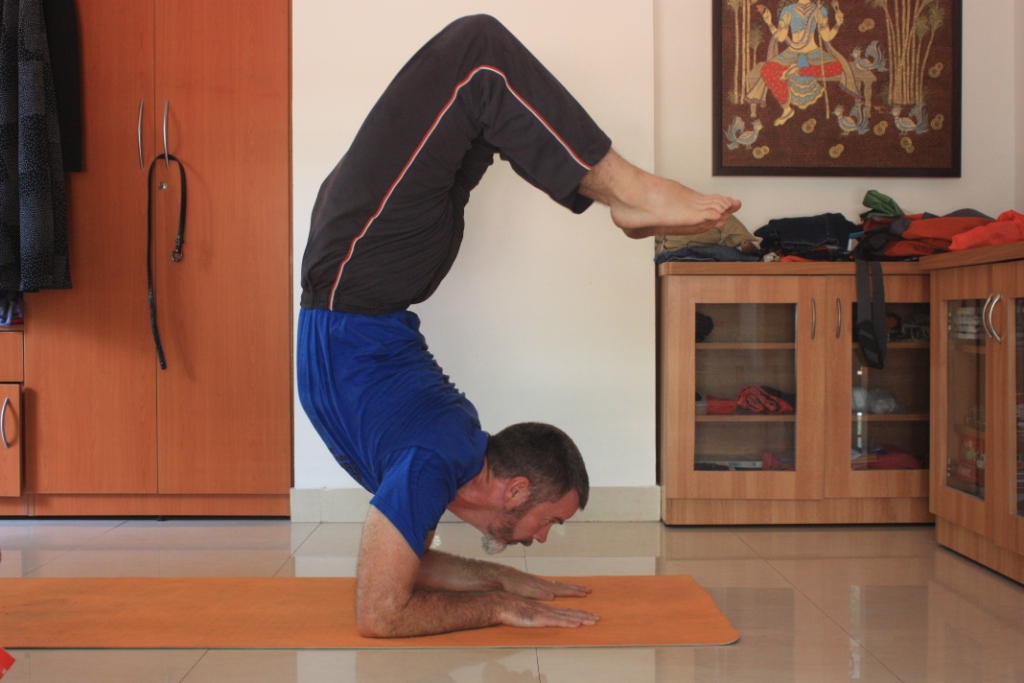
I saw something sad in the park this morning. A boy was trying to learn to ride a bicycle, but I could see that he never would — not with his present approach. Why? He had one training wheel, and the bike was leaning about 15-degrees off vertical as he struggled to use the bicycle as a tricycle. I could see that the metal arm that supported the training wheel was starting to bend from the strain — thus making the lean ever more pronounced. [Incidentally, with two training wheels, I think he might rapidly learn to ride because he’d experience tipping from one side to the other, through the balance point.]
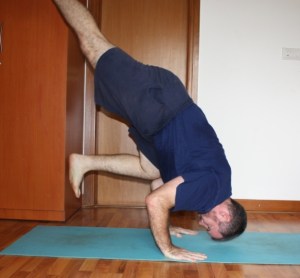
I’ve told yoga students before that there are three timelines for learning inversions (upside-down postures, which all require one’s body to learn to balance 180-degrees out of phase with the balance we all mastered as toddlers.) The first timeline is if you are willing to learn break-falls (i.e. how to safely land when — not if, it will happen — one loses balance.) If so, one can learn any inversion (that one is otherwise physically capable of performing) in an afternoon. Second, if one gets near (but not up against) a wall, and only uses the wall when one is falling towards over-rotation, then one can learn the inversion in a month — give or take. Finally, one can lean up against the wall for a million years and one will not spontaneously develop the capacity to independently do the posture. Why? Because one’s center of gravity is outside one’s body, which means one is in a perpetually unstable state, and one cannot stabilize into a balanced position from a state of falling (and leaning is just falling with a barrier in the way.)
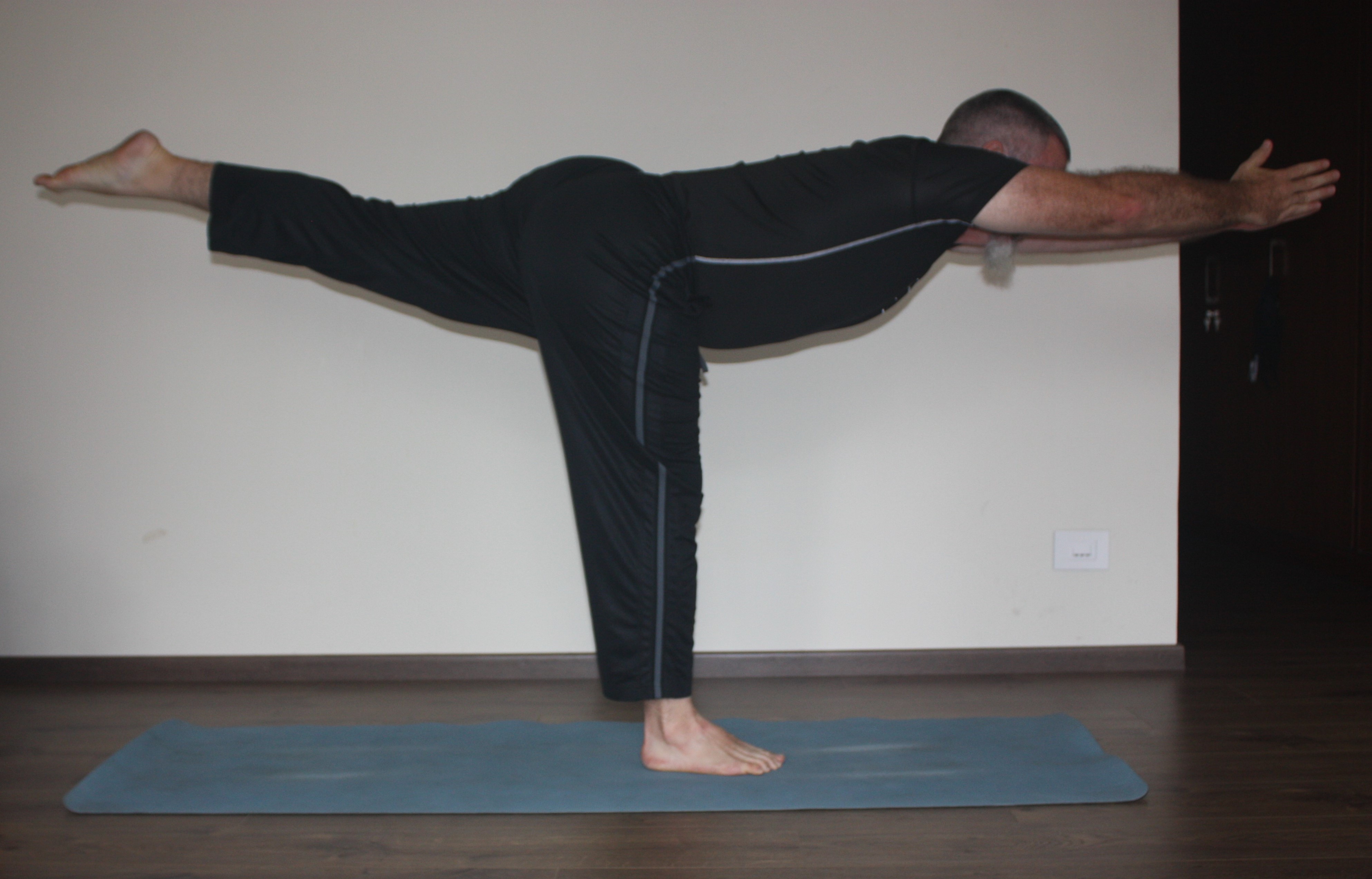
Finding balance requires that the body be able to adjust toward any available direction to counteract the beginning of a fall in the opposite direction. I was fortunate to have studied a martial art that required learning break-falls from the outset, this made learning balances (not just inversions, but also arm balances, standing balances, etc.) much easier because there was no great concern about falling. I knew my body could fall without being injured.
Without falling there’s no learning balance, and if you only fall into the under-rotated position, you are still not learning to achieve stable balance. At some point, you will need to experience the dread fall towards over-rotation.
Time to ditch the training wheels.
 This is month ten in my year of studying altered states of consciousness, and this post will be on movement and the mind.
There are many downsides to being introverted, but one upside (at least in being a kinesthetic-oriented introvert) is that I can get out of my head and in touch with my body quickly and efficiently when I’m in motion. It can be a blissful state when the inner yakking pipes down and my awareness becomes attuned to sensation.
I would differentiate three types of movement that have very different effects on my state of consciousness. First, there are highly repetitive acts of movement such as running. Now, I do run because it’s great exercise, but it doesn’t tend to put me in the state of mind I’m talking about. Your results may vary. I know many people find “runner’s highs” or achieve a quieting of the mind when running. For me, running tends to produce a daydream-centric state of mind. I sometimes counter this by focusing my awareness on my breath, stride, or sensations, but — left to its own inertia — my mind goes into daydream mode.
Second, there are fixed sequence series of movements — preferably with a flow. The best example that I can think of — and which I currently practice — is taiji. I’ve been practicing Yang Style Taiji for a few years now, and find it’s conducive to this state of mind. However, the point that differentiates this type of movement from the next is that it takes some time to get to that point. One has to ingrain the sequence of movements into one’s body, then coordinate the breath, and then correct minute mistakes in the movement. It’s worth it, but it’s not an instant ride to altered consciousness. While you’re getting the fundamental movements down, the conscious mind is necessarily quite active and it’s hard to tune into the movement and the sensations.
Third, this is what I would call free movement. Some people think of it as a kind of dance, but not one with a fixed choreography, which would fit more in the second category. Free movement is just letting your body move (usually to music) with awareness to the body, but without conscious direction. While the feel created is much like that of the second type of movement, mentally it bears more resemblance to free writing, which I discussed last month. That is, one is trying not to direct the body consciously, but rather let the movement come about (perhaps mediated by the music.) Rather than trying to consciously direct the movement, the conscious mind is used to direct and maintain awareness of sensations. Sometimes, I keep my awareness on the soles of my feet, feeling how various movements — subtly or unsubtly — change the distribution of weight on the feet.
In doing this, I find that sensitivity to sensations — external and internal — dials up. While I’m focusing on internal sensation. I often notice tactile sensations that would usually not register. There’s also a more visceral experience of the effect of music, which is another subject in its own right. The blissful effect of music seems to be amplified by the body in motion.
In thinking about the difference between the second and third types of movement experience, I was reminded of the argument that a ritual is an essential element of plumbing the depths of the mind. As the argument goes, there’s something about inggraining a sequence of actions into one’s muscle memory and continually performing them that tunes one into something vaster than the self.
I’m still planning to do two more posts in this series, although I’m bouncing around alternative subjects for November and December, those joining this experience in progress and curious about previous posts can find them:
January – Psilocybin Mushroom
February – Sensory Deprivation / Float Tank
March – 30 Days of Meditation
April – Hypnosis
May – EGG Feedback
June – Breathwork
July – Lucid Dreaming
August – Sleep Deprivation
September – Free-writing / Poetry


