BOOK REVIEW: The Body Has a Mind of Its Own by Blakeslee and Blakeslee

The Body Has a Mind of Its Own: How Body Maps in Your Brain Help You Do (Almost) Everything BetterThe Body Has a Mind of Its Own: How Body Maps in Your Brain Help You Do (Almost) Everything Better by Sandra Blakeslee
My rating: 5 of 5 stars

Amazon page


This book examines the role of the nervous system in movement and bodily activity. It describes how one’s body is able to perform extraordinarily complex maneuvers that we often take for granted because they feel effortless. It investigates some of the ways in which the interface between body and brain go awry, as well as the various effects this can have. It also offers insight into how we can be deceived because we are experiencing the world less directly and more through the shaping activities of the brain than we feel is true.

The book contains ten chapters, plus a little forward and back matter. The first chapter is entitled “the body mandala” and it provides an overview of how the nervous system can be thought of as a series of maps layered upon maps that routes various input from outlying areas to the brain and commands from the brain to the outlying areas. A “mandala” is a symbolic representation of the universe [from Hindu and Buddhist traditions], and this notion is repeatedly revisited throughout the book.

Chapter 2 explores the mapping of the homunculus and its ramifications. If you’ve ever seen a 2-D or 3-D image /model of a human being that has gigantic lips and hands and disproportionately small torso and thighs, you’ve seen said homunculus (as the term is used in neuroscience.) The reason it’s scaled this way is that body part size is reflective of space in the nervous system dedicated to said parts and not their actual size. If you’ve ever seen one of those maps–called cartograms–in which the size of a country reflects a statistic, say, population (thus India, China, and Singapore are much larger than their physical size, but Canada is much smaller than its), you get the drift. This chapter also answers the question everyone wants to ask (and many do) which is “why–if the lips are so large because of their dedicated territory in the brain—are the genitals unexpectedly small in the homunculus?

Chapter 3 describes how body maps can be in conflict and what effect this can have. It talks about why people who lose weight often still feel fat and move in ways that are not reflective of their actual figure. It also gets into anorexia (and the lesser known bigorexia) which reflect mismatches between perceived body image and actual body schema.

Chapter 4 investigates a fascinating phenomenon in which visualization can often result in strength and performance gains. Said gains aren’t on the same scale as among those who actually exercise or practice, but the fact that one can make gains without moving a muscle is certainly intriguing. Of course, the takeaway is that one can get the best of both worlds by augmenting physical conditioning and practice with visualization—one has a more finite number of feasible physical training hours in a day (i.e. there are diminishing returns on physical training at some point.)

Chapter 5 is the first of two chapters that deal with problems related to improper interaction between the nervous system and the body. Here we learn about “the yips” that plague golfers and other occupational dystonias. When one begins practicing any physical activity, the objective is to build up muscle memory so that the movements can be completed purely unconsciously. This works through neuroplasticity—the fact that sequences of neurons that frequently fire together become more strongly linked—but neuroplasticity can have a dark side at the extremes.

Chapter 6 considers the way in which the system of maps can fail such that one fails to recognize one’s own limbs, one recognizes extra ones, or the like. Chapter 7 is about peripersonal space—i.e. the physical bubble of space that one needs to feel comfortable, and which varies both culturally and individually.

Chapter 8 delves into the role that upcoming technology may have in changing how we look at the body-brain connection. Mirror neurons are the subject of the penultimate chapter. You’ve probably heard of these neurons which fire when we see someone else perform an action. Usually there is an inhibitory signal to keep our body from actual mimicry, but sometimes you may find yourself unconsciously mimicking the position or body language of another person when one is engaged in an engrossing conversation. (Yawning contagiousness is a featured example.) Mirror neurons play a role in how we learn so quickly, how we sometimes anticipate the behavior or emotions of others, and deficient activity in these cells has been speculated to be responsible for autism.

Chapter 10 describes the role of the insula in human activities. The insula has been found to be involved in emotion and rewards system by which humans are motivated to engage in a number of bodily activities.

The book has many graphics to clarify technical points, many of these being line drawings of the brain and other physiological structures. There is also a glossary of key scientific terms.

I found this book to be fascinating. It was highly readable despite its technical subject matter, and it described these systems and the research about them in a clear manner. I’d highly recommend it—particularly if one is interested in movement, fitness, and optimal human performance.

View all my reviews

BOOK REVIEW: On Looking by Alexandra Horowitz

On Looking: Eleven Walks with Expert EyesOn Looking: Eleven Walks with Expert Eyes by Alexandra Horowitz
My rating: 5 of 5 stars

Amazon page


This is a field guide to getting the most out of walks in the city; though it’s presented through a series of essays. City-centeredness is the book’s niche. There are tons of books that teach one how to get more out of the subtle signs and signals seen in nature, but we tend to miss the nature (and a good deal of the culture) in our city walks because we view them in a utilitarian fashion and because there is so much shouting for our attention that it’s easy to miss nature’s subtle cues.

The book consists of 12 chapters—each of which is organized around a city walk. Eleven of these walks are with experts who offer the author (and her readers) greater insight into some dimension of the city walk experience that is often lost to the limits of our attention. When I use the word “expert,” I use it broadly. The reader may find some of these individuals more worthy of the title “expert” than others—e.g. two among them are the author’s 19 month old son and her dog—but they all offer a unique insight. [You may recognize the author’s name from a popular book she wrote on dog behavior, and that’s a particular area of interest for her.] Others are the kind of experts that might testify in court or be asked to give a consultation at a corporation. Along the way, Horowitz inserts more general information on the psychology and science of human attention–and its limits—as is relevant to the larger discussion.

The twelve chapters are organized into three parts. The first part deals with the inanimate dimension of the city. Its four chapters deal with the things that children notice owing to either their height or their unjadedness, the natural materials of the city (rocks and biomass), fonts and signage, and the under-appreciated ordinary.

The second part explores the animate part of the city, including insects, animals, and humans. The reader will learn that–despite the fact that they may only see the occasional bird or squirrel—the city is teeming with non-human fauna. The two chapters that deal with humans take quite different perspectives. One is with the Director of the Project on Public Spaces, an expert on how cities are organized (by planning, organically, and by default) and the effect that this has on people and their movement through cities. The last chapter in this part is by a doctor whose expertise is making diagnoses in the style of Sherlock Holmes by means of close observation of the minutiae of a person’s appearance and posture.

The final part is about the sensory experience of a city walk. The first chapter in this section details a walk with a blind woman who is attuned to moving about the city using her other senses. There’s a chapter with an expert on sound, and the walk she takes with her dog—whose experience is largely informed by its olfactory sense. The last chapter is a short summation of what the author has learned and begun to apply in her own solo walks.

The book has few graphics, e.g. depictions of relevant art. There are source citations arranged by chapter in end-note form.

I found this book to be intriguing and beneficial. I think we could all benefit from city walkers who were more tuned in to what was going on around them. (Sadly, the trend seems to be going the other way.) I’d recommend this book for anyone who likes to take a walk, and nature lovers may find it unexpectedly fascinating.

View all my reviews

The Thai Yoga Bodywork / Yoga Nexus


[Note: This article was first posted on the IMOSHA website.]


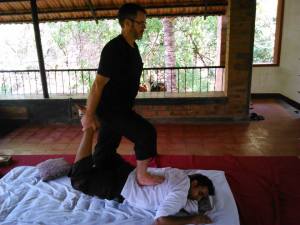
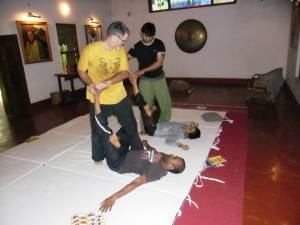
It was October of 2013 and I found my way to the Meditation Hall at the Fireflies Ashram off Kanakapura Road outside Bangalore’s southern sprawl.  That morning, I’d begin learning the sequence of actions of the Chiang Mai style of Thai Yoga Bodywork (TYB.) I would struggle to remember that sequence as I awkwardly groped about trying not to drive my thumb into the bones or nerve junctions of my fellow students. But over the course of those ten days, I progressed to the point that my awkwardness was less apparent, and I could get through the sequence without forgetting much.


I’d arrived in India with a long list of activities to try and skills to learn as part of a plan of self-betterment. That TYB course was the first item on the list to be scratched off. I’d been in the country a little over a month.  The strange thing about that was that TYB was the activity farthest outside my comfort zone. I wasn’t a complete stranger to yoga or meditation when I arrived in India. And while I was new to the martial arts of Kalaripayattu and Muaythai, I’d practiced a Japanese martial art my entire adult life.  So while I wasn’t skilled at those arts, I had a level of transferable confidence to counterbalance my lack of skill. The same couldn’t be said TYB. It was all new. But that’s the magic of moving around the world, everything is outside your comfort zone, so you might as well go big or go home.


Small world.  A couple of years later, I’d be in that same Meditation Hall for the capstone weekend of my 500-hour yoga teacher’s course.  I remember lying in that Meditation Hall, resting after having learned the advanced cleansing practices (shatkarma) of hatha yoga. (By then there was an entirely new level outside my “comfort zone” as I’d purged my entire alimentary canal.) At any rate, the Fireflies Meditation Hall was just a piece of geographic connective tissue that linked my yogic and TYB educations. I’d like to discuss five more substantial links.


5.) Anxiety management:  Let me begin with a theme that I mentioned in my introduction. It’s an aspect of personal development that I’ve spent a lot of time working on recently, and that’s moving outside one’s comfort zone to dispassionately observe one’s anxieties.   Both Yoga and TYB present practitioners with opportunities to observe and tame anxieties in a safe way. In TYB, one’s anxiety might be about injuring the person one is working on, about doing a poor job, or it could even be just about touching strangers. People have various reasons—from various social anxieties to germophobia—for discomfort with physically touching people they don’t know well. (Being an introvert, I have a tinge of this discomfort that would likely be much worse if I hadn’t studied martial arts. But, having studied a grappling-centric martial art for so many years, I’d developed a bit of transferable confidence about being in close physical proximity with people I didn’t necessarily know well.)

Anxiety about injuring another


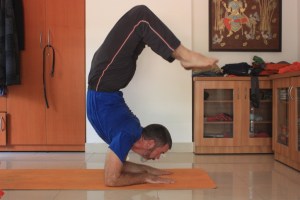
In yoga, the sources of anxiety are often gravity related (e.g. inversions and arm balances), but can be quite varied. I mentioned shatkarma as another example. And I’ve found external breath retentions from pranayama to be a potent area in my own personal practice.


Anxiety about injuring oneself


At any rate, what both Yoga and TYB do to help one take on one’s anxiety is to insist that one confront it in a mindful way. Just practicing forces one to experience the anxieties, but the crucial second ingredient is that one must keep one’s attention on the action—preventing one’s mind from engaging in the escalatory patterns by which it makes molehills into mountains. While it’s true that there are many other activities that this should be true of, it’s common in many fitness activities to practice distractions. People often blare portable music devices to drown out their body and mind as they exercise and practice other self-betterment activities. Such distractions aren’t an option in [good] TYB or Yoga instruction (Note: I say “good” because one can see a sad wave of distraction yogas out there that bury the sensations of practice in cute animals, alcohol, and—even–frat-house style raves.)


4.) Anatomical intuition: Both TYB and Yoga expand one’s understanding of the human body. A great feature for those who practice both systems is that the two systems are complementary. They present both overlapping and non-overlapping means to insight into the body. Yoga provides insight through all of one’s senses—not just the five we think of, but including proprioception (the sense by which a person is aware of the position of his or her own body parts and their movement) and balance. In other words, yoga allows one to see inside one’s own body as fully as possible. On the other hand, TYB offers the opportunity to learn about the wide range of variance in human bodies—feeling all their varied characteristics, strengths, and weaknesses.

Finding the limits of another


I think a yoga teacher can learn a great deal by practicing TYB. It encourages a greater understanding of the strengths and limitations of others. At the same time, TYB practitioners benefit from yoga’s high degree of intra-bodily awareness because the Thai style involves many assisted stretches that require strength, balance, and awareness.


Finding one’s own limits


3.) Appreciating the Slow: Modern life shouts at one to do everything faster. Yoga and TYB are two activities in which there isn’t any payoff for being faster, and, in fact, there are costs. In TYB, the massaged individual will find a fast tempo massage less relaxing. If one has ever been handled by a masseuse or masseur like a baker making bread, one knows exactly what I’m talking about. Hatha Yoga also emphasizes slow movement. Even when one is doing an active style like Ashtanga Vinyasa Yoga, there’s an emphasis on maintaining control of the body throughout, and that requires engaging musculature to counter the forces of gravity and momentum.

FYI- this is the aforementioned Meditation Hall during that first training


Sometimes slow is the only way to succeed


2.) Core stability and muscular endurance:  Both TYB and Yoga build and require core strength and muscular endurance. Bodywork is a physically demanding job. When one learns TYB, a great deal of attention goes into the minutiae of handling the client so as to minimize the stress and strain on one’s body. Still, there’s no way around the fact that one is manipulating another person’s body  and one has to bear that weight so that the client can be relaxed as one stretches them out or turns them over. Commonly, those people will be larger and heavier than the person delivering the massage.  Even if one isn’t doing TYB all day, one will likely feel it—perhaps all the more because one hasn’t developed that core strength and muscular endurance. Yoga can also help the TYB practitioner to keep supple in a job that can easily make a person sinewy.


On the other hand, yogis and yoginis can learn a thing or two about balance and control of the core from the challenging act of manipulating another person through their stretches.


1.) Attentiveness to Subtle Sensations:  In yoga teacher training, one is often shown Wilder Penfield’s homunculus. Penfield was a doctor who studied the functional organization of the brain, and particularly the sensory and motor cortexes (the parts that process sensations and commands to move body parts.) He was eager to map the motor cortex so that he’d know what portions of damaged or cancerous tissue could be removed without causing paralysis or the like.  At any rate, you’ve probably seen either a flat or 3-D version of the homunculus. It’s notable for its huge lips and hands and comparatively tiny chest and thighs. That’s because the size of a body part on the model doesn’t represent its anatomical size but rather its size in the brain, and our hands have a truly astounding piece of cerebral real estate.


What’s fascinating is that for all this capacity for feeling through our fingers, one has to practice to get the fullest out of that ability. In the beginning, it can be quite different to feel huge knots in the muscle during TYB sessions—even though our ability to differentiate tiny tactile differences is tremendous.  In yoga one isn’t so much engaged in feeling with one’s fingertips as one is with one’s internal sensory suite, but the point remains that we have a great deal of capacity that most people leave unused.


I suspect there are many more points of confluence between TYB and Yoga that haven’t occurred to me. If you’ve got one, feel free to comment below.

BOOK REVIEW: How Enlightenment Changes Your Brain by Andrew Newberg and Mark Waldman

How Enlightenment Changes Your Brain: The New Science of TransformationHow Enlightenment Changes Your Brain: The New Science of Transformation by Andrew Newberg
My rating: 5 of 5 stars

Amazon page


This book busted me over the head with some profound food for thought. I’d been skeptical of the notion of Enlightenment. [Note: the authors distinguish big-E Enlightenment as a permanent and substantial brain change, in contrast to the little-e enlightenment which is just a momentary epiphanies or insight—a number of which may precede the big-E Enlightenment.] It’s not that I disbelieved that some people had life-changing and / or perspective-changing experiences, but rather that such events represented permanent change. My skepticism was influenced by the many gurus who have been said to be Enlightened, but who behaved to all appearances like petty, materialistic douche-bags. It’s not that I couldn’t believe that these teachers achieved some momentary heightened state of consciousness during their youth, but—if they had—they clearly couldn’t maintain it under the pressure of being idolized. I’d, therefore, come to think that life is a perpetual struggle to try to be a better version of oneself, and backsliding can and will happen at any moment. This book, however, suggests there is a possibility for permanent brain changes. [Though Dalberg’s “Absolute power corrupts absolutely” seems to still apply.]

Andrew Newberg is a neuroscientist who has made a career out of conducting brain imaging studies of people engaged in various spiritual, religious, and meditative activities. His co-author is a psychologist, Mark Robert Waldman, who works on applying neuroscientific understanding to positive psychology. In this book, the two examine what Enlightenment is from a neuroscientific standpoint and then try to cull the common features across a population of cases of Enlightenment / enlightenment. Discovering the common elements of Enlightenment is no easy task. While it seems everybody is theoretically capable of achieving Enlightenment, it also seems that the experience is different for everybody and the collection of systems (religious, spiritual, and secular) by which it’s pursued is vast. However, the authors present a five-step outline by which readers can prime themselves to achieve Enlightenment, and it can be personalized depending upon one’s beliefs (or lack thereof—Enlightenment occurs among agnostics and atheists as well as religious practitioners) and background.

The book consists of 12 chapters divided among three parts. Part I (Ch. 1 to 5) lays the groundwork for readers to understand what Enlightenment is, how it feels, how it’s experienced between people with radically varying belief (and disbelief) structures, and it presents a model of human awareness that is crucial to the later discussion. Part II (Ch. 6 to 9) considers what happens in the brain during various practices by which individuals advance towards Enlightenment. Concepts like unity, surrender, and belief are explored in detail. Part III (Ch. 10 to 12) describes the process by which readers can pursue Enlightenment for themselves. If one is inclined to chart one’s own path, versus adopting an existing program, one has all the insight and tools to begin constructing one’s personal method by the time this section is complete.

The book has graphics as necessary (e.g. brain diagrams) that largely consist of line diagrams. There is an appendix that consolidates tools and resources, and the book is annotated by chapter.

I found this book to be both interesting and potentially beneficial to readers who take it beyond a popular science book and into the realm of self-help. The authors do a great job of navigating the waters between religion and science. Obviously, they are scientists and are agnostic about that which cannot be proven, but they don’t question other people’s beliefs and–if anything–error on the side of being open-minded. Still, I suspect that there will be religious types offended by the very notion that all humans are biologically primed to achieve this heightened state. It should be pointed out that the book could be supremely useful for such individuals because it points out the need to engage in exercises to challenge one’s most closely held beliefs. (Those with less mental flexibility and capacity for tolerance seem to be less likely to achieve Enlightenment.)

I’d recommend this book for anyone trying to figure out how to be the ultimate version of oneself.

View all my reviews

POEM: Sitting

I feel the swell,

but can’t see the boat.

Let alone know whether

it contains passengers.

It’s night.

The sea is dark,

and the most I can hope for

is a glint against the hull.

If I look to where the glint was,

She’s gone.

Tune to the

rise and fall

of the swell.


[National Poetry Month: Poem #17]

BOOK REVIEW: The First and Last Freedom by Jiddu Krishnamurti

The First and Last FreedomThe First and Last Freedom by Jiddu Krishnamurti
My rating: 4 of 5 stars

Amazon page


The edition of the book I’m reviewing is the Harper Collins e-book with a Forward by Aldous Huxley and in which more than half of the page count consists of appendices of Krishnamurti’s answers to various broad-ranging questions (i.e. What is the meaning of life, and such?) Jiddu Krishnamurti was a philosopher of Indian origin who passed away in 1986. This was one of his early books (first published 1954, though this is a 2010 edition) and it covers quite a bit of philosophical ground.

Krishnamurti’s teaching attracted a unique audience and existed in a unique space—at least back in his time. The topics he addressed were traditionally in the domain of spiritual philosophy, theology, or theosophy, but Krishnamurti downplayed belief and spiritualism. His teachings were attractive to those who were interested in developing their minds and selves, but who were dismayed by religiosity and all that such proclivities brought with it. Like mysticism, his ideas are about turning inward, but sans the notion that there’s a deity residing inside. In Krishnamurti’s writings, one hears echoes of Emerson’s suggestion that one must trust oneself and not get tangled up in the ideas of others—though, again, Emerson was clearly a believer. There’s also overlap with the ideas of some secular humanists, though they tend to be more scientists and less interested in meditations of the sort that have usually been relegated to spirituality in the past. (This has, of course, changed considerably in the decades since Krishnamurti’s death. Now this is a thriving space.)

The book itself consists of 21 chapters, and then there are 38 question-appendices. The chapters are 140+ pages and the appendices are cumulatively the same length. The appendices may be offered to attract readers who read the original book in a different edition. (It’s not so much a padding situation, because the 21 chapter book is long enough to stand as a book in print edition in and of itself.) The question section offers past readers a substantial amount of new material while providing an opportunity to reread the book.

There’s too much material covered by this book to make it worth accounting for it all. The overall theme of looking within to find one’s answers plays out across topics like fear, desire, the tension between individual and society, etc.

There’s good and bad news about readability. The good news is that, as one might expect of a book with almost 60 chapters (or chapter-like appendices) in a book of less than 300 pages, the information is delivered in bit-sized chunks. The bad news is that Krishnamurti was a thinking-man’s thinker. He’s not troubled to employ story-telling, humor, or the spinning of interesting language. This is raw philosophizing, and so it reads incredibly dryly unless one is a philosophy-lover to the core.

I would recommend this book for philosophy lovers.

View all my reviews

BOOK REVIEW: What Does Fear Do To You? by J. Krishnamurti

What does fear do to you?What does fear do to you? by Jiddu Krishnamurti
My rating: 3 of 5 stars

Amazon page


This book is one in a series called “Krishnamurti for the Young.” It deals with an important subject: fear and the adverse consequences of fear unchecked. Jiddu Krishnamurti was an Indian philosopher who was being groomed for a leadership position in the Theosophical Society as a young man, but he withdrew from that organization to pursue a more independent-thinking and non-sectarian philosophy.

Judging from the fact that the first edition of this book is dated 2004 and Krishnamurti passed away in 1986, it’s safe to say that this work is cobbled together from a combination of unpublished and previously published speeches and writings. There’s a page of sources and acknowledgements that provides the citations for the previously published writings. This is presented in end-note format.

The first half of the book is a story from Krishnamurti’s life that transitions into the basic theme of the book. The second half is presented in the form of questions and answers. The questions are clearly of the type children would ask, and so they may have been from school visits and the like.

It’s a short book of fewer than 30 pages–appropriate in length for kids. It has simple child-friendly drawings that were based on originals drawn by children. While the text is edited to a readability level suitable for children, as I’ll explain below, the material by-and-large isn’t presented in manner conducive to reaching children.

The book is a bit cerebral for young children in places–both in terms of the approach to delivering the material and the concepts presented. It may be of use to older children (but they may feel it’s targeted for younger kids based on the graphics.) The central message is sound: that one can watch one’s fear and see that it’s a mental product and then one can figure out how to respond to the emotion without acting impulsively or destructively. However, a more story-centric approached would better serve kids. There’s a story at the beginning about Krishnamurti walking close to a rattlesnake, but after that it becomes much more of a philosophy and psychology lesson. Krishnamurti frequently uses Socratic Method (asking questions instead of lecturing to help the reader discover a conclusion.) This method is of greater benefit to adults and young adults than young children.

I also felt that this was clearly an adults-eye view that could have benefited from a more child-eyed worldview. There’s an assumption that kids are afraid of everything and everybody and that adults are the experts in being fearless who can teach kids everything they need to know. Only an adult whose inner-child had been brutally murdered could think something so inherently ridiculous. As someone who’s taught kids yoga and martial arts, I can tell you that this is clearly not the case. In some domains, kids are far more expert fearlessness than are adults. This is something that could be tapped into to better make the point.

It seems to me that this book might be most productively read by someone who’s going to teach kids about fear and how to manage their fears. It’s great information, but it’s not presented in a manner that seems likely to grab a child’s attention. It’s not presented in an interesting fashion, and it deals in topics like conscious and consciousness that are heady for a youngster.

View all my reviews

5 Reasons to Write Poetry

We’re a week into National Poetry Month. I’ve posted a few poems with more to come, but here I’ll reflect upon the benefits of writing poetry. Some may point out that this is one-sided because the pantheon of poets is littered with opium addicts and suicidal depressives. I read a BBC article citing research showing poets were 20 times more likely to be institutionalized than the non-poet population. I maintain that those bards were broken from the beginning, and that there’s another side to the story.


5.) Poems are puzzles, and puzzles make you problem-solve. This may be more true of structured poetry than free verse, but a poem wrangles words into a relationship designed to create a desired outcome–often an emotional state. With structured poetry one faces a tight puzzle that’s constrained by syllable counts, the relation of stressed and unstressed beats, or rhyme schemes. But even free verse cuts away everything that dampens a desired resonance. That’s done by a series of strategic choices.


4.) Poetry aids emotional management. A study by UCLA researchers found that poetry writing dampens the activity of the amygdala (the brain’s bringer of fear) and, of course, gives the pre-frontal cortex something to do (besides creating catastrophic scenarios–which is its go-to occupation under stress.)


3.) Poetry helps build better prose. Some writers will be more concise and others will be more graphic, but there’s always a benefit to be had. I found a NaNoWriMo blog post that tackles this topic nicely, so I’ll just link.


2.) Poetry activates attentiveness. This is especially true of a form like haiku, which consists of natural observation unembellished by analysis or sentiment. However, all poetry styles require one examine the world intensely enough to see the old anew. This post may be of interest on the topic.


1.) Poetry can access the unconscious. As a practice, I often just put pencil to paper write whatever comes without intervening or directing my conscious mind. Yes, most of it’s crap.  Or not even crap–more like gibberish. But when I go back through these later on, phrases often jump out at me as interesting or evocative, and these often find their way into the heart of actual poems. This is a particularly beneficial practice when one is stuck.

BOOK REVIEW: Head in the Game by Brandon Sneed

Head in the Game: The Mental Engineering of the World's Greatest AthletesHead in the Game: The Mental Engineering of the World’s Greatest Athletes by Brandon Sneed
My rating: 5 of 5 stars

Amazon page


There are many factors that influence whether an athlete can reach an elite level. Physical factors such as VO2 max (maximum oxygen consumption) and musculature have long been at the fore in the minds of coaches and trainers, but they’ve never told the full story. There are athletes who have the muscles, lungs, and general physiology to dominate their sports who fall apart under pressure. One also sees the occasional athlete who is consistently good even though he seems puny by comparison to his peers. It used to be that mental performance was considered an endowed X-factor–you either had it or you didn’t. Coaches didn’t know how to coach for issues of the mind and often exacerbated problems with old school attitudes and approaches.

We’ve now entered a new era in which a bevy of techniques and technologies are being exploited to strengthen the mind and improve psychological deficiencies, just as gyms have always been used to build the body and combat physical deficiencies. These range from techniques of meditation and visualization that have been known to yogis and Buddhists for centuries to advanced technologies that have only become available in recent decades and which are constantly improving and being made obsolete. Sneed examines the gamut of these approaches as they are applied to improving performance in sports: from the meditative or therapeutic to the electronic or pharmacological. One no longer need give up on athletes who are great at their best, but who get the yips at the worst possible times. The performance of mediocre athletes can be improved and that of the best can be made more consistent.

Sneed has a unique qualification to write this book. He counts himself among the athletes who couldn’t reach his potential because of inconsistency rooted in psychological challenges. His willingness to be forthright about his own problems makes the book more engaging. His own stories are thrown into the mix with those of athletes from football, basketball, soccer, baseball, adventure sports, and mixed martial arts (MMA.)

The book’s 19 chapters are divided among four parts. The first part lays the groundwork, helping the reader understand the rudiments of how the brain works, doesn’t work, or works too hard for a competitor’s own good. A central theme is that the ability to analyze and train through the lens of neuroscience has removed some of the stigma that has always been attached to psychological issues in sports (not to mention the days when they were written off as weakness.) Much of the six chapters of Part I deal with assessment of the athlete’s baseline mental performance. The last chapter (Ch. 6) covers a range of topics that have been around a long time as they’ve been reevaluated through modern scientific research. These include religion, faith, superstition, meditation, visualization, and the immortal question of whether sex is good or bad for athletic performance.

The second part consists of five chapters taking on one fundamental truth: mind and body are not two disparate and independent entities. This section starts at the most logical point: breath. Practitioners of yoga (i.e. pranayama) and chi gong have known for centuries that breath can be used to influence one’s emotional state and level of mental clarity. Sneed evaluates the technology that is being used to help athletes master the same age-old lessons. Having laid the groundwork through breath, the section advances into biofeedback technology. There are two chapters in the book that deal with pharmacological approaches. One is in this section and it deals with legal (at least in some locales) substances such as caffeine, alcohol, nicotine, nootropics (alleged mind enhancing drugs), and marijuana. (The other is in the final part and it deals with hallucinogens.) There are also a couple of chapters on technologies used to produce or enhance desired mental states.

For most readers, the third part will be seen as the heart of the book. Having considered how to evaluate an athlete’s mental performance (Part I) and how to influence mind states by way of the body (Part II), this part explores the range of technologies that are used to exercise the mind in a manner analogous to working out the body. These technologies focus on a range of areas including improving the nervous system’s ability to take in information, process that information, and respond appropriately. Much of this part focuses on video games; albeit video games using state of the art virtual reality and which are customized to improvement of athletic performance. Some of the games are used to train general cognitive performance (e.g. Ch. 13) but others are specifically tailored to the game in question (i.e. Ch. 14.) Just as simulators are used in aviation, part of the advantage of these games is the ability to put players in progressively more challenging conditions.

The last part of the book was the most interesting to me, personally. [It’s also the part of the book that will be the most relevant and readable a few years down the road because it’s not as modern technology-centric as most of the book—especially Part III–is.] It’s entitled “The Spirit” and it explores X-factors to performance, but sans the assumption that these are endowments, but rather under the assumption they are trainable. The part has an important introduction that presents the research about how “soft” factors like gratitude play into outlook and performance. Then there are the Part’s three chapters. The first describes an experiment involving taking elite athletes into physically arduous conditions of the kind normally experienced by military special operations forces in survival training. The second tells the story of MMA fighter Kyle Kingsbury’s use of hallucinogenic substances (most intriguingly, ayahuasca, a powerful drug long used by Peruvian shamans.) Finally, the last chapter deals with sensory deprivation—a technology some will associate with the movie “Altered States” but which many athletes swear by.

The book has an extensive section on notations and sources organized by chapter. There are no graphics.

I enjoyed this book and found it to be informative. There are a number of books that explore the techniques and technologies of optimal mental performance, but this one develops a niche by focusing on the realm of sports and some of the technologies that are only available with the kind of deep-pockets seen in professional sports. The book is heavily weighted toward the technology part of the equation, which is both good and bad. If you’re reading it now (2017), it’s great because you’re getting an up-to-date discussion of the subject from the perspective of entities that are awash in money for tech. The downside is that this book won’t age well, at least not as well as it would if there was more emphasis on approaches that aren’t based on cutting-edge technology.

I’d recommend this book if you are interested in optimal human performance, and if you have an interest in sports, all the better.

View all my reviews

BOOK REVIEW: Missing Link Discovered by P. Marer, Z. Buzady, and Z. Vecsey

Missing Link Discovered: Planting Csikszentmihalyi's Flow Theory into Management and Leadership Practice by using FLIGBY, the official Flow-Leadership GameMissing Link Discovered: Planting Csikszentmihalyi’s Flow Theory into Management and Leadership Practice by using FLIGBY, the official Flow-Leadership Game by Paul Marer
My rating: 4 of 5 stars

Amazon page


So, you’re a leader and you’ve experienced Flow. Self-criticism vanished. Time fell away. The task was challenging, but the performance felt effortless. Your attention was rapt, and any craving for distractions disappeared. Maybe you even had a spate of creativity. You come away feeling great. Clarity reigns. Maybe you found Flow at work, but maybe it was skiing, golfing, or composing haiku. Either way, after thinking about how to repeat the feat, your next thought is, “What could my business [or organization] achieve if my people were in this state of mind for even a fraction of each day?” Increased productivity? Decreased healthcare costs and / or disruptions from sick days? Maybe, you’d see fewer complaints between stressed co-workers, or coming from customers? Regardless, you know that Flow is elusive and fickle. It may seem that the harder you seek it, the less success you have. You pick up a couple of books on finding Flow—maybe you watch some TedTalks on YouTube–and they provide helpful tips for finding the state for yourself, but most don’t have much to say on facilitating Flow for others.


That’s where FLIGBY comes in, and “Missing Link Discovered” is a companion to FLIGBY. [Note- “FLIGBY” is short for “FLow is Good Business for You,” which ties it into the work of positive psychologist Mihaly Csikszentmihalyi who both coined the term “Flow” and wrote a book entitled “Good Business” about both achieving Flow in the workplace and how some businesses succeed in the simultaneous pursuit of profit and virtue. Csikszentmihalyi was actively involved in the development of the FLIGBY game. The “missing link” referenced in the title is between leadership and Flow.] FLIGBY is an educational video game in which the player assumes the role of General Manager (GM) of a winery. The last GM was a hard-driving pursuer of profit who left the winery’s mission and values in a muddle and its employees stressed out and at each other’s throats. The player makes about 150 decisions over the course of the 23 scenes that map to a timeline of one’s first half a year as GM. While the player still has to consider the usual business objectives–such as profitability–to succeed one also has to help one’s employees find Flow. The game is used by both by professors of business education courses (e.g. in MBA programs) and by corporate trainers.


As this is a review of the book and not the FLIGBY game, I won’t talk too much more about it beyond this paragraph. However, I did have an opportunity to play the game and found it to be both educational and engrossing. The scenes are live-action, and the cast did a great job of creating the emotional tension necessary to make one feel a stake in the decisions. There’s a narrative arc that unfolds over the course of the game, and so it appeals to the way our brains best take in information. Of course, the game also pays attention to those factors that facilitate Flow, such as offering immediate feedback and an increasing challenge such that the difficulty rises with one’s skill.


I’ll now clarify what I mean by the book being “a companion” to the FLIGBY game. It’s not a game manual. [i.e. The nuts and bolts of how to navigate the game as well as general background information are provided within the game itself as well as through a series of digital appendices—a list of which is included in the book.] Rather, “Missing Link Discovered” is intended to bring readers up to speed in three areas relevant to the FLIGBY game. These areas are delineated by the book’s three parts. Part I (Ch. 1 – 3) introduces Flow and explains how its pursuit fits into the larger scheme of leadership responsibilities. It begins with an introduction to Flow and Csikszentmihalyi’s research, then links Flow and leadership, and—finally–describes the set of leadership skills used in the game.


The second part (Ch. 4 – 8) introduces the game, situates it in the context of serious games (those for which entertainment is a secondary concern), and discusses the topic of feedback in great detail (Note: feedback is a crucial issue because delayed or inadequate feedback is one of the major reasons that people have trouble achieving Flow–particularly in a workplace setting.) The last chapter in this section is a collection of captioned photos that charts the development of the game from the first meeting with Professor Csikszentmihalyi to the game’s use for both instruction and research.


While the first two parts of the book are relevant to all players, the last part is aimed at Professors, corporate trainers, and researchers. It consists of two chapters. Chapter 9 discusses such issues as where in an individual’s education or training the game should be situated, and how it should be presented. The last chapter (Ch. 10) is a bit different in that it opens up a discussion about the research potential offered by FLIGBY. Given the game’s widespread use in both academia and the corporate world, a great deal of data is collected that can be used anonymously by researchers to study interesting research questions (e.g. how players in differing demographics or job positions make decisions.)


The book offers a number of ancillary features that increase its usability and clarity. The first of these features are two single-page summaries that introduce readers to Flow and FLIGBY, respectively. Besides the aforementioned photo chapter, the book has many diagrams and other graphics to clarify concepts addressed in the text. The book is footnoted throughout, and provides a glossary of key terms. It should also be noted that there is an introduction by Professor Csikszentmihalyi in which he describes his involvement in the project and presents his thoughts on the value of FLIGBY.


I recommend this book, particularly for those who will be playing FLIGBY or who are in the process of determining whether FLIGBY is right for one’s students or employees. From corporate programs in mindfulness to interest in Flow-based leadership, all signs point to a workplace revolution in which there is a long overdue convergence of incentives and objectives between employees and employers. It’s been a long road from Henry Ford’s plan to make sure all employees could afford the cars the company made to the explosion of Google’s “Search Inside Yourself” program and others like it, but this revolution is picking up steam and if you’re unaware, you might want to look into it.

View all my reviews