BOOKS: “Live Like a Philosopher” by Massimo Pigliucci, Gregory Lopez, and Meredith Alexander Kunz

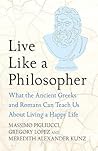
Live Like A Philosopher: What the Ancient Greeks and Romans Can Teach Us About Living a Happy LifeLive Like A Philosopher: What the Ancient Greeks and Romans Can Teach Us About Living a Happy Life by Gregory Lopez
My rating: 4 of 5 stars

Publisher Site — Hachette / Headline Press

This book is for a person in the market for a philosophy of life, but who only knows that they want a system rooted in Ancient Greece. While the coauthors are all Stoics, the book explores twelve additional philosophies and gives each roughly equal consideration. In addition to the expected systems, such as Epicureanism, Stoicism, Platonism, and Skepticism, there are also several lesser known or defunct philosophies such as Cyrenaic hedonism, Cynicism, Pyrrhonism, and Megarianism.

The book is organized into four parts. The first examines schools that value pleasure (Cyrenaicism and Epicureanism,) the next investigates schools that focus on virtue and character (Aristotelian Peripatetics, Stoicism, Cynicism, and Political Platonism,) the penultimate focuses on systems encouraging doubt or caution in knowledge (Socratic philosophy, Academic Skepticism, Sophism, and Pyrrhonism,) and the last set are posed as questionable candidates for a life philosophy (i.e. those of the Pythagoreans, Megarians, and Neoplatonists.) The last three schools are questioned on various grounds, including: is enough known about what its practitioners believed, did they live their philosophy or just ruminate on it, and could the system be considered a full-fledged philosophy (as opposed to a stance on a specific issue or issues.)

The book is presented in self-help fashion, with each chapter ending in a set of exercises designed to help the reader build practical understanding of each school. The goal of these exercises (as comes together in an appendix) is to help the reader determine which philosophy is best suited to their disposition and inclinations.

I enjoyed this book. The authors use stories to convey ideas and the book’s readability is kept inviting to general readers. If you’re interested in better understanding Greek schools of philosophy, I’d recommend the book as quick and easy way to get a better grasp.

View all my reviews

“Loss and Gain” by Henry Wadsworth Longfellow [w/ Audio]

    When I compare
What I have lost with what I have gained,
What I have missed with what attained,
Little room do I find for pride.

I am aware
How many days have been idly spent;
How like an arrow the good intent
Has fallen short or been turned aside.

But who shall dare
To measure loss and gain in this wise?
Defeat may be victory in disguise;
The lowest ebb is the turn of the tide.

“Lament I” [感遇一] by Zhang Jiuling [张九龄]

A lone goose flies in from the sea,
Not daring to land in water.
Glimpsing a pair of Kingfisher --
Nested Three Pearl Tree squatters --
It asks, "High up in that rare tree
Of gold spheres, are you not afraid?
Fancy clothes incur points and jeers
And those high up are harshly weighed.
As I roam dark rivers and hills,
Envious hunters give me chills."

This is the first of the 300 Tang Poems [唐诗三百首] and it is also the first of a quartet of poems. The original poem in Simplified Chinese:

孤鸿海上来, 池潢不敢顾; 
侧见双翠鸟, 巢在三珠树。
矫矫珍木巅, 得无金丸惧?
美服患人指, 高明逼神恶。
今我游冥冥, 弋者何所慕?

“A Question” by Robert Frost [w/ Audio]

A voice said, Look me in the stars
And tell me truly, men of earth,
If all the soul-and-body scars
Were not too much to pay for birth.

“A sepal, petal, and a thorn” (19) by Emily Dickinson [w/ Audio]

A sepal, petal, and a thorn
Upon a common summer's morn --
A flask of Dew -- A Bee or two --
A Breeze -- a caper in the trees --
And I'm a Rose!

“From China” by Amy Lowell [w/ Audio]

   I thought: 
The moon,
Shining upon the many steps of the palace before me,
Shines also upon the chequered rice-fields
Of my native land.
And my tears fell
Like white rice grains
At my feet.

“Climbing Mt. Xian with Friends” [与诸子登岘山] by Meng Haoran [孟浩然]

Human affairs ever grind on --
Ancient or modern, shit repeats.
Mountains and rivers are changeless.
We climb to find our vista seats.
Cascade, fisher, and bridge -- subdued;
Air grows cold near dreamy, deep pools.
We read an old stone monument,
As tears glisten on cheeks like jewels.

Original Poem in Simplified Chinese:

人事有代谢, 往来成古今。
江山留胜迹, 我辈复登临。
水落鱼梁浅, 天寒梦泽深。
羊公碑字在, 读罢泪沾襟。

Note: This is poem #125 from 300 Tang Poems [唐诗三百首]

Wen Fu 7 “Music” [文赋七] by Lu Ji [陆机]

Matter comes in countless varieties,
And the forms are evershifting, as well.
Writers must dance the varied characters
To dulcet lines where elegance dwells,
Finding the right pace, cadence, and stresses
To blend like harmony in the five hues.
Though the tune fades in and out randomly
And the path is rugged and hazard-strewn,
Those who know the ways of change and order
Will find all falls into place with a flow.
But if one misses the proper pivots
It's like grabbing the tail to steer the nose --
Like yellow painted onto wet, black walls,
One's writing becomes muddy, and it stalls.

The original in Simplified Chinese:

其为物也多姿,其为体也屡迁。 
其会意也尚巧,其遣言也贵妍。
暨音声之迭代,若五色之相宣。
虽逝止之无常,固崎锜而难便。
苟达变而识次,犹开流以纳泉。
如失机而后会,恒操末以续颠。
谬玄黄之粗叙,故浍涊而不鲜。

“Now Close the Windows” by Robert Frost [w/ Audio]

Now close the windows and hush all the fields;
If the trees must, let them silently toss;
No bird is singing now, and if there is,
Be it my loss.

It will be long ere the marshes resume,
It will be long ere the earliest bird:
So close the windows and not hear the wind,
But see all wind-stirred.

“On this wondrous sea” (4) by Emily Dickinson [w/ Audio]

On this wondrous sea
Sailing silently,
Ho! Pilot, ho!
Knowest thou the shore
Where no breakers roar --
Where the storm is o'er?

In the peaceful west
Many the sails at rest --
The anchors fast --
Thither I pilot thee --
Land Ho! Eternity!
Ashore at last!