BOOK REVIEW: Light on Yoga by BKS Iyengar

Light on Yoga: Yoga DipikaLight on Yoga: Yoga Dipika by B.K.S. Iyengar

My rating: 4 of 5 stars

Amazon page

I recently reviewed the book Asana Pranayama Mudra Bandha [APMB] and used this book as a point of comparison, and so further insight into my thoughts on this book can gleaned from that review. This will be fairly short and to the point as the APMB review provided a great deal of detail.

Light on Yoga is the work of world-renowned yogi BKS Iyengar. Iyengar is one of several noted students of T.T. Krishnamacharya, and is celebrated for developing a system using props (belts, blocks, chairs, bolsters, etc.) to achieve correct alignment in yogasanas. You won’t learn about props in this book. Iyengar–at least the Iyengar of the 1960’s–didn’t need props to achieve proper alignment. In fact, he was capable of all manner of what can best be described as contortionism.

This book is a solid reference for Hatha Yoga. It covers all the basic asana (postures), pranayama (breathing), bandha (locks), and a large number of variations and advanced asana. Light on Yoga also has an introduction to the eight limbs of yoga (of which asana and pranayama are but two.) There are also helpful appendices like a glossary, a 300-week course outline, and a list of courses for various ailments. The book doesn’t cover shatkarma (cleansing practices) or mudra (sealing postures) in any depth.

The graphics in this book are beneficial and consist of black and white photos of Iyenger performing the asana with his perfect alignment. There are multiple shots of asana as needed either to demonstrate how to enter / exit the posture or to show the completed posture from multiple angles.

As I suggested in APMB review, my biggest complaint with Light on Yoga is that it doesn’t systematically address contraindications, and we don’t learn what evidence supports various claims of benefits.

I’d recommend this book for Hatha Yoga students and teachers. Its strengths make it a valuable text and its weaknesses can be addressed with other books.

View all my reviews

BOOK REVIEW: Asana Pranayama Mudra Bandha by Swami Satyananda Saraswati

Asana Pranayama Mudra BandhaAsana Pranayama Mudra Bandha by Swami Satyananda Saraswati

My rating: 4 of 5 stars

Amazon page

Asana Pranayama Mudra Bandha [APMB] is one of two textbooks used in a yoga teacher training course I recently attended. The other text is BKS Iyengar’s Light on Yoga. Iyengar’s book is one of the most well-known yoga books in the world, and I, therefore, expected that I would prefer Light on Yoga to the much more utilitarian looking APMB—a book that you’re unlikely to find at your local bookseller (unless, like me, you live in India—in which case it is quite popular.) However, having now read both books, I think I would give an edge to APMB. I don’t usually frame a book review in comparative terms, but–in this case–the books are similar in subject matter, and comparison may benefit the many who have the Iyengar book.

Both works are largely collections of detailed descriptions of yogasanas (postures), breathing methods (pranayama), mudra, bandha, and, in the case of APMB, Shatkarma (cleansing practices.) Shatkarma is not well-known in the West, but it is a series of 6 cleansing practices that, along with asana and pranayama, are part of the trio making up Hatha Yoga.

Before proceeding with this comparison, it should be noted that the APMB is associated with the Bihar–or Satyananda–School of yoga. Indian yogis and yoginis will likely be familiar with this school as a form of Hatha Yoga that was founded in 1964 by Sri Swami Satyananda Saraswati. Western practitioners are less likely to be familiar with the Bihar school as it has not made the same kind of splash in the West as Bikram Yoga (the most famous “hot yoga” style), Iyengar yoga (which uses props when necessary to achieve proper alignment), Power yoga (a faster and more endurance oriented form of yoga), and many other yoga styles with a hook. (I don’t mean to suggest that Westerners need a gimmick to keep their interest in yoga, but, on a whole, they do.) At any rate, while the Bihar School was founded in 1964, the yoga it presents is classical Hatha Yoga, incorporating some of the knowledge gained from modern understanding of anatomy and physiology.

What I liked best about APMB–and why I liked it better than Iyengar’s book– is its superior organization. APMB lists not only the alignments and benefits, but systematically spells out the contra-indications in their own bold headed section. Iyengar indicates contra-indications only sparsely and puts them in with the “effects” section which is mostly benefits. This makes contraindications easy to miss in the Iyengar book. APMB also has bold sections for breathing, awareness, and variations. This might make it seem like APMB would be denser, but it’s not—it’s actually more concise. Most of these subsections are short and to the point. Each asana takes between one and two pages (unless there are several variations.) While Iyengar clumps asana together with a logic, APMB delineates different sub-classes of asana (standing, forward bends, backward bends, etc.) with separate chapters.

One thing that surprised me is that I found APMB to be more forthright and scientific in its approach. I’d always heard Iyengar was modern and relatively scientifically oriented. After all, this is the man who introduced props for students who cannot perform asanas without proper alignment otherwise—so as to avoid injuries. Now I know that the Bihar School is also known for integrating present-day research into its understanding of yoga, but I was initially not so familiar with Bihar. So while both texts are better than most about depicting the risks, as indicated, Iyengar gives short shrift to the contra-indications and occasionally suggests an extreme posture for a severe ailment. While I applaud Iyengar’s passion, I think it has made him prone to see yoga as a panacea for all ills and to downplay the risks—at least in the late 1960’s when Light on Yoga was written. (Both books were written in the late 60’s, but—based solely on the front matter—it appears there may have been more revised editions for the APMB.

I should note that neither book uses citations to provide supporting evidence about what is a benefit or a contraindication. Some of these claims may be supported by scientific studies, some may be supported by experience, but some may just be old wives’ tales handed down based on pseudo-scientific or outmoded beliefs.

APMB doesn’t win hands down in all dimensions. Graphics is one area in which Light on Yoga is much more useful than APMB. Iyengar’s book uses photographs, and given Iyengar’s penchant for perfect alignment, his book’s photos are quite informative. APMB has line drawings, but some of the drawings suggest incorrect alignments (e.g. the knee well forward of the toes in an asana for which the shin should be perpendicular to the floor.) This would be a damning criticism if I thought anyone should or could learn yoga from the drawings in a book, but since I think pictures are just there to remind one of the general form of the asana, I don’t deduct too much for this flaw. [On the other hand, Iyengar is so flexible that his photos can be a little demoralizing for a person incapable of touching his or her skull to his or her coccyx.]

Iyengar’s book also has more information. While Light on Yoga has many more asana, each book has a few postures that the other doesn’t, but—for the most part—both of the books hit all the classic asanas of Hatha Yoga. I don’t give a lot of credit for having more asana or variations because both books have more than enough material to keep beginner, intermediate, and advanced students busy.

What I think may be valuable is the fact that Iyengar covers more background material in greater detail than does the APMB. Iyengar writes extensively on yamas and niyamas, and the other legs of Ashtanga Yoga (not to be confused with Ashtanga Vinyasa–a flowing and strenuous set-sequence form of Hatha Yoga from Mysore). Of course, if you are interested in shatkarmas or mudras, you’ll only get that information in the APMB.

Both books are beneficial references for students and teachers alike(not to suggest that teachers shouldn’t remain forever students, but not all students should be /need be teachers.) I’m particularly pleased to review this book as it may be an opportunity to introduce this book to some outside of India who may not be familiar with it. If you practice Hatha Yoga, you should give this book a look.

View all my reviews

BOOK REVIEW: The Wild Life of Our Bodies by Rob Dunn

The Wild Life of Our Bodies: Predators, Parasites, and Partners That Shape Who We Are TodayThe Wild Life of Our Bodies: Predators, Parasites, and Partners That Shape Who We Are Today by Rob Dunn

My rating: 4 of 5 stars

Amazon page

Dunn’s book addresses a host of intriguing questions such as:

-Why are there diseases that disproportionately attack those in the richest parts of the world while being almost non-existent in poor countries?
-Why is obesity at epidemic proportions among modern humans?
-Why—while people have diverse tastes overall—do there seem to be universal preferences for sweet, salty, and fatty foods?
-Why are so many people’s lives wrecked by constant stress and worry?
-Is the Appendix really a vestigial organ with no apparent purpose?

As the subtitle suggests, this book is about the role that other species have played in human evolution and the way we look, behave, and think today. The message of The Wild Life of Our Bodies is that humanity’s proclivity to see itself as an island–uninfluenced by other species–has its cost.

The book is popular science–approachable to a layman but with the usual disdain for gratuitous assertions and shoddy reasoning that define the scientific though process. That being said, Dunn does put some editorial opinion out there in ways that might appear as fact in a slipshod reading. The most prominent example being Dunn’s suggesting that what best defines humanity is not our intelligence or ability for abstract representation (or even our physical appearance), but that we are the only (first?) species that has killed other species off not purely of self-defense or for food, but to exercise control over our ecosystem. I doubt this would strike a majority of impartial scientists as a fair and unbiased way to define humanity. Granted, this point not what The Wild Life of Our Bodies is about, and whether one thinks this it is fair or not is not critical to whether one will find the book to be of value. However, the idea (and the fact) that humans have zealously killed off other creatures is certainly relevant to the discussion at hand.

If “terraforming” is the term for how an alien race might environmentally engineer Earth to make it suitable for them to live here, perhaps we could call humanity’s assault on other species “bio-forming” of the planet—choosing a roster of species that strikes our fancy. All the time humans were trying to make ourselves more comfortable by getting rid of inconvenient species, we remained ignorant to the downside.

Dunn covers a broad range of mismatches between who we are evolutionarily and how we live in the modern world. The Wild Life of Our Bodies suggests that, like the pronghorn antelope, humans are in many cases over-designed because of the loss of species (parasites, predators, symbiotes, etc.) that helped to make us who we are today. (One question that once puzzled biologists was why pronghorns were so much faster than every species they faced.)

While it sounds good to be over-designed (at least relative to the alternative), it’s not without cost. In our case, we had guts that were supremely adapted to having parasites, but the lightning fast (on an evolutionary timescale) elimination of those parasites has left us with bodies that attack a non-existent enemy and this has resulted in a number of new diseases. We are used to diseases that succeed in the poorest—and, hence, least hygienic areas– but disease that mostly attacked in the cleanest places on Earth have puzzled us for some time. Crohn’s disease is a prime example. “Rewilding” (i.e. putting parasites back into) the guts of Crohn’s patients has shown positive results.

Dunn lays out a couple of the theories as to how the loss of our intestinal bacteria may result in a number of first-world ailments. Interestingly, some of these diseases aren’t even digestive in nature, and might seem to have no logical connection to gut bacteria. However, our body’s systems are a system-of-systems—i.e. they are integrally linked. One issue is that some parasites have been able to mask their presence, and our bodies have learned to present a heightened response to account for this veiled threat. Today our systems can’t tell the difference between our squeaky clean guts and a gut full of these sneaking parasites so it drops the immune system version of an A-bomb.

This is one example of why some diseases don’t exist in the third-world where the body knows what parasites it’s up against. One might say, “Yes, but these ailments of over-reactive systems can’t be as bad as the effects of the parasites.” That’s often not true. Most people with internal bugs (we all have them to some degree), don’t even realize it. The fact that people with Crohns’ are willing to have predators implanted in them speaks to this issue.

There has been concern for years about downside of the rampant use of anti-bacterials, antibiotics, and antiseptics, and this is a topic Dunn addresses as well. For example, there seems to be little evidence that such agents in soap do any particular good, but they decidedly do bad (encouraging drug resistant species.)

Perhaps the single greatest change in the nature of homo sapiens life resulted from the agricultural revolution, and Dunn delves into how this seminal event changed our bodies. With paleo-dieting all the rage, it will come as no surprise that there have been some major changes to the human diet since our hunter-gatherer ancestors roamed the Earth. Once again, we have bodies built on an evolutionary timescale, and they don’t necessarily cope well with our new diets.

One problem is that we have strong hardwired drives for foods that were a rarity in our species’ past, but which we now produce in abundance. For example, we eat far too much refined sugar because our bodies are wired to love sweet, but that kind of food was rare to our pre-agricultural ancestors. Hence we have the existence of diabetes, and its greater prevalence where high-sugar diets are common. Many people are also saddled with an evolutionary advantage to store fat because their ancestors come from a clime where food was not abundant year round. The problem is that now there’s a grocery store on every corner and this once great advantage is contributing to burgeoning waistlines.

I gave this book a high rating on the grounds that it presented a lot of food for thought, and that’s what I most value in non-fiction. Some of the theories may turn out to be incorrect, but this book offers one a lot to think about and clear explanations of the bases for what can otherwise seem a little outlandish. There is also some wit in places that contributes to heightened readability.

View all my reviews

Yoga Instructor / Lotto Girl–A Most Dispicable Combination

A Product of Non-linearity.

A Product of Non-linearity.

Today, I did Power and Hatha Yoga classes back to back. The instructor for both these classes was highly-skilled, knowledgeable, and challenging–which is to say, somewhere between a Marine Corps Drill Sergeant and the Marquis de Sade in terms of capacity to bring the pain. If there’s not something that threatens to collapse  me into a disheveled  heap of limbs in each class, I risk getting bored. So when I say this yoga instructor is sadistic, I mean it in the most appreciative way imaginable.  And not appreciative  in that “Thank you, Sir. May I have another?” Animal House sort of way, but genuinely.

All that being said, there’s one particular piece of Sadism that stands above the rest, and that is a predilection for non-linear counting.

Imagine you’re in a pose, say a back bridge with one leg up in the air. The teacher has been counting down in the usual fashion taught to school children. You are quaking and your muscles are burning, but, from the integers being rattled off, you suspect you’re near being able to release and seek the momentary solace of some other unforgiving act of contortionism that will eventually have a different part trembling. However, sensing she needs more time to make a circuit of corrections, the teacher abandons our much-beloved linearity and begins rattling off numbers like the weather-girl who makes the nightly lotto drawing. (e.g. “and 4…3…37… 19…”)

Wait, what?   I can’t cry–at least not first. I’m the only man in room. Besides, sobbing might dislocate something.

Now, I’m aware that a true yogi wouldn’t give a whit what random numbers were being “counted” off. Said yogi would find his bliss in the asana and melt into oneness with the universe. However, being closer to the type of Yogi who likes to steal pic-i-nic baskets than the kind whose “Kundalini is awakened” (I’m not even sure what that means; I hope it’s not dirty), I still find it presents a challenge.

Paleo-Stressing: Acute v. Chronic Stress

"What happened to the good ole days when I ate you people--not lived in your cages?"

“What happened to the good ole days when I ate you people–not lived in your cages?”

Paleolithic dieting is all the rage these days. I’m no expert on the paleo-diet, but–as I understand it–this refers to the practice of eating the foods consumed by our pre-agrarian ancestors. The idea is that if one consumes the foods that our species is evolutionarily-optimized to eating, one will be healthier.  Whether one believes in the merits of the paleo-diet or not on the whole, it’s hard to argue that one wouldn’t be better off eating less highly-processed and highly-refined foods and more things that look like food at a glance.


Our diet isn’t all that has changed since the days of our pre-agrarian ancestors. Modernity has brought with it an entirely new way of experiencing stress. Eliminating or reducing stress is a common topic of discussion, but not all stress is created equal. There’s a necessary form of stress, a stress that makes one better, stronger, faster, and smarter. We don’t want to willy-nilly eliminate stress; we want to reduce the wrong type of stress.


Our ancestors—like animals–experienced brief periods of intense stress (e.g. saber-tooth tiger attacks), followed by longer periods in which they were free of deadlines, carpools, and after-school activities. Now, no one likes to have a saber-tooth tiger stalking them. It’s unpleasant. Modern humanity has gone to great lengths to eliminate those short bursts of terror, but not without cost. (If you don’t believe me read Robert Sapolsky’s Why Zebras Don’t Get Ulcers.)


Whether or not you believe that eliminating acute instances of terrifying stress is bad for mankind, it’s hard to argue that modernity’s leveling process didn’t eliminate stress, but instead resulted in a chronic stress on a smaller scale. People today have impossibly long daily to-do lists, and they have to accept trade-offs between work, family, and personal development.


It’s true that you don’t get eaten by a giant cat when you drop the ball, but life is so packed diverse events that one may feel like one is dropping some ball constantly. If your boss thinks you’re a model employee, then your kids are probably going to need therapy. If you have a contented home life, your boss may have his or her eyes open for someone who can give the firm consistently 70+ hour work weeks. If you feel you’re doing alright on both the work and family front, your body and / or mind is probably a train wreck.


Chronic [mini] stress may feel better than acute [catastrophic] stress, but it takes its tolls in various ways. First, with our sympathetic nervous system (fight-or-flight reaction) constantly engaged our body’s power to heal itself is reduced. When the parasympathetic nervous system is engaged, the body devotes resources to long-term goals like getting healthier, but in stress mode activities not relevant to immediate survival shut down. This is a great system if you have periodic life and death stress, but is not so good if you’re under constant stress.


Second, chronic stress reduces sleep, and sleep is essential to one’s mental and physical well-being. There are a wide variety of symptoms associated with sleep deprivation such as forgetfulness, decreased concentration, decreased alertness, reduced reasoning ability, diminished problem-solving capacity, and depression—all of which can diminish our physical health through accidents, ailments, suicide attempts, and lack of energy for exercise.


Third, chronic stress can make one fat, with all the health issues that result. Some people use food as a coping mechanism. Other people eat too fast or choose their food poorly because of time constraints or because they are not mindful of eating as their monkey minds churn at a mile a minute. Then there is the more convoluted and complex issue of cortisol–a hormone released under stress that is linked to weight gain in at least some cases. Even if you don’t have a problem on the calorie intake side, the stressed individual may not do so well on the calorie burning side—either because of a lack of time to exercise or a lack of energy.


Modern humans are uniquely suited to chronic stress because we are the only species that achieves the same physiological stress response by remembering and obsessing about a stressful event as experiencing it. Abandoning the modern approach to living isn’t an option most are willing to entertain; but there are ways to combat chronic stress.


Move – Meditate – Mindfully Breath: The bad news is you’ve got to shoehorn these activities into your schedule daily (or at least several times a week.) The good news is that they don’t need to take up a lot of your day. There are a number of systems that address all three components in one handy package such as Qi Gong, Yoga, and some martial arts. I don’t think it matters so much which one chooses as how one goes about one’s practice.


Movement strengthens and strategically stresses the body, but it also increases one’s bodily awareness so that one becomes aware of how stress is manifesting itself in one’s body. Meditation teaches one how to live in the present moment, and it trains one to recognize the seeds of negative thought and emotion earlier so that one can counter-act them. Obviously, breathing is essential to life, but learning to be aware of one’s breathing patterns and to “manually override” the breath patterns associated with harmful emotional states is a beneficial skill.


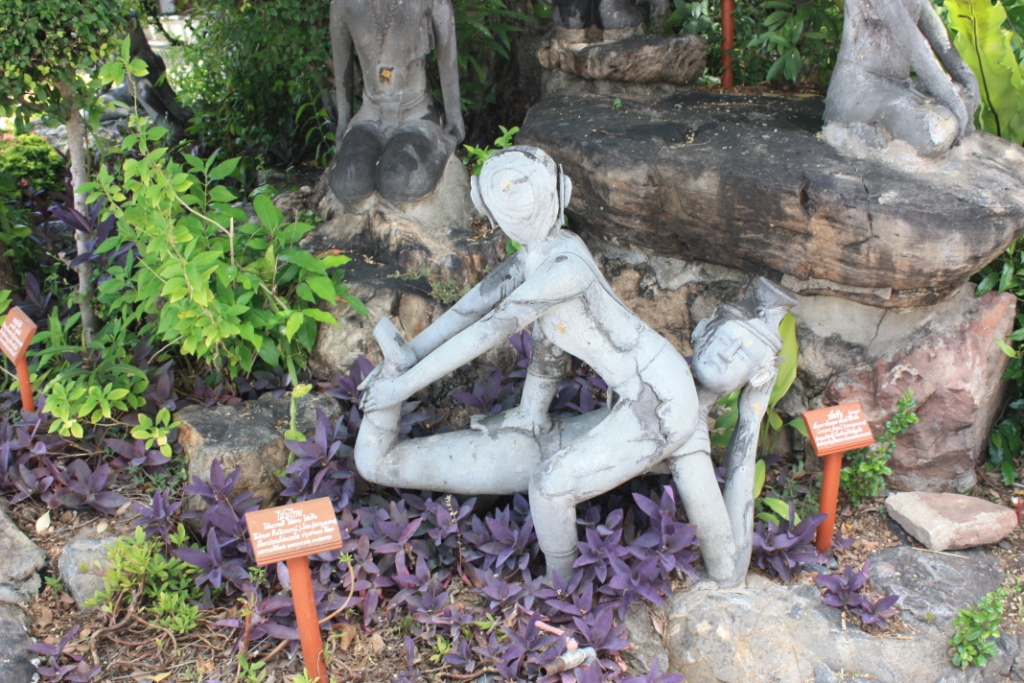
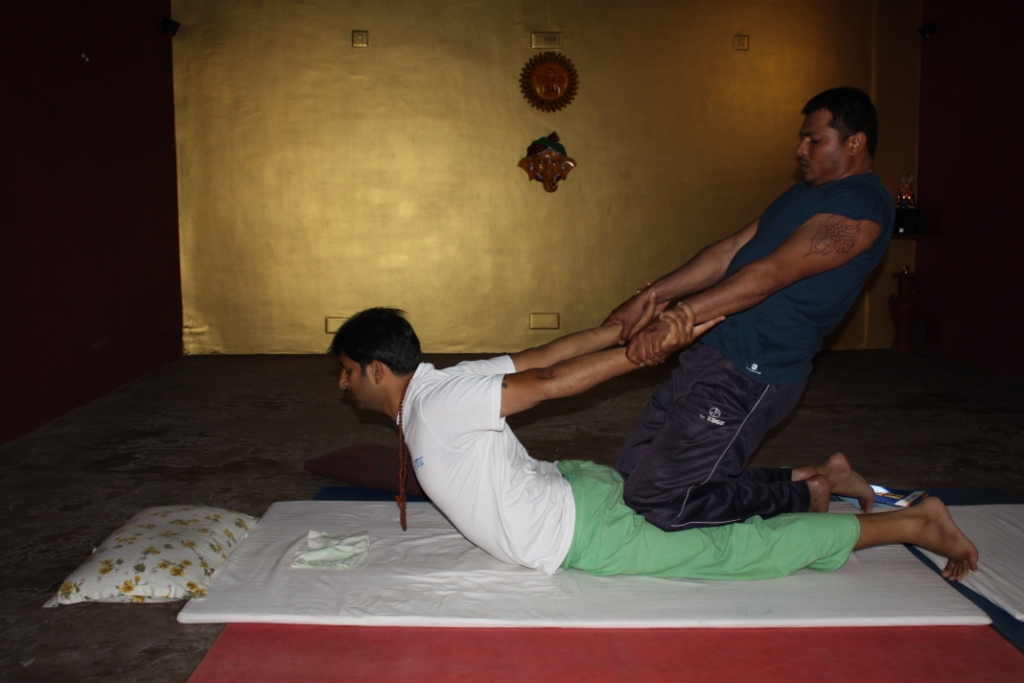
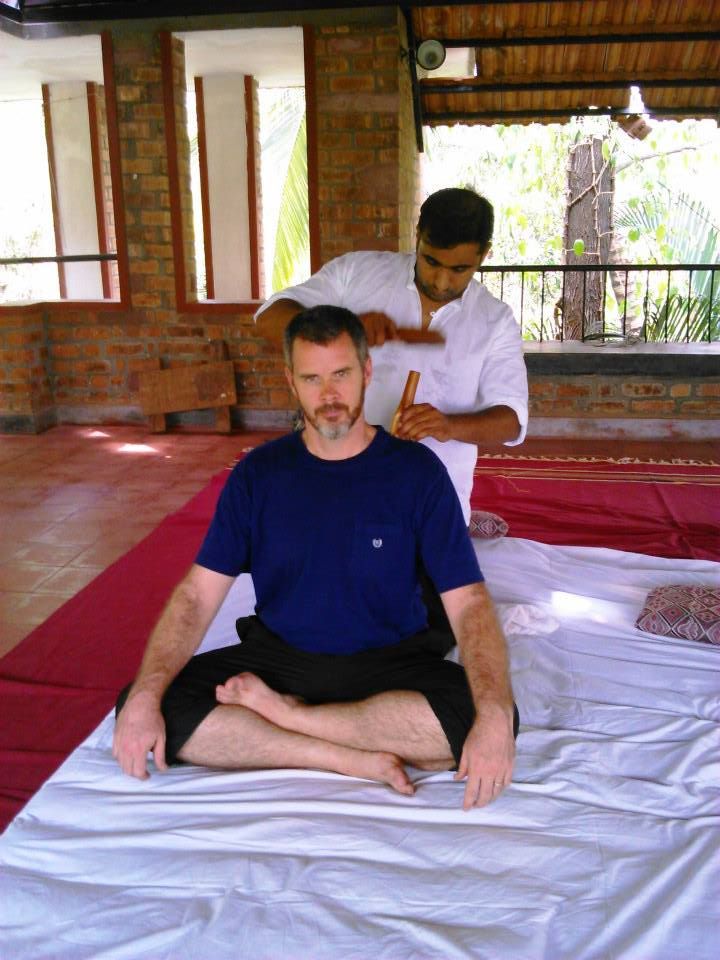
Massage / Bodywork: Whether self-administered or other-administered (the latter allowing greater distressing–particularly if the masseuse is skilled) massage is an activity, like movement, that can help one become aware of where one is physically holding one’s stress. These physical manifestations of stress can exacerbate the whole experience of stress. One should take time periodically to have bodywork done. A day rarely goes by in which I don’t work on my own neck, shoulders, head, or face, and I occasionally get professional Thai Yoga Bodywork done.


The Places that Scare You: Force yourself to go someplace (not necessarily literally a “place”) that scares you once in a while. This needn’t be skydiving or hand-gliding—but it could be. It may be a martial arts class in which one has to put on the gloves occasionally and go at it. It may be joining Tostmasters and having to give a speech in front of a crowd. It may be traveling to some backwater where you don’t know the language, but you want to learn. This is a very personal issue. (i.e. A Type-A personality he-man may not find that skydiving is outside his comfort zone. If so, sorry, skydiving doesn’t count, he may need to learn ballroom dancing, or something else that truly takes him outside being comfortable.) KEY POINT: The problem with hiding from all stressors is that it doesn’t result in a stress-free life, what happens is that smaller and smaller stressors loom bigger and bigger in one’s mind. Which brings us to…


Perspective:  One must put life’s challenges in perspective. Each person’s problems are important to them, and I don’t want to diminish anyone’s problems, but—come on—you’re not going to be eaten by a freaking saber-tooth tiger.

BOOK REVIEW: The Science of Yoga by William Broad

The Science of Yoga: The Risks and the RewardsThe Science of Yoga: The Risks and the Rewards by William J. Broad

My rating: 3 of 5 stars

I brought a great deal of interest and enthusiasm towards this subject as I began reading this book. As I proceeded to read, my feelings about The Science of Yoga became much more mixed. At its best, the book shows the state of scientific research on yoga and crushes myths that are deeply ingrained, and it points out risks of which yogis and yoginis should take notice. At its worst, it is sensationalism run-amok–suggesting hugely expensive solutions to issues that are either relatively small problems or that the author fails to prove are really problems at all. Put more simply, at its best it’s outstanding, but at its worst it’s tripe. What I will say about this book is the same thing that its author says about yoga, which is that—on balance—it does more good than harm.

The book is arranged into seven chapters, each of which discusses the scientific research on a different dimension of controversial beliefs about yoga. These include the historic claims of supernatural yogic abilities, the issue of whether yoga increases cardiovascular health, the role of yoga in mental health and well-being, the safety of practicing yoga, the role of yoga in healing, the sexual claims of yogis, and whether yoga enhances creativity. It is written in a scholarly format, heavily end-noted and with bibliographic citations. There is front matter giving information about key people, time lines, and yoga styles in outline form.

In an afterword, Broad points out that this has been his most controversial book to date. I can see why, but, to be fair, I’m sure much of the criticism is unfairly based on a failure to read the book or a desire for the author to treat many of yoga’s mythical aspects as science (as many of its practitioners do.) The former problem was exacerbated by the fact that a single chapter excerpt was published in the New York Times as a teaser for the book. Designed to spark controversy (always good for readership), it was one of the most negative of chapters—the one dealing with yoga injuries. Some who took umbrage probably didn’t realize that Broad is a yoga practitioner, and that there are chapters that are overwhelmingly positive on yoga (e.g. the chapter on “mood” which deals with yoga’s influence on psychology has mostly great things to say about the discipline.) While all of the chapters combine a mix of good and bad news, one comes away from some of them seeing a positive picture of yoga and others with a negative one. In the first half of the book it seems as though chapters may have been arranged to alternate positive and negative dimensions.

Of course, there will also be people who are outraged because of the discussions of the debunking of the con games of their beloved yogis, or for a failure to discuss the critical importance of things like Chakra fluffing. It should be noted that Broad doesn’t deride or mock such spiritual beliefs, he more or less ignores them beyond the occasional off-hand mention—as one would expect in a book about science.

My primary criticism with The Science of Yoga is a common one consideration of problem-solving utilizing public policy (not just with respect to yoga), which is to become so impassioned about a problem that you lose all sight of cost-benefit considerations or the negative feedback effects incentivized by your “solutions.” The problems about which Broad gets so exercised as to suggest an overhaul of yoga as we know it, largely fall into two categories. First, there are problems that are exceedingly rare but catastrophic for in individual involved. This is exemplified by the apparent heightened incidence of strokes among individuals engaged in certain inversions (e.g. a shoulder stand in which the neck is under compression.)

In an interesting turn away from science, Broad makes assumptions in the face of lack of evidence about the incidence of stroke in yoga practitioners. He assumes that yogis have at least the same incidence of stroke due to vertebral artery injury as the general population because of inversions and other yogic activities that put pressure on blood vessels in the neck. He does make clear that it’s just a guess, but one could equally well speculate that those who practice yoga suffer a diminished rate of such strokes because of greater flexibility and strength in the neck. (For the most part the human body is an anti-fragile system, i.e. it grows stronger when subjected to stresses—up to a point—than when shielded from stresses.) While he does call for increased study of the issue, he’s also simultaneously calling for expensive reforms. In essence, he’s calling for a solution before awaiting the evidence that there’s actually a real problem. Stroke is the 800 pound gorilla of the risks the Broad writes about in terms of damage, and so it’s not surprising that he paints the risk in ominous terms. He criticizes the Yoga Journal for dismissing it as a “minuscule number of cases”, but even taking his estimate of 300 (and realizing it could be much lower and is compared to 800,000 cases of stroke per year in the US according to the CDC) “minuscule” does not sound that out of line in a country of 314 million people.

Second, there is the issue of bad information being spread by yoga teachers and authors either because they don’t know any better or because they have an incentive to deceive. This is exemplified by the widespread notion that yoga (and particularly pranayama— breathing exercises) increases one’s cardiovascular fitness. Is it wrong? Yes, but it’s not clear that this propagation of bad information has hurt anybody. That may sound harsh, but—think about it–many people lead long and fruitful lives believing things that aren’t true. Now you may say, “Yes, but people who believe the Earth is flat can’t get hurt believing that, but yoga practitioners can be hurt by wrong information.” I would agree that some wrong information could be damaging, but consider the example given, which–I might add–is one of the main thrusts of Broad’s book. If it were the case that many people got fat because they thought yoga would help their cardio when instead it decreased their metabolism (as the evidence suggests it does), then no one would believe the myth. The idea wouldn’t have the strong hold that it does. What happens more often is that people either lose weight because they stress and eat less or they stay the same—either way they haven’t been hurt any more by bad information. Even if someone came to yoga to lose weight and gained some, they will abandon yoga and go to Zumba or Taebo with greater flexibility and probably a diminished risk of injury for having done yoga.

By spreading information about the risks and the state of scientific understanding of them Broad is doing good work. However, he goes on to suggest that we need lots of bureaucrats to monitor and license yoga and that we need much more rigorous requirements for yoga teachers than the 200 or 500 hour Yoga Alliance certifications that currently exist (or the teaching certificates issued by the gurus or teacher trainers of various styles of yoga), and herein lies two problems. It’s not clear that a problem exists to merit such an expensive solution.

First of all, many of the worst cases that he points out were people engaged in questionable practices on their own. I’m sorry for my frankness, but you can’t regulate stupid out of existence. There was one kid who sat for hours in Vajrasana (sitting on haunches), one who fell asleep in a forward bend, and another who had a stroke after holding a shoulder stand on a hard surface for hours. Now, my experience may not be as extensive as others, but I’ve attended yoga classes in the US, India, and Thailand. I’ve had teachers tell me to hold a pose for 5 deep breaths. I’ve even had teachers tell me to hold a pose for 10 deep breaths. No teacher has ever said to me, “Hold that pose for four hours or until you have a stroke, whichever comes first.” Even teachers with a couple hundred hours of instruction and a couple hundred more of experience don’t—as a rule—give patently stupid advice. (To the degree that there are rare exceptions, thinking that no teacher would ever again give a piece of bad advice if they just all had PhDs is a little presumptuous.)

The major problem with Broad’s suggestion of a need to overhaul the system and install bureaucratic gatekeepers and overseers and to make teachers jump through vastly more educational hoops is that it increases the cost of doing yoga with a teacher. Now, I know that yoga is associated with relatively affluent people, but—believe it or not–there are yoga practitioners who aren’t SUV-driving, Abercrombie&Fitch-wearing, maid-hiring suburbanites. If the monthly cost of attending yoga class goes from tens of dollars to hundreds of dollars because every yoga teacher has to have a PhD in Kinesiology and every studio has to comply with the extensive regulations and licensing fees of the newly formed Department of Yoga Management, then many people who are happy with the level of instruction they are currently getting are going to be emulating books and videos and injury rates could actually go up.

Another example of a “problem” that is not definitively shown to be a problem is Broad’s extensive criticism of an author of a popular book on yoga (i.e. Larry Payne) for using a Ph.D. designation that was from a southern Californian diploma-mill. While there is something objectionable about putting a PhD behind one’s name that wasn’t justly earned, it’s not at all clear that this was a problem. One expects to hear how Larry Payne left a pile of wrecked souls in his wake. However, while Broad devotes pages to ridiculing Payne for putting PhD after his name, the few mentions of the Payne’s interactions with others suggest that he helped them get healthier (e.g. Dr. Ursatine) and that he furthered the state of his professional field. The implication being that the credential matters vastly more than the individual’s experience and diligence. Interestingly, Dr. Fishman (for whom Broad has nothing but kind words—presumably because he holds an MD) is quoted as speaking glowingly about Payne and his contributions to the field.

Another example of sensationalism can be seen in the chapter on sexuality. While we would expect this chapter to be entirely about the claims of yoga being able to enhance one’s sex life, a fair amount of it is devoted to pointing out instances of lecherousness among yogis. I’m not saying that it’s bad to point out bad behavior of gurus in terms of harassing or molesting their female students, but unless there’s some evidence that this inclination is tied the sexual practices of yoga, this would seem to be the wrong venue for the discussion. In other words, if yogis are no more lecherous on the whole than other teachers or coaches, then it would seem that mention of this issue is just to titillate. If yogis are uncontrollable horn-dogs because of yogic practices, then fine, but you’ve got to establish that there’s evidence for that somehow.

Overall, I’d recommend that individuals interested in the scientific literature on yoga read this book. It provides a good overview of the literature, and is well-cited. The books weakness comes from insisting that a large number of mole hills are really the Himalayas. These mole hills can be addressed with education, but can never be eliminated. Suggesting we upend the apple cart to produce “solutions” to marginal problems is ridiculous. We may think a world in which there was never another fatal traffic accident would be nice, but I assure you we would not want to live in the world in which all the actions were taken necessary to achieve said goal. If one compares the extrapolated estimates of hospital visits for yoga injuries, they are really quite few and we have no reason to believe that the vast majority aren’t life-threatening or permanently disabling.

For me it would have been a great book if it laid out the risks and rewards, and suggested caution. Of course, then it probably wouldn’t have gotten any more attention than the many books that already exist on the subject of yoga injuries, so maybe some good can come of Broad’s implication that going to the yoga studio is akin to storming the beaches at Normandy and that we need to stop the horrors or yoga practice.

View all my reviews

Yoga for Martial Artists

Long before I ever took a yoga class, I was doing a kind of yoga. It may have even had its roots in India, but it also might have blossomed independently. In the Japanese martial art I study, we called it junan taiso, and many of the poses would be recognizable to a yogi. While it didn’t include the complex and balance-challenging poses seen in yoga, stretches like the butterfly (Poorna Titali Asana), straddle stretch (Upavistha Konasana), and the back stretch (Pashchimottanasana) were virtually identical. As with yoga, the manner of breathing was as important as the nature of the stretch.

Butterfly Stretch (Poorna Titali Asana)

Butterfly Stretch (Poorna Titali Asana)

Back Stretch (Paschimottanasana)

Back Stretch (Paschimottanasana)

Straddle Stretch (Upavisthakonasana)

Straddle Stretch (Upavisthakonasana)

Flexibility is key in the martial arts, and not just the ones with high-flying kicks. Even grapplers and practitioners of the less fancy striking systems gain from increased flexibility, but it isn’t only increases in range of motion that yoga offers.

Let’s consider a modest front kick to a target no higher than the solar plexus. One might be inclined to say, “I don’t need yoga to help with that, I do that kick all the time, and have no problem reaching my target.” Do an experiment. Take a full 30 seconds to do the kick, from the time the foot leaves the floor to the time it extends out, and then hold it for 15 seconds, or so. If you succeeded in this without any problem, you may be good to go.

Front kick, slow-motion style.

Front kick, slow-motion style.

However, there are three problems that might plague one, and yoga is tailor-made to fix two of them. First, you may not have adequate range of motion. You may have thought you did because you can kick at speed and reach the target. But, you say, “Why would I need to kick in slow motion?” You wouldn’t, but this exercise shows you that you are having to use inertia to kick through the resistance of your own muscles. Unless you’re a hardcore bodybuilder that resistance might not seem too daunting, but you are essentially having the brakes applied–albeit softly–to your kick and that’s costing you speed and power.  Yoga can help you develop that range of motion. Consider the pose below, which requires the same type of flexibility.

Hand to Big Toe (Utthita Hasta Padangusthasana)

Hand to Big Toe (Utthita Hasta Padangusthasana)

Maybe you can raise your leg, but keeping it cantilevered in place is too much for you. This means you don’t have the strength to support your own leg. Either your leg is  heavy, your strength is lacking, or both. Building this kind of strength isn’t necessarily yoga’s forte. There are styles and approaches that may help you build that strength, but there are other things you can do that may be more efficient for that purpose–not the least of which is doing a whole bunch of kicks one after the other without a break until your leg is burning, and then doing some more.

You may have had the strength and flexibility, but found it hard to stay on balance. The naysayer says, “Yeah, but that imbalance would never be noticeable at speed. That is (as with the lack of flexibility) one can hide weaknesses with speed. While there maybe some truth in this, a lack of balance will cost you in subtle ways, and yoga can help. There are a number of postures that enhance one’s balance, balance on one’s foot, one’s head, or one’s hands (the latter could be useful for the ground grapplers.)

Warrior III (Virabhadrasana III)

Warrior III (Virabhadrasana III)

Headstand (Shirshasana)

Headstand (Shirshasana)

The Crane (Bakasana)

The Crane (Bakasana)

Tree (Vrksasana)

Tree (Vrksasana)

There are a couple of other areas in which yoga can help one’s performance as a martial artist. One is expansion of bodily awareness of issues of alignment and posture. These might not seem so crucial, but if you are in the martial arts for the long-haul, then having the awareness to make small adjustments can be the difference between chronic ailments or a lack thereof. It can be difficult to discover a misalignment in the quasi-combative environment of martial arts training. It’s easier to notice these issues in the slow and controlled practice of yoga.

Postures like Warrior II and the Side Angle Pose and show you where you are holding tension that you might not otherwise be aware of.

Warrior II (Virabhadrasana II)

Warrior II (Virabhadrasana II)

Side Angle Pose (Utthita Parsvakonasana)

Side Angle Pose (Utthita Parsvakonasana)

It must also be remembered that asana (postures) are only a part of yoga. Another aspect that can be extremely helpful for martial arts is pranayama, or the discipline of breathing.  There’s no substitute for cardio, but that doesn’t mean that one can’t benefit greatly from learning more about how to breath, and the science of breath. This is an area in which yoga excels. The great yogis made extensive study of breath and the effects that are achieved by various types of breathing, and these exercises can expand and strengthen the diaphragm and the muscles of the rib-cage. One tends to see the coup de grace strike and think, “There’s your problem.” However, often it’s fatigue that’s the underlying culprit. Better breathing can reduce fatigue.

Of course, meditation is another critical skill for calming the mind and learning to live in the present. Many martial artists already practice some form of meditation, but this is another option.

There is one more benefit and that is building greater confidence in your ability to exercise control over your body. There are many challenging postures in yoga. I don’t advocate all asana that have been taught historically because there can be such a thing as too much flexibility for a martial artist and some poses exercise joints in ways that were not meant to operate. There needs to be a proper balance of strength and flexibility, a proper tension within /between the skeletal and muscular systems. However, there are many poses that just take a bit of time and effort to develop the skill without putting too much wear on the body.

8-Twists Pose (Astavakrasana)

8-Twists Pose (Astavakrasana)

Tradition v. Modernity in Fitness and Movement Arts


TheScienceofYoga_BroadOne of my favorite professors (and I had a lot of them) was in the Religious Studies department of Indiana University in Indianapolis (IUPUI.) Among the lessons he taught us were the various forms of fallacious reasoning applicable to the discipline. He did so in a way that was both erudite and folksy, often in a humorous way.


While I don’t remember the formal names he gave these concepts or their technical definitions, I do remember the more colorful variations. One was the “firstist-is-bestist” fallacy in which it’s assumed that the old ways are inherently superior because bad ideas die out, and young ideas are at least as likely to be crap as not. This is sometimes called “appeal to tradition.” Over a sufficiently long time horizon this assumption may prove true (i.e. the time horizon beyond which Keynes warned we’d all be dead), but we know that wrong ideas can live on for centuries.


Another was the “outhouse” fallacy, which says that because pre-modern man didn’t have indoor plumbing they must have been complete idiots, and we should assume newer is better. This is sometimes called the “appeal to modernity.”  While there is some advantage to having access to the compiled knowledge of history, this doesn’t keep people from coming up with idiotic ideas regularly.


What made me think about these conflicting fallacies is that I’ve been reading a lot about the science of yoga–and other systems of movement–lately. Specifically, I was reading The Science of Yoga by William Broad. During the 20th century, yoga went from not giving a whit about science to trying to show that it wasn’t at all at odds with science–if not that it was grounded in science. (Note: this statement could be applied to many of the old ways—e.g. religions—which sought to prove themselves consistent with scientific evidence out of fear that–in the age of rationality–to be inconsistent with scientific observation would be death to old beliefs.) While the hucksters and con men seeking to bilk people out of money through shows of yoga “magic” have lost power (though some still exist and prey on the gullible regularly), this isn’t to say that science has yet won the day entirely.


Chapter two of Broad’s book discusses the findings of the scientific community on whether yoga has any merit as aerobic exercise. (The consensus is that it doesn’t.) Now, one would think that the whole yoga community would be pleased that academia has for the most part shown that yoga has a range of positive benefits that make it a worthwhile endeavor when practiced safely and conscientiously, but some have been unwilling to accept that yoga isn’t excellent cardio on top of all its unambiguous benefits. The established consensus is being ignored and a single seriously flawed study (small sample size, no control group, and—while peer-reviewed—the author was the journal editor) is cited, that one—of course—suggests that yoga meets all one’s cardio needs.


It’s easy to follow the incentives. For example, if one runs a yoga studio one would like to be able to say that yoga is a panacea for all of a person’s health needs. People are busy and lazy, and if someone else can sell them a silver bullet then they’ll lose business.  If one gives the matter thought, it becomes hard to imagine an exercise panacea. Consider a list of health goals that includes reduced stress, improved balance, greater flexibility, more strength, and enhanced cardiovascular capacity. One should see that some of these goals are at odds with each other. The first three goals—at which yoga excels–require holding a static position for a time while engaging in deep and controlled breathing. The fourth goal, strength enhancement, (which yoga achieves only in a limited way) requires repeated alternation of stressing and relaxing a muscle. And cardio, the fifth goal,–for which yoga is less than helpful–requires rapid and sustained motion so as to cause the heart to be stressed.


Of course, individuals have tried to rectify yoga’s cardio deficit by creating yoga styles that add speed and repetition. If one does five sun salutations per minute for 45 minutes, then—congratulations–you are now getting cardio and strength building. Unfortunately, you are now losing out on the first three goals of stress reduction, balance enhancement, and flexibility improvement. Those three things requiring holding poses while engaging in relaxed and controlled breathing. So the question is whether one is happy having sacrificed the benefits yoga does better than everything else in a desire to have yoga gain benefits that other exercise systems probably still do better.


The old systems of movement and exercise, be it yoga or chi kung, have shown themselves to have merit. However, the mechanisms by which that merit is achieved (or the nature of the merit) are often not what the system’s mythology suggests. There’s no need to fear science, but one should be ready to embrace what is shown true and set aside what is shown to be false.


On the other hand, this modern idea that we can have our cake and eat it too by throwing together disparate systems, which often have conflicting goals and modes of operation, needs to be reevaluated. All of these fads have been created where someone crams together tai chi and yoga or yoga and jazz dance or Zen meditation and parkour and they think they have the ultimate system based on a more complete picture of modernity, and what they’ve got is a muddle.


What we need is the tested merit of tradition without its voodoo, and the compiled knowledge of modernity without its hubris.


Antifragility and First World Diseases

Antifragility

TheWildLifeofOurBodiesI was sitting at an outdoor cafe as I thought about how to write this post. I’d just finished reading chapter 5 of the Rob Dunn book entitled The Wild Life of Our Bodiesand was reflecting upon how interesting it was to be reading two books whose central premise–in broad brush strokes–was the same. As I was ruminating, a family of four–a couple and their two daughters, an infant and a preschooler/kindergartener–came and sat down at an adjacent table.

For a while the preternaturally-cute infant crawled around on the table top, but as the mother became concerned that the wriggly little child might fall or spill scalding coffee, she eventually set the child down. The child proceeded to crawl around on the ground–ground on which one could easily imagine pigeons trolling for crumbs. [Full-disclosure: I didn’t actually see any pigeons, or even any noticeable filth on the ground for that matter, and–while this is India–it was a major coffee chain attached to the side of a popular up-scale shopping mall, and so that particular ground was probably at least hosed down daily.] The child crawled on all-fours, except that she had the plastic number placard which told the waitress where to bring the order in one of her hands, and she would alternate between dragging it across the ground and–when she got tired of crawling–she would roll onto her rump and pop a corner of the placard into her mouth.

If reading the preceding scene made you a bit queasy, you should be reading one [or both] of books mentioned above. Doing so gave me a totally different perspective on this event. There was a point when I–like many–would have assumed the little girl would get some sort of ailment and that her parents would pay in lost sleep for letting the kid crawl on the ground in an urban public space, but I’m now more inclined to think that probably nothing will happen, and she could–theoretically–end up better off for the wear. I’m not advocating wallowing in filth, but I have come to see biological stressors in a new light. I wouldn’t go so far as to advocate letting a child crawl around sticking things in his or her mouth that have been on the ground at a cafe, but it would no longer surprise me to hear that this child lived a healthier life than children of germophobic (properly “mysophobic”) first-world moms who are about one cookie-off-the-kitchen-floor from forcing their children to live in a bubble.

The reader may be wondering two things: 1.) how these books could mitigate one’s queasiness, and 2.) what the books even have in common. If  you’re familiar with Nassim Nicholas Taleb, it’s likely you associate him with criticisms of the misuse of statistical methods, and the failure to understand under what conditions the usefulness of these methods break down. While Taleb does consider a wide range of examples in his popular books Black Swan,  Fooled by Randomness, and–most recently and most relevantly–Antifragilethe world of business is where Taleb’s background lies and where much of his discussion is centered. The Dunn book, one the other hand, fits squarely in the domain of biology and medicine.

Both of these books take as their core idea that there are systems that must face constant and occasionally serious challenges to grow stronger, and that the removal of these challenges can have adverse and sometimes dire consequences. Taleb looks at such systems in a broad and general sense, and coins a term, “antifragile”, to describe such systems. A system is antifragile if it gets stronger (i.e. in some way better) when subjected to stresses. This shouldn’t be confused with robustness, which is being indifferent to stressors. Robust systems can take or leave stressors, but antifragile systems need them or they become weakened. Dunn’s book deals with a specific example of an antifragile system, our guts. The biologist suggests that our war on parasites and germs has created a whole raft of problems never before seen. It’s probably not a new idea to most readers, as there are ongoing arguments about the risks of our antibacterial frenzy.

While first-world dwellers tend to take a superior view of those poor third-worlders and their myriad ailments–a number of which have been stamped out in the developed world–Westerners may not even be aware that there are a number of ailments that exist almost exclusively in the first world. Increasing evidence is developing that certain forms of diabetes and allergies are linked to “clean living.”  Interestingly, while one might readily imagine how a digestive tract ailment like Crohn’s Disease is tied to insufficiently populated digestive ecosystem, there’s reason to believe that diverse issues such as autism and anxiety disorders may also be linked to loss of internal predators and the imbalances their loss causes.

It’s not entirely a coincidence that I’m reading these books concurrently. I’ve been interested in the issue in a broad sense as of late. How does the craving of comfort weaken a population? What are the risks of indiscriminately weeding the stressors out of one’s life? (As seems to be a major objective of modernity.)  Of course, stressors are not eliminated, but instead stressors that are relatively feeble may become the 800 lb. gorilla of stressors.

BOOK REVIEW: Vajramushti by Christopher Fernandes

Vajramushti; Martial Arts of IndiaVajramushti; Martial Arts of India by Christopher Fernandes

My rating: 3 of 5 stars

Amazon page

There aren’t many English language books on Indian martial arts, and most that do exist address a single style (most commonly Kalaripayattu.) Christopher Fernandes’s book, therefore, fills a void by providing an overview of martial arts on the subcontinent, and for the most part the book does an admirable job. I do have a couple of criticisms of the book that I’ll get into further down in the review.

The 350 pages of this book are arranged into 17 chapters, with the front and back matter of a scholarly work (i.e. in addition to an introduction and epilogue there are appendices and a bibliography.) The first few chapters set the historical background, and the last few chapters address topics that are related to—or interconnected with—the martial arts, e.g. pranayama (breathing), Ayurveda (traditional Indian medicine), dance, and games of martial relevance. Chapters 6 through 11 form the core of the book, and this is where one gets the book one expected. These core chapters are organized by region, and each gives an overview of one of India’s martial arts in great detail. The arts covered include: Thang ta (northeast), Gatka (author classifies as Central, but it’s commonly associated with the Sikhs [i.e. Punjab, in the Northwest]), Yudhkaushalya che Talim (Central), Silambam (south, Tamil Nadu), Kalaripayattu (south, Kerela), and Marma Adi (South). It’s not all-inclusive, but that might not be possible in a single volume. It does hit the major arts and covers a range of weapons and unarmed skills, and I suspect offers a fair representation of Indian martial arts past and present.

I have two major criticisms, and a third mild criticism. The first is purely technical and likely only applies to the Kindle edition (that’s the only edition I’ve seen), and you can probably guess my gripe. The formatting on the e-version of the book is poor. While this book isn’t as graphics-intensive as a typical martial arts book (i.e. there aren’t long sequences of technique photos) there are many graphics—and necessarily so. It would be hard to convey all the information in textual form for this type of book (e.g. consider the value of a picture of a complex weapon over a description.) What happens in Vajramusthi where the graphics are inserted is that the captions get kicked in among text. At least they italicized the captions so one can get used to this oddity, but it’s a bit hard on readability when one is reading along and there is a fractional caption randomly inserted mid-sentence. The photos also cause odd white space and very narrow columns here and there.

The second major criticism is that the book often forgets its theme. By that I mean that the author goes into far too much depth on topics that are tangential to the subject at hand and sometimes fails to indicate how the subject at hand is relevant. I’m not saying that historical background and discussions of breathing and Ayurveda shouldn’t be included, they are both quite pertinent, as are the other chapters that are more tangential. However, at one point the author provides a mini-herbal field guide that seems a bit too much information for those specific herbs, but, because it’s not an Ayurveda herbal field guide, he only covers a few. This creates a book that sometimes doesn’t seem to know what it wants to be or who its intended audience is. It’s most confusing in the early chapters that begin with the dawn of humanity. Obviously, the development of martial arts is inextricably tied into the rise of societies and states, but the author doesn’t consistently do a good job at connecting these dots so the book can maintain a consistent theme. I should point out that history buffs, dance enthusiasts, or physical education nerds may find the bonus material fascinating—and it is; it just belongs in different books. It does indicate that the author has done his research. While I’m a neophyte on the subjects covered, I believe that the quality of the information is quite good. (Although myth and fact are sometimes equated as with the discussion of Bodhidharma—a myth that many historians now believe false.)

The third criticism is classified minor both because it only comes into play in the epilogue and because if I was going to criticize every martial arts book author for this sin, I’d rarely have anything nice to say about a martial arts book. At the tail end of the book the author suggests that all the other martial arts of the world are just superficial competitive endeavors and only the Indian martial arts have depth that can lead to bettering oneself in a broad sense. This is a complete oversimplification, and especially odd for someone (like the author) who has apparently trained in other systems. (At one point there is a photo of Bruce Lee, captioned “Epitome of a Warrior,” and I can only assume from his commentary in the epilogue that the author is mocking the founder of Jeet Kune Do.) I do understand the passion that inflames the author’s sentiments, which is sadness that young Indians who study martial arts overwhelmingly look to the East—just as those in Europe and the Americas do. In Bangalore, where I live, there are two places that I know of that teach Indian arts (both Kalari) and at least eight places one can learn Muay Thai—not counting the fitness centers that have no one qualified to teach MT but do so anyway. Still, one need not take cheap shots at other martial arts in attempting to encourage people to study the indigenous arts.

While my review may come across as critical, there’s really not much wrong that a skilled editor and formatter couldn’t fix. (For example, one could get blitzed playing a drinking game whereby everyone takes a shot whenever they read the exact words “Vajramushti the classical Kshatriya Lion’s skill.”) The book’s virtues tend to outweigh its vices. If there were as many books out on the Indian martial arts as there are about those of China, Japan, or Korea, I don’t know that this one would get my recommendation in its present state, but there aren’t and so I do recommended it. It’s well-researched, contains useful graphics, and it provides insight into how the martial arts fit into the history, yogic science, and movement arts of India—if sometimes a bit too much insight.

View all my reviews