Unknown's avatar

About B Gourley

Bernie Gourley is a writer living in Bangalore, India. His poetry collection, Poems of the Introverted Yogi is now available on Amazon. He teaches yoga, with a specialization in pranayama, and holds a RYT500 certification. For most of his adult life, he practiced martial arts, including: Kobudo, Muay Thai, Kalaripayattu, and Taiji. He is a world traveler, having visited more than 40 countries around the globe.

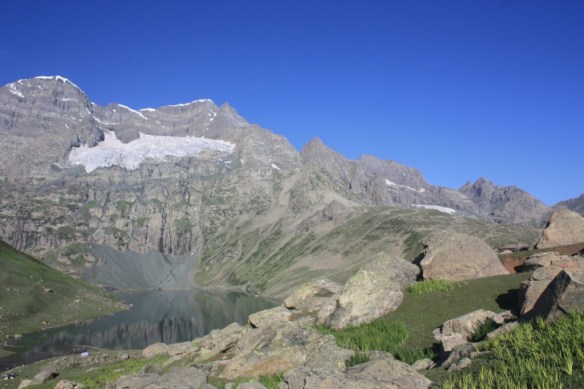
Lake Haiku

alpine lake,
depth a guarded secret,
mirroring mountain


ships sit
on your sandy bottom,
yet, you’re called “lake”


in sunlight
your glistening canvas,
a bowl of diamonds


winter ice cracks
with steel cable song,
sending shudders


barren pine
beside mud-rimmed lake,
heeding drought

DAILY PHOTO: A Few Exhibits of the Indian Museum, Kolkata

Taken in July of 2016 in Kolkata (Calcutta)

Monsoon Haiku

outside? muggy;
from inside: gray skies look
like Viennese winter


cool mornings,
after a rainy night,
soothe the spirit


the guard shack,
topped by a wading pool
only I can see


rain song
absorbs harsh sounds,
hushing the city


trust old people
with umbrellas more than
the blue in the sky

DAILY PHOTO: Agora [Sculpture], Chicago

Taken in August of 2018 in Chicago

BOOK REVIEW: Notes from Underground by Fyodor Dostoevsky

Notes from UndergroundNotes from Underground by Fyodor Dostoyevsky
My rating: 4 of 5 stars

Amazon page


This novella is divided into two uneven parts. The first part consists of eleven chapters of floating head philosophizing by an old man about all manner of topics loosely connected by a cynical outlook. The most prominent topic is consciousness and how it’s a curse upon mankind – for the more one has of it the more one is trapped in a dead-end life. (Presumably what Dostoevsky meant by “the underground.”) One really has to be interested in philosophy to get through the first part, which is about 1/3rd of the book, because there is no story and nothing in particular to make one interested in the monologuing old man’s life or thoughts. However, it’s considered the first existentialist novel, and is considered important on that grounds, and the philosophy is thought-provoking now and again.

It’s in the second part that the book gets interesting. In this part, we get a flashback to the narrator’s life as a young man and the events that presumably shaped the cynical philosophy that he’d rambled on about in the first part.

One can subdivide the second part into three subsections that each get more extensive and more interesting in turn. In the first section, the narrator tells about how he became irritated that there was an alpha male military officer who would walk boldly down the sidewalk and everyone would get out of his way. The narrator is ashamed that he consistently got out of the man’s way, himself. Since there was no rule that this man was owed the right-of-way, the narrator devises a plan to play chicken with the man. This may seem like a silly and sad little story, but it gives insight into the man’s state of mind. There are shades of “Fight Club” in this book, as the narrator feels emasculated by society and modernity. He’s a coward, but a proud coward who believes the world is ruled by fools, while men of intellect – such as himself – are trapped in the underground. He also has a masochistic ambivalence about pain and suffering.

The second and third sections flow together from a solitary event. The narrator runs into an old acquaintance from school, Zverkov, and invites himself to Zverkov’s going-away party dinner. However, neither Zverkov nor his chums particularly care for the narrator. There is a tension not only because they are of a higher status, but because the narrator has a chip on his shoulder about it. The narrator feels himself the superior man, and his self-invitation to the party is in a way another act of playing a game of chicken with those who are de facto superiors. His low-income post, combined with his feelings of superiority, compels him to assert himself to no good end.

When Zverkov and his pals slip away, in part to continue their festivities and in part to get away from the narrator, the narrator pursues them to the brothel they’ve taken their boy’s-night-out to. This is where the third part begins when the narrator ends up sleeping with Liza, a young prostitute. After the deed, the narrator rambles on about how she should get out while the getting is good, engaging in moralistic diatribe. Before leaving, he gives her his address card. Over the next several days, he swings between fears that she’ll actually show up to his shabby abode and fears that she won’t. His feelings for Liza bounce between whipping post and object of affection. And, being a classic unreliable narrator, the reader is left to guess as to the weight of those competing feelings.

Once one gets into the second part, this book becomes intriguing. The lead character would, at best, be classified and anti-hero. There’s nothing likable about him, but still one wonders how events will unfold. The first part offers the occasional bit of food-for-thought, but isn’t a compelling read for those who didn’t major in Philosophy. Even most Philosophy majors will find it needlessly cynical – if interesting. Still, it’s worth reading, and, hey, it’s really short.

View all my reviews

DAILY PHOTO: The Streets of Mumbai

Taken in July of 2018 in Mumbai (Bombay)

BOOK REVIEW: Bodyweight Strength Training Anatomy by Bret Contreras

Bodyweight Strength Training AnatomyBodyweight Strength Training Anatomy by Bret Contreras
My rating: 4 of 5 stars

Amazon page

This book combines a calisthenics manual with the anatomical drawings and descriptions necessary to explain the muscle activations involved in each exercise. It takes a very straightforward approach, being organized by body part. Each chapter discusses the component muscles of said part and their unique features, and then gives a series of exercises to work said part. For each exercise, at least one anatomical drawing is provided, showing the primary and secondary muscles being worked in the exercise. In some cases, more than one drawing is needed to convey the full range of motion of the exercise, but in many cases one drawing is sufficient. Each exercise also receives a brief bullet-point description of the action, a textual list of muscles utilized, and notes on issues and cautions to keep in mind to get the most out of the exercise.

Chapter 1 sets the stage for the rest of the book. It discusses general principles to be kept in mind like the need to balance opposing muscle groups, and it also lays out the advantages and limitations of calisthenics, or bodyweight, workouts over other approaches to fitness. Like a number of other calisthenics’ books, this one emphasizes the advantage of not necessarily needing any equipment. In other words, with a little creativity and some quality doors, robust furniture, or park access, one can do all of these exercises without either a gym membership or costly trips to the sporting goods store. Of course, one does need sturdy stationary objects to pull against, particularly to maintain a balanced upper body. What I like about this book more than some others I’ve read is that it emphasizes the need for safety in taking the equipmentless approach. I’ve cringed before in seeing some of the improvised set ups that have been jury-rigged as examples in other calisthenics manuals, but this book uses stout furniture and rafters to get the point across.

Chapters 2 through 9 each focuses on a particular body part, including (respectively): arms, neck and shoulders, chest, core, back, thighs, glutes, and calves. Each chapter starts with some general information on muscle action before launching into the exercises. If you have a particular interest in developing your glutes (i.e. your butt, your backside), then this is definitely the book for you. The author specializes in glutes, and while there are about a typical number of exercises for that musculature, the background information up front is more extensive than for most of the other chapters. For many of the exercises, the author proposes regressions and progressions — that is, easier and harder variants of a fundamental for those who either aren’t up to the basic yet or who need a harder version to challenge them.

The penultimate chapter, Ch. 10, presents whole-body exercises (e.g. burpees, mountain climbers, etc.) and discusses the benefits of including such exercises in one’s workout regimen. Included in this chapter is an introduction to both high-intensity interval training (HIIT) and to Metabolic Resistance Training (MRT.)

The final chapter offers an overview of all the factors to keep in mind when arranging exercises into a program (e.g. number of sets, repetitions per set, and how such considerations are varied depending upon one’s goals.) There’s a lot to consider when putting together a workout regimen, including: the necessary rest periods, balancing one’s workouts to avoid structural imbalances, and how to vary one’s approach depending upon one’s individual goals. A section on exercise for fat loss is included, which is important not only because there are so many people interested in that subject but also because there is so much misinformation out there.

As mentioned, most of the graphics are anatomical drawings showing the muscles in cut-away as the action of the exercise is being performed. There are a few other graphics to help clarify information, as well as tables in the last couple chapters to present information in an organized and easy to use fashion.

I found this book to be informative and well-organized. It’s a straightforward presentation of the skeleto-muscular action involved in various calisthenics exercises. If that’s what one is looking for, or even if one is just looking for a guide to bodyweight exercises, this book will meet your needs.

View all my reviews

DAILY PHOTO: Standing in Canoe, Kaziranga N.P.

Taken in April of 2017 in Kaziranga National Park in Assam

On a Brahmaputra tributary in Kaziranga National Park.

DAILY PHOTO: Kiosks, Vác

Taken in the winter of 2014 in Vác, Hungary.

POEM: Masked Men

The Jane outside my window is not real.
She’s just a fevered dream I can’t describe,
a searing pain that I don’t want to feel,
an intoxicant that I can’t imbibe.
My mind conjures so many listless souls.
I see them out the corner of my eye.
They have a gravity, I feel its pull,
but that force is only the devil’s lie.

Where do they go when I turn to see them?
Do they rain down to some dark underworld?
Or, tis I who fade from the world of men?
A sightless, silent brute in fetal curl?

Taking you by the lapels, I must ask,
what do you see revealed in all these masks?