Unknown's avatar

About B Gourley

Bernie Gourley is a writer living in Bangalore, India. His poetry collection, Poems of the Introverted Yogi is now available on Amazon. He teaches yoga, with a specialization in pranayama, and holds a RYT500 certification. For most of his adult life, he practiced martial arts, including: Kobudo, Muay Thai, Kalaripayattu, and Taiji. He is a world traveler, having visited more than 40 countries around the globe.

Horse Latitudes [Sonnet]

I scoured vast seas in search of wisdom lost.
It happened when they made me walk the plank,
like scuttled wreckage, sunk sans thought of cost,
as I began to rise, my treasure sank.
I bobbed in seas that each way looked the same.
How could I find my way back to that spot
carried by currents dastardly untamed,
and found days later by a ragged yacht.
And so I drift upon the choppy seas,
and hope for winds to steer me on my course,
but mostly there's not even a slight breeze,
and I'm stuck in ghost screams of a dumped horse.

I hope one day to regain my attitude,
but not stuck down in these damned horse latitudes.

BOOK REVIEW: The Good Man Jesus and the Scoundrel Christ by Philip Pullman

The Good Man Jesus and the Scoundrel ChristThe Good Man Jesus and the Scoundrel Christ by Philip Pullman
My rating: 5 of 5 stars

Amazon.in Page

Pullman tells the story of Jesus’s life from manger birth to the birth of the religion that flowed from Jesus’s crucifixion, with two major deviations from the gospel accounts. First, in this book, Mary gave birth to twins: one healthy, disciplined, and charismatic [Jesus] and one stunted, bookish, and with grand designs [Christ.] Second, the book tells the story in a way which requires no miracles or magic.

The reason for complicating the story with twins is to be able to split apart two confounding entities. Jesus represents the traveling preacher that most people find appealing and admirable. He’s compassionate, non-judgmental, simple (in the sense of eschewing wealth and glory,) and is a great storyteller. Christ represents the path that Christianity would come follow — one of billionaire evangelists, manipulative missionaries, and the Spanish inquisition – as well as, less intentionally, the Crusades, witch hunts, and pedophilic priests. That said, “scoundrel” status is only realized at the story’s end when Christ plays the Biblical role of Judas. Even then, Christ is conflicted and thinks he’s acting in accord with the directions of an angel.

While most of the events described will be familiar (in some form) to those acquainted with the New Testament stories, there’s an ongoing sub-plot between Christ and “the stranger,” a mysterious character who has an interest in seeing Christianity blossom, if in its imperfect form.

This book is part of a series on mythology called the Canongate Myth Series that features numerous renowned authors.

I found this take on Jesus’s story to be compelling and thought-provoking. I’d highly recommend it, except for those who take their Bible stories very literally and get riled by such writings.

View all my reviews

DAILY PHOTO: Sacred Seat of Judgement [Throne Hall]

Taken in Phnom Penh in October of 2012

BOOK REVIEW: Kafka: A Very Short Introduction by Ritchie Robertson

Kafka: A Very Short IntroductionKafka: A Very Short Introduction by Ritchie Robertson
My rating: 5 of 5 stars

Amazon.in Page

Kafka’s life story presents us with one of the greatest literary counterfactuals: What if Kafka’s friend, Max Brod, had honored the writer’s deathbed wish to burn his novels and other unpublished works? After all, Kafka had an outsized influence on modern literature; “The Trial” and “The Metamorphosis” alone have had profound reverberations across the world of literature. It’s with this hook that we are pulled into Kafka’s short, tragic, but brilliant life.

This book presents sketches of both the life and the body of work of Kafka, but subsequent chapters apply three different lenses to Kafka’s canon. The first of these is the body. It’s easy to see this theme’s influence in “The Metamorphosis” (in which the protagonist wakes up to find he’s a huge bug,) but Robertson shows us how the body cuts through other works and was influenced by skinny Kafka’s turbulent relations with his imposing father as well as by his difficulties in intimate relationships.

The second lens is institutions. Again, one of Kafka’s more famous works springs to mind, “The Trial,” but we also see that this, too, is a recurring theme — not only with respect to government / bureaucratic institutions (e.g. “In the Penal Colony”) but otherwise, as well. The final lens is religion and secularity. Kafka was living in the wake of Nietzsche and other nihilist and existentialists, and the atheist worldview was coming to dominate among the erudite segment of society. But Kafka straddled a line; the spiritual had appeal for him, but his life felt governed by nihilistic patterns.

I learned a great deal from this book. I think it offers important insight into Kafka and his writings.

View all my reviews

BOOK REVIEW: Hippias Major [a.k.a. Greater Hippias] by Plato

Hippias MajorHippias Major by Plato
My rating: 5 of 5 stars

Amazon.in Page

Socrates questions the arrogant sophist, Hippias, about the nature of beauty. The dialogue begins, as do most, with a meeting and pleasantries. This involves Socrates’ seemingly sarcastic praise of Hippias (we’re given no indication that Hippias sees the sarcasm, but – given the degree to which the sophist is in love with himself – that’s no surprise.) It’s possible Socrates is being sincere, but given the views attributed to him elsewhere, it seems uncharacteristic that Socrates should truly think Hippias wise because the sophist rakes in cash for making eloquent speeches.

The dialogue plays out with Hippias offering a range of unacceptable “definitions” of beauty. Hippias first presents a set of examples of things which are beautiful. This, of course, is unacceptable because if there is some common property of these varied entities, Socrates believes that property should be definable such that a person could see how the trait applies to other things. There are a series of other false starts involving goldenness, goodness, usefulness, popular agreement about what is beautiful, and a combination or two of the aforementioned.

Finally, Socrates suggests a definition of that which is pleasing to the eyes or to the ears. The discussion peters out after this definition is shown to be incomplete because pleasantness to eyes and to ears still begs the need of a common characteristic, as well as the fact that there are many concepts that are called beautiful that aren’t sensory experiences at all (e.g. a beautiful idea.)

This dialogue is more satisfying than Lesser Hippias, but is by no means one of the best. However, it does encourage thought about beauty, as well as about how both members of a set can have a characteristic that each does not have individually. If you’re interested in aesthetics, check it out.

View all my reviews

Butterfly Paralysis [Haibun]

Struggling to wiggle its wings, the butterfly warms in the morning sun. Is it like sleep paralysis - that hypnopompic impulse to flee that's stymied by stuck muscles? What's a wind gust or rapidly advancing shadow like for the butterfly? Normally, such occurrences would provoke an erratic fluttering away. But now the screaming instinct to wing away can't be answered. Does the butterfly know dread, or does it just quietly await the moment it's unfrozen?


cool morning -
a butterfly twitches,
but can't yet fly 

DAILY PHOTO: Ta Keo, Angkor

Taken in October of 2012 at Angkor

BOOK REVIEW: Lesser Hippias [a.k.a. Hippias Minor] by Plato

Lesser HippiasLesser Hippias by Plato
My rating: 5 of 5 stars

Amazon.in Page

Also known at “Hippias Minor,” this isn’t one of the better Socratic dialogues, but it’s amusing and somewhat thought-provoking. It’s one of two dialogues which feature the exceedingly narcissistic Sophist, Hippias, as Socrates’ philosophical sparring partner. The crux of the matter is Hippias’ claim that Achilles is fundamentally truthful while Odysseus is a liar. Socrates takes issue, showing that both heroes tell both truths and lies over the course of Homer’s works.

When Hippias is challenged on his oversimplified classification scheme, the Sophist claims that Achilles’s falsehoods are involuntary, whereas Odysseus’s lies are committed on purpose. This brings the dialogue to the issue that will play out to its end. While Hippias claims that involuntary falsities make Achilles the more virtuous man, the Sophist is led through a series of examples showing that the person who does bad voluntarily is invariably the better man. To give one of the countless examples (not countless, but I’m too lazy to count them,) Socrates suggests that the musician who plays badly on purpose is considered the better musician than one who plays badly because it’s all he or she is capable of.

While most of the dialogue is about whether it’s better to be bad voluntarily or involuntarily, it doesn’t seem that’s really Socrates’ point. In the end, when Hippias last says he doesn’t agree with Socrates, Socrates says that he’s not sure he agrees with himself. Socrates’ point might be that Hippias is full of untested claims because Hippias thinks himself smarter than everyone else.

It’s true this isn’t among the best, but it’s worth reading for this one lesson: don’t be like Hippias.

View all my reviews

Dream Door [Triolet]

I dreamt the door looked out upon treetops
and I could walk out on blue sky and cloud
and see the world as would a tall cyclops.
I dreamt the door looked out upon treetops,
but in my dream I plunged into the copse.
Sky walking proved more dream than was allowed.
I dreamt the door looked out upon treetops,
but could I walk out to blue sky and cloud?

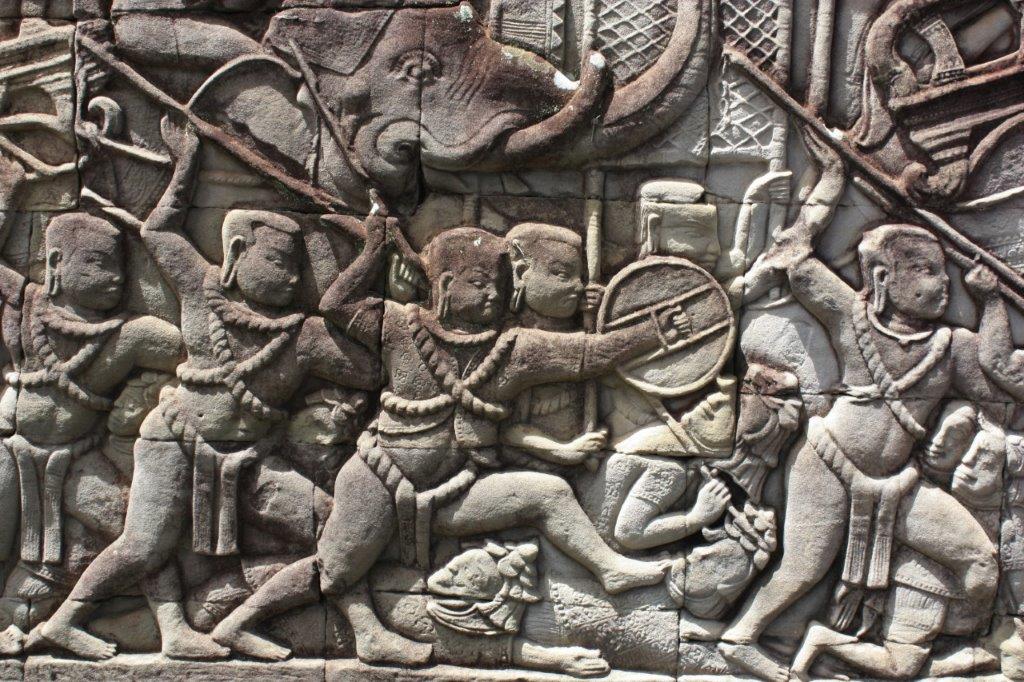
DAILY PHOTO: Battle Bas Relief of the Bayon

Take at the Bayon [Angkor] in October of 2012