Unknown's avatar

About B Gourley

Bernie Gourley is a writer living in Bangalore, India. His poetry collection, Poems of the Introverted Yogi is now available on Amazon. He teaches yoga, with a specialization in pranayama, and holds a RYT500 certification. For most of his adult life, he practiced martial arts, including: Kobudo, Muay Thai, Kalaripayattu, and Taiji. He is a world traveler, having visited more than 40 countries around the globe.

Ducks Adrift [Haiku]

a pond in summer:
ducks look like wooden toys,
drifting leisurely.

Winter Malaise [Lyric Poem]

One bitter winter afternoon --
Locked under skies so low and gray --
The city slowed in cold cocoon
As what verve remained slid away.

And then the clouds, they broke apart,
And frozen souls began to thaw.
But some needed not the sun's kickstart
To free themselves of winter's maw.

What was their secret? I wish I knew.
To be happy sans the skies of blue.
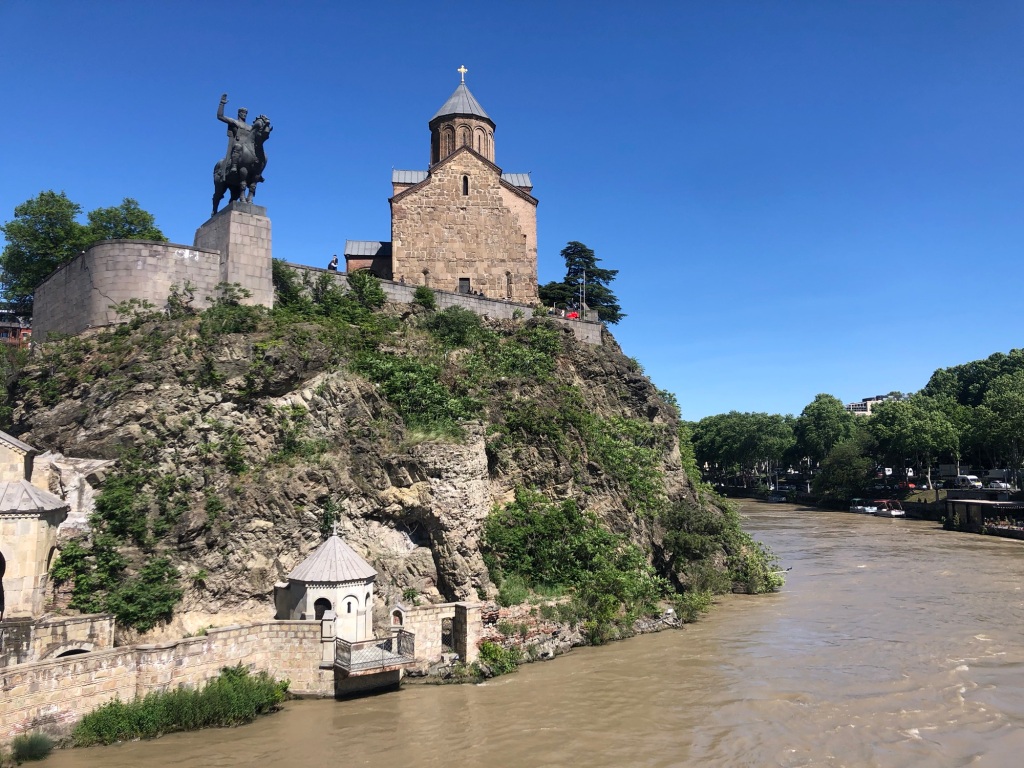
DAILY PHOTO: Metekhi Virgin Mary Assumption Church on the Kura River

Psychopomp Shanties [Lyric Poem]

Here comes some sing-song psychopomp,
Shepherding all those stone-cold souls.
He sings stirring songs all day long,
Dragging the Dead over dark shoals.

Sonnet 130 by William Shakespeare [w/ Audio]

My mistress' eyes are nothing like the sun;
Coral is far more red than her lips' red;
If snow be white, why then her breasts are dun;
If hairs be wires, black wires grow on her head.
I have seen roses damasked, red and white,
But no such roses see I in her cheeks;
And in some perfumes there is more delight
Than in the breath that from my mistress reeks.
I love to hear her speak, yet well I know
That music hath a far more pleasing sound;
I grant I never saw a goddess go;
My mistress, when she walks, treads on the ground.
And yet, by heaven, I think my love as rare
As any she belied with false compare.

Poppies [Haiku]

roadside poppies
sway in unison behind
passing autos.

BOOKS: “Forensic Psychology: A Very Short Introduction” by David Canter

Forensic Psychology: A Very Short IntroductionForensic Psychology: A Very Short Introduction by David Canter
My rating: 4 of 5 stars

Publisher site

This book discusses the many roles that psychologists play in the criminal justice system: e.g. as expert witnesses, as consultants to police and prosecutors, and as therapists to prisoners. The big takeaway is that forensic psychology is much messier than we have been led to believe. In the 1980’s, a wave of pop psych books suggested that a clever psychologist could build a detailed profile that would tell the authorities all they needed to know to winnow a suspect pool down to one. Fascination with this Neo-Sherlock Holmesian notion resulted in it spilling over into popular culture, most famously in the excellent movie, “The Silence of the Lambs.” The only problem is that it’s largely BS. Humans are too complex and varied for such easy policing to be achieved.

The book begins with an examination of how criminals are made, and this – too – is largely a disputation of the overly simplified single-source arguments: nature, nurture, etc. Instead, the suggestion is that it is a range of factors and their interactions that lead one down the road to crime, and that said factors can be very circumstantial. The rest of the book explores the specific roles that psychologists play in criminal justice and their limitations, therein.

I found this book to be interesting and an eye-opener.

View all my reviews

DAILY PHOTO: Republic Square, Yerevan

Government House # 2
Government House #1
Museums Building [National Gallery and History Museum]

BOOKS: “Best Literary Translations 2024” ed. by Jane Hirschfield, et. al.

Best Literary Translations 2024Best Literary Translations 2024 by Jane Hirshfield
My rating: 5 of 5 stars

Publisher Site

This “best of” annual celebrates the unsung translator. Many of the original works are recent but some are old or even ancient; it is these translations to English that are in all cases recent. Spanish and Arabic translations are well-represented, but with respect to the twenty or so languages included, almost all are the sole representative for that particular source language. Poetry makes up the bulk of the collection (including prose poems,) but there are several pieces of short fiction and a piece of creative nonfiction or two.

Among my favorites were: “Grazing Land” (Greek,) “The Snail’s Spiral” (Spanish,) “The Lion” (Kurdish,) “Deterioration” (Persian,) “Graceless” (Chinese,) “Our Village” (Tigrinya,) and “The Sea Krait” (Tagalog.) But, as one would expect of a carefully curated “best of” collection, there were no stinkers in the batch.

If you enjoy literature in translation, this book is well worth investigating.

View all my reviews

“Finely Woven” [Poetry Style #14] by Sikong Tu [w/ Audio]

The building blocks of everything --
Too fine to feel or see or smell --
Dance their way into hardened shapes
Via forces, invisible.
And so water flows, flowers bud,
But - also - dew evaporates.
This expansive path stretches on --
It's slow-going through dark lands.
It can't be spoken of smartly.
It can't be pondered fruitfully.
It's Early Spring green in sunlight,
Or like the snow seen by moonlight.

NOTE: The late Tang Dynasty poet, Sikong Tu (a.k.a. Ssŭ-k‘ung T‘u,) wrote an ars poetica entitled Twenty-Four Styles of Poetry. It presents twenty-four poems that are each in a different tone, reflecting varied concepts from Taoist philosophy and aesthetics. Above is a translation of the fourteenth of the twenty-four poems. Translated titles vary: Giles calls it “Close Woven” and others have titled it, “Fine.”