Unknown's avatar

About B Gourley

Bernie Gourley is a writer living in Bangalore, India. His poetry collection, Poems of the Introverted Yogi is now available on Amazon. He teaches yoga, with a specialization in pranayama, and holds a RYT500 certification. For most of his adult life, he practiced martial arts, including: Kobudo, Muay Thai, Kalaripayattu, and Taiji. He is a world traveler, having visited more than 40 countries around the globe.

The Good and Ugly of Olden Times

This was posted in my martial arts blog, Jissen Budoka, as well.

I’ve been doing a lot of reading about Japan’s past recently. In my spare time, I’m working on rewrites for a novel in which 14th century Japan features prominently. Being my first foray into historical fiction, I’m finding the need to go back and do a lot of research about the time because the quick and dirty draft I wrote needs a lot of gussying up. I just finished reading Charles Dunn’s Everyday Life in Imperial Japan,  which is about a later period but one which would have shared much in common when it comes to everyday life. Presently, I’m reading The Taiheiki–which is about the 14th century, but which blends fact and fiction.

Doing such research encourages one to consider what it meant to live during that time. We all build constructs of the world to adjust for our limitations in knowledge. Some of these constructs hold up better than others, but they’re all simplifications. When one reflects upon a time before one’s experience–and particularly regarding a place with which one has limited familiarity–there are two major forms of fallacious reasoning that can take hold:

1.) The Golden Age Fallacy: This is the thought that everything was better back in the day–back before humanity started slouching toward craptasticness.

2.) The Outhouse Fallacy: This is the idea that any society that couldn’t manage indoor plumbing couldn’t possibly be worthy of emulation.

Of course, these simplifications are both true and false in some regard, and–as absolute statements–are absolutely false. The truth is something more like what Ralph Waldo Emerson suggested in Self-Reliance. Emerson described society as a wave, receding on one side as quickly as it advanced on the other. In other words, changes maybe seen as progress, but they also bring about the destruction of valuable knowledge. In martial arts terms, the spear becomes obsolete and the art of spear-fighting dies.

LastSamuraiThe movie entitled The Last Samurai revolves around this premise. Of course, in Hollywood fashion the forces of modernity are made entirely villanous and our heroes, the samurai, are entirely virtuous. In a way the movie is perverse in that it suggests we root for the medieval approach over our own.

When considering feudal Japan, Golden Agers point to it as a time during which virtue was paramount, craftsmanship was exquisite, and much culture flourished. They are right; but don’t set your time machine just yet because Outhouse Agers are also correct when they say that it was a time during which most of the population had no rights, wars ravaged the country, and in which farmers were not allowed to partake of many of the products they produced–but rather had to feed and cloth their families with inferior substitutes.

One should be careful to neither romanticize nor vilify the samurai. We should keep what is of value of the old ways without being a slave to the worst ways of our predecessors’ nature. One shouldn’t abandon everything old on the assumption that by definition everything abandoned to the past is refuse.

Snowden’s Muddled Message

Also posted in my blog, Strategic Ramblings.

Edward Snowden is once again the headline leader. The man some consider a whistle-blower and others think a traitor is trying to gain temporary asylum in Russia. His U.S. passport having been suspended, Russian asylum seems to be his only immediate path out of the transit lounge of Sheremetyevo International Airport in Moscow. A few countries in Latin America have agreed to offer Snowden asylum and he has expressed interest in taking Venezuela up on the offer, but without a passport he is stuck like Tom Hanks’ character in Terminal Man.

The request for Russian asylum is problematic in that Russian President Vladimir Putin has said that asylum wouldn’t be considered as long as Snowden was still leaking. While Snowden said he has no interest in hurting the U.S., he is still talking about U.S. intelligence activities and seems unlikely to give up giving up information.

When the revelations of this story initially broke in the Guardian, I was outraged by the allegations being put forth by Snowden. In essence, Snowden suggested that Americans’ electronic communications were being spied on without warrants and without specificity. While lawyers and politicians love to play word games, the Fourth Amendment is clear and concise. Where there is a reasonable expectation of privacy, searches require a warrant that says who is involved and what’s being sought. In short, the Constitution doesn’t allow fishing expeditions.

The damage control by the Administration and the Intelligence Community in subsequent days was even more infuriating. The message seemed to be, “We want to have an open debate about all these nifty protections that are in place to make this all legal, but, alas, that’s all classified.I’m not saying you should just trust us, but–yeah–just trust us, ya-da-ya-da-ya-da.” I’m suspicious of a government attempting to expand its power; I abhor a government that tries to do it under the cover of darkness.

Director of National Intelligence, James Clapper, had been asked the following question by a Senator during his testimony, “Does the NSA collect any type of data at all on millions or hundreds of millions of Americans?”

Clearly the answer to this question, in light of the Verizon revelation was, “yes.” However, Clapper answered in the negative, and then added a qualifier “not wittingly” that didn’t help improve the truthfulness of statement, but should have been a red flag that the Director was trying to play some type of semantic game. Clapper later went on a Nixon-esque / Clinton-esque defensive about how his answer was the “least untruthful.” Of course, to suggest that the Verizon data was “unwittingly collected” strains credulity.

When General Keith Alexander of the NSA (among others) testified, he said that he had three points. First, that the programs had yielded positive results, or–in other words–the ends justified the means. Second, that the programs in question were “limited, focused, and subject to rigorous oversight.” Third, privacy and civil liberties are protected by the programs. However, he seemed to only want to talk substance about the first point–that is, what ends justified these means. I found it disconcerting that Gen. Alexander could tell us something about which cases had positive outcomes as a result of these programs, but not about the processes and protections required to draw specific information from the vast pools of data being collected on Americans. The former being the kind of information that could have negative security ramifications, the latter could only embarrass politicians. Secrecy is needed to protect assets and methods, but shouldn’t be a tool of protecting dubious legal practices. Al Qaeda doesn’t get a leg up by knowing the legal process required to access data generically.

The testimony was full of what would be objected to as “leading questions” in a court of law. For example, Alexander was asked if there was “any switch that could be flipped to allow analysts to eavesdrop on communications.” This makes for nice ass-covering when it turns out that they, in fact, have to type a command into a command line. “No, we never lied. We were as truthy as can be, there is no switch– we had the switches replaced with buttons decades ago.” Alexander repeated the “flip a switch” phrase back in his reply so that they were all on the same page.

As sad as any comment made was when Alexander said, “Further, as the Deputy Attorney General noted, virtually all countries have lawful intercept programs under which they compel communications providers to share information about individuals they believe represent a threat to their societies.” At the risk of sounding nostalgic, I remember when America prided itself in being a leader in liberty rather than saying, “look we aren’t doing anything that Russia and China aren’t!”

Telling me that you had success due to these programs isn’t enough for me. If you said, “hey, we put everyone of a particular religious persuasion in jail, and we foiled x-number of plots,” should I be reassured or outraged. I would argue the latter.

Telling me that other countries have such programs doesn’t satisfy me. I think the U.S. should seek to be on the leading edge of freedom and not happy slouching around the middle of the pack.

Telling me that a given database has only phone numbers and metadata and no identifying information doesn’t really inspire confidence. It turns out that there’s this nifty thing called “the internet” that allows one to look up people’s names from a phone number. You’re going to tell me that no one is going to google the number they’re looking for information about?

If the government wants to reassure the public, they need to have transparency in legal processes and not hide behind a veil of classified information.

Of course, part of the disagreement is that the law as it now stands only suggests only the content of messages incurs a reasonable expectation of privacy. That Mr. A talked to his therapist for two hours one Sunday evening as (according to cell tower triangulation data) he was sitting in the parking lot of a hospital is–in the eyes of many–completely unprotected information that no one could reasonably expect to be their own damn business.

I’m not comfortable with the collection of vast stores of information on citizens. Even if there are some protections that are working for the moment, all that information will just be waiting for some moment of weakness, some rally-around-the-flag moment, during which people are willing to flush all they hold dear down the crapper in exchange for a promise of security.

Having said all this, I’ve had a bit of trouble retaining sympathy towards Snowden as he’s muddled his initial message about unconstitutional actions. When he started releasing information about how the U.S. was spying on China, his message became lost. Of course the U.S. is spying on China, and they upon us. That’s the nature of the game in an anarchic international system. Yes, it’s a political embarrassment; coming as it did when the President was attempting to give China “the old what for” over the issue, but spying on other countries in order to keep one safe is part of what is expected of a government. (Yes, even on allies. You can be certain Israel, Japan, and the United Kingdom are spying on the U.S.) I take as a given that other countries might try to read my email if they think it has any potential benefit to them. However, they haven’t been granted a monopoly on the legitimate use of force against me. I expect my government to serve to protect me from any dire consequences of other country’s snooping. In fact, I have held jobs where other countries may have eavesdropped on me (not because of the work I did, but because of with whom I was in contact.) The potential for nefarious activities by a foreign country are just not the same as they are for domestic shenanigans–for most of us at least. There is less incentive to try to manipulate a random Joe for political or material gain across borders than there is within.

If Snowden is driven by his love of freedom, why has he headed in the direction that he has. Even if everything he says is absolutely true, the U.S. is still vastly more free than either Russia or Venezuela (e.g.Freedom House ranks the former as “not free” and the latter as “partially free.”) (There is some doubt about whether what Snowden says is true, but as the government hasn’t really delved into details or engaged in any contradiction that is not riddled with carefully censored qualifying words, one cannot tell.)

DAILY PHOTO: A Walk in the Park

Taken in the summer of 2008 in a small park in Beijing's Central Business District

Taken in the summer of 2008 in a small park in Beijing’s Central Business District

Beijing has workout equipment all over the place–mostly in parks, but sometimes just by the side of the road. One sees the same sorts of things in Bangkok, and even Phnom Penh has exercise equipment on the river front strip of park.

DAILY PHOTO: Steeple lens flare

Taken in summer of 2011 in Tallinn, Estonia

Taken in summer of 2011 in Tallinn, Estonia

DAILY PHOTO: Dear old MOM, not exactly

Taken in October 2012 at Doi Suthep (near Chiang Mai.)

Taken in October 2012 at Doi Suthep (near Chiang Mai.)

DAILY PHOTO: Isla Contoy Egret

Take in the summer of 2009.

Take in the summer of 2009.

BOOK REVIEW: A Search in Secret India by Paul Brunton

A Search in Secret IndiaA Search in Secret India by Paul Brunton

My rating: 4 of 5 stars

Amazon page

A Search in Secret India is a travelogue by Paul Brunton as he wondered through India in search of sages. In the process, he found a number of masters of body, mind, and both. However, he finds these individuals as rare nuggets in a sea of frauds.

Brunton states up front that he won’t waste time with any of the blatant frauds or suspected frauds, but he does devote space to a number of the more impressive ones. Impressive either by way of a large following or artfulness of technique. He also finds individuals he doesn’t know what to make of. These individuals appear to have impressive otherworldly skills, but skills that he can neither reconcile with known scientific understanding nor uncover as hoaxes despite his best skeptical inquiry. Given Occam’s Razor, he seems to be left suspecting that these are masters of illusion, but he maintains skepticism of his skepticism. A prime example of this is a Yogi who seems to be able to conjure any scent upon request.

Brunton also runs across individuals who are able to do amazing things that are inconsistent with his knowledge of the world, but which his exhaustive investigations leave little room to dispute. For example, there is one yogi who can completely cease his respiration for a seemingly impossible length of time, and who resumed breathing not with a gasp but with a slow, calm series of breaths.

As suggested above, this book is really an attempt to analyze India’s spirituality through the lens of Western logical and scientific approaches. The author is a Brit and the book was first published in the 1930’s. His worldview is consistent with that status. While Brunton would like to master his own mind, he is unwilling to let himself be duped.

There is another side to this juxtaposition of East and West. The yogis and gurus with which Brunton comes into contact often have trouble grasping the Western mindset (there is one notable exception.) What these wise-men have difficulty understanding is why a people, like the British, devote so much time to mastering the external world (and with a great measure of success it must be added), but put so little effort into mastering or understanding the self. Most of the gurus appreciate that a Brit is taking an interest in the spiritual and yogic ways of India, but with their own skepticism. They find Westerners materially rich, but bankrupt of the mind. They find the Brits strong, but lacking the supple power that yoga introduces.

After completing his travels, it seems the book is set to draw to an end. However, Brunton realizes that while there were a number of skilled individuals that he came across in his travels,there is one that stands out as someone he should not miss an opportunity to learn more from. Therefore, instead of getting on a steamer back to England, he returns to South India to a man called the Maharishee in order to find out if the guru will take him as a student. The last couple chapters describe his time under the Maharishee’s tutelage as well as under one of the guru’s most advanced students. The Maharishee is a sage the likes of which Brunton has not seen in all his travels. The guru has the humility to say that he cannot teach Brunton anything, but instead can only show him some things that he learned on his own journey.

If there is a lesson for those who would like to follow in Brunton’s footsteps, it seems to be that there is an inverse relationship between how easy a guru is to find(/how eager a guru is to talk to one) and the level of skill of that teacher. In almost all cases, Brunton had to take great initiative and steer off the beaten path to find the true masters. On the other hand, most of the individuals who were easily found, and eager to talk, were just con men.

I recommend this book for those interested in development of the mind and body.

View all my reviews

Haiku from my daily walk

Hazy hilltop morn,
a resting hiker looks like
a granite Buddha

Chicks chirp noisily
each tremor anticipates
mamma coming home

DAILY PHOTO: Berry Season

Taken July 6, 2013 on the Arabia Mountain Trail

Taken July 6, 2013 on the Arabia Mountain Trail

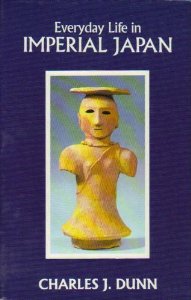
BOOK REVIEW: Everyday Life in Imperial Japan by Charles Dunn

EverydayLifeImperialJapanEveryday Life In Imperial Japan by Charles J. Dunn

My rating: 4 of 5 stars

Amazon page

This interesting little book is invaluable for anyone researching what life was like for people in Japan before the Meiji Restoration. While it’s an essential volume for a writer of historical fiction, those interested in Japan more generally will find it readable and packed with interesting tidbits of information. For example, I would recommend it for those who study traditional Japanese martial arts (i.e. kobudō)to get a better insight into the art they study through knowing the society from which it sprang.

This type of work is relatively rare, but is a writer’s dream come true. It’s not a history book, but–as the title implies–tells one how people of various classes and occupations lived day in and day out. That is, its approach is more anthropological than historical.

The range of occupations in Japan’s pre-modern period were far fewer than in society as we know it, and so the book takes broad job classes as its primary unit of organization. It begins with the group that undoubtedly draws the most interest, the samurai. It proceeds to the occupation which is most numerous in any pre-modern society, the farmers. Beyond that, it covers the lives of skilled craftsmen, merchants, courtiers, priests, doctors, intellectuals, actors and outcasts. The concluding chapter looks specifically at life in the city, and–in particular–life in Edo. Edo is the city that would become known as Tokyō, and which became the capital of the Shogunate in 1603 and eventually the nation’s capital.

Japan’s relative isolation throughout its early history has made for many intriguing national peculiarities. It’s true that Japan’s literary, religious, and philosophical systems were greatly influenced by China, but–in all cases–these cultural elements were forged into a uniquely Japanese form. This uniqueness provides many “ah-ha” moments while reading.

One learns why warriors were required to wear extra long hakama (a very billowy form of pleated pants that look like a long skirt–though having individual pant legs.)One learns about how one got around on the early highway system in a time when infrastructure (e.g. bridges) were minimal, and who was allowed to use the roads–such as the famous Tōkaidō road. The book tells how police went about arresting armed samurai. The roles played by women in society are discussed. While this was obviously a patriarchal society, women weren’t locked entirely outside the domain of power.

This was a feudal society with the samurai owning the land and the farmers toiling in hopes of having a little left over to support their families. While farmers made silk, they were, by law, not allowed to wear it. Farmers sometimes resorted to selling daughters to brothels to make ends meet.

There were many types of craftsmen from saké brewers to carpenters to makers of lacquer-wares. Japan has a long history of appreciation for master craftsmanship as is most apparent in sword-making. The Japanese sword was the cutting weapon perfected. Its folded steel design offered a flexible spine with a hard edge that could be honed to razor sharpness.

Merchants were a class that was both looked down upon and increasingly powerful during this period. Samurai were often barely making a living then, but merchants were beginning to flourish. Japan’s first indigenous money wasn’t introduced until 1636. Prior to that Chinese coins were used, much in the same way that some present-day countries use US dollars for currency–thus avoiding inflation that would be inevitable if they had their own currency and governance. There is an extensive discussion of the early sea trade.

Some of the most interesting careers were those more peripheral. Doctors practiced something akin to Traditional Chinese Medicine. There were wandering street performers and holy men of a wide variety.

I’d recommend this book for anyone interested in Japan’s history, and would call it indispensable for a writer addressing pre-Meiji Restoration Japan.

View all my reviews