
Taken on January 26, 2014 at Lal Bagh Gardens
Taken at the 2014 Republic Day Flower Show in Bangalore.


Taken on January 26, 2014 at Lal Bagh Gardens
Taken at the 2014 Republic Day Flower Show in Bangalore.

Taken in December of 2013 in Kuala Lumpur
The smell of roasting chestnuts seems a little out-of-place in a Malaysian Chinatown, but there’s no rule saying you must see your breath to savor this Christmas treat. Plus, you can eat them in the comfort of shorts and a tank top.

Taken in November of 2013 at the Mysore Zoo
There is no smile
worn by a crocodile,
that’ll induce me to pet him.
There’s no grin,
neither wide nor thin,
that extends my treasured limb.
Save your beaming.
It looks scheming.
“No, I won’t go for a swim.”
 A Record of Cambodia: The Land and Its People by Zhou Daguan
My rating: 4 of 5 stars
Traveling to an archaeological site as grand as Angkor, it’s natural to wonder what the city must have been like in its heyday. Angkor’s population was estimated to be as much as 1 million people, making it one of the world’s biggest urban centers in its day. One can get a feel for how vast and impressive Angkor was by way of the restorations, its artwork, and even the lay of its rubble fields. However, today’s Angkor is in large part a testament to the power of Mother Nature to swallow once proud temples and palaces with strangler figs and to shatter stout walls with white silk cotton trees. It’s hard to fathom what it was like when it was occupied by kings and concubines, slaves and shamans.
A Record of Cambodia offers a rare glimpse into life at Angkor at the tail end of the 13th century—near the city’s peak. It was written by Zhou Daguan, a Chinese diplomat sent by Yuan China [Mongolian era] as part of a delegation. Zhou spent almost a year at Angkor during 1296-1297. His report was translated into French during the 19th century, and all the English translations in existence had been based on the French not the original Chinese (i.e. twice translated.) This 2007 edition, however, was translated directly from Classical Chinese by Peter Harris.
The thin volume weighs in at only about 150 pages, but fewer than 40 pages are Zhou Daguan’s report. The other 110 pages include front matter, graphics, appendices, and notes. The Introduction, at 30 pages, is almost as long as Zhou’s document. However, this should not be taken as criticism. There’s a lot of useful expansion upon, and explication of, the information in Zhou’s report in both the Introduction and the end-notes. While it’s written by the translator, Peter Harris, it’s probably best to think of the Introduction as an Editor’s Introduction rather than a Translator’s Introduction–the latter creating an impression of a discussion of the minutiae of ancient grammars. (There is a little of that in a separate “Notes on the Translation.”) Harris’s introduction sets the background, elaborates on certain mistakes that Zhou seems to have made, and contrasts Zhou’s report with the accounts of other famous travelers such as Marco Polo, Ibn Buttata, and Xuanzang
Zhou’s report is divided into 40 chapters; though the word “chapter” seems more fitting for some than others, as many are no more than a single short paragraph. Each chapter is themed by some element of Khmeri life during the era. They include coverage of how people dressed, the nature of slavery at Angkor, what the buildings looked like in their glory days, sexual practices, agriculture, trade, local flora and fauna, and eating practices.
While short, Zhou’s book gives us a great deal of information that we wouldn’t have had otherwise. I learned a number of intriguing facts such as that fireworks displays were a regular event, runaway slaves had their faces tattooed blue, and the only ones not all allowed in Angkor Thom were those who were missing a toe(s) (removal of digits was a punishment back in the day.) Zhou has a great curiosity with the sexuality of the Khmeris, which was a great deal more liberal than that of China. Even the practice of toplessness among both men and women of all classes drew Zhou’s attention.
As when one reads the accounts of European explorers and adventurers, there’s a certain bigotry and conceit that comes across in Zhou’s writing—though it doesn’t come across as jarringly as in the works of, say, Francis Galton. Zhou does report on matters where the Khmeris looked down on Chinese practices as uncivilized (e.g. using human waste as fertilizer or using toilet paper / not reserving their right hand for sanitary endeavors.) On some cultural differences, Zhou comes across as mocking the Khmeri ways (e.g. communal bathing practices), and he goes as far as to refer to them as “Barbarians.”
If you’ve been to (or plan on going to) Angkor, I’d highly recommend giving this thin volume a read. It won’t take much time, and it’ll allow you to see the ruins in a new light.

Taken in January of 2014 in Phuket Town.
Jor Ong is one of Phuket Town’s numerous Chinese Shrines. You’ll note the prominent white tiger painting.
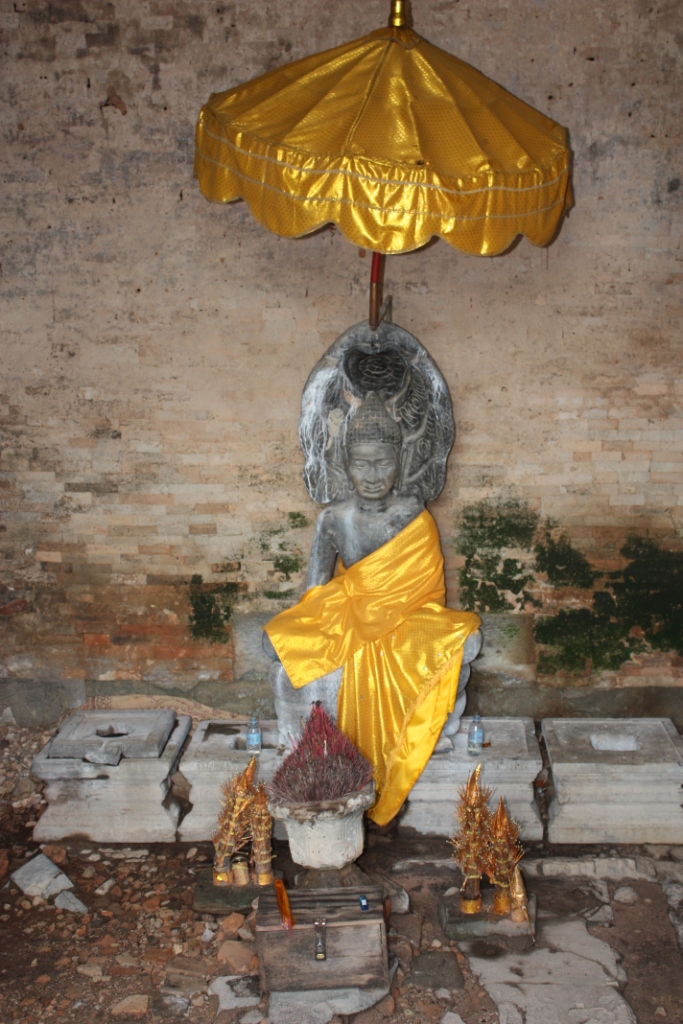
Taken in October of 2012 at Angkor, Cambodia.
I was just doing some research on 13th century Angkor, and so I figured I’d dig back to 2012 for a photo from my visit there.

Taken in December of 2013 in Kuala Lumpur
I took this on Jalan Alor, Kuala Lumpur’s famous food street. It was early, well before dark when the street gets thronged with hungry travelers. The fruit stands were just getting erected and the frog porridge was simmering.
 Regarding Ducks and Universes by Neve Maslakovic
My rating: 4 of 5 stars
As one might guess from the title, this is a lighthearted–dare I say whimsical–science fiction novel set around parallel universes. The light tone works to discourage one from being too much of a stickler about logical consistency and scientific validity. Parallel universes can raise almost as many troubling questions as time travel; but when the tone is comedic, it’s easy to set the these concerns aside and take it as a simple plot device. This isn’t to suggest that Maslakovic neglects the issues altogether. She is, after all, an engineer by training. Having the universes split a relatively short time in the past is likely an attempt to deal with the fact that the two universes are extremely similar, but recognizably different (a cliché among sci-fi parallel universes.) But she does avoid getting bogged down in the minutiae of consistency. There may be some happenings that leave one a bit befuddled, given there is obviously different decisions and behaviors occurring in the alternative universes, so events in one universe shouldn’t be a predictor of events in the other.
The backdrop is that a technical writer and aspiring novelist, Felix Sayers, finds out that he has an “alter.” In Sayer’s world, there are two San Franciscos. He is from what’s considered the original Universe, A, and there’s an alternative Universe B that one can cross over to if one is willing to follow a number of rules–mostly set in place to prohibit interacting with one’s alter. Everyone born before the schism of the two universes has an alternative version of themselves in the alternate universe unless that person has passed away. Like identical twins, “alters” look alike, but because of chains of different decisions and experiences, they may lead considerably different lives. Felix thought he was alter-less, but when he finds out about a discrepancy in his birthdate, he realizes he does.
Felix decides to go to Universe B, to spy on and possibly interrogate his alter—in contravention of the rules. Specifically, Felix of A wants to know if Felix B is working on a novel, and, if so, if the alter is ahead of him. He doesn’t want his to be relegated to writing the novel by “the other Felix Sayers.”
As the story progresses, the novel crosses genres again, adding a mystery component. When Felix crosses over, he draws much more attention than he wants or expects. This includes several failed (and sometimes comedic) attempts on his life. Felix immediately suspects one person, but it wouldn’t be much of a mystery if the initial suspect turned out to be the villain. Actually, it’s not much of a murder mystery because there are few characters who we can believe would be credibly wicked.
However, there’s still the mysterious question of whether Felix engaged in an activity that resulted in the split. Of course, there’s a scientist who creates the conditions in which the schism can happen, but Felix nonetheless worries whether he “caused” the split through some inadvertent act as an infant. This may not be so much a critique as it is insight into what makes the lead likable, if hapless. Incidentally, this is where the duck comes in.
If you like light sci-fi, this is a good read. It’s not side-splitting like Douglas Adams, but it’s laid back and has a dry sense of humor.

Taken in January of 2014 at Kata Beach on Phuket.
I took this with a phone as the sun was getting low. It’s taken at the north end of Kata Beach, which is separated from the south end of Karon Beach by a little promontory. It’s either blurry or minimalist, depending on whether you like it or not. The boats were in for the night, and the sun was shimmering hard.
I just began my study of Kalaripayattu this morning. Kalaripayattu is an Indian martial art that is named for the training space (kalari) in which it is conducted. It’s a very different martial art from others I’ve studied, and is a great learning experience—as well as an excellent workout. Kalaripayattu is said to be one of the oldest formal martial arts that has survived into the modern era. I have no reason doubt this. The art is documented in the 11th century by a historian who attributes its development to wars between the Chola and Chera kingdoms.
However, there’s another common claim that is much more controversial, and that’s that Kalaripayattu is the “mother of all [Asian] martial arts.” With all due respect, I’m skeptical of this claim—even if we don’t take it in the literal sense (i.e. Asia is a big place and there are almost certainly places where martial arts were established before contact with the Buddhist diaspora.) I obviously don’t base my skepticism on what I have been taught—as that is, at this point, a miniscule portion of the most basic of basics.
While I can offer no definitive proof to discredit the claim, I do have specific reasons to be skeptical. The theory of Kalaripayattu as the origin of martial arts is based on the legend of Bodhidharma. The legend says that the famous monk shared martial arts with the monks of Shaolin in conjunction with the Zen (Cha’an) form of Buddhism, and from Shaolin as Buddhism spread so did the martial arts. I’ve read myths about the origins of the Japanese martial arts that I’ve studied that place the beginnings of their ancestor arts with Chinese Buddhists fleeing persecution during the T’ang Dynasty (as well as later periods.)
The first problem with this theory is that historians have found it to be unsubstantiated and dubious. While the belief that Bodhidharma introduced the Chinese to martial arts is one of the most widely believed and cited pieces of martial arts lore, Meir Shahar in his book The Shaolin Monastery [http://www.amazon.com/The-Shaolin-Monastery-History-Religion/dp/082483349X] states that the evidence doesn’t support this popular belief. Specifically, the only historical documentation of this theory is a document that was written in the 1600’s that the author claimed was “discovered” from an earlier time—the problem is that the language usage isn’t consistent with the claim that the document was from a much earlier period, and there are many verified mistakes in the document.
Even if Shahar and other historians are wrong, the evidence that Bodhidharma came from southern India and that he studied Kalaripayattu specifically seems to be non-existent. There is at least one popular theory of Bodhidharma that puts the origin of this famous spiritual leader outside of India altogether. If the aforementioned Indian historian was right and Kalari developed during 11th century wars, then it’s late for the life of Bodhidharma by some 500 years.
The challenge is that it’s difficult to compare the modern martial arts and see definitive evidence of historic connections. Some will say, “But Kalaripayattu doesn’t look like Shaolin Kung fu (or any other subsequent arts) at all.” While it’s not true that they don’t look anything alike, it’s true that they look very different. However, what one has to keep in mind is not only did Kung fu continue to evolve in order to optimize to its circumstance, its predecessor system (whether Kalaripayattu or otherwise) would have continued to evolve as well. The Kalaripayattu of today most likely looks quite different from 11th century Kalaripayattu, but we can’t know how so in any detail. This could make for some pretty rapid divergence. Others may say, “But, hey, I do see the similarities in kicks and postures and so forth.” This may be true as well, but can one be sure that one of those commonalities is causal of the other? What if it’s just the constraints of the human body that make all martial arts similar at some level of granularity?
My intent is neither to destroy origin stories nor to discredit any martial art. Obviously, Kalaripayattu has a long history, and the fact that it survived to modern times is a testament to its value over that time. Combat is a harsh evolutionary environment, and things that don’t work for the situations they face are likely to die with the people who practice those systems. However, I think it’s important for warriors to not succumb to false fables because they must see the world as it is and not as they wish it to be.


