Unknown's avatar

About B Gourley

Bernie Gourley is a writer living in Bangalore, India. His poetry collection, Poems of the Introverted Yogi is now available on Amazon. He teaches yoga, with a specialization in pranayama, and holds a RYT500 certification. For most of his adult life, he practiced martial arts, including: Kobudo, Muay Thai, Kalaripayattu, and Taiji. He is a world traveler, having visited more than 40 countries around the globe.

BOOK REVIEW: You Are Your Own Gym by Mark Lauren

You Are Your Own Gym: The bible of bodyweight exercisesYou Are Your Own Gym: The bible of bodyweight exercises by Mark Lauren
My rating: 4 of 5 stars

Amazon page

As the title suggests, this is a guide to bodyweight exercises, and—specifically—periodized callisthenic training without equipment. Periodization is an approach in which the volume and intensity of workouts is in constant flux, as opposed to the regular approach that used to be the norm. It’s with regard to coping with a lack of fixed equipment that this book really seeks to separate itself from the many high-intensity interval training (HIIT) books in bookstores today. Obviously, calisthenics require much less equipment than weight training. However, without at least a pull-up bar and dip bars, it’s hard to get a well-rounded bodyweight workout. You Are Your Own Gym shows the exercises done with makeshift apparatus where necessary. Some of the suggested substitutes look safer than others, and a few of them (e.g. door pull-ups) work muscles a little differently than the basic. However, the examples get one into the habit of considering how one can use one’s environment creatively to get a good workout. [I would recommend exercising caution and safety when using the demonstrated improvised methods.] Even if one has access to equipment in day-to-day life, frequent travelers often have trouble getting a good workout in on the road. This book can be helpful in assisting one in avoiding the dead spots in one’s training regimen due to inability to get to a fitness facility.

The author, Mark Lauren, is a former Combat Controller and Special Operations fitness instructor. For readers who aren’t familiar with the US Air Force, Combat Control is one of two special operations career fields in the Air Force (excepting pilots and crew who fly special operators around.) Combat Controllers usually serve with Army Special Forces, facilitating the provision of air support in the midst of combat operations. Lauren certainly has the bona fides to write intelligently on the subject.

The book consists of 12 chapters, but it’s the penultimate and final chapters that present the meat of the work. Chapter 11 presents a thorough collection of bodyweight exercises organized by the area of the body worked. In most cases, the exercise descriptions include a photo, as well as modifications to provide a more or less strenuous version of the exercise. The latter feature makes Lauren’s program nicely scalable. The reader can optimize exercises to his or her needs.

The last chapter lays out the program. Because varying the characteristics of the workout is the key to the periodization approach, varied workout structures are discussed. These include well-known approaches such as interval sets, super sets, and tabatas, as well as less familiar approaches such as stappers (cycling through a fixed number of repetitions of a few exercises for a set amount of time without rest periods—but with a low enough number of reps to avoid failure) and ladders (i.e. long sets in which one does on rep, rests for one, does two reps, rests for two, etc. up to just before the point of failure, and then working back down to one rep in a symmetric manner.) While one can certainly make up one’s own workout with the knowledge gained to this point in the book, there are 10-week sample programs at four different levels (starting with beginners and working toward advanced practitioners of calisthenics.) If you’re not sure which level is right for you, the author provides a set of exercises that one should be able to carry out as a minimum to begin work at a given level.

The first ten chapters deal with a range of subjects including: diet, strength training myths, motivation, intensity, and the nature of bodyweight exercise. These short chapters lay out basic concepts helpful to engage in the program. There are three appendices that discuss equipment issues, a summary of guiding principles, and a discussion of the science of the program. The latter is beneficial, given some claims by the author that old school fitness buffs might find hard to accept–such as the lack of need for high volume endurance activities for cardio (i.e. one doesn’t need go for a run to get cardio benefits.)

I found this book to be beneficial. I like the fact that Lauren addresses the science of the approach rather than just throwing his approach out there with all the fad workouts. I found the advice to be sound, and have become more creative when considering how I can get a good workout on the road as a result of reading the book. As I write this, I’m in the 10th (and final) week of one of the sample workout sequences. I believe I’ve gotten good strength workouts from the program. I enjoy the scalability of the program, and have taken advantage of both easier and harder variants of the exercises.

I’d recommend this book if you’re looking for a bodyweight exercise program—particularly if you travel a lot, don’t have access to fitness facilities, or just like to workout at home.

View all my reviews

DAILY PHOTO: Colorful Mosaic with Wild-eyed Bull

Taken in June of 2015 in Chandigarh

Taken in June of 2015 in Chandigarh

DAILY PHOTO: Rustic Nrityagram

Taken in the summer of 2015 at Nrityagram.

Taken in the summer of 2015 at Nrityagram.

DAILY PHOTO: Tiny Chapel in the Woods

IMG_5099

Taken in the summer of 2011 on Seurasaari Island near Helsinki, Finland.

DAILY PHOTO: Finnish Totem

Taken in the Summer of 2011 in Helsinki

Taken in the Summer of 2011 in Helsinki

DAILY PHOTO: Llama King of the Mountain

Taken in the summer of 2011 at Machu Picchu

Taken in the summer of 2011 at Machu Picchu

DAILY PHOTO: Kotmale Reservior: Dark and Bright

Taken in May of 2015 at Ramboda Falls, Sri Lanka

Taken in May of 2015 at Ramboda Falls, Sri Lanka

IMG_0658

7 Stress Fighting Tips with Relevant Monty Python Song Interludes and Book Recommendations

In writing this post, I realized that Monty Python provides the I-Ching of life wisdom. If they don’t say it, it may not need being said. So I’ve let them expound upon my points wherever possible.


1.) Always  Usually look on the bright side: Our brains are programmed to constantly be on the look for potential problems and ruminate over solutions. This isn’t without its advantages. However, as your brain takes flight with this problem anticipation mode, it can begin to taint how one sees the world.

My high school psychology teacher told us a story of what he called the “gestalt of expectations.” The story goes like this: One is driving across southwestern America and there’s a gas station coming up, but one still has half a tank. Being from the East, one doesn’t realize how rare service stations can be in the desert, so one passes it by. Of course one runs out of gas (it wouldn’t be much of a story otherwise.) As one is walking back toward the service station, one begins to obsess over how the service station attendant is going to screw one over. After all, the unknown individual knows one is in a desperate situation. The more one walks under a burning sun, the more one inflates the gas station attendant’s ill-intentions, and one suitably escalates one’s mentally rehearsed response. Finally, disheveled and weary, one reaches the service station. A concerned-looking attendant bursts out of the station to meet one, saying, “Geez, you look beat, what can I do for you?” And that’s when one punches him right in the nose.

BuddhaBrainThe good news is that one can gradually train one’s brain to take a more positive perspective. A neuroscientist, Rick Hanson, has written a few books on how one can go about this cognitive rewiring. Buddha’s Brain is probably the most well-known of these books. The book lays out the science behind the brain and negative thinking in particular, and then goes on to present suggestions as to how one can change this cycle and yield the benefits of a more positive outlook. While the title of this book makes it seems like a religious tract, it’s really secular and scientific. If you’re still concerned, you might check out the more secularly titled Hardwiring Happiness.


2.) Make rest part of the process–and an essential one at that: Duh?  Yeah, it sounds self-evident, but  too many people think of rest as the slacking off that one does between doing “useful stuff.” What isn’t valued is given short shrift. Don’t think of rest as a necessary evil. Equating rest with goofing off results in two problems. First, the obvious one, people don’t get as much rest as they should. Second, while one thinks he or she is resting, one may be under chronic stress (the bad kind) as one’s minds churns over what they should be doing and the adverse impacts of not doing it. Just as one should have rests built into one’s workout for maximal effect, one should have rest times built into the day, week, and year.


3.) Find your bliss, and just do “it”: You probably think that by “it” I’m referring to sex. Actually, sex isn’t a bad “it,”  as its go, but it’s not the only it. Exercise, work the heavy bag, do a vinyasa (yoga flow sequence), go to work solving the problem at hand, or practice your Silly Walk. This also sounds like a “duh!” kind of statement, but far too many people wallow when they feel overwhelmed. What do they wallow in? Negative feelings. They worry that they can’t possibly hit the deadline or find the perfect solution. They worry that they’ll let someone down. They get angry at other people, the world, or a god or gods for putting them in their present predicament. They bristle at the unfairness of the universe. All of this snowballs into a stress monster–to mix my metaphors up nicely. If one can’t meditate or keep one’s mind on one’s breath, one may find relaxation in exhaustion. It’s all about inertia. It’s hard to get moving when one thinks one’s world has gone to shit, but that movement will make one feel much better–even if it doesn’t seem it can solve the problem at hand. One might need to change one’s life’s course altogether and become a lumberjack.


4.) Don’t create false monsters:  Remember what Michel de Montaigne said, “My life has been full of terrible misfortunes most of which never happened.” As this is really just expanding on a point in item #1, instead of elaborating, I will offer you this Monty Python skit to consider.


5.) Exhale: Each exhalation trips the “rest & digest” circuit (i.e. the Parasympathetic Nervous System [PNS])  just a little. Granted, this subtle relaxation effect is easily overwhelmed by the countervailing forces of stressors and even the antagonistic effect of inhalation with its–also minute–fight or flight mode (of the Sympathetic Nervous System [SNS.]) Still, if you don’t know what to do, controlling your breath while elongating each exhalation is a good start. This will help in two regards. First, it helps the PNS gain a little ground. Second, it’ll break your conscious mind’s obsession with the problem (or potential problem) at hand. One’s mind will wander and one will lose track of the breath, but the more one practices quietly returning one’s attention to the breath the better off one will be. Becoming frustrated with these diversions only strengthens the stress monster–so don’t do it.

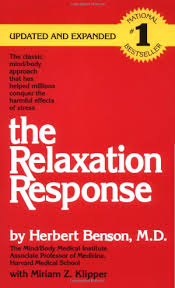
Relaxation ResponseThe bible of the rest and digest mode is Herbert Benson’s Relaxation Response. This book was first written over a quarter of a century ago, but it remains readily available. It’s telling that Walter B. Cannon’s work on “fight or flight” mode predates Benson’s work by such a long time. In other words, the medical and scientific community were researching the body under stress for decades before it ever occurred to anyone to think in terms of rest mode as a state that could be studied and advanced–as opposed to just being the normal state of affairs. This should give one an insight into how the human mind goes about considering problems.


6.) Recognize that stress is like cholesterol–there’s a good kind as well as the bad: Acute stress can serve one well during instances of danger. We have this response for good reason. The problem is chronic stress. When one’s body is in a stressed state, it’s not taking care of general maintenance tasks like healing itself. That’s fine in a short term, but problems compound over time. Chronic stress brings a high likelihood of illness because the body isn’t dealing with its run of the mill chores as it should be.

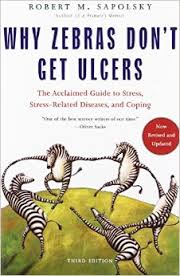
ZebrasUlcers_SapolskyThere are a number of books that expand upon this issue and which offer advice for keeping one’s stress of a healthy type. Robert Sapolsky’s Why Zebras Don’t Get Ulcers is among the best. It’s a long book and goes into great detail, but Sapolsky’s sense of humor helps to continue reading when the scientific minutiae might seem overwhelming. Another book on this topic that I found to be quite informative was Lissa Rankin’s Mind Over Medicine.  Rankin is a medical doctor, and so she offers a little different perspective from that of Sapolsky. (The latter is a biologist / neurologist.)


7.) Realize that you are a speck in a vast universe and, so, how big or long-lasting can your problem be?: Yeah, it’s a double-edged sword because it’s–in a way–a demoralizing thought as well as a comforting one. Therefore, one should first watch this bit of Monty Python wisdom:


But then one can keep things in perspective through the realization that one is not yet dead.

DAILY PHOTO: Tibetan Horns at the Ready

Taken in March 2013 at Namdroling Monastery in Bylakuppe, India

Taken in March 2013 at Namdroling Monastery in Bylakuppe, India

BOOK REVIEW: The Elephanta Suite by Paul Theroux

The Elephanta SuiteThe Elephanta Suite by Paul Theroux
My rating: 4 of 5 stars

Amazon page

The Elephanta Suite is a collection of three novellas that feature Westerners out of their league in India. As an American living in India, I suspect anyone who’s had this experience will recognize instances in which—for good, bad, or a mix of each—one is swallowed whole by some feature of India that one couldn’t possibly have anticipated. The novellas aren’t interconnected, except by way of the themes that run through them and Theroux’s trademark use of what I’ll call—for lack of a better term—cameo references. These aren’t his own cameo appearances in the book—as he’s also been known to do—but rather minor instances in which the lives of the characters in one story brush up against those in another.

The first of the novellas is called “Monkey Hill,” and it features a tourist couple who are staying at an upscale resort that’s near a town with a large Hanuman temple. (Hanuman is the “monkey-god” of Hinduism, a popular deity with a monkey-like face and a man-like body who features prominently in the epic entitled Ramayana.) The resort grounds also have monkeys, and so there are two potential meanings to the title. Like many wealthy travelers to India, the couple isn’t really experiencing India—though, like the characters in the other stories, they end up doing so in a major way by the story’s end. Experiencing India in unexpected ways is a central theme across the three works. The couple’s only real experience of India comes through each of their respective dalliances with locals that are carried out unbeknownst to the other. (I would point out that characters who aren’t particularly high in moral fiber are another prevailing theme across these stories, but really such characters are a hallmark of Theroux’s writing in general.)

“The Gateway of India,” as Bombay visitors might suspect, is set in that city and the waterfront attraction features prominently in the novel. The lead in this story is a business traveler who’s staying in the famous Taj Hotel in Mumbai. (The hotel overlooks the Gateway and was allegedly built by a pissed off J.N. Tata who was irate because, as a Parsi, he wasn’t allowed to stay in any of the upscale hotels because they exclusively catered to Westerners. As a “screw-you,” he built the most elegant hotel in the country at the time.) At the story’s beginning, our business traveler is a caricature of business travelers to India. He’s too scared to eat or drink anything that isn’t from a five-star hotel—and even then he’s wary. He’s filled with disgust whenever he rides through town or interacts with locals in the street. By turns, he’s transformed over the course of the story. Like the couple in “Monkey Hill” his introduction to the real India comes from a sexual liaison with a native. That said, this story features the most positive character transformation of the three stories. This is the one “feel-good” transformation of the three.

The final novella, entitled “The Elephant God,” begins in Mumbai, but is largely set in Bangalore. This story features yet another class of traveler to India–the backpacker. This lead is a young woman who is traveling on a tight budget while staying at an ashram. Beginning the story in Mumbai allows the reader to see how the backpacker loses her traveling companion, an issue that will prove crucial to the story’s resolution. As one might expect of a backpacker, our protagonist has had a truer experience of India than the wealthy protagonists of the other stories. She knows a little of the indigenous culture and how real people behave faced with real world events. In fact, there’s an intriguing piece of the story line that involves a job she gets teaching English to employees of a call center for a multinational corporation. [It should strain credulity that she’d be able to get a job on the visa she would have, but this is India.] At any rate, she begins to realize that—by teaching the call-takers to speak to American customers in a way that will make Americans comfortable—she’s essentially turning them rude—all their endearing deferential mannerisms fade in the face of her teachings. She feels bad about this. The titular reference involves an elephant and its handler (mahout) that she befriends. (In two years living in Bangalore, I’ve not seen an elephant living inside the city, but I can’t say that I found this aspect of the story unbelievable. I have seen, for example, the equally improbable camel or two.) The elephant isn’t a major feature of the story until the climax, though visits do recur.

I enjoyed these stories and would recommend The Elephanta Suite–particularly for any Westerners who have spent, or plan to spend, substantial time in India. The book may not surprise or inform such readers, but it’ll probably resonate with them.

View all my reviews