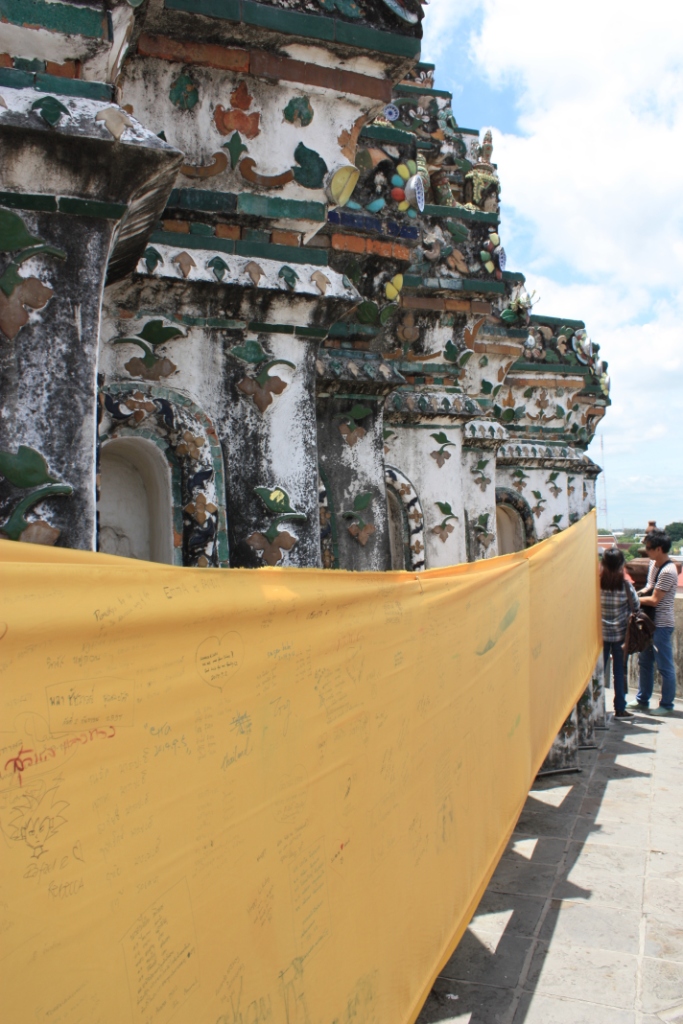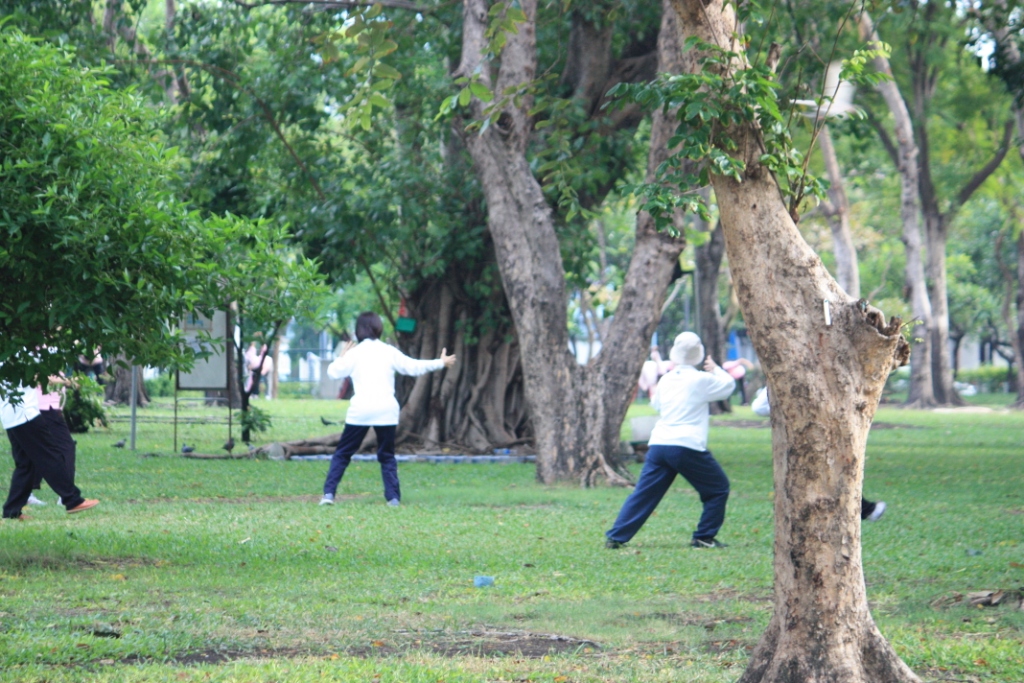
Taken in January of 2014 in Phuket Town
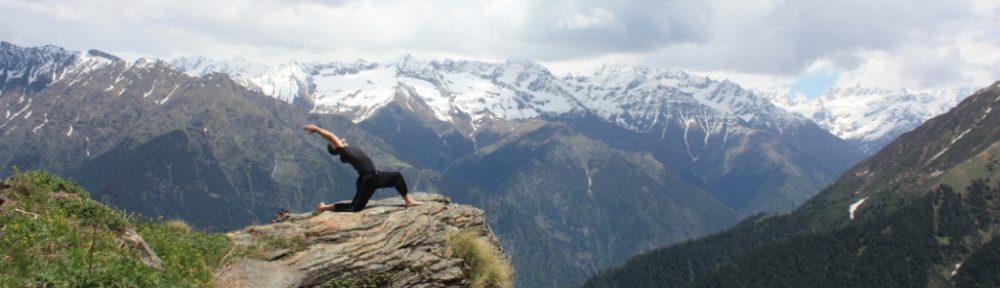

Taken in January of 2014 in Phuket Town

Taken in Great Himalayan National Park in June of 2015
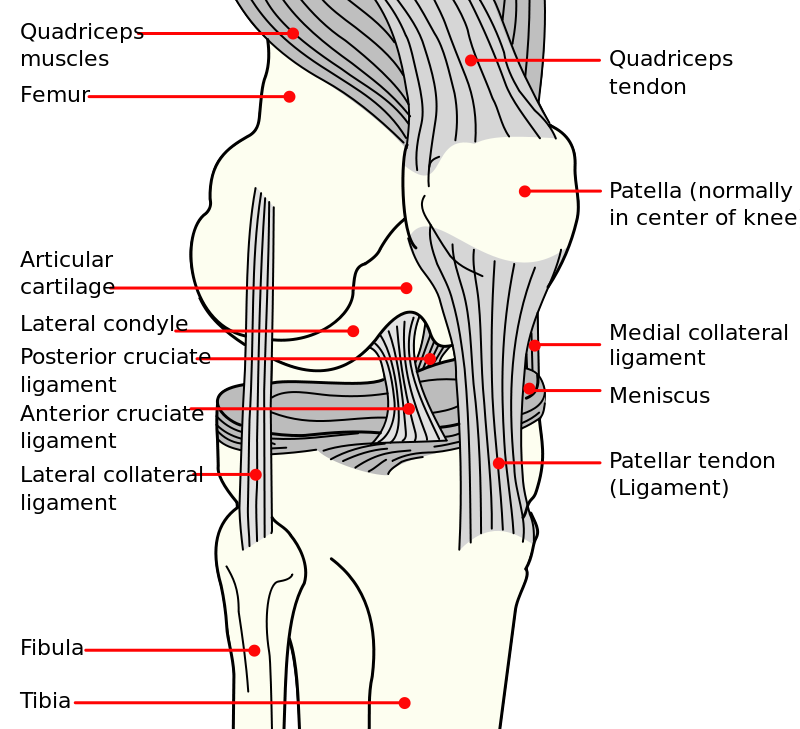
Public Domain Image from Wikipedia
The knee is a hinge joint. It’s designed to flex and extend with the thigh bone (femor) and the shin bone (tibia) in the same plane. A healthy joint can tolerate a certain amount of torquing or poor distribution of the body’s weight on occasion, but repetitive movements of that nature and /or severe uncontrolled movements can lead to permanent damage. Healthy knees are stable when straight (extended), but become slack when bent (flexed.)
Knee damage among martial artists is all too common, and the causes may or may not be self-evident. Martial artists whose practice includes kicks that require pivoting on a support leg or which involve landing leaping maneuvers may be intimately aware of the risks. However, the first martial art that I ever trained in had no twisting / pivoting kicks and few leaps (that were rarely practiced), but knee injuries were epidemic. The culprit in this case was low postures which required the thigh to be turned out (externally rotated and abducted) with the knee deeply flexed.
Well, I should say those postures were the culprit in conjunction with lack of flexibility and/or strength in all the right places. This isn’t to say that the individuals who developed knee problems weren’t strong or flexible, but the areas that needed work weren’t necessarily the big muscle groups that leap to mind when workout time comes around. Emphasis on the big muscle groups (quadriceps and hamstrings) with neglect of the muscles involved with adduction, abduction, external rotation, internal rotation and stabilization can create some problems. If you’re a runner or a weightlifter (with good form) you may be able to get away with such a stretching and strengthening emphasis. [Note: I’m not advocating such an approach for anyone. What I’m saying is that if your knee is only worked with the knee straight below the hip and pointed forward in a hinge fashion, your risks are not the same as someone who works with a flexed knee with the thigh turned out. The likely injuries are different.]
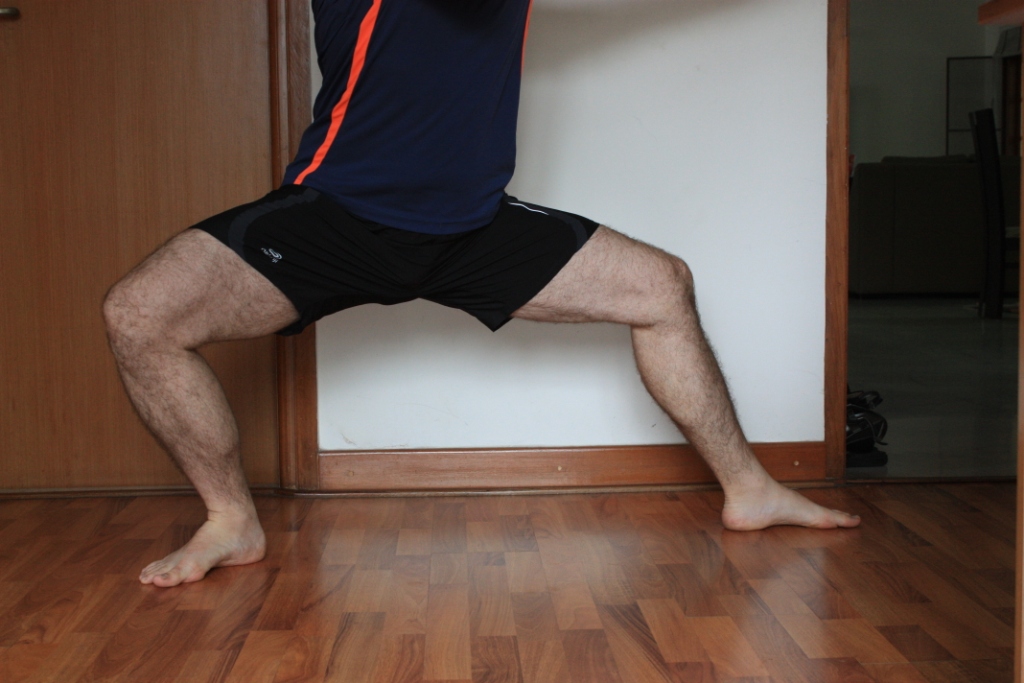
Note: Knees pointing the same direction as the toes. (The back knee might be a little far back but that’s an issue for the ankle health post.)
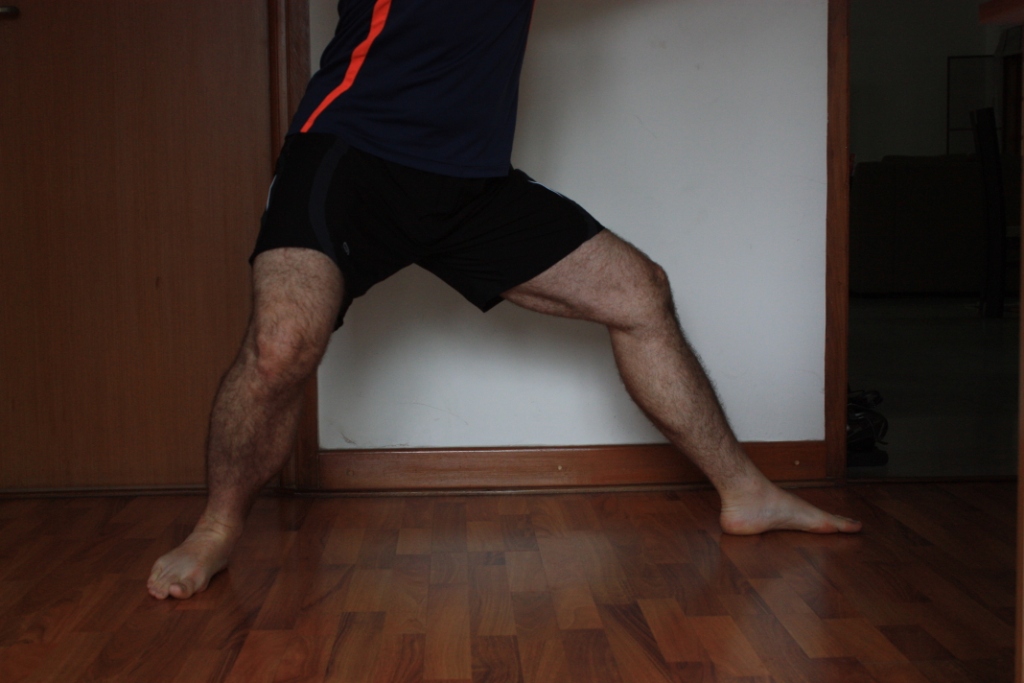
WRONG: Note: if one dropped a line down from the knee it would be well inside the foot. That means the ligaments are having to work too hard and your skeleton isn’t doing enough
To do a posture like the one above, one needs the flexibility to keep the knee wide enough so that it points the same direction as the toes. The joint shouldn’t be wrenched or torqued with load on it. The four ligaments (Anterior Cruciate Ligament [ACL], Posterior Cruciate Ligament [PCL], Medial Collateral Ligament [MCL], and the Lateral Collateral Ligament [LCL]) and the surrounding musculature keep the joint snug during movements. And, as mentioned earlier, when the knee is deeply flexed it’s more sloppy than when extended.
-Increase flexibility in the muscles that internally rotate and adduct the thigh: When one goes into a wide-legged stance, one’s thigh is pulled away from the body’s center-line (abducted) and the thigh externally rotates. If the muscles that act in the opposite direction (pulling the thigh back on center and rolling the thigh inward) are too tight to allow the knee to move into proper position, then the load of the body weight will be going into the ground through a kinked joint. Furthermore, one will end up torquing through the joint as one moves. Below are a few hip openers that will help one achieve the requisite range of motion.
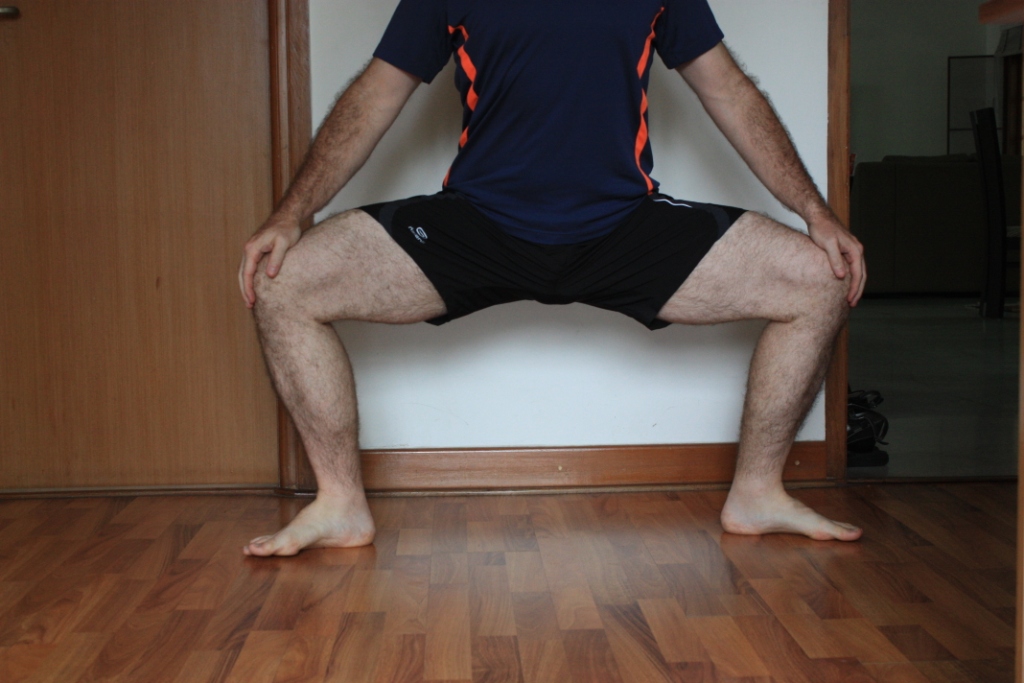
Utkatakonasana (often called goddess pose) variations will show you whether you’re getting your knees and toes in line.
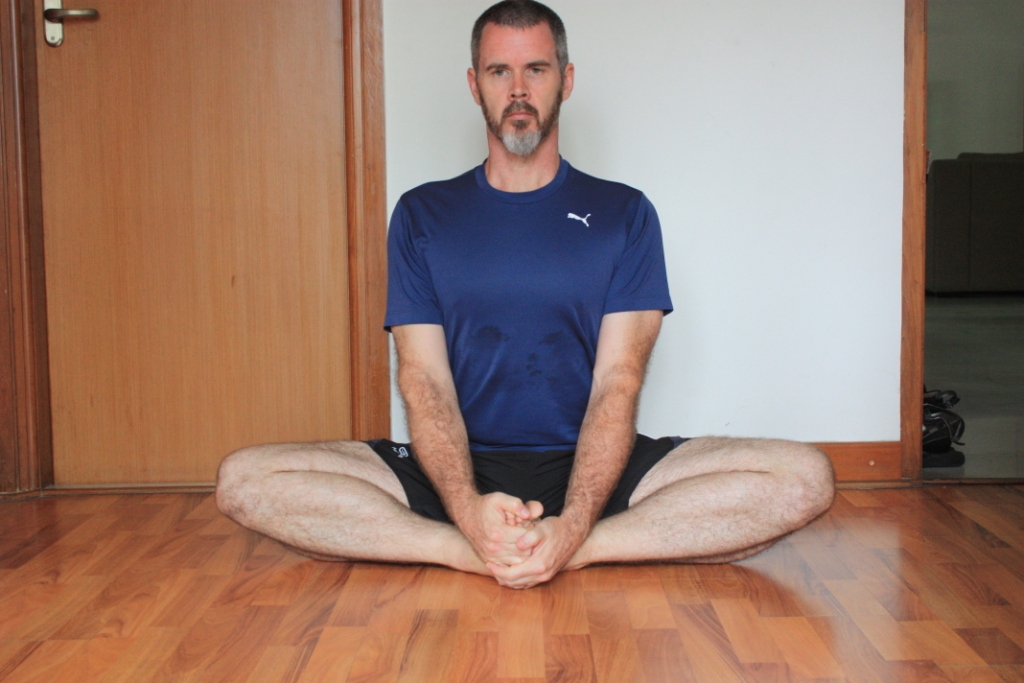
Badhakonasana (often called the butterfly stretch): Work on getting those knees down
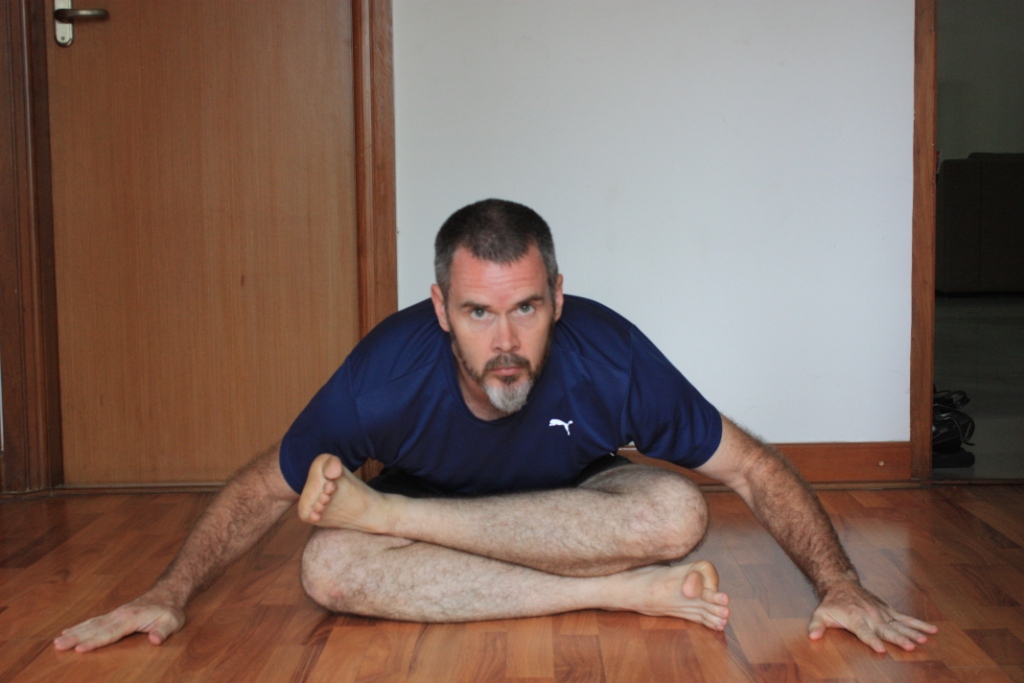
Place one foot on top of the opposite knee (and vice versa for the other side) carefully shift weight forward. This puts an intense stretch on the hip-joint to help rotate the thigh sufficiently
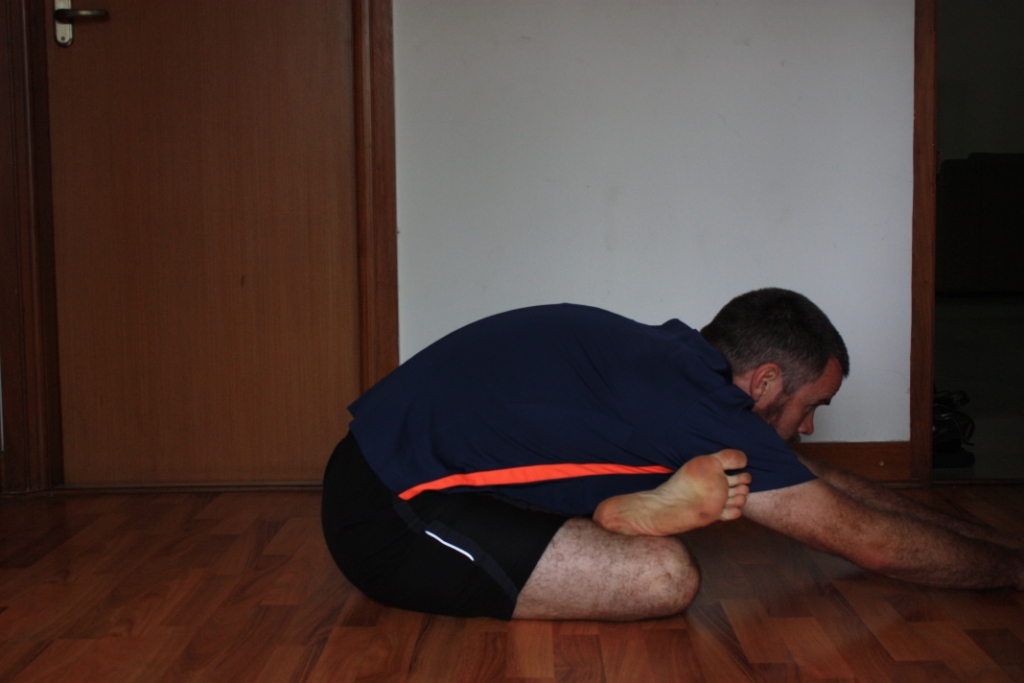
Same as the last from the side
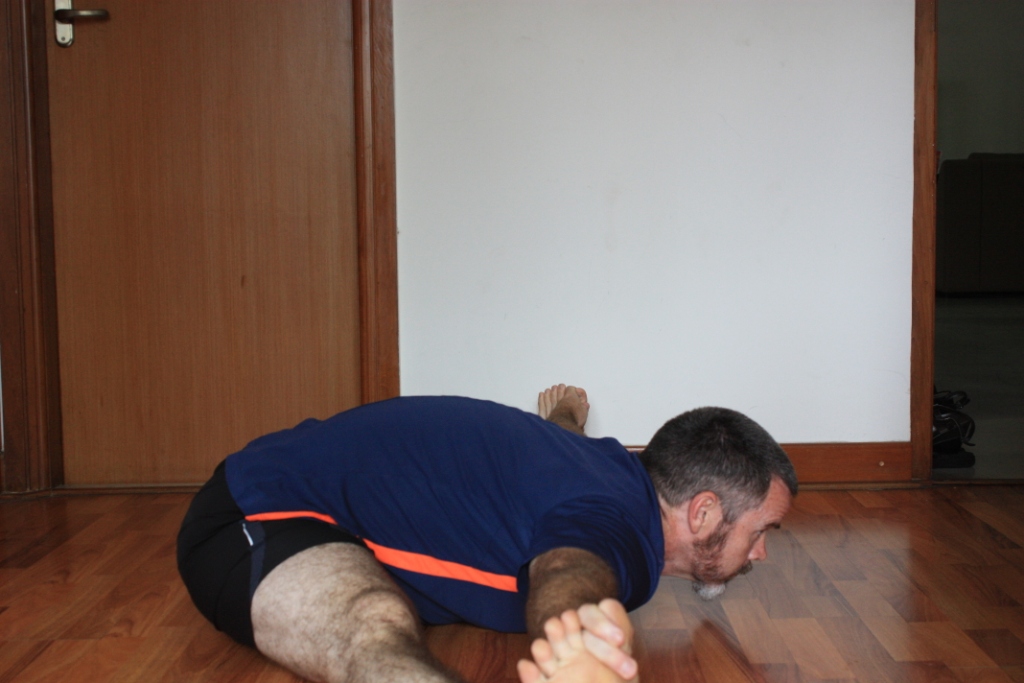
Upavistakonasana: put legs at about 90 degrees relative to each other, and then lean forward with a flat back placing the stomach, chest, and chin on the floor (in that order.)
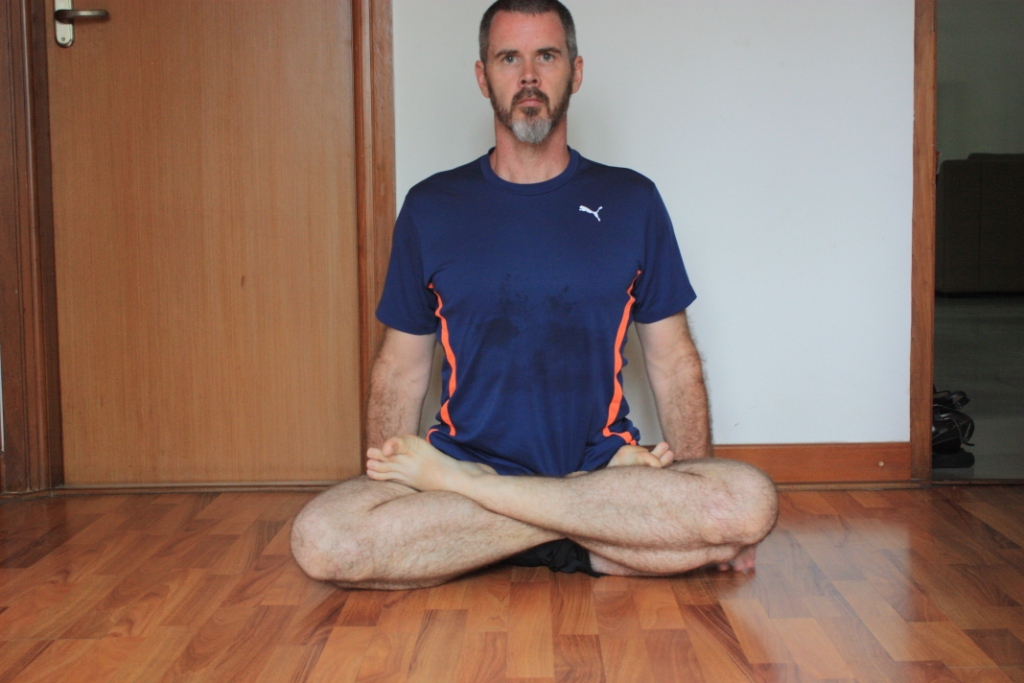
Padmasana (lotus): If you meditate in padmasana, you probably already have the range of motion necessary. Note: if padmasana hurts your knees, you need to go back to hip openers and discontinue the practice.
-Strengthen the muscles that stabilize the knee-joint. One begins this process with the usual suspects of leg exercise. One just needs to focus intently upon alignment. Here are a few of the exercises you may already be doing.
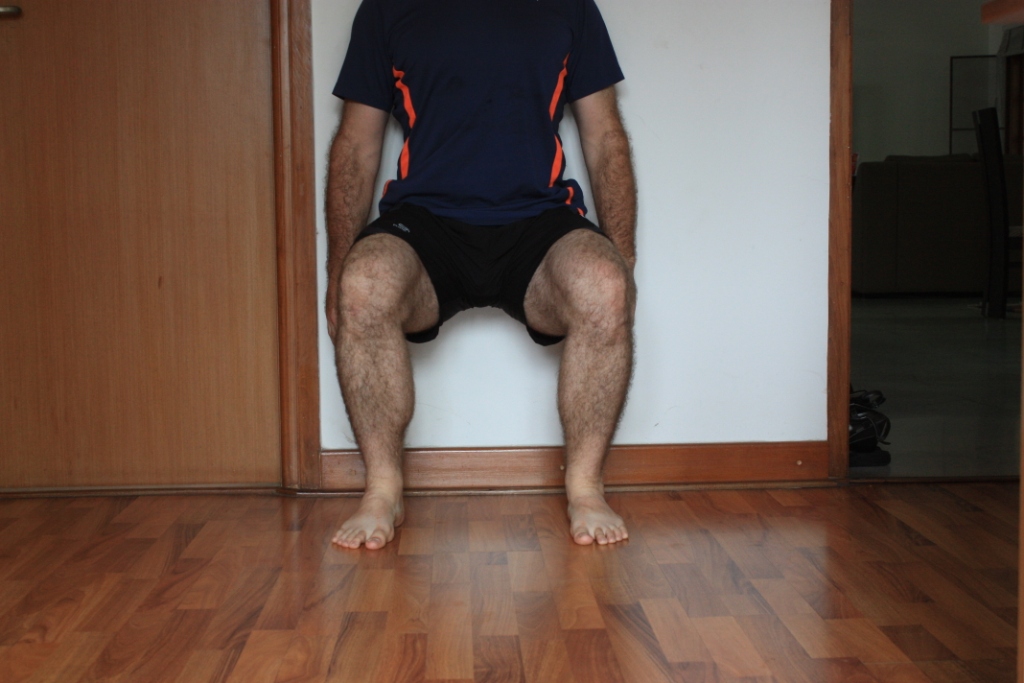
Wall squat: just like sitting on a chair with one’s back to the wall–sans the chair.
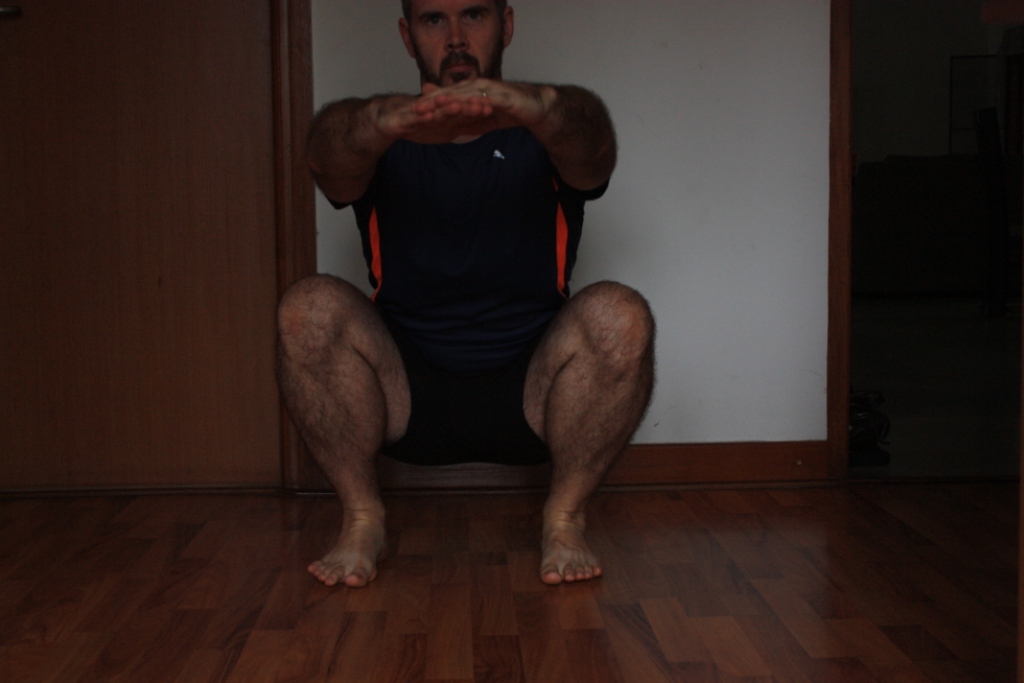
The classic squat
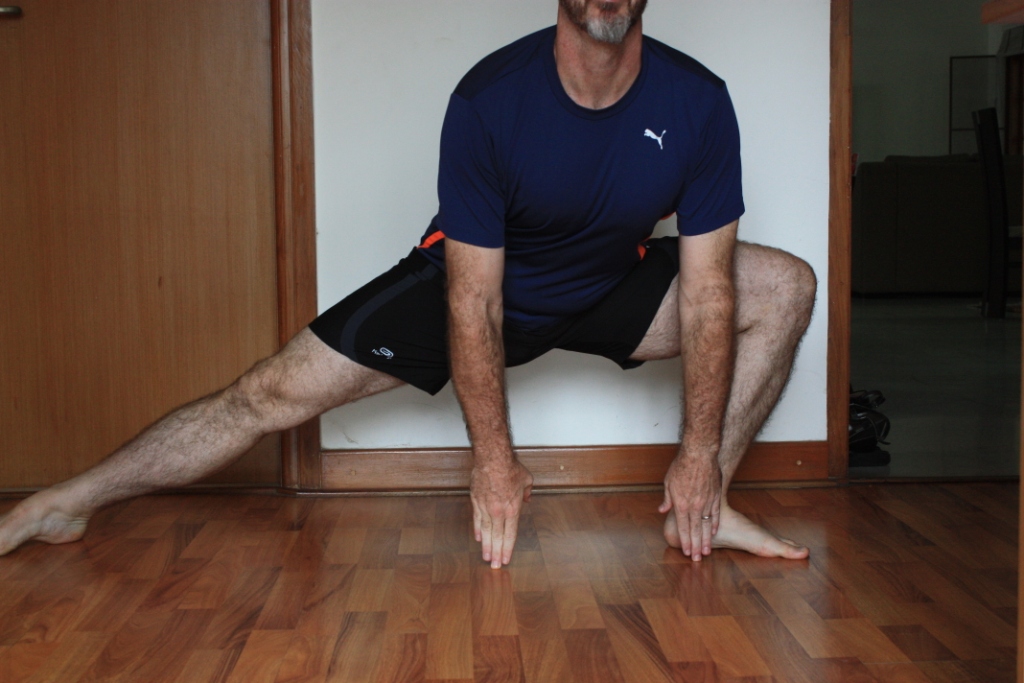
Side lunge: This one is particularly important to get the knee aligned with the foot.
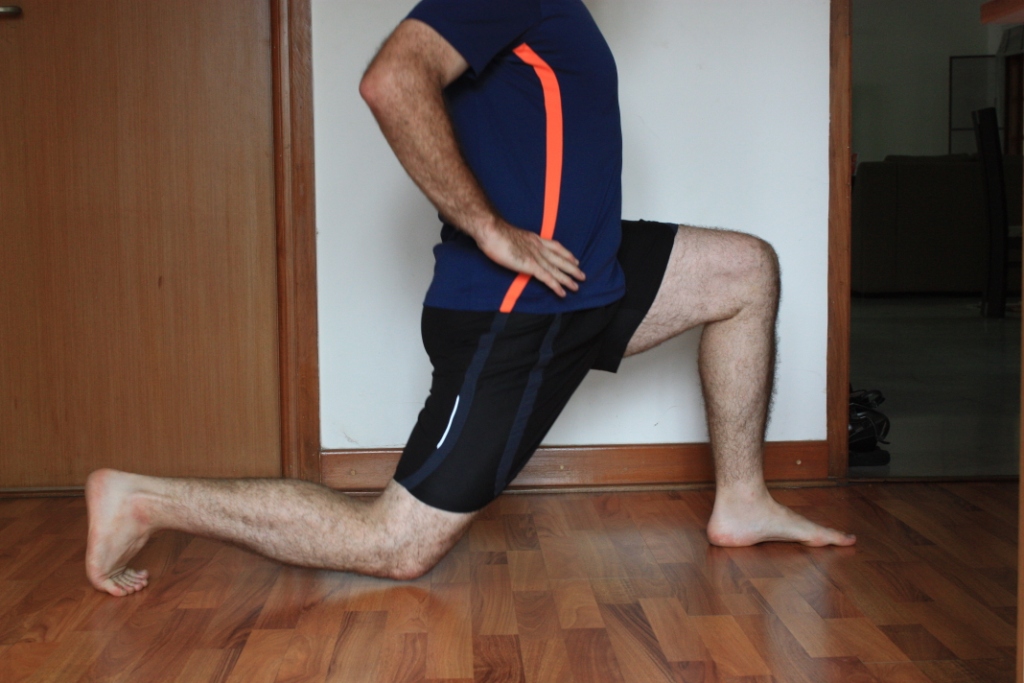
The basic lunge: can be done stepping forward, backward, or both (the latter in an alternating fashion)
As one needs more challenge, one can achieve it in the usual ways (single-legged, unstable surface, add weight, or combinations thereof.) Below are a couple of variations that combine single-limbed work with an unstable surface.
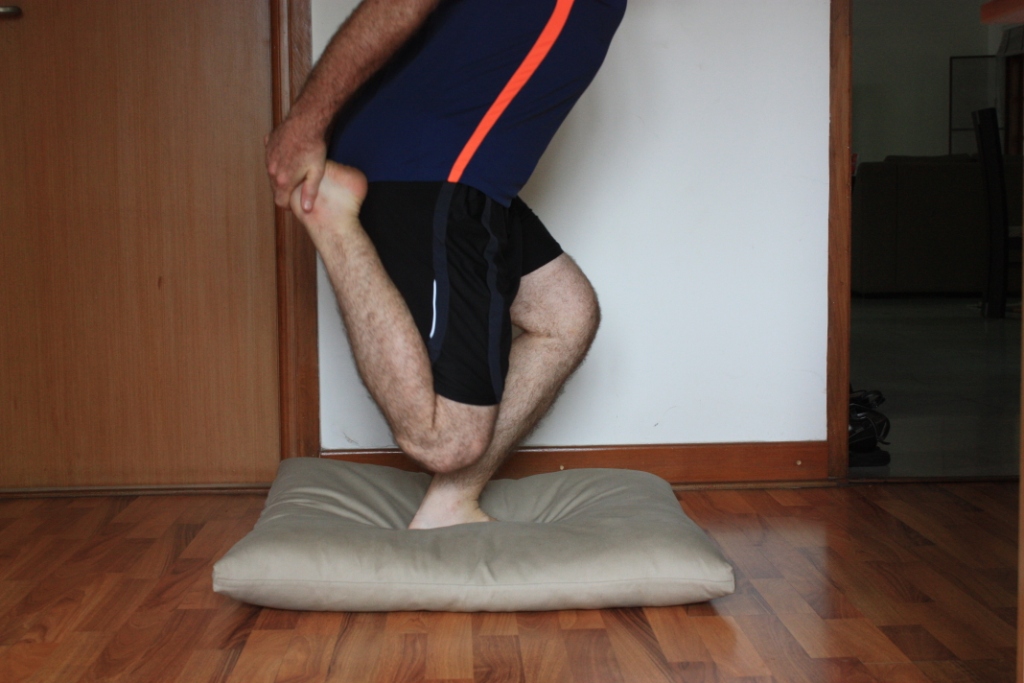
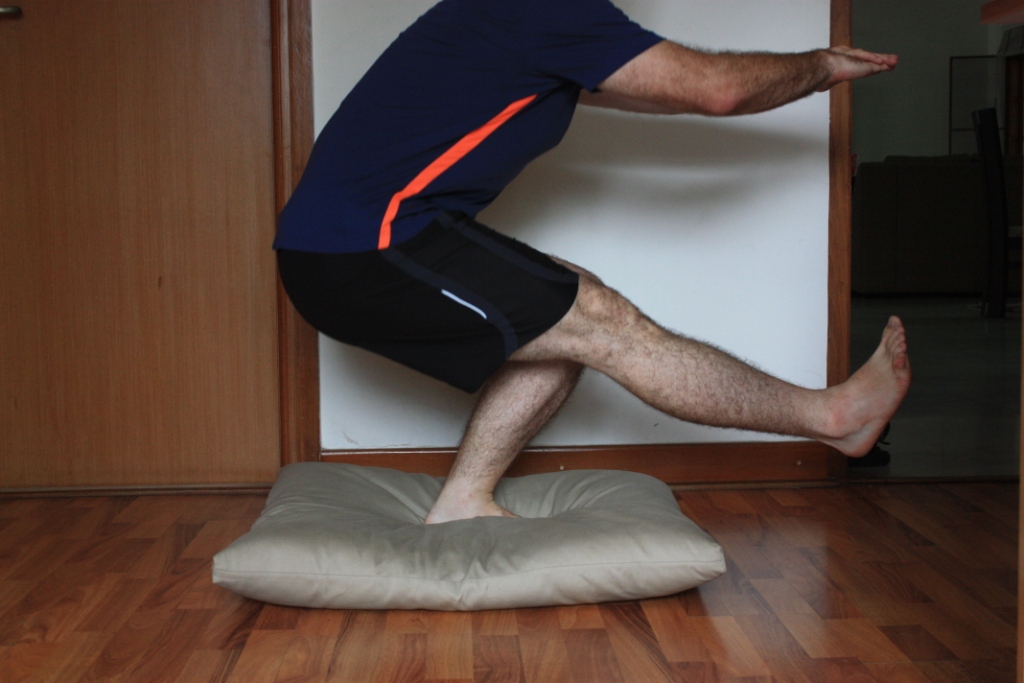
-Save static stretching for after the joint has warmed up. It used to be common to begin a workout with static stretching. While few do this anymore, it’s a practice that needs to be replaced. Stretch warm.
-Don’t neglect the opposing muscle groups: When I said that one needs to increase flexibility in adductors and internal rotators, that doesn’t mean to ignore the opposing muscles. Nothing good comes of stretching or strengthening in an unbalanced fashion. Your musculature works as a team with agonists, antagonists, and stabilizers all working in conjunction to produce effective movement.
-Don’t go overboard with stretching: If your aim is to be a contortionist, then by all means go ahead. However, highly flexible martial artists need to be concerned about joint laxity. Laxity is when the joint gets so loose that it’s vulnerable to popping out-of-place. A martial artist needs a balanced style of fitness. Extreme flexibility results in weakness and lack of joint robustness, just like extreme strength training produces a body that lacks range of motion and stamina.
Most importantly, don’t ignore pain when it’s still at the minor twinge point. If you have knee pain you’re doing something that joint doesn’t like. One should reevaluate your movement and, if necessary, considering stepping back from your current practice to work on capacity building exercises.
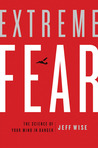 Extreme Fear: The Science of Your Mind in Danger by Jeff Wise
My rating: 4 of 5 stars
Extreme Fear examines the science behind fear—particularly the fear of life and death situations. In doing so, the author presents findings from scientific research as well as cases that demonstrate the concepts behind those findings. People are often so close to their fears that they take them for granted, and feel that there’s nothing to be done about them. However, there’s a great deal to be learned about how fear operates and how one can improve one’s performance in fearful situations. By replacing the lens of shame with one of science, one can see what fear is objectively, and make the emotion more of a help and less of a hindrance.
A central idea in the book is that fear evolved to maximize one’s chance of survival against the age-old threats facing mankind. These pre-historic threats were relatively straightforward: saber-tooth tiger attacks, clubbing by members of warring tribes, fire, famine, flood, etc. Ancient threats often called for hauling ass, freezing in place, or getting stabby. The problem is that our present-day threats often call less for gross motor skills (run, kick, or throw) and more for creative or nuanced solutions to technological problems (i.e. sliding cars, falling planes, or malfunctioning assault rifles.)
Motor learning is one means by which this mismatch between what our brain tells our body to do in a stressful situation and what is called for in our modern world. Take the case of the infantryman with the jammed rifle. Without training, he might pick up the rifle like a club, intending to use it to unleash blunt force trauma. That is, if he’s still alive then the enemy gets into cudgeling range. Alternatively, the soldier may drop the rifle and run for his life. However, because he had a drill sergeant who made him practice clearing his weapon over and over, his body can go to that behavior while his conscious mind is blinking out.
Still, motor learning only takes us so far. Sometimes creativity is called for, and that’s a tall order in the face of where our body / brain want to put limited resources. In fact, Wise begins the book with the story of a pilot who was flying an old plane when the wing support broke and the wing flipped up, threatening to rip off. Somehow the pilot figured out—based on a vague memory and lots of experience—that he could flip the plane over and fly it upside-down and the wing would snap back into place. Then he had to figure out how to land: a.) upside-down crash, or b.) try to flip the plane over at the last second. The brain systems that this pilot smoothly accessed are among those that one doesn’t expect to be operating in life or death situations—e.g. those involved with long-term conscious memory and abstract problem solving.
The question of how some people can keep their wits about them, as the above pilot did, while others crash and die is the one that Wise really wants to answer. It turns out that it’s not such and easy question. During World War II, the military conducted studies to try to determine which soldiers could be counted on under life and death stress. The answer didn’t readily present itself. Among the problems in finding an answer is that courage and fearfulness aren’t as unitary or straightforward characteristics as one might think. Wise presents the case of Audie Murphy as a prime example. Murphy was at once one of the most decorated American soldiers in World War II—a man who’d taken on a company of Germans single-handedly—and a man of great social anxiety.
The book’s 13 chapters are divided into three parts. The first part presents fear and its effects. The middle section deals with various forms, aspects, and facets of fear, including: social v. life-and-death fear, choking behavior in sports, and fear of fear v. fear of an outcome. In the last part of the book, Wise suggests how one might achieve better performance in the face of fear.
I found this book to be informative and interesting. Wise did a good job of picking cases to illustrate the concepts discussed in the scientific literature. I’d recommend this book for individuals who are interested in the science of the brain and the ways to achieve ultimate human performance.

Taken in July of 2014 in Munnar
It doesn’t really show up well, but the tree in the center apparently swallowed and digested another tree. i.e. It encased a tree that died and rotted.

Taken in December of 2014 in Budapest