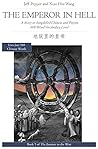
BOOK: “The Emperor in Hell” [Book 5 of the “Journey to the West” Series] ed. by Jeff Pepper; trans. by Xiao Hui Wang

The Emperor in Hell: A Story in Simplified Chinese and Pinyin, 600 Word Vocabulary LevelThe Emperor in Hell: A Story in Simplified Chinese and Pinyin, 600 Word Vocabulary Level by Jeff Pepper
My rating: 4 of 5 stars

Publisher Site – Imagin8 Press

This is the fifth volume in a series that abridges and simplifies the classic Chinese novel, Journey to the West, so that it can be read by a language learner with about a HSK 3 grasp of Chinese. It tells the story from Chapters 10 and 11 of the original novel. Like the preceding volume, this one doesn’t deal with Sun Wu Kong (i.e. the Monkey King — protagonist of the novel overall,) and doesn’t even deal with the monk Xuanzang — the protagonist of the true story on which the novel was based.) These chapters tell a story that feels like a diversion, though it will be involved in the segue back to the actions of the main cast.

In this book, the Jing River Dragon King gets in trouble when he makes a bet with a fortune-teller. The Dragon King has to cheat to save his pride, but this runs him afoul of the Jade Emperor. The Dragon King appeals to the human Emperor, Taizong, who agrees to help. When wires get crossed, Taizong ends up in the underworld for judgement. With the help of others and with promises made, Taizong is allowed to return to earth.

It’s an interesting story and gives some insight into Chinese mythology. As is always the case with a book such as this, events of the story must be cut or rushed. Readers may vary in their views about whether the right material was cut or thinned.

I continue to enjoy this series. This book was a little more challenging to read than earlier volumes, not because the vocabulary was harder. I think it was more that contextual cues were fewer, owing to it not being so tightly tied to the overall story.

If you’re just learning to read Chinese, I’d recommend this series as an interesting story made readable to a language learner.

View all my reviews

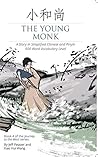
BOOK: “The Young Monk” [Vol. 4 of the “Journey to the West” Series] ed. by Jeff Pepper / trans. by Xiao Hui Wang

The Young Monk: A Story in Simplified Chinese and Pinyin, 600 Word Vocabulary (Journey to the West Book 4)The Young Monk: A Story in Simplified Chinese and Pinyin, 600 Word Vocabulary by Jeff Pepper
My rating: 5 of 5 stars

Publisher Site — Imagin8

This book, Volume 4 of the Journey to the West series, takes a turn from the books thus far. While the first three volumes (Ch. 1-7) focus on Sun Wukong, the Monkey King, this volume leaves him under the mountain where the last volume left him, and — instead — focuses on the origin story of Xuanzang — the monk who is sent by the Buddha to India to get scriptures in the original book — based on the real-world monk who did travel to India to complete the selection of Buddhist scriptures available to Chinese Buddhists.

The monk’s story might not sound like it would be as thrilling as that of the superpowered immortal monkey, but it’s a gripping tale. The story begins before Xuanzang is born and ends in his eighteenth year. So, before he is assigned to travel West to get scriptures.

As I’ve said in earlier reviews, I really like the approach of this series. It has Simplified Chinese script, pinyin, an English translation, and a full glossary of terms used, and it’s organized so as to facilitate reading by a language learner.

I continue to recommend this series for language learners who need a linguistically simplified text to be able to read.

View all my reviews

BOOKS: “The Life of Hiuen-Tsiang” by Hui-li [trans. by Samuel Beal]

The Life of Hiuen-TsiangThe Life of Hiuen-Tsiang by Hui-li
My rating: 4 of 5 stars

Available free online through the Indian Gov’t

Those familiar with Chinese Literature (or smash-hit video games) will be acquainted with the tale of Sun Wu Kong, the Monkey King. The central event of the novel Journey to the West is a Chinese Buddhist monk traveling to India to gather a complete set of the Buddhist canon. In the novel (and video game, Black Myth: WuKong,) the monk’s name is Tang Sanzang (in translations – and movie / television – he’s sometimes called Tripitaka, which is actually the name of the Pali Canon — the original Buddhist books, themselves.) In real life there was also such a monk, and his name was Xuanzang (玄奘, Romanized as Hiuen-Tsiang in an earlier system,) and this book describes his travels to, through, and back from India.

It turns out the monk was not escorted by a god-tier mythical creature and his two superpowered compatriots (i.e. Pigsy and Sandy.) For this reason, the actual Xuanzang occasionally got threatened, robbed, and was once almost killed by riverine pirates. This book is a travelogue of Xuanzang’s journeys through China, Central Asia, [present-day] Afghanistan and Pakistan, and throughout India.

Needless to say, this book isn’t as taut and thrilling as the fictional account with its gods and monsters, but – for those with historical and geographic interests – it’s not without appeal. It does have extensive description of Xuanzang’s visits with various monks and royalty that is dry reading as well as discussions of where Xuanzang’s collection stood at any given point, but there are a few intense events and harrowing moments.

If you’re interested in Buddhist history, you may want to give this book a look.

View all my reviews