“Upon the Road of My Life” by Stephen Crane [w/ Audio]

Upon the road of my life,
Passed me many fair creatures,
Clothed all in white, and radiant.
To one, finally, I made speech:
“Who art thou?”
But she, like the others,
Kept cowled her face,
And answered in haste, anxiously,
“I am good deed, forsooth;
You have often seen me.”
“Not uncowled,” I made reply.
And with rash and strong hand,
Though she resisted,
I drew away the veil
And gazed at the features of vanity.
She, shamefaced, went on;
And after I had mused a time,
I said of myself,
“Fool!”

“Have you ever made a just man?” by Stephen Crane [w/ Audio]

"Have you ever made a just man?"
"Oh, I have made three," answered God,
"But two of them are dead,
And the third --
Listen! Listen!
And you will hear the thud of his defeat."

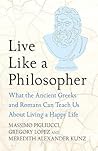
BOOKS: “Live Like a Philosopher” by Massimo Pigliucci, Gregory Lopez, and Meredith Alexander Kunz

Live Like A Philosopher: What the Ancient Greeks and Romans Can Teach Us About Living a Happy LifeLive Like A Philosopher: What the Ancient Greeks and Romans Can Teach Us About Living a Happy Life by Gregory Lopez
My rating: 4 of 5 stars

Publisher Site — Hachette / Headline Press

This book is for a person in the market for a philosophy of life, but who only knows that they want a system rooted in Ancient Greece. While the coauthors are all Stoics, the book explores twelve additional philosophies and gives each roughly equal consideration. In addition to the expected systems, such as Epicureanism, Stoicism, Platonism, and Skepticism, there are also several lesser known or defunct philosophies such as Cyrenaic hedonism, Cynicism, Pyrrhonism, and Megarianism.

The book is organized into four parts. The first examines schools that value pleasure (Cyrenaicism and Epicureanism,) the next investigates schools that focus on virtue and character (Aristotelian Peripatetics, Stoicism, Cynicism, and Political Platonism,) the penultimate focuses on systems encouraging doubt or caution in knowledge (Socratic philosophy, Academic Skepticism, Sophism, and Pyrrhonism,) and the last set are posed as questionable candidates for a life philosophy (i.e. those of the Pythagoreans, Megarians, and Neoplatonists.) The last three schools are questioned on various grounds, including: is enough known about what its practitioners believed, did they live their philosophy or just ruminate on it, and could the system be considered a full-fledged philosophy (as opposed to a stance on a specific issue or issues.)

The book is presented in self-help fashion, with each chapter ending in a set of exercises designed to help the reader build practical understanding of each school. The goal of these exercises (as comes together in an appendix) is to help the reader determine which philosophy is best suited to their disposition and inclinations.

I enjoyed this book. The authors use stories to convey ideas and the book’s readability is kept inviting to general readers. If you’re interested in better understanding Greek schools of philosophy, I’d recommend the book as quick and easy way to get a better grasp.

View all my reviews

FIVE WISE LINES [May 2025]

It is a happy talent to know how to play.

Ralph waldo emerson

Just living is not enough… one must have sunshine, freedom, and a little flower.

Hans christian andersen

Don’t abandon kindness, mercy, and sympathy in an emergency.

Qiānzì wén [千字文], Ch. 3

Logic will take you from A to B. Imagination will take you everywhere.

albert Einstein

You must live in the present, launch yourself on every wave, find your eternity in each moment.

Henry david thoreau

FIVE WISE LINES [March 2025]

Would the world ever have been made if its maker had been afraid of making trouble?

george bernard shaw, PygMalion

Refrain from talk of others’ shortcomings; don’t rest on your strengths.
[罔谈彼短; 靡恃己长.]

Thousand Character classic [千字文]

The reasonable man adapts himself to the world: the unreasonable one persists in trying to adapt the world to himself. Therefore all progress depends on the unreasonable man.

george bernard shaw, Man and superman

A child is the most reliable measure of time. His daily growth is proof of your daily ageing and decline. The child’s gains are your losses, and the closer a child gets to anything, the farther you withdraw, as though you were tied to one another on opposite spokes of a wheel and the wheel, without your noticing it, turns. Dawn for the child is dusk for you.

Otar chiladze, A Man was going down the road

We are all dependent on one another, every soul of us on earth.

George bernard shaw, Pygmalion

BOOK REVIEW: Meno by Plato

MenoMeno by Plato
My rating: 5 of 5 stars

Amazon.in Page

Online: MIT Classics

The central question of this dialogue is the teachability of virtue. The dialogue called Protagoras also delved into this question. Lest one think there’s no benefit to be had from reading a second take on the subject, the ultimate answer in this dialogue is the opposite of that seen in “Protagoras.” Socrates agreed with Protagoras that virtue was teachable. However, here Socrates concludes that it isn’t, citing the fact that there are no viable teachers of virtue (ever the anti-Sophist,) and yet there are people who consistently behave virtuously.

[If one wonders how two of Plato’s Socratic dialogues could feature completely different answers on the same question, the mid- and late dialogues are often thought to reflect Plato’s personal views more than his teacher’s. “Protagoras” is an early dialogue, while “Meno” is a middle dialogue. (It’s also possible they weren’t written by the same author as a number of dialogues attributed to Plato are in doubt.)]

I don’t find Socrates’s arguments on the subject at hand compelling. Socrates proposes that there are certain concepts that come pre-loaded into humans. He questions one of Meno’s slaves on geometry to show that the slave seems to have a grasp of geometry without having ever been taught. Ultimately, Socrates concludes that a grasp of virtue is divinely installed in many people.

Still, there’s lots of beneficial food-for-thought, particularly when Socrates differentiates knowledge and true beliefs / right opinions.

View all my reviews

BOOK REVIEW: Alcibiades I & II by Plato

Alcibiades I and IIAlcibiades I and II by Plato
My rating: 5 of 5 stars

Amazon.in Page

While these two dialogues feature Socrates questioning Alcibiades (a youth – apropos of nothing – for whom the philosopher has the hots,) they’re different. While it’s not certain that either was written by Plato, it’s much more widely accepted that the first dialogue was so authored. I found the first part to be the more engaging read.

In Part I, Socrates urges Alcibiades to put off going into politics (as the young man is about to do) until he’s more enlightened on the subject at hand – i.e. justice, expediency, and virtue as it pertains to matters of war and peace. In the second part, Socrates convinces Alcibiades that the subject of prayers should not be taken lightly, leading the young man to delay his sacrifice and prayer to a time he can be wiser about it.

The first part is more piquant. In it, Alcibiades on occasion seems to be holding his own (rather than being a talking head.) A great example of this can be seen after Socrates makes clear that Alcibiades’ education in language, the lyre, and wrestling hardly qualify him to advise Athens on matters of war and peace. Alcibiades turns the tables and asks whether it isn’t possible that he could attain the requisite knowledge of justice other than through formal education. Socrates admits that he could by discovery, but just when Alcibiades thinks he has the point, Socrates argues that the only way Alcibiades could make a discovery was if there was a time that the youth didn’t think he already knew. Socrates goes on to show that – even as a child – Alcibiades labored under the impression that he knew what was just.

The most interesting topic of the second dialogue is the question of whether lack of wisdom and madness are the same thing. In Phaedrus, Socrates explores several varieties of divine madness, and I wondered how closely this dialogue might echo that one. (It doesn’t because it’s more about madness that’s not so divine, but Socrates does refute Alcibiades’ equation of the two concepts.)

Definitely read First Alcibiades, and if you have time, the second one makes some intriguing points as well.

View all my reviews

BOOK REVIEW: Hipparchus by Plato

HipparchusHipparchus by Plato
My rating: 5 of 5 stars

On-line

In this Socratic dialogue about “lovers of gain,” Socrates and an unnamed friend debate whether pursuing gains can be wicked. Usually, the title of a dialogue is the name of Socrates’ philosophical sparring partner, but, herein, Hipparchus is a historical figure who Socrates cites as the reason he wouldn’t hornswoggle his friend, quoting “Walk with just intent” and “Deceive not a friend” as credos that he, Socrates, lives by.

The friend tries a number of approaches to argue the loathsomeness of lovers of gain. Recognizing the starting premise will be that a gain is a good, the friend argues that such people (presumably greedy / materialistic types) purse valueless gains. Socrates attacks that as an oxymoron. Next, the friend argues that lovers of gain seek gains that no honorable man would pursue. Again, Socrates argues that a gain is a good and all humans seek good. Since the friend doesn’t want to call the lovers of gain fools (i.e. unable to recognize a gain when they see it,) the friend is stuck. The third approach is to argue that a wicked gain could be considered a loss. This is also swiftly rebutted. The last tack is to argue that some gains are good, while some are evil, which runs afoul of the same argument.

This isn’t one of the best dialogues – in fact, many question whether it was written by Plato. That said, it brings up a few ideas that are worthy of consideration. It felt very much like a conversation I once heard in which a young woman argued, “No one should have that much more than they need.” Which drew the response, “You realize that 90% of the world would say you have tons more than you need?” Which resulted in the instigator walking off in a huff. If you want to engage in debates about the virtue (or vice) of wealth acquisition, this might be a good place to begin your reflection.

View all my reviews

5 Philosophical Questions Life Forces You to Answer

Like it or not, life makes philosophers of us all. You may hate philosophy, but you can’t escape it. You can — as many people do — outsource how you answer these questions, but that still requires a decision.

5.) How do I know a thing is true?  Sometimes the answer is self-evident, but, more often then people acknowledge, it’s not. This is exacerbated by the confusion of subjective truth (a personal “truth”) with objective truth (the universally true.)

Some people relinquish decision to an authority — be it a teacher, a scripture, or the scientific consensus. Some people only believe what said person’s personal experience tells them.

There is a related question of how tightly should one hold onto whatever beliefs one acts as if are true. The scientific approach suggests one should be ready to abandon something one believes is true in light of new information (assuming the new information is sound and can be validated.) Religions tend to prefer that the truths that have been handed down should be grasped firmly no matter what one sees, hears, or learns. One’s philosophical stance may take either approach, or one in between.

4.) [Who] am I?  As the brackets suggest, this is actually two questions. The full question, “Who am I?” presumes that there is a self (an I.) Some philosophies, e.g. Buddhism, reject this presumption, hence the more fundamental question of “Is there an I?”

3.) What constitutes a virtuous or moral life? Of course, some philosophies would reject the ingrained presumption that one should care, but that’s a fringe position. Maybe the more general question of “What constitutes a good life?” is a better one.

2.) What does it mean for something to be real? Some will say, “Come on. I know what’s real. I don’t need to philosophize about that?” Really? Because the best minds in the world are constantly debating this and have reached no consensus on the subject. It’s certainly possible to get through life behaving as though reality is “x,” whether or not “x” turns out to be true. But that’s very different from knowing what is true.

1.) Is there free will, and — if so — in what sense?  It feels like we have complete free will, but there are a couple of grounds on which this has been questioned. For the religious, reconciling an omnipotent god and free will takes some mental gymnastics. (If one can act completely freely, how can a god also?)

But more recently, free will has been challenged by science as well. Benjamin Libet’s work showed that “decisions” take place before people become conscious of them, and — therefore — aren’t decisions in the sense we usually understand that word (i.e. the product of conscious deliberation.) Of course, while some have argued that the repeated validation of Libet’s work shows free will is purely an illusion, there remain many who argue there are still possible ways in which some form of free will exists. (Including, apparently, Libet who believed we at least have “free won’t” even if we don’t have free will — i.e. we can consciously veto deterministic “decisions.”)

Best of luck picking — or building — your own life philosophy.

POEM: Blake’s Virtue

by Thomas Phillips, oil on canvas, 1807

box of virtue, or box of sin
which one does this act go in?
and why put each one in a box?
to sell the sins down by the docks?

Blake the madman, Blake the pious
the difference reflects your bias
wedging each act into a crate
dilutes the evil and the great
all so the vain can extricate
themselves above the ones they hate