Sonnet 18 by William Shakespeare [w/ Audio]

Shall I compare thee to a summer's day?
   Thou art more lovely and more temperate:
 Rough winds do shake the darling buds of May,
   And summer's lease hath all too short a date:
 Sometimes too hot the eye of heaven shines,
   And often is his gold complexion dimm'd:
 And every fair from fair sometime declines,
   By chance, or nature's changing course untrimm'd;
 But thy eternal summer shall not fade,
   Nor lose possession of that fair thou ow'st,
 Nor shall death brag thou wander'st in his shade,
   When in eternal lines to time thou grow'st;

   So long as men can breathe, or eyes can see,
   So long lives this, and this gives life to thee.

Self Portrait [Common Meter]

So many historic figures 
 whose look we think we know.
  Did Jesus of Nazareth sport
   hippie hair & a halo?

Perhaps, he did have quite long hair
 but not the tawny blonde
  of which so many "portraitists"
   seemed to be quite fond.

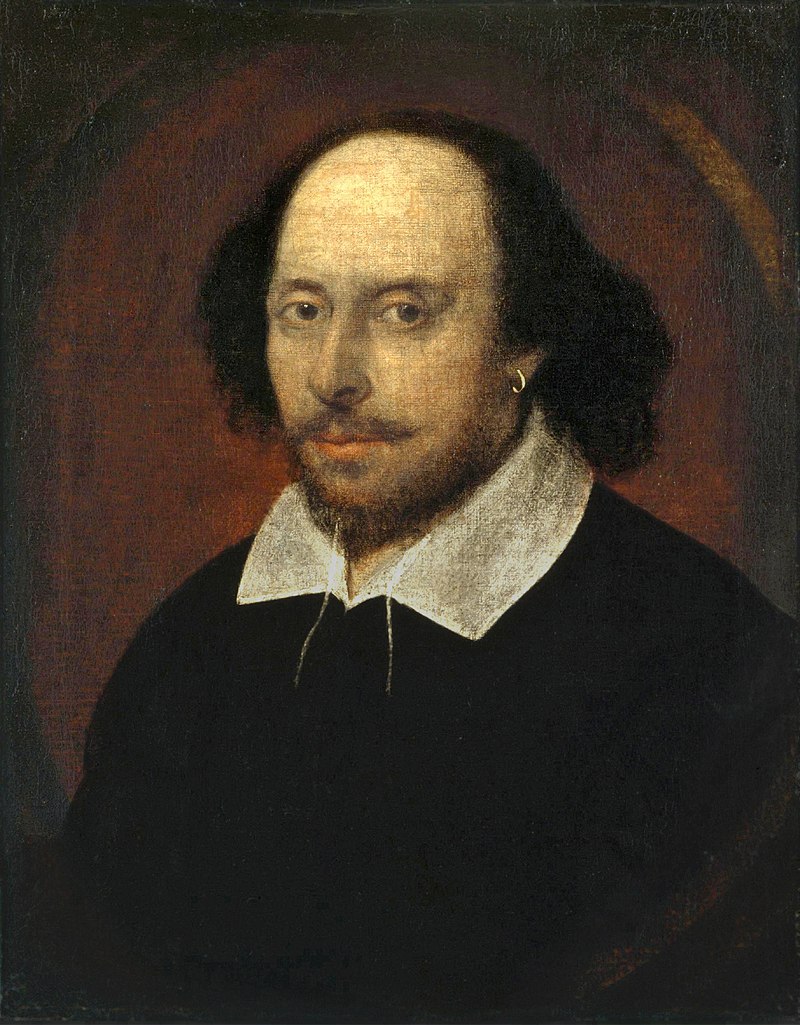
The Shakespeare that we recognize 
 is drawn from memory.
  Kings oft declared true depiction
   a form of treachery. 

Past commoners' appearances 
 are lost in bygone days.
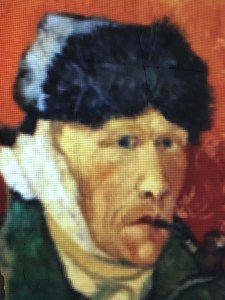
  We know Van Gogh from a mad mind,
    and know him thirty ways. 

Do you know whose look we do know?
 Every teen now alive.
  There're pics from every angle
   stored on redundant drives. 

Five Wise Lines from Macbeth

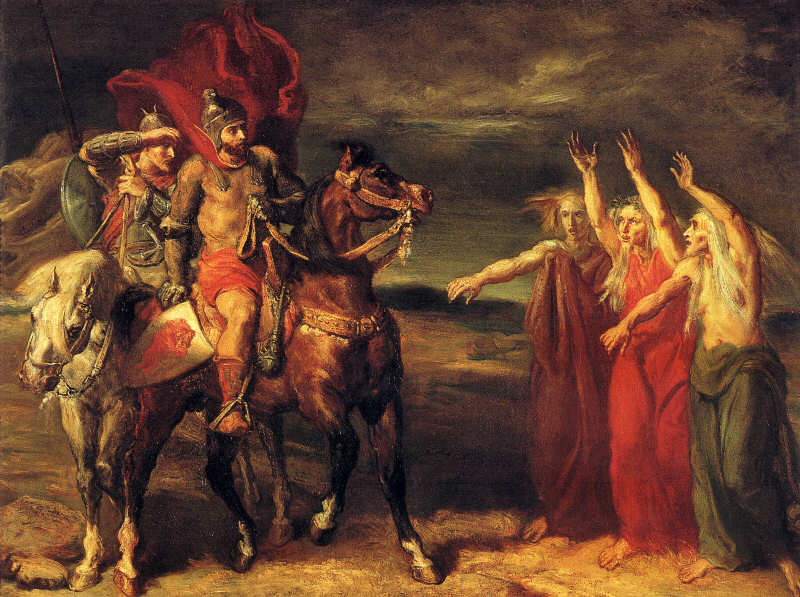
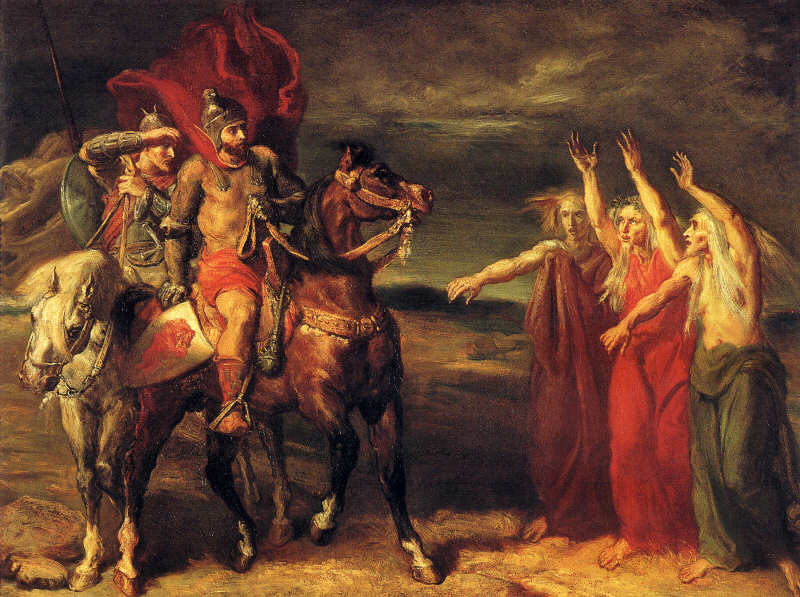
Macbeth & Banquo Encounter the Witches
by Theodore Chasseriau

“There’s no art to find the mind’s construction in the face.”

Duncan in Act I, Scene 4

“Bloody instructions, which, being taught, return to plague the inventor.”

Macbeth in Act I, Scene 7

“when our actions do not, our fears do make us traitors”

Wife of Macduff in Act IV, Scene 2

“Then the liars and swearers are fools, for there are liars and swearers enough to beat up the honest men and hang them up.”

Son of Macduff in Act IV, Scene 2

“Life ‘s but a walking shadow, a poor player, that struts and frets his hour upon the stage and then is heard no more. It is a tale told by an idiot, full of sound and fury signifying nothing.

Macbeth in Act V, Scene 5

Hamlet’s Revenge [Limerick]

A befuddled Prince from Denmark's Elsinore
 was asked by his dad's ghost to even a score:
  "Old Claude poisoned my ear,
   wed (-n- shtupped) my wife, dear.
 So, please ensure that he lives, Nevermore!"

Macbeth Limerick

Macbeth and Banquo Meeting the Witches;
Théodore Chasséria (1855)
There was a great General named Macbeth.
All that kept him from kingship was a death,
but - as with a Pringle -
he couldn't do a single.
So, he showed seven more their last breaths.

Hamlet Limerick

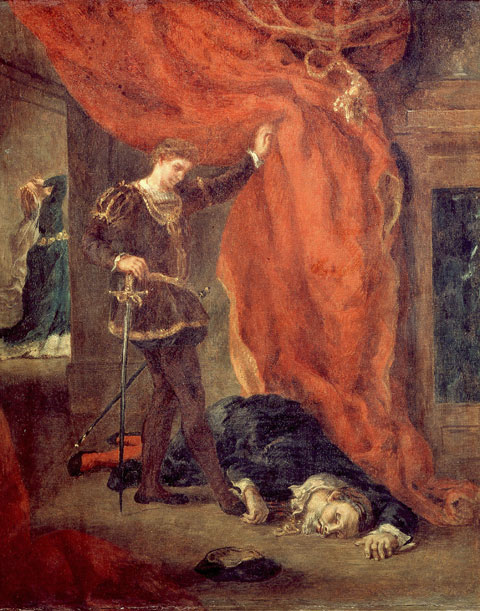
Hamlet Stands Over Polonius;
Eugène Delacroix (1855)
There once was a wavering Prince of Denmark
whose uncle replaced his dad as monarch.
The ghost of his dad
said, "Kill 'em, my lad!"
Too bad he took that stab in the dark.

Prospero’s Limerick

There once was a bookish Duke from Milan
who, while distracted, was played for a pawn.
They thought him a twerp
his Dukedom was usurped…
Eventually, brains won out over brawn.

A Midsummer Night’s Limerick

Four Athenian youths fled out to the trees,
lacking the love geometry to put hearts at ease.
It might've been tragic,
but Puck worked his magic.
They returned by twos, not ones or threes.

Shakespeare Clerihew

The Bard, the great William Shakespeare,
made stony souls feel love, hate, and fear,
but I'll cease to dote,
in case he never wrote...

BOOK REVIEW: Supernatural Shakespeare by J. Snodgrass

Supernatural Shakespeare: Magic and Ritual in Merry Old EnglandSupernatural Shakespeare: Magic and Ritual in Merry Old England by J. Snodgrass
My rating: 4 of 5 stars

Amazon.in Page

Like – I suspect – most of humanity, I’m a big fan of Shakespeare’s work, but I’m also not alone in feeling that I’ve missed a some of the depth and texture of his plays. Both language and the body of common / popular knowledge have evolved and migrated tremendously since the Elizabethan era. This makes a market for books that offer insight into the age and the role that the beliefs, norms, and daily life played in Shakespeare’s theatrical works. This book is one such work. It focuses on the role supernatural beings and various festivals play in the Shakespearean canon and why they do so.

Conceptions of the supernatural may be one of the areas in which human beliefs have changed most severely since Shakespeare’s day. The book has chapters on witches, ghosts, fairies, and enchanted forests that are interspersed among chapters that deal with various seasonal festivals of Pagan origin. I did find this leapfrogging around a bit odd, but I would speculate two possible reasons for it. First, the author may have wanted to build cyclicality into the overall organization, and thus put beings and creatures that seemed thematically related to a season near its festivals. Second, it may have seemed like a good idea to break up the festivals because that discussion could have felt tedious to a general reader if it’d been clumped together (as opposed to the “sexier” topics of witches and ghosts and the like.) This organization didn’t bother me; it just seemed a bit strange, but I could imagine it being for the best.

I learned a great deal from this book, and my newly gained knowledge wasn’t all about the supernatural elements of Shakespeare. The author dropped some fascinating facts regarding other domains as well – such as Elizabethan sexuality and lifestyles as well as biographical facts about Shakespeare. If you’re looking to expand your understanding of background information relevant to Shakespeare’s plays, this book is worth looking into.

View all my reviews