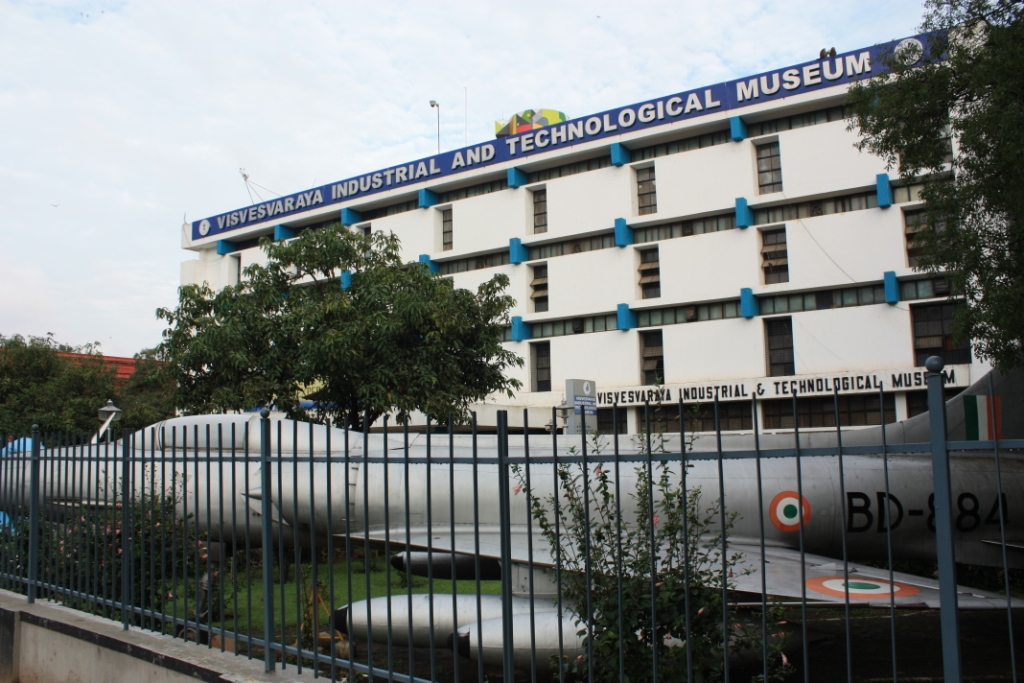
Visvesvaraya Industrial and Technological Museum

The plane is the HF-24, India's first indigenous figher jet (circa 1960's)

The plane is the HF-24, India’s first indigenous fighter jet (circa 1960’s)

I visited the Visvesvaraya Industrial and Technological Museum last week. I wasn’t sure what to expect. The admission fee is only 30 rupees (less than 50 cents in USD terms.) I ended up being pleasantly surprised. It took me back to childhood visits to Chicago’s Museum of Science and Industry. Granted it’s neither on the scale of the windy city’s museum nor as well-maintained, but it’s largely interactive and has some fascinating–if often retro–displays. It’s great for kids or adults who’d like to revisit the science that they’re forgetting, and to do so in a way that’s entertaining.

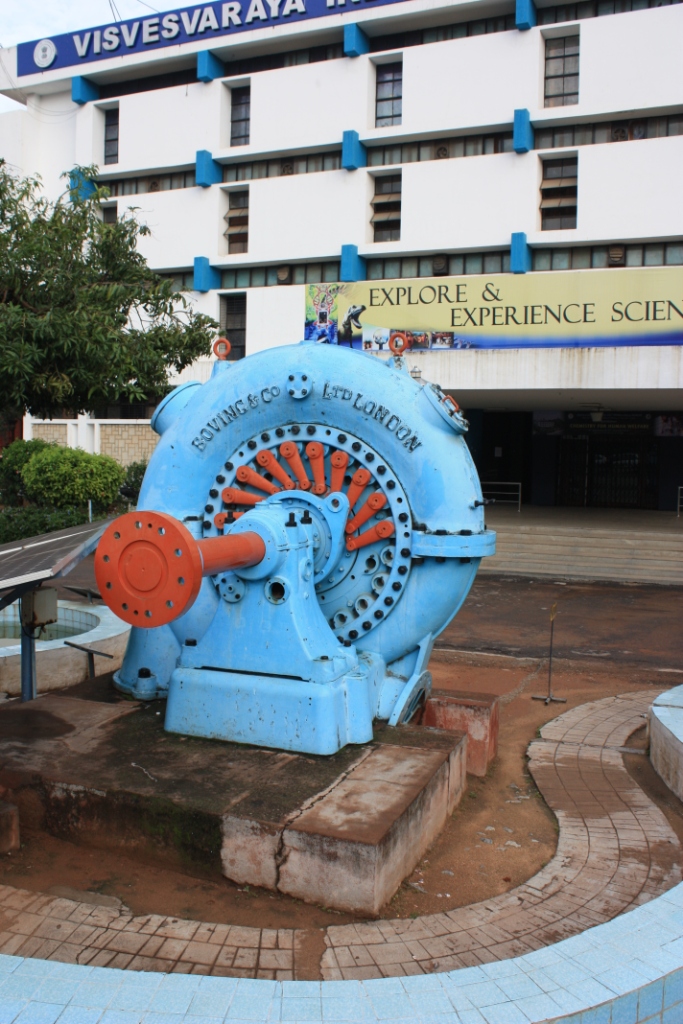
The museum consists of five exhibit halls and a few other stand-alone displays both inside and outside the building. Outside one will see an old locomotive, a copy of India’s first indigenously-built fighter jet, an Archimedes water drill, and a big steam turbine. One’s visit inside, unfortunately, begins inauspiciously with a solitary animatronic T-rex that looks a bit dog-eared.

Also on the ground floor, the first exhibit hall one visits is the Hall of Engines. This covers steam power, gasoline engines, turbines of various forms, as well as displays of human and animal powered technology. There are hand-crankable cut-away scale models that allow one to see how the various engine designs work. There are also cut-aways of some full-sized engines. Overhead there are a series of wire tunnels through which billiard-size balls circulate, having been hand-cranked up into the track by various mechanisms. This, I believe is intended to demonstrate gravity power, which it does in a whimsical Rube Goldberg-esque sort of way. There’s also a video on simple machines that looks like it was initially made for 1950’s school children in America.

There are two exhibit halls on the first floor (that’s the second floor to Americans), one that deals with electricity and another called “Fun with Science” that’s all hands-on exhibits intended to spark the interest of school-aged children. The former covers the basic science of electricity as well as looking at the various generation methods, including nuclear, wind, solar, hydroelectric, and fossil fuels.  The latter has interactive exhibits of the kind found in many a science or children’s museum. I would say the exhibits here are largely geared toward middle school and high school students. There is a small exhibit on the top floor that is aimed at young elementary school age students.

The second floor has a biotechnology exhibit hall as well as one that deals with space. The biotech hall covers basic biology, agriculture, and even beer brewing. The space hall discusses the history of space technology and particularly focuses on India’s Chandrayaan-1 moon-orbiting mission. (If you didn’t know that India had orbited the moon and delivered an impactor to the lunar surface, you are in good company. I had no idea either. But this was back in 2008-2009.)  Anyway, it was good to see some Indian focus. As I was traveling through the exhibit halls up to this point, it occurred to me that there wasn’t a great deal for the school children passing through this museum to take national pride in. There was a lot of material about discoveries made in places like Germany, America, and Japan, but not a lot of segments on contributions of national scientific heroes as one would expect at such a museum.

The third floor has a full-sized exhibit hall dedicated to electronics and computer technology, and part of one hall that is split between a small “Science for Children” exhibit geared toward young children (pre-school and the younger elementary grades) and a temporary exhibit on chemistry. The chemistry exhibit is the most reading-oriented exhibit, except for a couple of models and a touch screen interactive periodic table, it’s pretty much a poster exhibition. The hall of computers and electronics has many interesting exhibits, such as a cylinder supposedly containing the 42 million transistors that it takes to make up one Pentium 4 processor.

There’s a nice poster exhibit about the 2012 Nobel Prize Winners. I assume this will be updated sometime next month after the new winners have been announced.

All and all, I’d say this museum is a bargain at several times the price.
IMG_0189

BOOK REVIEW: Einstein’s Dreams by Alan Lightman

Einstein's DreamsEinstein’s Dreams by Alan Lightman

My rating: 4 of 5 stars

Amazon page

One might think that a novel written by a physicist would make for dreadful reading–and most of the time one would probably be correct. However, Lightman’s Einstein’s Dreams is a fascinating read. The arc of the book–what makes it a novel rather than a series of short scenes–is conveyed by a prologue, a few interludes, and an epilogue. These brief sections show an Albert Einstein as he went about life trying to work out his special theory of relativity.

In between the interludes are a series of written sketches that depict dreams that might have been had by Albert Einstein between April 14th and June 28th of 1905. Each of these dreams depicts an alternative universe in which time is not experienced as we experience it: that is, as an inexorably flowing river with a clearly defined arrow. In one dream, time is circular. In another, a lifetime is compressed into a day. In another, there is no flow of time; the world is a snapshot. In another, immortality is the norm. In the latter dreams of the book, we see a convergence on time as we know it–though in dream-like abstraction.

This short book is both creative and well-written. Lightman excels at creating scene through vivid description. His approach to structure is unique.

One thing that might have improved the book is if the author had been a little bolder. Lightman feels the need to explicitly state what is going on in each dream world. However, his description is strong enough that such discussion is generally anti-climactic–one already knows how time is working (or not working) in a given universe before the author states it explicitly. Thus, these explicit descriptions succeed only in taking one out of the dream.

View all my reviews

A [Different] Skeptic’s View of Traditional Chinese Medicine

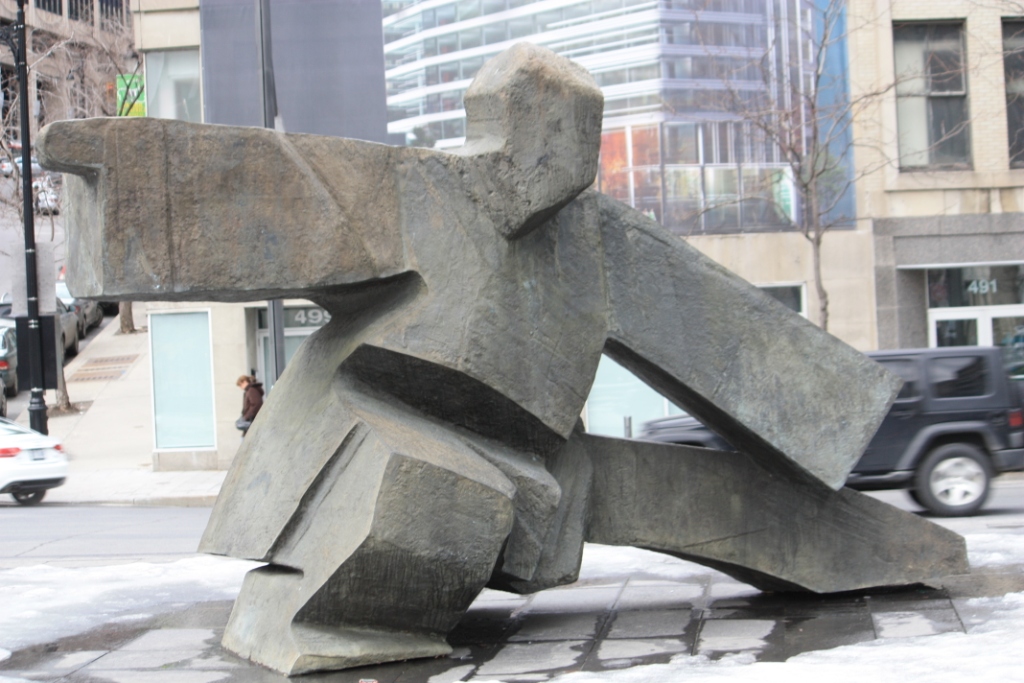
Tai Chi Sculpture; Taken in Montreal

Tai Chi Sculpture; Taken in Montreal

I’m sick. I mean that literally for those readers who are saying, “Yes, I read your blog occasionally; I’m well aware that you’re a sick freak.”

I rarely get sick. I can usually knock colds out at the first sign of a scratchy throat with big does of zinc and remedies I’ll discuss below. I can’t remember the last time I had the flu. Let me say to any angry gods that I’m not bragging, so please don’t smite me. I hope I haven’t just fallen off some divine pestilence list (God: “Geewhiz, that boy hasn’t had the flu since like 2002, lets send him a doozy… plus throw in a side of locust plague.”) I’m just stating a fact; I’m blessed with a mighty immune system and a lack of those plague-bombs commonly called children.

However, before you, too, begin to wish evil upon me for my freakish good health, let me say that when I do get a full-bore cold, it’s a catastrophic train wreck. This is because I have a proclivity for sinusitis. That means that all those tiny little tubes by which mucus flows from one chamber to the next in my head so that it can eventually be expelled into a facial tissue become clogged up. This creates an effect similar to a trucker’s strike at a dildo factory. The phalli (phalluses?) keep coming off the line, but none of them are being shipped out, so soon everything is fucked. When I tap on the highest point on my head it sounds like one thumping on a perfectly ripe watermelon. GROSS CONTENT AHEAD: (If you’re disgusted easily, skip to the next paragraph.) So, last night my left side passages were so blocked that pus was oozing out around my left eye, and I began to have an earache as the pus tried to escape out my ear only to find my eardrum in the way. END GROSS-OUT ZONE.

So you might be expecting that I had a sleepless night and have a doctor’s appointment this morning. I’ve gone that route before. I know exactly what the doctor would do, she’d write a prescription or two: one for a round of antibiotics and one for something to reduce the pain. As a skeptic, this is the approach in which I should put my trust. They develop these medicines using the scientific method and double-blind studies.

What did I do? I diced up some ginger and made a steaming cup of ginger tea and, as it steeped, I ran through a couple qi gong exercises. Then, after drinking the tea, my passages opened up, I blew my nose and slept soundly for about four hours until it was time for me to get up and start my day. As a skeptic, Traditional Chinese Medicine (TCM) isn’t the horse on which I should put my money. It all revolves around chi (qi), life energy, a substance whose existence is to the best of my knowledge is completely unsupported by direct observation. It’s chocked full of archaic sounding treatments like “Immortal spanks the naughty dragon.” (Okay, I made that one up, but you get my point.) TCM proposes that the kidneys are integral to sexual health.

So why am I pressing acupressure points, doing qi gong (life energy exercises), and making homemade tea? The easy answer would be that, if I hadn’t, I probably would have gotten five non-consecutive minutes of sleep last night, and I’d, at best, now be sitting in a waiting room with my skull in my hands hoping to be squeezed in to a doctor’s busy schedule.  However, I have more of an explanation than that.

I don’t know much about medicine (either Western allopathic  or TCM.) So in the absence of knowledge about what one doesn’t know, one seeks analogy in what one does know.  First, everything I know makes me distrustful of the  “free lunch.” To my mind, the Western approach, in which I don’t have to do anything but pop pills periodically, is a free lunch scenario. If I to be active (or even consciously passive, i.e. restful) to achieve my cure, I’m inherently  more confident in it. In the martial arts, we groan at the sight of these “home-study black belt” courses. Any martial artist who is honest with himself or herself knows that the only way to develop the skills is by spending at least a couple of days a week in the dōjō and training outside the dōjō as well. One can’t learn martial arts like one learns music appreciation or business administration. As an economist, there’s always some hidden cost of the “free lunch.” So despite the vigorous use of the scientific method, I tend to be skeptical of Western medicine.  I’m skeptical because nothing worthwhile I’ve ever done could be achieved by just popping a pill, and I see little reason why achieving a healthy state should be any different. [If anyone knows of a pill for manuscript revision, I’d be willing to try it.]  (I’m particularly disconcerted by medicines like pain-killers that remove the symptoms while apparently doing nothing about the ailment itself.)

So I can’t say for sure whether the ginger tea, acupressure, and qi gong had anything to do with my passages opening up. It was, after all, a system under tension. GROSS-OUT BEGINS: At some point either the passage was going to open, my left eyeball was going to pop out of its socket, or my eardrum was going to rupture sending an avalanche of pus pouring onto my shoulder. GROSS-OUT COMPLETED. However, even if all the TCM approach did was to take my mind off of my misery while I was waiting, it did more for me than the pill-popping alternative.

Second, I also know a little something about systems, generically speaking. Another thing that appeals to me about TCM is its fundamental recognition that any problem will create feedback effects that reverberate through the system.  In other words, the root cause may not be anywhere near where the problem is first noted. Because of this, one may end up having to fix a dysfunction distant from the symptom in order to fix the problem. This seems consistent with other systems with which I am familiar.

I have some arthritis from a lifetime of beatings–most notably in my lower back and my ankles. It occurred to me that my back problem might be exacerbated–if not caused–by a problem with my right foot and ankle. I suspected the damaged ankle and flat foot might cause my pelvis to tilt and my lower back to be off kilter, thus wearing through the cartilage on the side of my back that gives me problems. Maybe this was, in fact, wrong. However, when I asked the specialist who diagnosed my ankle arthritis about this possibility, he looked at me like I was the biggest idiot in the world.  “You see, son, the ankle bone is connected to the shin bone and the shin bone is connected to the knee bone and the knee bone is connected to the thigh bone, the thigh bone is connected to the pelvic bone, and it’s not until this point that the pelvic bone is connected to the back bone. There’s like half a dozen things between those two problems. They couldn’t possible have anything to do with each other.”

Now let me be clear, I’m not dismissing Western medicine by any means. There are some things it does vastly better than TCM or Ayurvedic healing or any other holistic healing method. So if I show up in your Emergency Room with a piece of rebar sticking out of my skull, please don’t throw this back in my face. “Oh maybe you should massage the Valley of Harmony (LI-4), do some ‘Parting the Clouds,’ and drink a glass of lavender-infused carrot juice.”

BOOK REVIEW: Unbelievable by Stacy Horn

Unbelievable: Investigations into Ghosts, Poltergeists, Telepathy, and Other Unseen Phenomena from the Duke Parapsychology LaboratoryUnbelievable: Investigations into Ghosts, Poltergeists, Telepathy, and Other Unseen Phenomena from the Duke Parapsychology Laboratory by Stacy Horn

My rating: 3 of 5 stars

Amazon page

For 50 years a laboratory operated at Duke University that studied extra-sensory perception (ESP), ghosts, and other paranormal events. Today one can’t imagine an academic laboratory devoted to paranormal activity surviving, especially at such a prestigious university. Horn’s book takes one through the life of this lab. It describes phenomena debunked as either fraud or poor methodology, but it also discusses events and outcomes that have remained unexplained.

The central character in the book is J.B. Rhine, Director of the Duke Parapsychology Laboratory. Rhine was a botanist by training, but he developed an interest in parapsychology– eventually becoming the foremost expert in the, albeit dwarf, field.

When the lab opened in 1930, the universe of unknowns was much greater than when it closed in 1980. This was exemplified by Albert Einstein’s correspondence with Rhine, and the author of relativity’s attendance at a séance on one occasion. By 1980, having recorded some unexplained phenomenon, but having produced neither well-validated results nor explanations, the lab was looking increasingly like a boondoggle.

The phenomena studied included some that could be systematically studied  in the laboratory, as well as others that could only be observed in the field. The former being exemplified by the use of cards with shapes on them to study telepathy (as depicted by Bill Murray’s character in Ghostbusters.) The latter included the study of poltergeists or interviews of children about the lives of people who lived before their time (e.g. as Tibetan lamas are selected).

One of the questions confronting the investigators was whether those phenomena that could be studied in the lab were best studied there. While telepathy studies sometimes showed a weak but positive result, some thought that more robust results could only be attained under real world conditions.

In the 60’s, Timothy Leary came to call on Rhine. Leary, of course, thought hallucinogens were the key to unlocking the hidden powers of the mind. Rhine apparently took LSD on a couple of occasions before concluding that there was nothing but vivid chaos coming out of the experience. Still, there remained adherents to the notion that mind-altering drugs might unlock hidden potentials. Horn devotes several pages to the work of Sidney Gottlieb, the head of the CIA parapsychology program. It should be noted that the government programs were not stopped until the mid-90’s, fifteen years after Duke’s Parapsychology Lab shut down.

The last gasp of parapsychology was an attempt to determine if quantum entanglement might have any ramifications for ESP. Quantum entanglement is the situation in which two particles separated at great distance can influence each other instantaneously. Could the particles in two minds behave accordingly, and, if so, to what result?

View all my reviews

Who Am I?

“I” am a collection of cells.
some  expressly invited by “my” genes
others are interlopers,  “my” guts their cross-town bus
but these interlopers defend “me”  daily
fending off worse marauders
thankfully
so “I” let them stay inside “me”
“my” greatest shame? “I” am a slave owner.
the  mitochondria in “my” cells  are trapped and  forced to serve “me”
all this begs one fundamental question,
am “I” really just a “me?”
or  a  whole society?

If “my” parts
needn’t be fully integrated
where do “I” end and “you” begin?
can “I” say that “I” have been everywhere?
well, everywhere on this tiny, spherical-ish speck of galactic dust?

BOOK REVIEW: Cat’s Cradle by Kurt Vonnegut

Cat's CradleCat’s Cradle by Kurt Vonnegut

My rating: 5 of 5 stars

Cat’s Cradle is Vonnegut at his most brilliant and witty.

The book follows a writer, John/Jonah, as he does research for a book on the Hiroshima A-bomb. To learn about the (fictitious) inventor of the bomb, the deceased Felix Hoenikker, he interviews  Hoenikker’s children and former supervisor. In the process he becomes entangled in global catastrophe in a way he couldn’t have imagined.

As it turns out, Hoenikker had invented another weapon of mass destruction, one that would make the H-bomb look like a firecracker. However, ice-9, as the weapon was designated, wasn’t intended as a weapon at all. Ice-9 turns all water into ice at temperatures below 114 degrees Fahrenheit. The idea was to make marshes crossable by Marine Corps units. It’s the failure to anticipate the ramifications of using such a chemical, i.e. the hydrologic cycle, that’s the central premise of this book.

A lot of the book deals with a fictitious religion called Bokononism. Bokononism is the cynical faith of the Island of San Lorenzo, and it perfectly reflects Vonnegut’s mildly misanthropic attitudes. The first sentence of the Book of Bokonon says it all, “All of the true things I am about to tell you are shameless lies.”

At the beginning of Cat’s Cradle we find out that John is a Bokononist, but that he’d grown up a Christian. Bokononism is prohibited on the island by the dictator, Papa Manzano. The reader comes to discover that not only is the prohibition a fraud designed to give the religion more sex appeal, but also that Manzano is a practitioner himself. This is just one of the quirky oddities that defines life on San Lorenzo.

It’s when John and all the Hoenikker children are assembled in San Lorenzo that the action really unfolds. Manzano is dying and turns the presidency over to Franklin Hoenikker (the non-midget son of the father of the bomb); Manzano later commits suicide in the oddest imaginable way. Franklin convinces John to take the presidency, but it becomes moot as the book approaches climax.

I’ll leave you with my favorite piece of Bokononist wisdom, “Peculiar travel suggestions are dancing lessons from God.” By the way, you should go to San Felix island off the coast of Chile. [Picked via a spinning globe.]

View all my reviews

BOOK REVIEW: Ishmael by Daniel Quinn

Ishmael: An Adventure of the Mind and SpiritIshmael: An Adventure of the Mind and Spirit by Daniel Quinn

My rating: 4 of 5 stars

A man answers an ad that says, “Teacher seeks pupil. Must have an earnest desire to save the world. Apply in person.” Expecting to find a charlatan, the man is surprised to find his new teacher is, in fact, a gorilla.

Like Socrates, this gorilla, Ishmael, uses questions to guide his pupil toward crucial knowledge. Ismael teaches his student to challenge some of his most deep-seated beliefs such as, the world was made for humans, humans are the ultimate culmination of biology, humans are inherently separate from (and above) nature, and that humans are fundamentally flawed in such a way as to make ruination of the planet inevitable.

The core of the book differentiates two human cultures. The author calls them the “takers” and the “leavers,” but they correspond to what we might call “us” and the “aboriginal peoples.” Takers are specialized, agricultural, and technologically advanced (if you’re reading this review on a computer and not chiseled on a cave wall, you, my friend, are a taker.)

The lives of “Leavers” aren’t that different from those of humans 10,000 years ago. They are tribal as opposed to (to borrow Desmond Morris’s term) super-tribal. [In a tribe everyone knows everyone else. Morris suggests that things go to shit –re: war, crime, and deviant behavior– in super-tribal societies.] Leavers live like animals in that they tend towards equilibrium within their ecosystem. Takers do not.

If you long for thrillers or potboilers, this isn’t the book for you. It’s a thinking person’s book. The nice thing about Ishmael’s use of the Socratic method is that one can think through the questions in parallel to the narrator’s discovery. In this way, the reader can install himself or herself into the conversation.

At the most generic level, the book’s value is in showing one how much one takes for granted. We can’t see forests for trees.

One may agree or disagree with the author, but either way one will be subjected to powerful food for thought. Some of the discussion may evoke a visceral emotional reaction that one may have trouble reconciling with logic, such as the discussion of the morality of feeding the starving.

The downside of the book is that the dialogue can be strained in places and it can get a bit repetitive. The latter serves to reinforce key concepts, but some of them feel as though they are reinforced inordinately. In making the narrating protagonist struggle, Quinn creates a lead who seems a bit dense sometimes. Also, as I indicated, the journey is by-and-large in the mind, and so the tension is limited. There is some drama when the narrator shows up one day to find that Ishmael has been evicted. However, this is resolved without too great a difficulty and they resume lessons with  Ishmael’s irritability being the only change to be seen. There is drama at the end that will remain unspoiled herein.

I’d recommend this book as a thought-provoking exercise for the mind.

View all my reviews

TODAY’S RANT: Hyper-relativistic Mathematical Zones: or, When Will my Car be Done?

Albert Einstein theorized that distance and time are relative depending upon one’s speed. In everyday life we rarely notice this because of a little-known tenet of General Relativity that says, “Whenever one attempts to approach the speed  of light, there will be an octogenarian in the left-hand lane.”

Since the early 20th century, physicists have thought they were this close (author holds up hand with thumb and index fingers about 3/4 of a centimeter apart) to being able to explain the whole shebang. Figure out why very small things behave differently from very big things, and, Bob’s your uncle, we’ve got your Eureka moment.

I, however, think physicists will find that they have yet another hurdle to solve (mixed metaphor intended, smartypants.) This has to do with certain zones in which conventional measurements of space and time break down even when one is only moving at the speed the planet is revolving (24 hours/day, I think, no that sounds wrong somehow.)

I don’t think physics is quite prepared to explain why an hour in a mechanic’s shop is equal to about 4.33 hours on the outside. We’ve all experienced the inverted time-dilation effect of the Department of Motor Vehicles. According to Einsteinian relativity, time slows as one approaches the speed of light. However, time slows even more when one is in the slowest state of movement possible, the DMV line.

I won’t go into the distance contraction effects localized to the crotch region of men who wear wife-beaters and gold hood ornaments around their necks.

Are these just zones in which bistromathics trump mathematics (Sorry only readers of Douglas Adams’s Life, the Universe, and Everything will get that reference.)

Any Unified Field Theory must explain these phenomenon before I can accept it.

BOOK REVIEW: Physics of the Impossible by Michio Kaku

Physics of the Impossible: A Scientific Exploration into the World of Phasers, Force Fields, Teleportation, and Time TravelPhysics of the Impossible: A Scientific Exploration into the World of Phasers, Force Fields, Teleportation, and Time Travel by Michio Kaku

My rating: 5 of 5 stars

Michio Kaku is the master of pop physics writing. While you may find names like Brian Greene or Neil Degrasse Tyson more recognizable, if you haven’t read any of Kaku’s work, this is a good one with which to start.

This book examines the possibility (or lack thereof) of many technologies and scientific concepts prevalent in science fiction.

Why spend time reading about things impossible? It turns out that one’s definition of “impossible” matters greatly. Kaku divides the world of impossible into three classes. The first, and largest class by far, are those technologies that are impossible given today’s capabilities, but aren’t prohibited by the known laws of physics. This class includes technologies that one can readily imagine such as: robots, starships, and phasers. However, it also includes developments that one might think are firmly in the realm of sci-fi, such as: teleportation, telepathy, force fields, and psychokinesis.

Class II impossibilities are those that look impossible now, but which may prove possible as our knowledge increases. They include faster than light travel, time travel, and the existence of parallel universes. The first two require uncovering loopholes in prevailing Einsteinian paradigm. The second also begs the question of why we don’t have time tourists.

Class III impossibilities are those that violate the known, well-established laws of physics. Kaku only puts two items in this bin, perpetual motion and precognition.

Kaku’s book discusses a fascinating topic in a highly readable format and using good science.

View all my reviews

BOOK PLUG: The Nuclear Renaissance and International Security

The Nuclear Renaissance and International Security 

Edited by Adam N. Stulberg and Matthew Fuhrmann

2013, Available Now

Buy this book

This is not so much a book review as a shameless plug (I have a chapter in this book.)

Nuclear energy has had a checkered past. From the 1950’s to the 1970’s, there was a massive build up of nuclear power reactors– granted among a fairly small number of nations. Recent decades have seen a drop off in the pursuit of nuclear power among all but a few diehards. This decline resulted from both accidents and unfavorable nuclear power economics (the former exacerbating but not entirely responsible for the latter.) With increasing desire to combat global climate change, there has been renewed interest in nuclear energy as part of a strategy to slow carbon emissions without crippling energy output. However, to date this interest has not turned into large-scale development of nuclear power anywhere except China. After the Fukushima Daiichi accident, even some diehards (e.g. Japan) are reconsidering nuclear power.

This book considers whether there will be a resurgence of nuclear power, if there is what shape it will take, and what the security ramifications of future nuclear power development might be.

Among the many questions addressed in the book are:

1.) Will the future bring more nuclear energy states, or will any expansion take place only within existing nuclear power states?
2.) Why do states supply other countries with nuclear energy technologies, and what are the ramifications of such supply efforts?
3.) Can an International Fuel Bank be successful in reducing the threat posed by proliferation of dual-use fuel cycle technologies?
4.) Will climate change drive a renaissance of nuclear power?
5.) What effect will an expansion of nuclear energy have on non-state nuclear trafficking?
6.) Are states with nuclear power more, less, or equally likely to get into wars?

If you are interested in these questions, this book is for you.