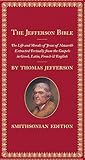
BOOK: “The Jefferson Bible” by Thomas Jefferson

The Jefferson Bible: The Life and Morals of Jesus of NazarethThe Jefferson Bible: The Life and Morals of Jesus of Nazareth by Thomas Jefferson
My rating: 5 of 5 stars

PDF available online [Public Domain]

Thomas Jefferson (yes, the same one who wrote the Declaration of Independence) produced this book by cutting and pasting excerpts from the Gospels so as to produce a distillation of who he believed Jesus was and what Jesus’s essential teachings were. It mixes parables and other New Testament teachings with biographical description.

There is an introduction which offers the reader more specific insight into Jefferson’s thinking than can be gleaned merely from what he includes and what he trims. The Introduction also discusses the similarities and differences between Christian philosophy and that of the Jews, the Greeks, and the Romans.

If you’re looking for a condensed version of the New Testament, I’d highly recommend this book. Jefferson was obviously a sharp guy who looked at the Bible from the perspective of Enlightenment-era thinking.

View all my reviews

“Have you ever made a just man?” by Stephen Crane [w/ Audio]

"Have you ever made a just man?"
"Oh, I have made three," answered God,
"But two of them are dead,
And the third --
Listen! Listen!
And you will hear the thud of his defeat."

PROMPT: Pet Peeves

Daily writing prompt
Name your top three pet peeves.

[Note: I will assume this to be the colloquial usage of “pet peeves” as I have no peeves about pets whatsoever (in fact, compared to most human children I see running around, I find pets to be positively civilized.)]

With that in mind:

1.) Forcing a “favor” on another person in expectation of some kind of reciprocation (usually outsized in scale to the fake favor.)

2.) Using the Q & A section of a program to make one’s own speech (the subtext being that one — rather than the lunkhead who just presented — should have been the one invited to speak in the first place.)

3.) Acting as though one particular set of cultural norms is the only moral / ethical way to live.

Bonus response: As we are presently on a blogging platform, I should mention a blogger’s peeve: Using another’s comment section as an advertisement for one’s own content — particularly with no actual comment about the post to which one’s “comment” is attached. I realize blogging is inherently a self-centered activity, but let’s not fall full-Narcissus into it.

“Behold, the grave of a wicked man” by Stephen Crane [w/ Audio]

Behold, the grave of a wicked man,
And near it, a stern spirit.

There came a drooping maid with violets,
But the spirit grasped her arm.
"No flowers for him," he said.
The maid wept:
"Ah, I loved him."
But the spirit, grim and frowning:
"No flowers for him."

Now, this is it --
If the spirit was just,
Why did the maid weep?

PROMPT: Patriotic

Are you patriotic? What does being patriotic mean to you?

I certainly was as a young man, but increasingly I have shifted towards a more “citizen of the world” worldview. I’m no doubt influenced by my admiration for the life of Socrates (such as we know it,) who was said to have been a valiant and fearsome hoplite warrior in his youth but came to call himself a Citizen of the World. As one becomes governed less by passions and more by reason, it becomes easier to have a logically consistent ethics by doing so.

Consider the question: “Is it wrong to stab a person in the back without warning, a person who you do not know, a person who doesn’t know a thing about you and has never done you any personal wrong, a person who to your knowledge has always lived a good and virtuous life?”

Of course, the immediate impulse is to say that that act is clearly wrong. Really, the only case we can attempt to successfully counter argue would be a soldier in war or a military action acting on lawful orders against an enemy combatant. But everything becomes messy. Is it enough that the soldier is operating on “lawful orders?” In that case, is the soldier a moral individual, if he lacks agency? To what degree can a infantryman or spec ops soldier know that it is – in fact – a lawful order? Can a lawful order be morally and ethically reprehensible and indefensible? The questions abound, and that’s why I suspect Socrates – lover of questions as he might have been – had a shift in philosophy about the matter over the course of his life.

It may seem I’m arguing that this is growth or betterment, but maybe it’s just the natural progression of a life. Maybe we need more passion in our youth and more agency as we age.

Of course, in those elder / “citizen of the world years,” the Athenians straight up murdered their onetime hero, so maybe I have not picked the best role model.

BOOK REVIEW: Humanism: A Very Short Introduction by Stephen Law

Humanism: A Very Short IntroductionHumanism: A Very Short Introduction by Stephen Law
My rating: 4 of 5 stars

Amazon.in Page

In this guide, Law lays out the basic principles of humanism, discusses the arguments for and against belief in a deity, and examines the humanist conceptions of morality and meaning of life (two constructs that religious people often claim can only exist in a deist world.) Humanism is an ill-understood system, in large part because it isn’t so much a set of ideas ascribed to as a way of approaching ideas in a questioning and secular way. Therefore, defining humanism isn’t as straightforward as listing a set of common beliefs because humanism can cover a wide variety of different worldviews. That makes this a particularly useful book as it clears up a number of false equivalences. Many think that humanism is the same as atheism or agnosticism, and while humanists generally follow one of those two approaches to the question of whether there is a god, humanism isn’t identical to either.

This book does a good job of organizing the debate and laying out arguments and counterarguments. I learned a lot by reading the book and by deliberating over the points of contention. There were points where I think more could have been said. For example, in the chapter on the meaning of life, after systematically dismantling the religious argument that a meaningful life is the sole domain of religion, Law doesn’t offer any guidance as to the humanist approach to pursuing a meaningful life (stating merely that most humanists agree with the religious about what is a meaningful life, even if they disagree about why it is.) I realize this is a brief guide, and the author might have wanted to avoid stepping on the toes of other guides in the series that investigate the question, but it stands as a deficiency. True, there wouldn’t be a list of what makes a meaningful life so much as an outline of how to approach it, but, still, even an overly simplified statement would have been useful.

I learned a lot from this book and would recommend it for anyone wanting to gain insight into the debates around humanism.


View all my reviews

BOOK REVIEW: Buddhist Ethics: A Very Short Introduction by Damien Keown

Buddhist Ethics: A Very Short IntroductionBuddhist Ethics: A Very Short Introduction by Damien Keown
My rating: 5 of 5 stars

Amazon.in Page

Most people, if they know anything about Buddhist ethics, have heard of the Eightfold Path (right + view, intention, speech, action, livelihood, effort, mindfulness, and concentration.) However, just knowing that can lead to the impression that Buddhist ethics are blurry and that it’s all a matter of doing as one pleases within one’s personal interpretation of rightness. This concise guide offers an overview of the Buddhist ethics and morality, focusing on issues of global and modern interest (as opposed to those issues only of interest in places where Buddhism is practiced or at the time in which Buddha was teaching – i.e. issues like abortion, vegetarianism, war, suicide, and cloning and not subjects like caste, traditional family roles, etc.)

The first two chapters present a broad overview, and the rest focus on particular ethical issues. I found the second chapter beneficial; it asks how Buddhist ethics fit in the categorization scheme employed by Western Philosophy. I considered it useful even though the answer was that Buddhist ethics aren’t neatly contained by this way of thinking, but rather can be seen as a mix of multiple approaches. (e.g. Buddhism has sets of precepts – ala deontology, has a karmic doctrine that is arguably consequentialist, and, also, has elements similar to the virtue ethics of ancient Greece.)

Chapters three through eight investigate specific issues: animal rights and environmental ethics (ch. 3,) sexuality and gender (ch. 4,) war and violence (ch. 5,) abortion (ch. 6,) suicide / euthanasia (ch. 7,) and upcoming technologies that will change what it means to be alive and conscious (i.e. cloning, artificial intelligence, cryogenics, and CRISPR.) As with chapter two, there’s often no tidy answer. For one thing, the author tries to contend with what is common across various sects, and this is often reflected in the laws of countries, laws which are only partially informed by Buddhist philosophy. Also, it’s not like the Buddha had anything to say on many of these issues, which either weren’t issues (e.g. cloning) or were considered radically differently (e.g. gender.) Still, one does get an idea of how these questions relate to ideas such as karma and dharma, and how contemporary Buddhist thinkers might begin to consider them.

One will note that there are ethical territories that aren’t addressed (e.g. justice / punishment, ethics of governance, business ethics, etc.,) but a brief guide needs filters, and this one chose to focus heavily on modern, individual ethical questions of broad international interest.

If you’re looking to better understand Buddhist ethics, this book is worth reading.


View all my reviews

BOOK REVIEW: Introducing Ethics: A Graphic Guide by Dave Robinson [Ill. by Chris Garratt]

Introducing Ethics: A Graphic Guide (Introducing...)Introducing Ethics: A Graphic Guide by Dave Robinson
My rating: 4 of 5 stars

Amazon.in page


This is one title in the “A Graphic Guide” series of books, many of which (including this one) are available on Amazon Prime. The books in the series explain fundamentals for a wide range of academic subjects, using simple descriptions supported by graphics. This particular book examines the philosophy of ethics and morality.

The book consists of a large number (almost 130) short topical sections, each with supporting graphics. Each section is just a page or two in length. The book has a chronological flow, moving from Socrates through the Postmodern philosophers. The nature of the topics varies, sometimes it is the view of a particular philosopher or school of philosophy, sometimes it’s a fundamental question or point of contention, and sometimes it’s a specific ethical issue. The last twenty-ish statements elaborate on two specific cases that the book addresses in detail: animal rights and euthanasia.

I felt the author did a good job of laying out a number of fault lines, controversies at the heart of differing views of ethics. The controversy that gets the most attention is that between absolutists and relativists. (Absolutists claim there are a set of core moral rules that are universally applicable, while relativists say one can’t make such rules because the morality of every action is relative, be it: situationally, culturally, or individually. An extreme view from either perspective is inconsistent with what one tends to sees in the real world.) A second point of contention regards whether ethical constraints are determined at the individual level or the societal / tribal / group level? A third controversy consists of a subjectivity versus objectivity divide – i.e. is morality just about what feels right or is there an objective way of defining moral knowledge? A significant portion of the book deals with the rivalries about these points, and – to a lesser degree – others (e.g. is biology the root of ethics or is it a domain devoid of ethics?)

There are cartoon drawings with most of the sections that illustrate key points, and / or depict interactions between rival philosophers. There is a “further reading” section in the back that suggests books to expand one’s grasp of the subject beyond the bare fundamentals that are addressed in this book.

I thought this book did a good job of laying out the issues. The cases (animal rights and euthanasia) helped show how different schools of thought apply their ideas to specific questions. I particularly enjoyed how the book clarified the subject through discussion of key questions of contention. If you have Amazon Prime, it’s definitely worth checking this one out. If not, you may want to see how it compares to the “A Very Short Introduction” guide for Oxford University Press, which is a similar series that explains the basics of a subject in a concise fashion.

View all my reviews

POEM: Good & Evil

Good & Evil —
Mankind’s most devastating invention.

Good & Evil
don’t feature in nature.

The rule of nature is:

SHIT HAPPENS!

Sometimes it’s nourishing shit that grows big ears of corn.
Sometimes it’s infected shit that cripples the village with E. coli,

but it’s all just days playing out.
-a big, indifferent system burning energy.

Nature doesn’t care that your worldview requires everything be the result of a reason.
Nature’s reason is that something must happen,
and anytime something happens it has effects —
it’s just that humans have to go sticking their labels
onto those effects: good / bad, naughty / nice, tall / grande.

Good & Evil
are cultural constructs,

but — oh my! —
what we haven’t done with them:

-global wars
-holocaust
-genocide
-hellscapes scraped into the world’s sensitive bits.

This may all sound unfair to GOOD.
Sure, EVIL is… well, evil,
“But why you gonna go crap on GOOD?”
one might ask.

Because GOOD is a line that can be hatefully drawn.

Or, if you prefer,
a box that can be hatefully placed
to separate what’s loved and hated —

or who is loved and who is hated.

5 Philosophical Questions Life Forces You to Answer

Like it or not, life makes philosophers of us all. You may hate philosophy, but you can’t escape it. You can — as many people do — outsource how you answer these questions, but that still requires a decision.

5.) How do I know a thing is true?  Sometimes the answer is self-evident, but, more often then people acknowledge, it’s not. This is exacerbated by the confusion of subjective truth (a personal “truth”) with objective truth (the universally true.)

Some people relinquish decision to an authority — be it a teacher, a scripture, or the scientific consensus. Some people only believe what said person’s personal experience tells them.

There is a related question of how tightly should one hold onto whatever beliefs one acts as if are true. The scientific approach suggests one should be ready to abandon something one believes is true in light of new information (assuming the new information is sound and can be validated.) Religions tend to prefer that the truths that have been handed down should be grasped firmly no matter what one sees, hears, or learns. One’s philosophical stance may take either approach, or one in between.

4.) [Who] am I?  As the brackets suggest, this is actually two questions. The full question, “Who am I?” presumes that there is a self (an I.) Some philosophies, e.g. Buddhism, reject this presumption, hence the more fundamental question of “Is there an I?”

3.) What constitutes a virtuous or moral life? Of course, some philosophies would reject the ingrained presumption that one should care, but that’s a fringe position. Maybe the more general question of “What constitutes a good life?” is a better one.

2.) What does it mean for something to be real? Some will say, “Come on. I know what’s real. I don’t need to philosophize about that?” Really? Because the best minds in the world are constantly debating this and have reached no consensus on the subject. It’s certainly possible to get through life behaving as though reality is “x,” whether or not “x” turns out to be true. But that’s very different from knowing what is true.

1.) Is there free will, and — if so — in what sense?  It feels like we have complete free will, but there are a couple of grounds on which this has been questioned. For the religious, reconciling an omnipotent god and free will takes some mental gymnastics. (If one can act completely freely, how can a god also?)

But more recently, free will has been challenged by science as well. Benjamin Libet’s work showed that “decisions” take place before people become conscious of them, and — therefore — aren’t decisions in the sense we usually understand that word (i.e. the product of conscious deliberation.) Of course, while some have argued that the repeated validation of Libet’s work shows free will is purely an illusion, there remain many who argue there are still possible ways in which some form of free will exists. (Including, apparently, Libet who believed we at least have “free won’t” even if we don’t have free will — i.e. we can consciously veto deterministic “decisions.”)

Best of luck picking — or building — your own life philosophy.