
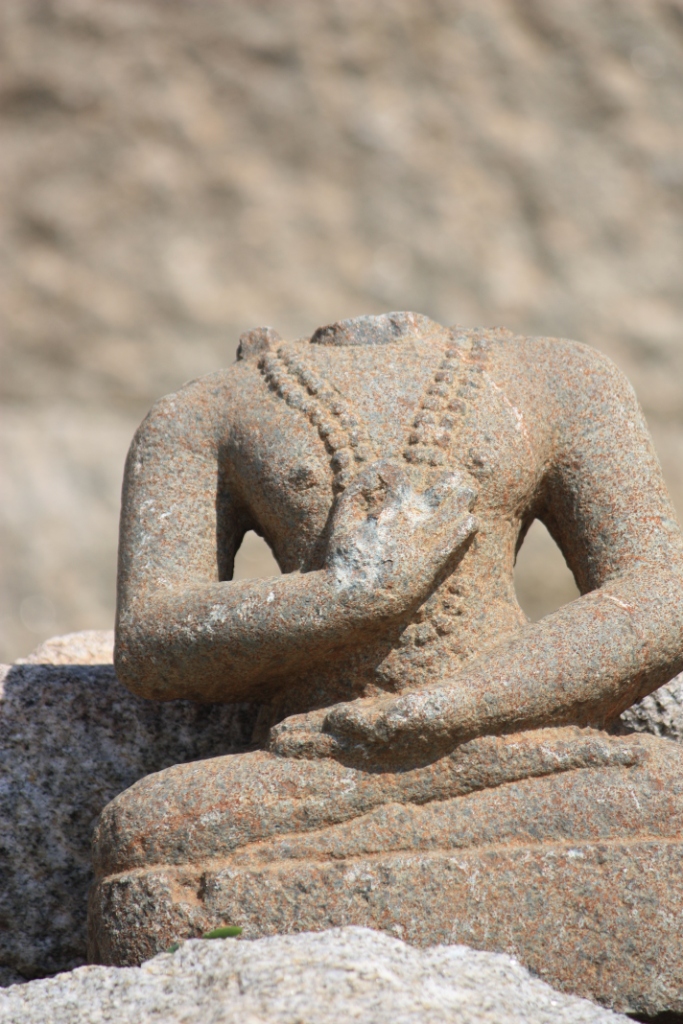
Taken in January of 2014

Taken in January of 2014
 Mind Over Medicine: Scientific Proof That You Can Heal Yourself by Lissa Rankin
My rating: 4 of 5 stars
This book is one of many that challenge the conventional approach to medical care in which a patient is a passive character who just goes to the doctor and does (or ingests) whatever the doc tells them to. In the vein of works by Deepak Chopra and Bernie Siegal, this book is written by medical doctor who has different beliefs on healing. So what’s the niche of Mind Over Medicine, given that there are already a number of prominent medical doctors preaching the same message? That message is that your body is a healing machine and will do MOST (not ALL, none of these individuals advocates abandoning modern medical science) of the heavy lifting of healing, if you create the right conditions. Rankin presents results from scientific studies as the thrust of her book. I’m not really that familiar with Siegal, but you’ll find Rankin’s work a great deal less spiritual and more scientific than the works of Deepak Chopra.
There’s a lot of scientific interest in understanding why some people experience spontaneous remissions from the most lethal of ailments while others succumb to diseases that most people weather with ease. While many people will chalk it up to divine will or chakra nudging or having one’s demons expunged, these aren’t satisfying answers for the scientifically minded individual. However, neither is the extreme skeptic’s suggestion that these are just randomly distributed flukes of nature—and it’s a waste of time to try to explain the outliers. The latter being unsatisfying because phenomena like the placebo effect are well documented.
So what conclusion does Rankin draw from the scientific literature. As suggested earlier, the conclusion is that the body is extremely good at healing what ails it, but it has to be in the right mode to have this healing take place. What’s the right mode? It has to be in relaxed mode, or, in scientific parlance, the parasympathetic system must be engaged. The problem is that when a person is under stress, the body switches into a fight or flight mode. Humanity hasn’t really come to grips with the fact that work deadlines, fears about ailments, or fears that our spouse may be cheating aren’t really the same as our ancestor’s experience of being chased by a saber-tooth tiger. When that ancestor was being chased by a tiger, his or her body shut down everything that wasn’t germane to immediate survival (e.g. digestion is interrupted, blood isn’t evenly distributed but goes to lungs and skeletal muscles, etc.) The tiger chase is over shortly, and the body returns doing its regular at-rest functions (e.g. digesting, healing, etc.) However, if we let our stressors kick us into that immediate survival mode–and just having a disease can be stressing enough in itself–then our healing can be severely or completely curtailed.
Can faith healing, karma cleansing, chakra fluffing, or sugar pills contribute to healing? Sure, but not in the way that the faithful thinks. These systems–each of which has proponents who’ll swear they witnessed first-hand the power of faith or magic or invisible energy (and they are probably not lying)–work because the person who firmly believes in these therapies is able to relax and let their bodies can do what they do.
Does this mean that those who don’t believe in religion or cosmic energy manipulation are out of luck? No. You just skip the middleman and engage in activities such as meditation, yoga, tai chi, or breathing exercises that allow you to put the body in a relaxed state. Secular meditation works just fine if practiced consistently, and particularly if one confronts, addresses, and eliminates the long-terms stressors in one’s life.
At the heart of the book is a discussion about how to go about performing one’s own diagnosis and writing one’s own prescription. As I mentioned earlier, this isn’t about cutting the doctor out. In this case one is diagnosing one’s stressors and prescribing activities to eliminate them. This doesn’t mean one should pass up medical treatment or doctor’s advice. However, it may entail switching doctors if you have a doctor that firmly believes you are incapable of getting better—you don’t need any doubts about your body’s ability to do its thing being foist upon you.
I’d highly recommend this book for scientifically-minded individuals interested in learning how they can help their bodies get into a state conducive to healing.
 The Equanimous Mind by Manish Chopra
My rating: 4 of 5 stars
Imagine going to a meditation center and living by the following rules:
1. You may not have access to any reading materials.
2. You may not have access to any writing materials.
3. You must leave behind cell phones, tablets, laptops, watches, radios, and other portable electronic devices.
4. While there will be other people around, you are only allowed to talk to your instructor/mentor, and mustn’t acknowledge or interact with others. You will scarcely hear a voice unless you are in meeting with your teacher or listening to the taped lessons in the evening.
5. You will be segregated from the other sex. They will have separate living and meditation spaces.
6. You will eat only the vegetarian meals provided by the center.
7. You will spend your days mostly in meditation—meditation of a rigorously prescribed nature.
8. You have to live by these rules for ten straight days. You are strongly discouraged from attending if you don’t believe yourself capable completing of all ten days.
Could you do it? If your response is, “Sure I can, piece of cake,” you are either an exceptional person or a little deluded. And it’s probably more likely you are like the person who imagines they will be a hero in a bank robbery or mugging, but who ends up catatonically cowering in a puddle of their own piddle. Maybe it shouldn’t be a tough proposition, but it is.
The ten days described are the basic course offered at Vipassana meditation centers around the globe. Except your travel costs, there’s no cost to attend, and you aren’t even allowed to tip the staff–though you can make a donation at the end of the course to assist others. If you happen to be near a center, there’s nothing but will and 10 consecutive days of freedom to keep one from taking the course.
The Equanimous Mind charts Manish Chopra’s personal experience with the course. I bought the book because I intend to attend the course myself, and I craved insight into what the experience is like.
For those who are unfamiliar with Vipassana meditation, it’s nominally a Buddhist method, but practitioners are quick to point out that it’s actually areligious. One need not be Buddhist to attend. One could be a Hindu, a Methodist, or an atheist and get the same value from attendance. Adherents believe that this is the meditation method that Buddha himself taught. For those who thought this sounded awfully cult-like when I described it above, in many ways it’s the antithesis of a cult. There is no central guru to worship. The closest thing to the overarching guru, S.N. Goenka, passed away last year. You don’t have to join a group or swear allegiance. And not only don’t you surrender your life-savings, you don’t have to surrender one, thin dime to have the experience.
Chopra doesn’t write at all about the background of Vipassana, nor much about its philosophy or method. Instead, this book is a retelling of Chopra’s personal experience with the camp. There are many books that deal with those aforementioned topics, and so it’s no loss that this book doesn’t. It does give the reader a first-hand look at what it’s like to live in the camp and what prolonged meditation is like, and thus meets a valuable niche in lending comfort to those who are considering the course–but who are leery of what they will go through.
It’s remarkable that the author had the detailed recollections necessary to construct an entire book. The organization of the book chapters is by day, and so there are ten core chapters. (This is a good way to arrange it as there is apparently some universality to experience day-by-day. Not only are people being taught the same methods, but it seems most people who quit do so on days two or six—indicating many people hit “walls” at the same point.) One will remember that notebooks and writing utensils are prohibited. The last chapter informs the reader that Chopra began frantically outlining the book on his way home. It’s surprising that an entire book sprang from memory. The author does claim that the clarity gained through the course improved his memory.
One can’t help but wonder what the book would have read like if it had been compiled day-by-day as a journal. In other words, how much was the book was framed by the euphoria of just having completed the course? Chopra does mention some low points of the course, but, overall, the picture he paints is rosy. It may be that his experience was just overwhelmingly positive, or he could have been on a high from completing something quite difficult.
Chopra suggests that by the end he had greater mental clarity, decreased vice, increased mental capacity, and was living an idyllic life. I don’t want to sound like I’m treating the account as suspect, and I certainly wouldn’t suggest that Chopra is being blatantly dishonest. However, I worry that Chopra might have oversold the course. It almost reads like he’s been imbued with superpowers (mental, not physical–think Professor Xavier, not superman) at the end of the book. (He doesn’t suggest anything magical, but the claims are pretty impressive.) Maybe this is genuinely his experience, but it sounds a little too good to be true.
I’d definitely recommend this book for people who are considering taking the course. I’m not sure it would be of much interest to a more general reader. As I indicated, one isn’t going to learn a lot about the philosophy or history of Vipassana. One does learn a little about the methods from Chopra’s description, but it is fairly cursory. There is a fair amount of mundane information that people interested in the course will love to know (e.g. what kind of food was served and what it’s like to have to sit through one’s body aches), but which will be less than thrilling for someone who has no interest in taking the course.
 Left to its own devices, the mind is like Indian traffic: chaotic, noisy, slow-moving, relentless, and brimming with latent rage. Meditation is a tool to help unsnarl the traffic jams so that one can observe the mind as something other than indecipherable chaos.
Meditation isn’t the end game. If one goes to the gym daily to lift weights, but one has no interest in–or use for–putting one’s muscles to practical use, one is engaging in an act of vanity more than one of personal development. In the same way, if one builds one’s awareness of the mind, and doesn’t use it for betterment in one’s daily life, what is the point? What do I mean by betterment? I mean defeating the petty elements of one’s nature that cause oneself and others suffering and that keep one living in a world of delusion.
Meditation trains one to take note of the daydreams and obsessive thoughts that run through one’s mind, and to do so progressively sooner—before they can coalesce into a full-blown avalanche of negativity and delusion. In meditation, we observe these errant thoughts and then let them float on down the river. As one lives one’s waking life, however, one may take time to consider what these thoughts and daydreams are doing for one. Often one can remain ignorant of the purposes these thoughts serve, realizing only that they make one feel better temporarily.
A few of the purposes that these errant thoughts may serve are:
martyrdom (i.e. thinking the world is against one so whatever goes wrong is the result of outside forces)
-ego-boosting (imaging one has the confidence to do something one doesn’t in reality)
-empowerment (fantasizing one has power in the face of feelings of powerlessness)
-wishful thinking (imagining a perfect life just a PowerBall ticket away)
So, if these thoughts make one feel better, why shouldn’t one let them fly? For one thing, they keep one from seeing the situation as it is. The fantasy or obsessive thought becomes one’s reality and one remains ignorant of what is real. The problem is that if one wants to fix the problem, one must know what it is (i.e. have a true view of it.) If one imagines that one has no role in the problem, then how can one fix the problem? If the problem is one’s unhappiness, one can always do something—even if one can’t change the external situation. One’s unhappiness is a function of one’s mind, and is, therefore, under one’s control.
Second, by giving into obsessive thoughts and fantasies, one becomes dependent upon them as crutches, and becomes stuck in a cycle of helplessness.
Third, when one removes oneself from the problem, one denies one’s power to change the situation—or the emotional result. One makes oneself vulnerable to manipulation. If one doesn’t recognize the ability of another person to “make one mad,” one denies them that power. (But this requires accepting that one has a responsibility for one’s emotional state, a sometimes uncomfortable proposition.)
I have a theory that the steadfast pursuit of an enlightened mind will either result in enlightenment or insanity. Why should it result in insanity? Because, the process involves stripping away the coping mechanisms that got one through each day. If one has the internal confidence (i.e. fudōshin, or immovable spirit) to stare in the mirror and see one’s flaws and weaknesses, one may achieve an enlightened state. If one lacks such confidence, seeing those flaws and weaknesses may be depressing. Of course, fudōshin is just one side of the coin, it also matters whether one has the relative freedom from stress to lead an introspective life or whether one feels the constant pressure that propels most people back into old habits. It’s easier to make positive changes when one’s life radically changes, then the power of routine and habit lose hold.
The challenge is that the pursuit of an enlightened state of mind is a constant job. Some branches of Buddhism and other mystic religions suggest that enlightenment is a tipping point, and that once one achieves that state one is forever enlightened. I’m not in a position to refute such beliefs, but it seems that it’s more like being a sober AA member–there is an ever-present potential to revert to old habits of the mind. So, one must be ever vigilant. There’s no rest until one is dead… as far as I know.
 How to Meditate: A Guide to Self-Discovery by Lawrence LeShan
My rating: 3 of 5 stars
LeShan’s book offers a secular and scientific guide to meditation. By secular, I don’t mean to suggest that it’s devoid of mention of religion. On the contrary, How to Meditate delves into a wide variety of meditation styles that have roots in religion, and it quotes from spiritual teachers across a range of religions–including the mystic branches of Christianity and Islam. I mention the latter because the book seems tailored to bringing individuals into meditation that do not normally think meditation as being their bag, which could include atheists, secular humanists, or those whose religious practices don’t involve a mystical component. I just mean that the book is secular in that it doesn’t advocate a specific religion or suggest that one needs to hold any particular spiritual beliefs to benefit from meditation.
Also, by scientific I don’t mean to suggest that the book gets bogged down in the minutiae of EKG’s or the like. How to Meditate is readable to the general reader, except perhaps for chapter 11, which deals with using meditation in psychotherapy. [However, by the author’s own admission, one can skip that chapter with no great loss if you aren’t a therapist.] What I do mean to say is that LeShan takes an approach to meditation that is grounded in real-world, observable results. He tells the reader of the mental and physical benefits of meditation as they are discussed in the scientific literature.
In other words, if you think that meditation is only for hippie-types who believe in auras and astral planes, this book may convince you otherwise. On the other hand, if you’re one who believes in auras, astral planes, or the idea that only one true guru / path exists, you’ll probably be miffed by this book. There are a couple of chapters devoted to ideas that people believe that both have little evidence of grounding in reality and which detract from meditation. This includes ESP, auras, strange maps of reality, and guru-worship.
The core of the book is chapter 8, which explains how to do meditations of eleven different kinds. The book addresses single-point awareness, breath counting, thought watching, bodily awareness (specifically, Theravada Buddhist style meditation), word association (1,000-petaled lotus), mantra meditation, meditation on “I”, movement meditation (particularly Sufi-style), sensory awareness, safe harbor meditation, and unstructured meditation. The first ten are all types of structured meditation, and an earlier chapter is devoted to distinguishing structured from unstructured approaches to meditation. There is also an earlier chapter that discusses a broad taxonomy of meditation and sub-classes of meditation.
The book is logically arranged for the most part. It begins with a chapter on why one should meditate. This first chapter sets up two chapters that deal with the psychological and physiological effects of meditation. There is one oddity of organization. The core “how-to” chapter is bookended by a chapter on ESP and one on various pitfalls of spiritualism. It would seem these two chapters should go together as they both deal with things that detract from meditative practice, and not with the central chapter wedged between them.
The last couple chapters and the Afterword aren’t as beneficial for the general reader as the first 3/4ths of the book or so. One of those chapters is the aforementioned chapter for psychotherapists and the other deals with the social significance of meditation. The last chapter before those that I found superfluous, however, is one addressing the question of whether one needs a teacher to learn meditation. This pro and con discussion seems like a good way to end this book.
There is a long afterword by Edgar N. Jackson that adds a perspective on what we should take from LeShan’s book. I suspect that if page count were not a concern the book would have ended on the chapter that talks about decisions about a teacher. The last two chapters and the Afterword seem to have been added for the twin-fold purpose of hitting a target page count and to add a couple of niche audiences—namely students of psychology and fans of Edgar N. Jackson (i.e. Christians with an interest in mystical approaches to their religion.)
Overall, I’d recommend this book for those who are new to meditation, those who are seeking to expand their practice to new types of meditation, and those who are interested in the mind in general. As I mentioned, if you think of meditation as a route to see the glow of chakras or to commune with the dead, this probably isn’t the book for you—you’re likely to find its disregard for such otherworldly endeavors to be unappealing.
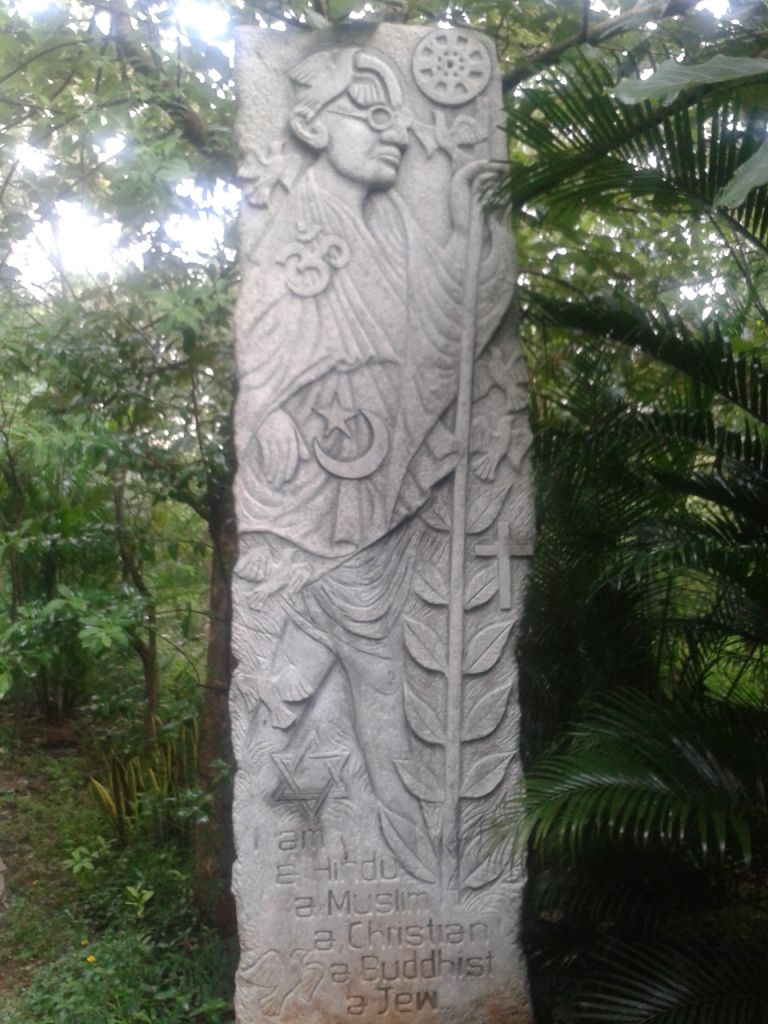
Taken October 20, 2013 at Fireflies Ashram.
Indian cities don’t whisper. They are often lovely, always lively, but offer little relief from bombardment of the senses. Horns are relentless. Bus and truck air-horns can make a person jump from one’s skin. The smells may be pleasing or putrid, but they’re never faint. There is sign pollution, wherein it’s often impossible to find what one is looking for in the sea of signage–even when it lies right in front of one’s face. Colors pop and glow, not smooth pastels, but oranges and purples that you can practically taste.
It shouldn’t have surprised me when I got to the southern edge of the city to find one of the major land uses was Ashrams. Ashrams in all shapes and sizes, from the small but authentic Narayana Gurukula (mentioned a few DAILY PHOTO installments back) to the massive Art of Living International Center–headed by Bangalore’s most famous guru, Sri Sri Ravi Shankar. Out Kanakapura Road, where monkeys sling through trees and fields of corn remind me of my own Hoosier upbringing, lies a diverse collection of houses of spirituality and reflection. They offer a much-needed island of tranquility amid a sea of chaos.
I stayed for nine nights at one of the most singular of these ashrams, Fireflies. One way in which it’s unique is that it’s a “guruless” ashram. That may seem oxymoronic. The terms “guru” and “ashram” seem to go hand in hand. Guru means teacher. My dictionary defines ashram as, “the home of a small community of Hindus.” [I think this definition could be challenged both on the necessity of “smallness” and “Hindu-ness.” As indicated, there are some pretty massive ashrams and there are ones that are associated with non-aligned spiritual groups.] It’s true that the typical ashram has a spiritual leader or yogi as its head. At Fireflies the gurus come and go with the groups that visit. While I was there, besides our group of Thai Yoga Bodywork practitioners, there was a group of psychotherapists and an organization of past life regressionists. Rather than housing a single unified set of beliefs, at this ashram a diverse and sometimes conflicting set of beliefs are harmoniously housed.
As I have little experience with ashrams, I can’t speak authoritatively about other differences. However, it’s my understanding that one other difference between Fireflies and many–more typical–ashrams is that the latter often have limited or non-existent staff. This means that the visitors may do much, if not the bulk, of the work. Fireflies has a staff that does the cooking and takes care of many needs of the visitors. This isn’t to suggest that it’s like a hotel stay. There’s somewhat of an expectation that visitors will take care of the things that they can do for themselves, and the accommodations are basic.
I found the experience of my stay to be beneficial, if not always stress-free. The main source of my stress had little to do with the Ashram. I received my phone sim card right before I left. After a couple of days I got my phone working for a day or two only to have the phone company turn it off because no one was home when they randomly dropped by to verify my address. [Showing up unannounced in the middle of the day and then treating you as non-existent if no one is home is one of the annoying little hallmarks of Indian institutions (corporate and government) that I’ve experienced on more than one occasion.] I will admit that it is a mark of both society’s and my own wussification that we can’t go a few days without being in contact with home and news of the world. Twenty years ago no one would have expected to have such constant verification that all was well in the world. People could go days back then without worrying that the sky was falling. While it wasn’t pleasant to be cut off, it was an eye-opening experience. [I will note that the Ashram property is on a slope and at the low end I got no reception at all, but on the high end I’d get a bar or two–enough to do the job if the phone company wasn’t screwing me over.]
It was also useful to go without brain candy for a while–that is without television and related entertainment. Part of what I hoped to learn from my stay was whether I was prepared to take the 10-day Vipassana meditation course in the spring. The Vipassana course is considerably more spartan level of existence than that of Fireflies.
On some levels, I proved ready, and on others I have yet to do so. I did just fine eating two vegetarian meals and a snack for dinner each day. (I could have had three full meals per day, but I wanted to make sure I was ready to cut my intake adequately. Therefore, I stuck with a snack in the evening and ate reasonable portions for breakfast and lunch.) I found the meals at Fireflies to be quite good, and I had no complaints in that regard. It should be noted that the ashram is not an easy walk to any restaurants or substantial stores (there are a couple small shops up on the corner, but they’re geared toward locals and don’t necessarily have what a traveler needs) so it’s not easy to go out for something–though I did see one auto-rickshaw around the premises at times.
The true test of preparation for the Vipassana course is that there are no books or notebooks allowed. This will be my greatest challenge. I finished two novels and two nonfiction books on Kindle during my stay, plus probably another 100 pages of other books, and I filled 2/3rds of a journal–mostly with notes from the TYB workshop.
Also, at the Vipassana meditation course one is not allowed to speak to anyone but the instructor at a specific time when they take questions about the course. I wasn’t nearly so cut off from humanity at Fireflies. The workshop participants and teachers were around all day and I had occasional conversations in the evening with others at the ashram. Furthermore, I’m a fairly solitary creature.
It was interesting that during the weekends there were so many people around, but during the middle of the week there were few. For a while I thought I was the only non-staff member person at the ashram—though I later found that to be incorrect.
So my time at the ashram was Spartan, but that’s part of the beauty of it.
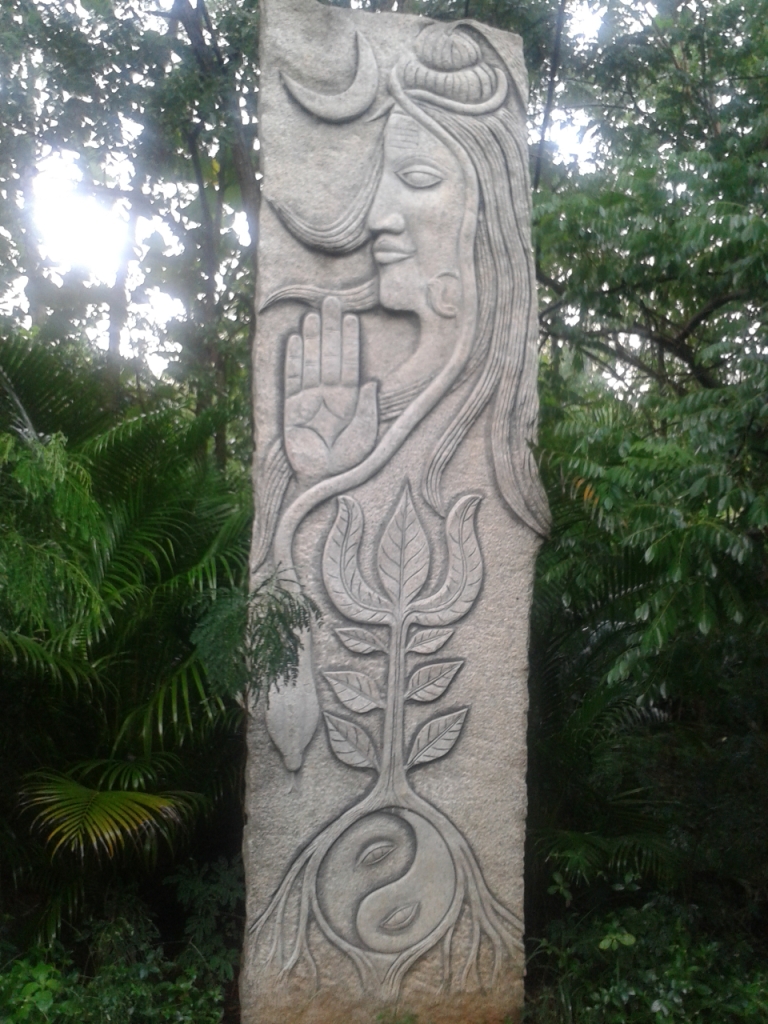
I should point out that there are some impressive stone carvings located throughout the property. The artists are international in scope. Each of these carvings or sculptures offers its own story. I’ll attach a few pics for your edification.


 “Why be mindful?” That was the question asked to the group assembled at the Thubten Lekshey Ling Tibetan Buddhist meditation center on Sunday.
We had just completed a couple of rounds of mindfulness meditation. We’d been told that there are four themes of mindfulness meditation, but there can be variations on each. First, there is mindfulness of the body. This was the first type of meditation that we practiced. It isn’t about recognizing the body as an object so much as a field of perceptions.
Second, there is mindfulness of one’s feelings or sensations, in other words, mindfulness of the outside world as perceived by our sense organs. We did a meditation in which we were mindful of sound in particular. The key, we were told, was to hear everything–even the sound of silence. “Listening to the sound of silence” may sound like an oxymoron, but it makes sense as one experiences it. When one thinks in terms of hearing sounds, one begins to actively try to “catch” a sound. One may even try to anticipate sounds, particularly sounds in series–like a roofer using a nail-gun on a nearby roof. This active listening, rather than hearing, is not what one wants.
We also did a mindful eating/tasting exercise. We ate a tiny bit of snack mix. The whole processing taking many times what it normally does to shovel a bit of snack into one’s mouth and wolf it down. The food was raised to one’s face, experienced, placed in one’s mouth, experienced, chewed, experienced, and swallowed.
Third, there is meditation on the mind. That is, one watches one’s thoughts. We didn’t do one of these meditations. However, I’ve tried it in the past, and I find this particularly difficult . Watching thoughts go by as if they were rising bubbles or logs floating on a river suggests a division between the observing mind and the thought-producing mind. Recognition of the thought intrudes upon it, and this becomes a whole new line of thought.
Finally, there is meditation on emotion. We did not do one of these in this session either.
Our final meditation was another type of meditation on the body, but it was a moving meditation. We walked and experienced the motion of the body as it moved through the room. I particularly enjoyed this.
However, before the last meditation, we discussed this question of “why be mindful?” I had my own ideas, which I shared. Others had their own ideas, some closer and others farther from my own thinking, but all thought-provoking and valid.
My own thoughts were two-fold. First, mindfulness allows one to be more stable and grounded. Fear is about the future and anger and sadness are about the past. In the present one is neither afraid nor fearful. Second, by being mindful, we can come to see problems before they tumble out of control. We can catch our angry thoughts and dissect them before they do us harm. We can recognize the subtle problems with our bodies before they come full-blown ailments.
Of course, as a martial artist, I had always thought in other terms about mindfulness. There’s no time at the speed of combat to consciously recognize and consciously respond to attacks, one must be mindful to have any hope of surviving a surprise attack.
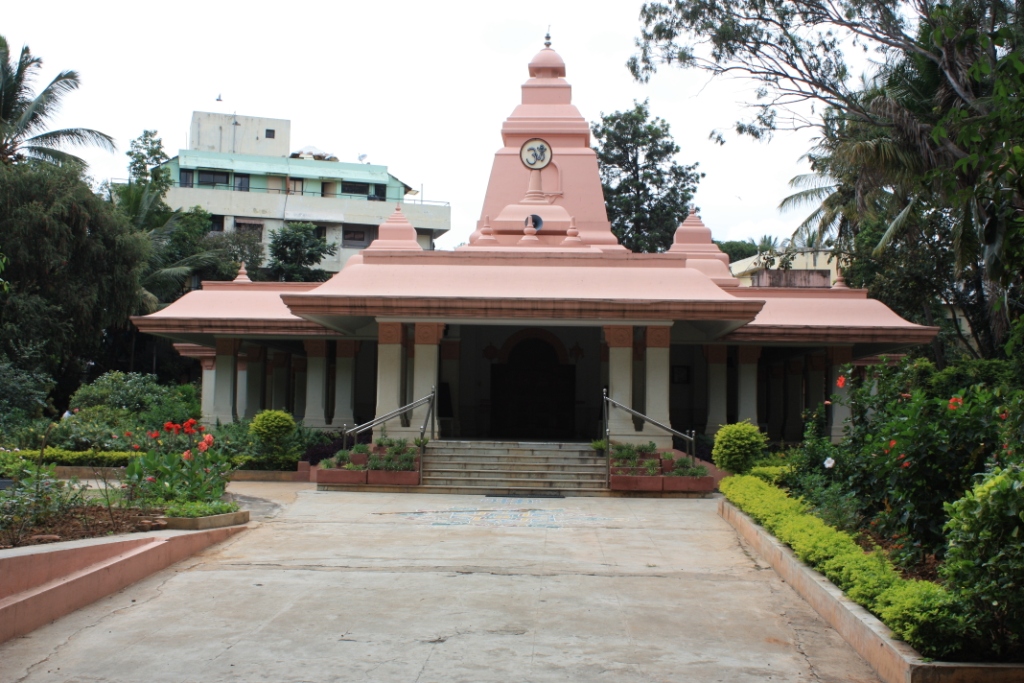
Taken September 30, 2013 in Bangalore
This small campus of buildings in the Halasuru neighborhood of Bangalore is dedicated to the teachings of Sri Ramakrishna. Ramakrishna was a holy man from Bengal who lived from 1836 to 1886. The Bangalore chapter is one of several associated with this non-secular monastic order. The order was actually begun by Ramakrishna’s lead disciple, Swami Vivekanada. Vivekanada is most well-known as the individual who introduced Yoga to the West, and particularly the US, back in the 19th century.
With a motto of “Liberation of oneself and service to mankind,” the order both facilitates personal growth through yoga classes and meditation sessions, and also has a major philanthropic thrust.
Having settled into life in India over the past month, I’m now getting around to some of the self-enrichment activities I’ve planned on taking advantage of here in Bangalore. Today I attended a meditation session and discussion/lecture at the Thubten Lekshey Ling Tibetan Buddhist Meditation Center. I’ve read a few books on Buddhism and even one or two specific to Tibetan Buddhism, but this was my first time attending such a session. Also, while I’ve done several kinds of secular meditation, both in a group and individually, this was my first exposure to guided meditation in the Tibetan Buddhist tradition.
The title of the session was As the Clouds Drift by… The first hour was the meditation portion and the following two hours were the lecture / discussion portion. The session opened with a few prayers that were chanted in what I believe was Sanskrit, but there was an English translation for newbies such as myself to follow along with the meaning. Then we did a few short meditations that were much like others that I’ve done: meditation on breath and meditation on bodily awareness. Then there was a visualization as we read a sutra in English.
Transitioning into the discussion and lecture portion, we first discussed the meaning of life. No, I’m not making that up. While it might seem like a hackneyed question, some intriguing points were raised. We were directed to think of the question as having two alternative meanings. First, why am I here? Second, what is my purpose? The conversation gravitated to the latter topic. I’m not sure if this was because there was a consensus that the question “why am I here?” is meaningless, or if the question of purpose was just more intriguing. There were various opinions about whether there was a purpose, and–if so–whether it is universal or individual-specific.
After a brief tea break, the remainder of the session involved readings from The Way of Bodhisattva followed by analysis and prompted discussion. Much of the discussion revolved around the issue of how compassion is expressed and the difficulty (or ease) of being a Bodhisattva. (A Bodhisattva is one who seeks enlightenment out of compassion for all sentient beings.)
I found the session to be thought-provoking and beneficial, and thought the atmosphere was conducive to growth. Emphasis was placed on discussion rather than straight lecturing. I will no doubt be back to visit in the future.
I did learn something interesting about myself through the process of the class, and that’s that I need to learn to be still for more than two hours. While there was no prohibition on moving around–particularly beyond the meditation portion– in an effort to not be a distraction, I tried to keep fairly still. I practically ran home afterwords. I had all this pent-up energy. I would have thought myself better than average at sitting in a contemplative state. I’m a writer for goodness sake. I spend entire days at my computer. However, in truth, I rarely sit more than an hour without getting up and stretching or doing some sort of movement to limber up my body and get the blood flowing. I was raised Catholic, and so I’m not new to sitting quietly for long periods of time. Though that was a long time ago. I also have three college degrees and have spent more than my fair share of time in classrooms, but the wandering mind is not discouraged in that environment–in a way it’s encouraged.
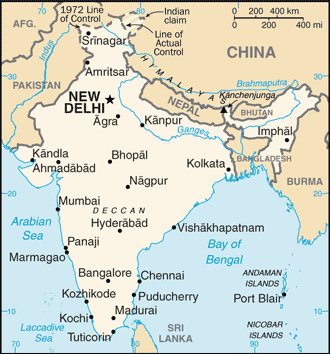 We’re down to about a month until our move to India.
The house is largely in order with only a few odds and ends remaining.
Most of our worldly possessions are in storage, and I haven’t really missed any of it. (A lot of “moss” collects when your stone stops rolling for a few years.) The house now echoes. Movers will be coming to get the small amount of stuff we’ll ship to India in the next couple weeks. Then we’ll really be living minimalist.
We’ve got all our shots with the exception of the final doses for Hepatitis. We’ll get those in country. With respect to shots, when moving to India, one has to get… well, all of them.
Visas are in the works though we’ve had some delay on that front. However, fortuitously, the local Indian Consulate is beginning to take applications, and so I won’t have to send my application off to another city and can eliminate the time and risk of postal transit.
My list of things to do consists of fewer large, all-consuming tasks and more quick and easy jobs.
All of this means that I’m getting back to writing. This is a bit like getting a corroded junk-yard jalopy running again. It’s remarkable how much the creative juices curdle when one spends a few months focusing on home repairs, monitoring contractors, getting shots, and other mundane tasks of international relocation. I worked almost exclusively on drafting two novels for a period of a little over a year, and now–as I resume writing and revisions–I’m having to re-read just to figure out what they’re about. On the bright side, I sometime surprise myself with what I wrote. For me, there’s definitely economy of scale in long writing projects. Writing eight hours a day yields a lot more than eight times writing for one hour a day. I lose voices, character idiosyncrasies, and plot detail so easily unless I’m immersed in them.
As for this blog, I think a rebirth is in order. Since I’m moving to India, I’ve invoked the concept of transmigration of soul. In Hinduism, some sects of Buddhism, as well as a few lesser known religions, there’s a belief in reincarnation in which the soul may be reborn into an altogether different type of container. For example, if you were good in your last life, you might come back as a lama or a lap cat. If you were bad in your last life, you might come back as a slug or a Congressman. So the question of the moment is what this blog will be reborn as when it sputters up from out of the ashes.
I would like the site to remain (or, perhaps, become) humorous, but I’d like the humor to be less curmudgeonly. This presents a challenge because I’m not sure that I know how to be funny without being a curmudgeon. In point of fact, I’m not sure I know how to not be a curmudgeon–funny or otherwise.
I want this site to be reflective of my new life. I’ll continue posting photos, though after the move they will be disproportionately from Bangalore, India, and a few adjacent countries to which I will be traveling. So it’ll remain part travel site. I’m sure I’ll have plenty of lessons learned about travel in India to share.
When I’m not writing or sleeping, I’ll be engaged in a quest of self-improvement. The development of mind and body have been raised to high art in India, and I hope to find some of those individuals with that knowledge.
Expanding my abilities and understanding of martial arts is one of my goals for this period. It’ll be a challenge to keep from becoming rusty in the jissen kobudō (Japanese old school martial arts that emphasize pragmatic skills) that I have been studying my entire adult life. However, in addition to working on what I know, there are other activities that I think will help expand my understanding while keeping me suitable limber and conditioned. I would like to learn a little about indigenous Indian martial arts such as kalaripayattu, silambam, and–if time permits–gatka. Furthermore, I would like find a place to train in Bangalore where I can do some training in what I’d call general jissen (practical fighting) skills.
However, my attempts to improve myself will not be limited to martial arts alone. India might be cursed with plagues of poverty, pollution, and–well–plague, but they have no shortage of gurus–whether I can find one that’s reputable and willing is another matter. The older I’ve gotten, the more I’ve realized that I don’t have a firm grasp of my mind. My mind runs and I don’t pay enough attention to what it is telling me; I don’t put enough effort into fixing what is broken. I read a quote recently about people who put great effort into studying the external world, but who remain ignorant of themselves. This struck close to home, but it’s not just me–it’s widespread. People study psychology in school and learn about cognitive biases, but they don’t put the information to use in becoming more virtuous people. For example, a person might learn about the “self-serving bias” –whereby people claim responsibility for successes but place blame for failures on external factors–and say, “yeah, it’s funny that other people totally do that.”
Part of practicing martial arts is keeping one’s self healthy, against all odds. While I’ve never practiced yoga, I appreciate the belief that mind and body are inseparable. I would like to work on building a body that is less likely to be crippled by the practice of martial arts as I age. I intend to study Thai yoga massage, which incorporates stretching and pressure point massage. There’s an interesting connection between India and Thailand with respect to this form of bodywork. While it’s most closely associated with Thailand, some claim that its roots are in Northern India with a master called Guru Jivaka. While visiting Thailand, I developed an appreciation for the health benefits of this type of massage–particularly for one prone to have things out of whack. However, I didn’t have the time to study it during that visit. There is also the more distinctly indigenous holistic healing system of India, Ayurveda, and I would like to learn more about it as well.
In short, I intend to have a pretty full agenda while living in India, and I hope readers will find my posts about these experiences interesting and worthwhile.


 Tiger Riding for Beginners