Tag Archives: martial arts
Teachable and Unteachable Lessons
[Note: This is posted in my Jissen Budōka blog as well.]
Miyamoto Musashi, who was undefeated in over 60 duels, claimed that he never had a teacher. Some historians refute this claim. Whether one accepts it or not, the statement astonishes.
Musashi wasn’t talking only about martial arts, but about the many areas in which he was accomplished. Not being a painter or a sculptor, I can’t say how important a teacher is in such domains. But it’s easy enough for me to imagine a successful writer who never took a formal class in writing; someone who read profusely and practiced his (or her) craft relentlessly could do it. (Certainly, one can easily imagine successful writers whose formal education was in some area other than writing because there are so many of them–probably at least as many as those whose education was in writing. Examples include: Vonnegut [Chemistry], Crichton [Medicine], Zane Grey [Dentistry], Ursala LeGuin [Anthropology], and J.K. Rowling [French]. That’s not even to start on the many literary legends who dropped out all together– e.g. Dickens, Faulkner, Twain, H.G. Wells, and Jack London.) This isn’t to say that writing teachers don’t make writing better, but just that there is a path to this skill that doesn’t involve being fed lessons.
However, I struggle to imagine a martial artist achieving so much without a teacher. Boiled down to its most workaday definition, a martial art is a collections of lessons about what works in a combative situation. This is what separates the importance of a teacher in martial arts from that of a discipline like writing. In writing, one has the leisure to make one’s mistakes, learn from them, and self-apply course corrections. Musashi was in life or death duels; he couldn’t learn lessons at such a leisurely pace and in such an iterative fashion.
A martial arts teacher has a number of roles, such as preventing inertia (slacking) from taking hold in the training hall. However, the most fundamental purpose is to pass along the collection of lessons so that a student doesn’t have to learn them all by way of personal experience. Most of us aren’t Miyamoto Musashi; we can’t survive the process of learning all our own lessons.
Needless to say, I am a firm believer in the value of a good teacher. I’ve had several over the years, and I received valuable lessons from all of them–all with different, but no less valid, points of emphasis and flavor.
Having said all that proceeds, there’s much that cannot be taught. Such lessons may be described or discussed, but they cannot be learned except through the initiative of the student. I said that most of us can’t survive the process of learning all one’s own lessons, but I’ve increasingly come to believe that one can’t survive learning none of them either. In the beginning, one must be fed the lessons from a teacher in order grow. However, as the decades pass, one increasingly needs the space to learn one’s own lessons. If one lacks said space, one will stagnate and eventually the wheels will roll off one’s training altogether.
So what are the unteachable lessons? Knowledge can be conveyed, but not everything that a martial artist must learn is knowledge. Confidence cannot be taught. A teacher may explain–or even show–how he or she became confident, but that won’t translate one iota into the student being more confident. This is like a Buddhist monk telling one that “desire is the root of suffering.” One may understand that statement. One may believe the statement. However, one’s suffering won’t decrease because one has the knowledge. One’s suffering will only decrease if one conscientiously does the hard work of reducing one’s desires.
Another area of unteachable lessons are the lessons that the teacher has never learned. Loyalty is a great virtue, and so there may be a tendency to restrict one’s learning to the lessons of one teacher. However, even if one has an outstanding teacher and are practicing a great lineage, blind spots happen. The only way to learn whether there is anything of value obscured in those blind spots is to throw off one’s blinders and have a look for oneself.
What blinders? An excellent and tricky question. It’s like when someone says, “it’s not what you said, but the way you said it.” We all understand that there is some intangible character in language that is commonly understood but not easily seen or defined. In any culture (and a dōjō contains a culture, believe me) there’s always a collection of norms, rules of thumb, ideas, beliefs, mores, credos, etc. that come to be taken so much for granted that they become an invisible filter through which one sees the world. This isn’t an inherently bad thing, and it’s probably necessary to produce sufficient order in a chaotic world in which to learn and grow. Having said that, some of the ideas and beliefs in our cultural filter may be arbitrary, or at least not universal, but yet we don’t necessarily see the potential for error because we are seeing the world through the cultural filter. We take for granted that grass is green, but what if we see it through a yellow filter? Then it’s blue. Right?
DAILY PHOTO: Capoeira Demonstration
Why I’m a Slacker Lately: or, Mysterious India
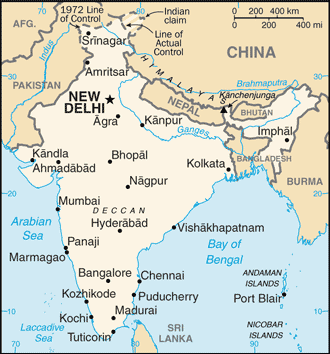
I haven’t been writing, editing, or conducting research much as of late. This has probably gone unnoticed in the vastness of the cyberspace, but in the spirit of blogging I thought I’d answer a question that no one asked. I recently learned that my wife and I will probably be moving to Bangalore, India later in the year. This has kept me physically occupied with home repair and boxing up the house. In my non-labor moments, my mental faculties are largely devoted to understanding the country in which I will be living. I’ve never been there before.
India is a harder nut to crack than one might think. Yes, there is the obvious. At 1.2 billion people, it has the world’s second largest population and is screaming up on China for number one. It’s the seventh largest country by land area. It’s the birthplace of that most excellent yoga that keeps all the twisty people twisty. It’s home of tandoori chicken and naan bread, both of which I love.
However, that’s all superficial. I must sadly admit that–until recently–my in-depth knowledge has come from three sources:
1.) The Jungle Books by Rudyard Kipling
2.) A junior high school field trip to see the film Gandhi, which I had been under the impression was six hours long, but, according to Wikipedia, is only a little over three hours long. I guess that, just as kids think everyone is taller, a kid’s perception of Oscar-winning motion picture run times is greatly distorted.
3.) A ton of reading about the Indo-Pakistani rift and its strategic implications as a graduate student studying International Affairs with a focus on Strategic Studies.
With respect to number 3, the amount of study of this region was not commensurate with the fact that the Indo-Pakistani border region is generally voted “Most Likely Point of Origin for Global Nuclear Winter.” I’m not suggesting that the relationship between India and Pakistan is any more dysfunctional, unstable, or rooted in irrationality than other relationships between nuclear powers. However, the adjacency of the two countries is a problem from the perspective of strategic stability. When alarms went off in the U.S. or the U.S.S.R. back in the day, there was at least a little time to evaluate and communicate. Being next-door neighbors makes the Indo-Pakistani conflict particularly troubling. That said, they’ve had some pretty big strain tests on their relationship without blowing up the world, so that’s a positive sign.
So why does this country, which should be so front and center in the global consciousness, remain so mysterious? One way we know countries is by those grand competitions through which nations–friends and enemies alike–interact. In this domain, India really hides its light under a bushel. India has won 26 Olympic medals in 23 games, this is fewer than either Kenya or Jamaica–and both of those countries did it in fewer games. Yesterday, in a post about a book by Nobel Prize-winning Hungarian, Imre Kertész, I may have mentioned that Hungarians have won 12 Nobel Prizes–that’s more than India by a large margin. Now, while India has had its problems, it’s 100 times more populous than Hungary, and has a history of publishing scientific literature in English (an undeniable advantage in this domain.) Depending upon which country Rudyard Kipling is counted toward, India has either eight or nine Nobel Prize wins. Of course, it would be ridiculous to think that India doesn’t have the human capital to excel in such domains. While I realize it may not be a representative sample, I think almost every Indian I’ve met in person has had an advanced degree and has been smart as a whip. So it’s certainly NOT true that this is a country that undervalues education. With a third of the world’s population, statistically speaking, they must be home to physical and mental specimens of humanity that are as impressive as any, but somehow either the will or ability to convert that human capital into winners on the global stage is missing.
I do know a little more about India. It’s the birthplace of both Hinduism and Buddhism, as well as a bunch of other religions. As a martial artist, I’ve heard that many believe most Asian fighting systems could trace their origins back to India. I don’t know how much truth there is to this belief. Martial arts always evolve into optimization with the local conditions and culture, and, therefore, a lack of superficial similarities doesn’t discount the possibility of such a connection. One of the origin myths the Indo-centric martial arts is the story that Bodhidharma brought a fighting style to China that would be the stepping off point for most of the myriad Asian martial arts. The current consensus among historians seems to be that this part of the Bodhidharma story is not true (See: Meir Shahar’s The Shaolin Monastery.) However, that being said, there is an odd but clear connection between this most pacifistic of world religions, Buddhism, and some of the world’s most kick-ass martial arts. Whether one is talking about China’s Shaolin monks or Japan’s legendary warrior-monk Benkei, it’s clear that some exceptional martial arts have developed in tandem with the spread of Buddhism. Of course, even this just creates more questions, namely: Why should a pacifist religion have legendary fighters sprouting up anywhere near it?
I’m looking forward to getting to know more about India than that it’s huge and its Chicken Vindaloo is scrumptious. It’s a country with a long and intriguing history. I want to see its jungles, its deserts, its mountains, and its beaches. I want to visit its temples and learn from its sages. I’m eager to see its vivid colors and smell [at least some] of its pungent scents. At some point I expect to have some awesome posts about my time there, and hopefully some bold pictures as well. In the mean time, please forgive my slacking.
5 Classics of Martial Arts Cinema
Martial arts cinema ranges from the horrible through the campy to the excellent. There is one ever-present risk facing this genre. That is, like porn, movie makers may conclude that viewers aren’t watching for character or plot so they might as well just focus on the action. When they do that and then they blow the action– well, that’s when it’s painful to watch. By numbers, most of this genre probably falls into that category. However, sometimes they get it right.
Of course, it’s not always clear what should be categorized as a martial arts film, given many cross-genre romps. The Matrix is science fiction, but it’s also a kung fu flick. The Bourne trilogy films are spy thrillers, but their characteristic gritty hand-to-hand combat sequences are integral to the films. I’ve tried to focus on films that one would unambiguously categorize as martial arts cinema (though anything by Kurosawa is likely to be considered mainstream cinema.)
I also, admittedly, display several of my own biases. I prefer films that avoid over-the-top superhuman choreography. I don’t want to say that I prefer realism. None of it is realistic, but there’s a vast difference between Jackie Chan’s choreography and that of The Curse of the Golden Flower. Still, I do include Crouching Tiger Hidden Dragon and Kung Fu Hustle, which both rely heavily on wires and superhuman feats. I also like period pieces as opposed to modern-day films. Of course, characters with charisma also get my attention, but I don’t think I’m unique in that regard.
5.) Enter the Dragon
Enter the Dragon is Bruce Lee’s last film, and features Lee as a Shaolin practitioner cum secret agent. The film reminds me of the Ian Fleming novel You Only Live Twice in that it’s about a person being tasked to infiltrate an evil mastermind’s sprawling lair not because it makes logical or reality-based sense, but rather because the proposed infiltrator is just that damn good.
4.) Crouching Tiger Hidden Dragon
This is undoubtedly the most critically acclaimed of the films on the list. It was nominated for a Best Picture Oscar in 2000, and while it did not win in that category, it did take four Oscars that year. It’s in a class of film that includes Curse of the Golden Flower and Hero that are known for stunning cinematography and historical settings. (Unfortunately, these films are also marked by an insanely excessive use of wire-work for my taste.) This film includes a romantic component as well as the fight to possess a sword called Green Destiny. As is mandatory for Kung fu films, there’s a martial arts master whose death must be avenged.
3.) The Legend of Drunken Master (aka Drunken Master II)
Jackie Chan plays a bumbling young man who is, ironically, a master of Kung fu when completely inebriated. The plot revolves around a mix up between an agent who is trying to steal a valuable artifact and Chan’s character who is trying to smuggle ginseng to avoid paying duty on it. Incredibly, the artifact and ginseng are packaged identically, and the thief ends up with the ginseng and Chan’s character with the artifact. It’s Chan at his best, with all the comedy and creative choreography that one would expect.
2.) Hidden Fortress
I’m not including this just to prevent a Chinese sweep. (On that note: I’ve heard the Thai Ong Bak films are quite good, but I haven’t gotten around do seeing any of them.) Anyway, there are some excellent Japanese period films that involve many combat sequences that are not over-the-top. Of course, Akira Kurosawa dominates in this realm. There are other Kurosawa films, such as Seven Samurai, Yojimbo, or Ran that could equally well be included. Hidden Fortress is probably best known to American movie buffs as a major influence on George Lucas in the making of the first Star Wars film. Hidden Fortress is a about a General (played by portrayer-of-samurai-extraordinaire Toshiro Mifune) who must escort a princess and her family fortune cross-country to safety. Of course, as in every hero’s journey, there are many challenges to be confronted.
1.) Kung Fu Hustle
This comedy is set in the gang-ridden slums of 1930’s Shanghai. A tenement complex is assailed by the gangs. However, the residents offer some surprising resistance in the form of unexpected apartment-dwelling kung fu masters. Unlike Jackie Chan’s down-to-earth comedies, this one is almost cartoon-esque. It features a cast of anti-heroes that keeps the film interesting, and the protagonist has a strong narrative arc.
Haiku no Gyokko-ryū Jōryaku no Maki
throw open the gate
mindless herds will charge headlong
into the stockyard
prolong each journey
show the Emperor the sights
drop his palanquin
the guitarist’s hand
bounds chord to chord on the dot
no beat is missed
the slug ricochets
yet always finds its mark
burrowing deeply
waves washing ashore
within a rocky inlet
turn about strongly
gulls flap into flight
slowly lifting skyward in
an unrushed climb
sparks pop from the fire
with impeccable timing
uncapturable
topple the gatepost
with a splintering impact
but start with a sting
the pinky finger
of a raging wild-eyed brute
snaps like a pea-pod
once the snake constricts
all is hopelessly lost
sting first and sting deep
bears don’t crush stout trees
stout trees sometimes crush a bear
falling in tree’s time
the bull’s hoof clomps down
a statement made decisive
not to be wrangled
The Budō Fishbowl
I posted this on my martial arts blog, Jissen Budōka, but decided to re-post here.
I’ve read and heard many quotes about the degree to which martial arts CAN’T be taught. At the extreme, there’s Miyamoto Musashi, who claimed to never have had a teacher of swordsmanship.
I recently found myself asking, “What if only 10% of budō is teachable?”
If that were the case, someone who was close to having all of the pieces that could be taught would think themselves a master–even if they were largely ignorant of the other 90%.
Such an individual would be like a fish in a fishbowl, thinking that there was nothing but emptiness above the waterline.
He would be like primitive man, thinking the stars were but pinpricks painted on a dome.
Or, in all likelihood, like the modern man who thinks that if we can just reconcile a couple sciencey bits–maybe experimentally validate string theory– that our picture of the universe would be complete.
BOOK REVIEW: The Book of Five Rings by Miyamoto Musashi
A Book of Five Rings: The Classic Guide to Strategy by Miyamoto Musashi
My rating: 5 of 5 stars
Miyamoto Musashi is probably the most famous swordsman in Japan’s history. Oddly enough,he’s not known for his experience in battle(he lived at the tail end of the Warring States period and was only in a couple of battles), but for his time spent in musha shugyo (warrior’s errantry), during which he engaged in over 60 duels. It is The Book of Five Rings that largely accounts for his continued fame. That being said, Musashi was quite the renaissance man, a painter and sculptor of note. He also left behind a school of swordsmanship, Niten Ichi-ryū.
The Book of Five Rings is divided into five parts: earth scroll, water scroll, fire scroll, wind scroll, and void scroll.
The earth scroll provides an overview of martial science and an introduction to Musashi’s school, which is noted for its simultaneous use of both the large and short sword. A section is devoted the rhythm of martial arts, a crucial topic. It also includes what might be considered Musashi’s 9-point budō kun (a list of warrior precepts.)It’s worth mentioning a couple of these.
#7 Become aware of what is not obvious.
#9 Do not do anything useless.
The Water scroll describes Musashi’s approach to swordsmanship. It covers a range of elements of a martial art including footwork, the focus of one’s eyes, physical posture, mental posture, techniques,kiai (spirit shout), and approaches to cutting and thrusting.
The Fire scroll deals with the strategic or interactive aspects of the battle. Among my favorite quotes from this scroll is, “If your own power of insight is strong, the state of affairs of everything will be clear to you.”
The Wind scroll teaches us about other martial arts. Musashi discusses martial arts that use an unusually long sword, an atypically short sword, that focus on powerful strikes, and those that focus on many rapid strikes. He contrasts other martial arts with his own on subjects such as their focus with the eyes and their footwork.
The void scroll deals with, well, emptiness.
Musashi had great insight into strategy from his career of dueling. His book is worth being read and reread.
Book Review: Takagi Oriemon, Budo Hero of Shiroishi
Takagi Oriemon: Budō Hero of Shiroishi by Mamiya Hyoemon
My rating: 4 of 5 stars
This is an English translation of a book that was written long ago. The translation is by the Jinenkan Honbu Dojo — specifically Manaka Unsui (the head [Kancho] of the Jinenkan) and his students Robert Gray, Maurizio Mandarino, and Eric Shahan. The original is entitled Budo Shiroishi no Ei and was written in Japanese.
The book is the story of the seven-year warrior pilgrimage (musha shugyo) of a warrior named Takagi Oriemon who lived from 1625 to 1711. Takagi founded a martial arts school that, as was typical, branched out over the centuries. As I understand it, there are two or three descendant schools still in existence today.
Takagi was legendary for his strength. The book offers many accounts of descriptions of both his physical strength (from moving boulders to help farmers to chopping down a house to create a fire break) and his strength of mind (e.g. staying where others were afraid to because of hauntings.) However, mostly it portrays Takagi as a supremely humble and virtuous man. He misses no opportunity to assist those in need of help, and always humbly declines reward. He does not use his great power for wanton destruction, but does punish the wicked when no other choice remains.
Unlike Musashi’s Book of Five Rings or Yagyu’s The Life-Giving Sword, which are mostly about strategy, this book is mostly examples of virtuous living with a few strategic concepts thrown in.
I can offer a test for whether a reader might enjoy this book or not.
You’ll love this book if you:
– are fascinated by biographies of great martial artists.
– enjoy learning about life in Japan during the Tokugawa period.
– enjoy morality tales and the example set by great men and women.
– like to be inspired by people who really had their stuff together.
– don’t mind the occasional ghost story.
You won’t like this book if you:
– are an editor or English teacher and things like errant apostrophes make your head explode.
– are turned off by the flouting of conventional writing style (multi-speaker paragraphs of dialogue abound in this book.)
– find that ghost stories or supernatural elements completely ruin an otherwise down-to-earth read.
– find typos grate on your nerves.
– are really grossed out by gory manga-style line drawings (they are not all like that, but some are.)
I had to deduct at least a star for the many grammatical and formatting deficiencies of the book, but I still think everyone would gain from reading it and seeing the life example set by Takagi Oriemon: Budo Hero of Shiroishi.
The Maai of Jokes
From my martial arts blog Jissen Budōka.
間合い
A duck walks into the dōjō for his first session. He’s awkward and seems to be getting everything wrong.
The Sensei calls out, “Duck!”
The duck snaps to attention and says, “Yes, Sensei” — boot to the head.
Maai often gets boiled down to “distancing.” Understanding distancing is simple, understanding maai is challenging. First, maai understood in three dimensions is maai misunderstood. The fourth dimension, time, is critical. Second, maai is always interactive. Rules of thumb will only get one so far because the peculiarities of the opponent matters. Third, the interval between recognition and response that occurs in the mind is as important as the physical distance.
It behooves the martial artist to see the maai existing in exchanges outside the dōjō. Thinking of maai solely in terms of kenjutsu, for example, can encourage one to focus on the physical distance. The distance gap is what we can see, and that is what is most easily analyzed. However, another area in which maai is critical is joke telling, and in jokes one has to optimize for intangibles –timing and audience response to the joke. Not that this should be an intellectual exercise (that slows everything down); I presume it’s intuitive for people with the skill.
A joke has a two-part anatomy: 1.) a set up that is straight, plausible, and –perhaps even– factual; 2.) a punch line that must turn expectations on their head with punch. The interval between parts 1 and 2 separates masterful joke tellers from horrible ones. If one runs the punchline into the setup, one risks the joke falling flat. If the recipient doesn’t recognize the transition they may start thinking about what was said (ugh –analysis is the nemesis of humor.) However, if one pauses too long, one risks the recipient anticipating the ending. Some jokes are easier to tell than others. The one that opened this post is easily anticipated. Recognition of the dual-use of “duck” happens quickly.
For a more user-friendly joke consider the one that a scholarly survey suggested was the world’s funniest joke:
A woman gets onto a bus with an infant. The driver vomits in his mouth a little and says, “Lord, that is the ugliest baby I’ve ever seen.”
The woman is appalled and speechless. She scowls, pays the fare, and proceeds to the rear of the bus.
Sitting down, she says to the woman next to her, “I’m outraged; I can’t believe how insulting the bus driver was.”
The woman says, “Well go give him a piece of your mind. Don’t worry. I’ll hold your monkey.”
The elaborate set up makes it difficult to anticipate the ending, and the twist between kindness and cruelty is readily apparent. (“Monkey” is very visual.) The punchline is really a punchword, the very last word.
Other jokes have more balance between set up and punchline, and that increases anticipation risk.
I was in the bookstore the other day and I asked the clerk for the self-help section.
She said that if she told me it would defeat the purpose.
Here one starts getting clues much earlier.
Other joke concepts are so well-known they invite anticipation.
Blonds all want to be like Vanna White, they yearn to know the… alphabet.
As for rushing the punch line, consider the joke:
I’m thoroughly familiar with 25 letters of the alphabet. I don’t know “Y.”
While in writing the joke is clear, this is the type of joke that can easily be missed and fall flat. It’s not just because it’s not exactly hilarious, but because the recipient may have to reconstruct the joke or, worse yet, have it explained to them –both of which are death.
The other thing that one must recognize is that there are always specific exceptions that work. “Interrupting cow” is the perfect example of a rushed punchword that works.