The Legend of Nai Khanomtom: Hero of Muay Thai

?????????????

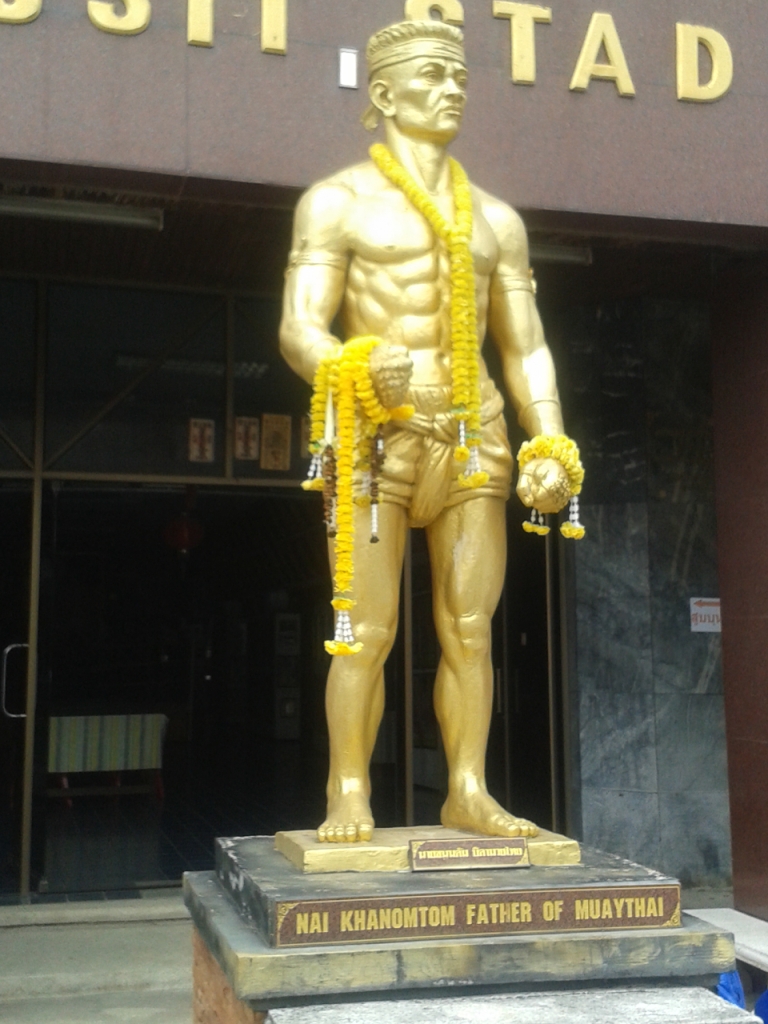
Muay Thai Institute in Rangsit, Thailand

In 1767 the Ayutthaya Kingdom of Siam fell to the Burmese. Burma occupied Siam only briefly because Burma’s king, King Hsinbyushin (a.k.a. King Mangra), was forced to withdraw his troops to combat a Chinese invasion to his homeland. The Thais were fabled to be valiant fighters and even had a numeric advantage, but they were easily put into disarray by Burmese forces. Even King Mangra was said to have declared that he couldn’t have taken Ayutthaya had the leadership of the opposition been more effective. [Keep in mind that even if he did say this, it might have been more a dig at his Thai counterpart than an expression of his true feelings.]

The Burmese captured a many prisoners during their Thai campaign and true warriors were particularly coveted as prisoners. One such fighter was Nai Khanomtom (fyi: it’s also written Nai Khanom Tom.) Nai Khonomtom was renowned for his skill in Muay Boran, an early Thai fighting style related to Muay Thai. This made him a logical choice to headline for the Thais in a tournament that would pit Muay Boran against Thiang–i.e. the indigenous martial arts of Burma (e.g. Lethwei and Bando.) The tournament would be part of King Mangra’s seven day festival in honor of Buddhist relics, the festivities of which would also include plays, comedians, and sword fights.

Nai Khanomtom was pitted against a Burmese champion, a man who was clearly the audience favorite. Timed rounds didn’t exist in those days. Fights stopped when one of the fighters was physically unable to continue, and not before. The Burmese fighter wore a kind of sarong that was the usual attire for the men of Burma, and Nai Khanomtom wore a loin cloth tied up in the traditional Thai style (see the statue pic above.) Each fighter wrapped only ropes on their forearms and hands, and each may have had some padding over the groin–though not as insurance against an accident, but because crotch kicks were fair game.

Nai Khanomtom began with a Wai Kru, which perplexed the Burmese. Wai Kru is a pre-fight ritual that has several purposes, the most important of which is to show respect for one’s teachers, deities, and the audience. The practice can take several minutes and some variants of it can be physically demanding.

When the fight started, Nai Khanomtom charged over the fight space taking the fight to his opponent and laying down a barrage of kicks, knees, elbows, and punches. By some accounts, his victory was declared invalid by a judge, who’d been distracted by other festival events (and who–no doubt–wasn’t pleased by the swift defeat of the Burmese champion.) The decision was made despite the fact that the Burmese fighter had been knocked unconscious.

The King was thrilled by the fight and offered Nai Khanomtom his freedom if he could fight nine more Burmese fighters. Nai Khanomtom didn’t get breaks between these fights, and as soon as an opponent went down the next was queued up to come after the Thai fighter. And so it was that Nai Khanomtom took on the Burmese fighters in an ironman fashion. The last of his opponents was a famous martial arts master teacher from Rakhine, a coastal region in Burma’s southwest. Nai Khanomtom went after the Rakhine master with flurry of kicks. It’s worth noting that in those days Burmese fighters were said to have relied much more heavily on hand strikes than kicks, and so the kicks may have given Nai Khanomtom a range advantage while presenting his opponent with attacks that the Burmese fighter was less practiced at defeating.

At the fight’s end, King Mangra honored his agreement, and Nai Khanomtom was granted his freedom and provided safe-conduct back to Siam. There are varying accounts that say that Nai Khonomtom returned home with either two Burmese wives or a number of his fellow prisoners as an additional payment for providing a spectacle that the Burmese king found gripping. In these accounts, Nai Khanomtom is usually said to have turned down a cash payment.

There’s a quote that’s often attributed to King Mangra that goes, “Every part of the Thai is blessed with venom, even with his bare hands he can fell ten opponents.” [FYI-It should be noted that seeing the same words quoted by several sources isn’t proof of truth, because the quotes could have a common (and false) point of origin.  So take it all with a grain of salt.]

[Note: The details of this story vary. So you may hear–or have heard–a slightly different version of events. The exact details are likely lost to history and–when that happens–embellishment may creep in. That said, the variations that I’ve heard are neither great nor particularly significant. It’s also worth noting that these events are celebrated in Thailand every March 17th on what is called Boxer’s Day or National Muay Boran Day.]

The 4% Rule, Yerkes-Dodson, and Finding the Sweet Spot in Martial Arts Training

I was watching one of Michio Kaku’s Big Think videos recently that addressed American science education. The question of interest was how America continues to do so well in science and technology given that the American (primary and secondary) educational system isn’t up to par in science and mathematics with its technological competitors. The bulk of his talk (re: the H-1B visa and importation of brain power) isn’t germane to this post. It’s Kaku’s mention of a second secret weapon that caught my attention, and that’s how America is able to do a better job than many of its competitors in identifying and nurturing top talent. While math and science education is better in many Asian countries, those countries (e.g. Japan, Korea, or China) don’t excel at skimming off the cream of the crop. Dr. Kaku explains that this is because Confucian values teach students to conform, and students are loathe to stand out–even for exceptional performance. Even if a student wanted to show their talent in hopes of having it fostered, the large classes, lecture-centric teaching, and testing of memorization and standardized processes doesn’t offer much opportunity to grow one’s individual strengths.


Kaku’s statement resonated with me because I’ve been thinking about the pros and cons of traditional approaches to martial arts instruction. I’m particularly interested in the gulf between the traditional approach and what martial arts teaching would look like if one took advantage of the wealth of scientific knowledge about mind and body development. Most of the martial arts instruction I’ve received over the years is consistent with Confucian thinking. All the students are doing the same practice (or faking it to the best of each’s abilities if it’s beyond one’s current capacities), and each is trying to closely emulate the teacher-presented ideal as much as possible. There’s not much consideration of the individual student’s weaknesses or strengths. Emphasis is on trying to convey as high-fidelity a replica of the techniques that have been handed down through the ages. (While this may be a laudable goal, I’ll later offer explanations as to why I think it’s both death for retention of students and ultimately counterproductive.)


Let me first say that there are a number of advantages to the traditional approach to martial arts instruction. First, it’s easy to teach many students at once. This was probably a huge advantage when there were armies of men having to learn these skills. Second, [theoretically] it helps students reduce their egotism through discipline and conformity. The highly hierarchical nature of this approach means students spend years in a lowly position, with the hope that some humility may stick. (NOTE: I’m not certain that this works out in practice.) Third, it creates a disciplined learning environment that is conducive to helping a student keep his or her head in the game.


What the traditional approach isn’t so good at is producing students who all perform at the best of their abilities. I suspect that the traditional approach doesn’t do so well for student retention either. It’s a system in which new students are forced to drink through the fire-hose; while students who’ve been around for a while often feel like they’re stagnating.  As I’ll get to below, there’s good reason to believe that a proper match between the challenge of a task and the performer’s skill level is critical to creating an intrinsically rewarding activity and to helping students perform at their best.


My thoughts on this topic have been heavily influenced by learning and teaching yoga. While one’s vision of a yoga class may be rows of students doing the exact same posture (and huge classes and / or poor instructors may result in that condition),  but there’s often a degree of variation in a class. This variation results from two concepts that I’ve been thinking about quite a bit lately, namely modifications and capacity building.


Modifications are a two-way street. If the task at hand is beyond the student’s current abilities, he or she may be given an easier variant that allows him or her to work toward the fundamental form. On the other hand, if the task of the moment is old hat, a student might be offered a more challenging version on occasion. I’m not suggesting that one shouldn’t drill the basics throughout one’s martial arts career. Repetition of fundamentals is key to drilling them down into one’s nervous system. However, the brain loves novelty and hates drudgery, and it will become harder and harder to remain engaged if the overall challenge level doesn’t rise. The science suggests that one needs to keep upping one’s game if one wants to perform at one’s best.


The nature of modifications in martial arts may not seem as clear as it is with respect to yoga postures. For randori, sparring, and other free-form training, it’s easy to envision how one can adapt the practice to reduce or increase the challenge to a level more apropos of the student’s skill level. One can practice a restricted form. For example, one may work only on sparring with boxing rules to kicks or grappling out of the equation until a student builds up his or her confidence and abilities with recognizing and responding to punches. Alternatively, an advanced student might be presented with armed or multiple attackers. There are some practices, such as specific techniques, for which modifications may not be an option, but that doesn’t necessarily let a teacher off the hook for helping a student who’s challenged by the technique. That may be where capacity building exercises come into play.


Capacity building goes beyond offering an easier modification to suggesting exercises to help the student build the physical capacity to do the technique repetitively WITHOUT INJURY. I emphasized those last two words for a reason. In some martial arts, the need for capacity building exercises maybe clear because of the acrobatic insanity involved. However, practitioners of more pragmatic martial arts may say, “We don’t do all those fancy spinning back kicks, so we don’t need capacity building. Anybody can do our techniques because they’re simple and direct.” Maybe that’s true, but if multiple members of your school have the same (or similar) repetitive stress injuries, it’s not true at all.


What kind of capacity building are we talking about?  If the technique involves jumping or leaping and the individual is gravitationally-challenged, then plyometrics might be the prescription. On the other hand, if the problem is the inability of the student’s joints to withstand the technique, there might be need for exercises that build up stabilizing muscles, help him / her to cut weight, or both. If a student can’t do a throw without risk of injury, maybe that individual needs to spend time practicing with elastic bands or inner tubes or working on their balance.


RiseOfSupermanWhat is this 4% rule? I read about it in Steven Kotler’s The Rise of Superman. As background, there’s a state of mind called “Flow” that’s associated with performing at one’s best. In this state of mind, which some call “the zone” and others probably once called satori or samadhi, one’s concentration on the task at hand is at its greatest, unnecessary features like sense of time and sense of self fall away, one’s inner critic shuts the hell up, and–at least afterwards–there’s a blissful state. Flow can be described as the shutting down of specific elements of the pre-frontal cortex (PFC)–largely involved with the consciousness mind. It can also be defined neuro-chemically by the hormones released (i.e. Serotonin, Endorphins, Dopamine, Anandamide, and Norepinephrine) and neuro-electrically in terms of one’s brainwaves (around 8 Hz.)


There are conditions that favor achievement of Flow, notably: 1.) clear goals, 2.) immediate feedback, and 3.) a good match between the level of the challenge and the level of one’s skill. Flow is a key factor in why some activities are intrinsically rewarding (whether or not they are rewarding in other ways) and why almost any activity can be intrinsically rewarding if it’s sufficiently challenging relative to one’s abilities. What’s sufficiently challenging? That’s where 4% comes into the picture. While it’s by no means an exact or universal value, it turns out that when a task presents a challenge that is roughly 4% above one’s present skill-level is when this state of mind is most accessible. This is why one may see students drop out if they find the level of challenge stagnant. On the other hand, one may not keep new students either if the challenge is constantly beyond their abilities.


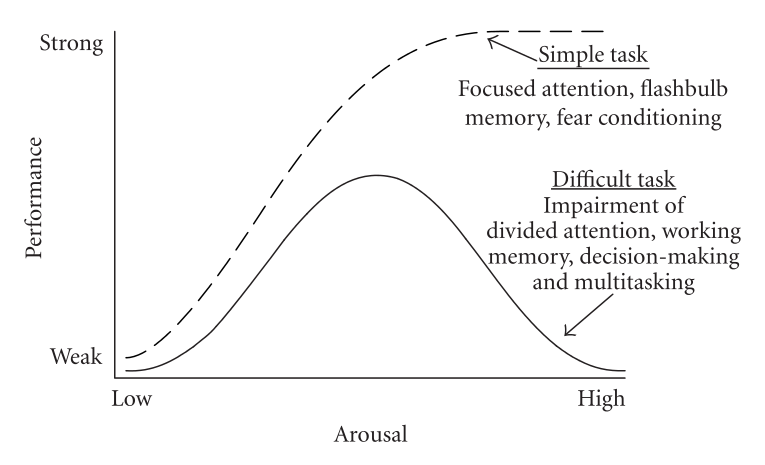
How about that Yerkes-Dodson? The two early 20th century scientists for whom the Yerkes-Dodson Law are named discovered that performance increases with arousal (one might do best to think of this as anxiety level rather than the colloquial use of that word) up to a certain point, beyond which performance either levels off or plummets–depending upon the nature of the objective.  The point is that keeping the training environment too sterile has it’s disadvantages. In free-form practices like sparring, a little nerves can be a good thing, but being overwhelmed can be detrimental.

Yerkes-Dodson Curves. Source: Wikipedia

Yerkes-Dodson Curves. Source: Wikipedia

Adjusting one’s instruction to the abilities of one’s students is challenging. Traditionalists may hold that it’s far more important to keep the tradition intact than it is to cater to the individual needs of students.  That is, said teachers may prefer to focus on the aforementioned high-fidelity transmission of the teachings of the lineage. There was a time during which I probably would have echoed that sentiment. However, it increasingly occurs to me that producing the best and most engaged students is the best way to keep a tradition alive.

2015 Martial Arts Movies, Revisited

As promised, I’m updating this post at mid-year because in January there’s a lot of uncertainty about what movies will actually come out and when. If you’re comparing notes, my original 2015 Martial Arts Movies post was here.


Wild Card (January 30 in US): This may be a cheat given what I said above. However, it’s a Jason Statham film, and like the “Transporter” films it probably doesn’t amount too much without the ass-kickery. Let’s face it, you’re not going to see Jason Statham for his extensive acting range.


Dragon Blade (February 19 in China, March for India, September for US): Featuring Jackie Chan, John Cusack, and Adrien Brody. This is a period piece, and–as you can tell from the casting–is big budget as martial arts flicks go.


Wolf Warrior (April 2) [China]: This looks like more of a shoot-em-up action film than a martial arts film, but some have listed it as a martial arts film and the close quarters action is definitely reminiscent of a martial arts film.


Skin Trade (April 23, direct to DVD): This film stars Tony Jaa and Dolph Lundgren as the good guys and Ron Perlman as the villain. As the title suggests, it’s set around a theme of human trafficking.


Kung Fu Killer (April 24 in theaters, July 21 on DVD): A Donnie Yen action flick in which Yen is in prison.


Pound of Flesh: (May 15 limited theater, June 23 to DVD, etc.): Jean-Claude Van Damme. The blurb says: “A man’s heroic attempt to help a woman in distress ends up with him waking up the next day without a kidney and plotting his revenge.”


Redeemer (June 12 in theaters, August 31 to DVD): A hit-man goes good. This is a 2014 movie that’s receiving an expanded international release.


SPL (Sha Po Lang) II / A Time for Consequences / SPL2: Rise of Wong Po (June 18): This Hong Kong film will feature Thai superstar Tony Jaa. (Like Donnie Yen, this guy is in everything. I don’t know whether they’re cloning these guys or what. Maybe they just don’t need to sleep, eat, or poop like the rest of us.)


The Monk Comes Down the Mountain (July 3): This movie is based on a popular Chinese novel entitled Dao Shi Xia Shan (A Monk Comes Down the Mountain) and is a comedic kung fu flick.


Underdog Kids (July 7, straight to DVD / online): Looks like The Karate Kid but with a lower budget but more [karate] kids. Here is the trailer:


The Boy and the Beast (July 11) [Japan]: This is an animated film, but martial arts is a prominent and necessary feature of the movie. (I believe I included one of the Kung fu Panda movies in one of my past posts, so I think this is fair game.)


Brothers (July 31) [India, in Hindi]: An Indian remake of the American film Warriors. In the American movie, two estranged brothers must fight each other in an MMA bout. (Hence the name of the Indian version, Brothers.)


The Martial Arts Kid (August 21): As the unimaginative title (a generic knock-off of the alliterative “Karate Kid”?) suggests, this is a low budget work, and the acting–if the trailer is any indication–is atrocious. It features competition martial artists-turned actors Don Wilson and Cynthia Rothrock.


Crouching Tiger, Hidden Dragon: The Green Legend (August 28): Interestingly, this sequel to an immensely popular film will be released on Netflix and IMAX simultaneously. If this were some risky, low-budget film, going straight to Netflix wouldn’t be at all surprising, but this is the sequel to the highest grossing foreign language film in America.


The Transporter: Refueled (September 4): Another “Transporter” film, but Ed Skrein plays the role of Frank Martin in this one. As with “Wild Card” it may be a cheat to include it as a martial arts film, but car chases and shoot-outs don’t get these movies all the way to watchability.


Skiptrace (December 24): This is a martial arts comedy featuring Jackie Chan and Johnny Knoxville as buddies on the lam.


Movies with unspecified release dates:


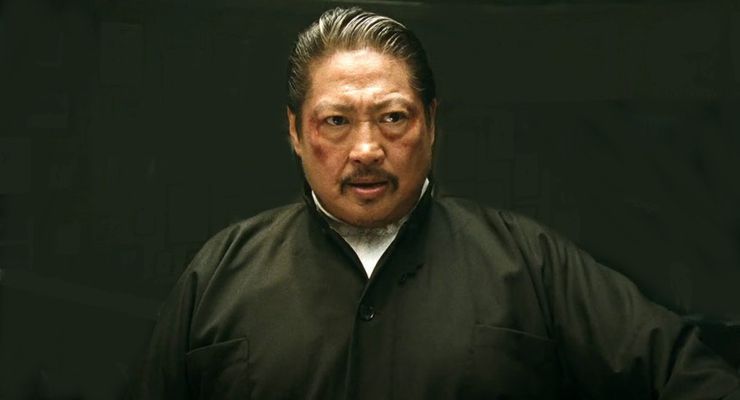
The Bodyguard (undesignated release) [China]: Featuring and directed by Sammo Hung. The lack of trailer makes me not optimistic for a 2015 release, but who knows…
sammo-hung-740x400


The Chemist: A grain of salt on the 2015 release. This is an “assasin-who-can’t-bear-to-kill-his-victim-and-ends-up-protecting-her-instead” film. It’s been in post-production for a while.


Iceman 2 (in post-production): This Donnie Yen sequel doesn’t have a set release date and I expect a 2016 release, but it’s still listed as a winter 2015 film. It’s a Kung fu Encino Man. I haven’t seen any publicity, but the plot blurb is: The imperial guard and his three traitorous childhood friends ordered to hunt him down get accidentally buried and kept frozen in time. 400 years later pass and they are defrosted continuing the battle they left behind


Close Range (in post-production): A guy is looking for a girl. It looks like a low budget Taken, but the fight scenes may be better.


Unlikely 2015 Releases:


White Tiger: Another film with Don “the Dragon” Wilson and Cynthia Rothrock.


A Man Will Rise: A Tony Jaa and Dolf Lundgren film with a “delayed” release status.


Black Salt: (in post-production): The blurb is: With time winding down towards world-ending devastation, the fate of mankind rests in the hands of Interpol agent Samuel Tharpe.

The Jujutsu Murders, Plus Some Brain Science

Jujutsu

Imagine you’re a detective in Edo Period Japan (1603-1868), and you’re told to investigate a case in which three highly-trained practitioners of one of the most well-respected jujutsu schools have been stabbed to death. Each of the three bodies has only one mark on it–the lethal stab wound. The wound is on the right side of the abdomen in all three cases. There are no signs of a prolonged struggle, despite the fact that each of the three had many years of training and none of the men was an easy victim. The stabbings happened independently, and there were no witnesses to any of the killings. So, who or what killed these three experts in jujutsu?


Nobody knows who killed them, but a rigid approach to training contributed to what killed them. As you may have guessed, the killer took advantage of knowledge of the school’s techniques, i.e. their “go-to” defense / counter-attack for a given attack. It’s believed that the attacker held his scabbard overhead in his right hand, and his weapon point forward in a subdued manner in his left. All three of the defenders must have instinctively responded to the feigned downward attack as the killer stabbed upward from below with the unseen blade.


It’s a true story. I read this account first in Jeffrey Mann’s When Buddhists Attack. That book offers insight into the question of what drew some of the world’s deadliest warriors (specifically, Japan’s samurai) to one of the world’s most pacifistic religions (i.e. Buddhism–specifically Zen Buddhism.)  Mann cites Trevor Leggett’s Zen and the Ways as the source of the story, and Leggett’s account is slightly more detailed.


This story intrigues because it turns the usual cautionary tale on its head. Normally, the moral of the story would be: “drill, drill, drill…”


Allow me to drop some brain science. First, there’s no time for the conscious mind to react to a surprise attack. The conscious mind may later believe it was instrumental, but that’s because it put together what happened after the fact and was ignorant of the subconscious actors involved. (If you’re interested in the science of the conscious mind’s stealing credit ex post facto [like a thieving co-worker], I refer you to David Eagleman’s Incognito.)  Second, our evolutionary hardwired response to surprise is extremely swift, but lacks the sophistication to deal with something as challenging as a premeditated attack by a scheming human. Our “fight or flight” mechanism (more properly, the “freeze, flight, fight, or fright” mechanism) can be outsmarted because it was designed to help us survive encounters with predatory animals who were themselves operating at an instinctual level. (If you’re interested in the science of how our fearful reactions sometimes lead us astray when we have to deal with more complex modern-day threats, I refer you to Jeff Wise’s Extreme Fear. Incidentally, if you’re like, “Dude, I don’t have time to read all these books about science and the martial arts, I just need one book on science as it pertains to martial arts,” I just so happen to be writing said book… but you’ll have to wait for it.)


So where do the two points of the preceding paragraph leave one?  They leave one with the traditional advice to train responses to a range of attacks into one’s body through intense repetition. Drill defenses and attacks over and over again until the action is habitual. This is what most martial artists spend most of their training effort doing. A martial art gives one a set of pre-established attacks or defenses, and it facilitates drilling them into one’s nervous system.


Of course, the astute reader will point out that the three jujutsu practitioners who were killed had done just what was suggested in the preceding paragraph, and not only didn’t it help them but–arguably–it got them killed. I should first point out that the story of the three murder victims shouldn’t be taken as a warning against drilling the fundamentals. As far as their training went, it served them well.  However, there’s a benefit to going beyond the kata approach to martial arts. One would like to be able to achieve a state of mind that once would have been called Zen mind, but–in keeping with our theme of modern science–we’ll call transient hypo-frontality, or just “the flow.” This state of mind is associated with heightened creativity at the speed of instinct. (If you’re interested in the science of how extreme athletes have used the flow to make great breakthroughs in their sports, I’d highly recommend Steven Kotler’s The Rise of Superman.) Practicing kata won’t help you in this domain, but I believe randori (free-form or sparring practice) can–if the approach is right.

Blinders (Literal and Figurative) in the Martial Arts

IMG_2553Many years ago I was training at a dōjō that had a practitioner who was a teacher for the blind. He requested that we put together a self-defense workshop for his students.  (If you’re wondering what kind of evil jackass would attack a blind person, rest assured that—sadly–such a level of jackassitude exists in the world.) The request presented an intriguing challenge. How does one adapt techniques that are premised on being able to see what the opponent is doing? Or maybe one shouldn’t adapt existing techniques but rather start from square one?


In preparation for working up a lesson plan, the person that asked for the workshop briefed the black belts. We learned that very few of the blind students lived in complete darkness. Instead, they displayed a wide range of different visual impairments. He even brought a large bag of goggles that simulated various impairments so that we could train in them to better understand what would or wouldn’t work with different types of impairment.


There were goggles that had funnels over the eyes such that one could see two little circles clearly while the rest of the world was black. There were others that had a complete field of view, but had translucent tape over the lenses so that everything was reduced to fuzzy blobs—as if one were looking through Vaseline. There were lenses that had a crackle effect such that one could only see veins of area clearly. There were goggles with no peripheral vision, and ones with only peripheral vision. He also had some goggles that blacked out the world entirely. Completely blind individuals may not be as common as one would think, but they certainly exist. Putting on any of the goggles was disorienting at first. A couple of the black belts even got vertigo or nausea when they moved around too quickly.


Now imagine what it would be like if one had always had the goggles on, that it was the only worldview one had ever known. Furthermore, imagine that everyone you interacted with on a daily basis all wore the same variety of goggles. You wouldn’t see it as an affliction or a limitation. To you, your view of the world would be full and complete. You would engage in behaviors that might seem odd to an outsider with unobstructed vision (e.g. sweeping your hands around in big arcs, turning your head at unusual angles, or calling out into the “darkness”), but these behaviors wouldn’t seem odd to you because you’d know it as natural behavior for someone who experienced the world as you did.  Because everyone you dealt with would see the world in the same way, it wouldn’t occur to you to think about whether there was another way to behave.


The preceding paragraph serves as an analogy for culture. One’s own culture is often invisible, especially if you don’t get outside of it much. All the people around you confirm your belief that you’re seeing the world as it is and behaving in the only natural and normal way imaginable. Sure, you may notice other people’s cultures—their skewed worldviews and the anomalous behaviors that result– but that’s because they do “strange things.” Still, some individuals will maintain that their culture doesn’t display any of the “odd” ways of behaving that more “exotic” cultures do.


But it does. Every culture is a mix of the good, the bad, and the ugly of how a people goes about living in the world given their cultural blind spots and skews. It includes collective coping mechanism for dealing with fears of uncertainty, and those are often the ugly side of culture. They encourage ingroup / outgroup separation, as well as primitive and superstitious approaches to dealing with those events, people, and behaviors that are out of the ordinary.


It’s easy to display double standards when one is blind to culture. I will give an example from my own life. It’s only been since I’ve been living in India (and traveling in Asia) that I’ve become aware of how many people are upset by Westerner’s secularization of Eastern religious / spiritual symbols and imagery. That’s a mouthful; so let me explain what I mean by “secularization of Eastern symbols and imagery.” I’m talking about “OM” T-shirts / pendants, bronze Buddhas, Tibetan thanka paintings, mandalas  (on T-shirts or posters), miniature shrines, or tattoos that are purchased because they are trendy, aesthetically pleasing, or vaguely conceptually pleasing without any real understanding of the tradition from which they came or intention of honoring it.


Granted it’s easy to miss the above issue if you’re a tourist because: a.) Many of said Eastern traditions practice a live-and-let-live lifestyle that make their practitioners unlikely to be confrontational about such things (in contrast to  practitioners of Abrahamic traditions (i.e. Judaism, Christianity, or Islam.)) b.) There are merchants in every country who are willing to sell anything to anybody for a buck, and so there are vast markets for tourists that offer up these symbols and images in droves.


It still intrigues me that it once caught me off guard that there were Hindus, Buddhists, Jains, etc. who were dismayed by the secularization of their traditions. I’m agnostic, but I was raised in a Christian household. Therefore, I can imagine the animosity aroused by the following conversation.


A: [Wearing a simple crucifix [or Star of David or crescent & star] pendant on a chain.]

B: Hey, A, I didn’t know you were Christian [or Jewish or Muslim]?

A: Because I’m not.

B: But you’re wearing a crucifix [or other Abrahamic symbol] pendant?

A: Oh, yeah, that. That doesn’t mean anything. It just looks cool. It’s kind of like the Nike swoosh.

B: [Jaw slackens.]


Now replace the crucifix with an “OM” shirt, and an inquiry about whether “A” is Hindu. Does it feel the same? If it doesn’t, why shouldn’t it?


Every martial art represents a subculture embedded in the culture of the place from which it came.  [Sometimes this becomes a mélange, as when a Japanese martial art is practiced in America. In such cases the dōjō usually reflects elements of Japanese culture (e.g. ritualized and formal practice), elements of American culture (e.g. 40+ belt ranks so that students can get a new rank at least once a year so they don’t quit), and elements of the martial art’s culture (e.g. harder or softer approaches to engaging the opponent.)]


The way that culture plays into a country’s martial arts may not become clear until one has practiced the martial arts of different countries—particularly in their nation of origin. While my own experience is limited, I have practiced Japanese kobudō in America (and extremely briefly in Japan), Muaythai in Thailand, and Kalaripayattu in India. I’ll leave Muaythai out of the discussion for the time being because I can most easily make my point by contrasting Japanese and Indian martial arts.  The Japanese and Indian martial arts I’ve practiced each reflects the nature of its respective culture, and they couldn’t be more different.


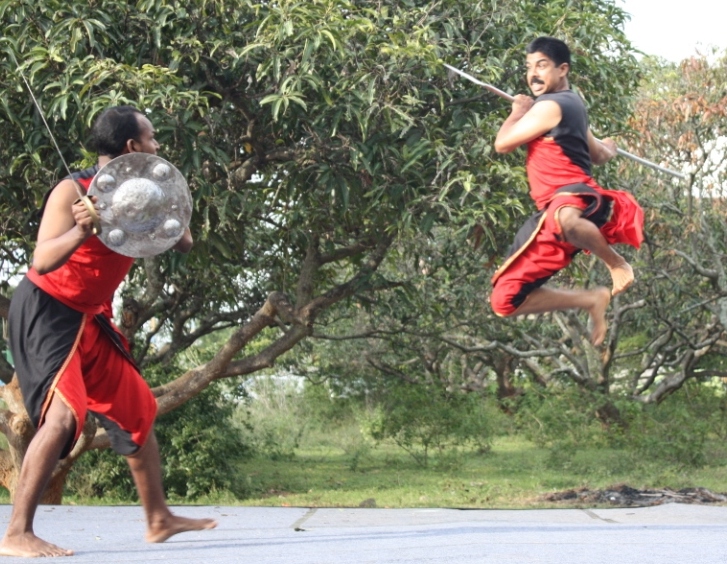
IMG_4525What are the differences between the Japanese and Indian martial arts I’ve studied? I’ve been known to answer that by saying that the Japanese martial art rarely uses kicks above waist level, while in Kalaripayattu if you’re only kicking at the height of your opponent’s head you’ll be urged to get your kick up a couple of feet higher.  What does that mean? The Japanese are expert at stripping out the needless and they work by paring away excess rather than building difficulty. The impulse of the Japanese is to avoid being showy. KISS (Keep It Simple, Stupid) appeals to the Japanese mind. (Except for the “Stupid” part, which would be considered needlessly confrontational and gratuitously mean-spirited.) There’s a reason why Japanese martial arts don’t feature prominently in global martial arts cinema. They don’t wow with their physicality; efficiency is at the fore.


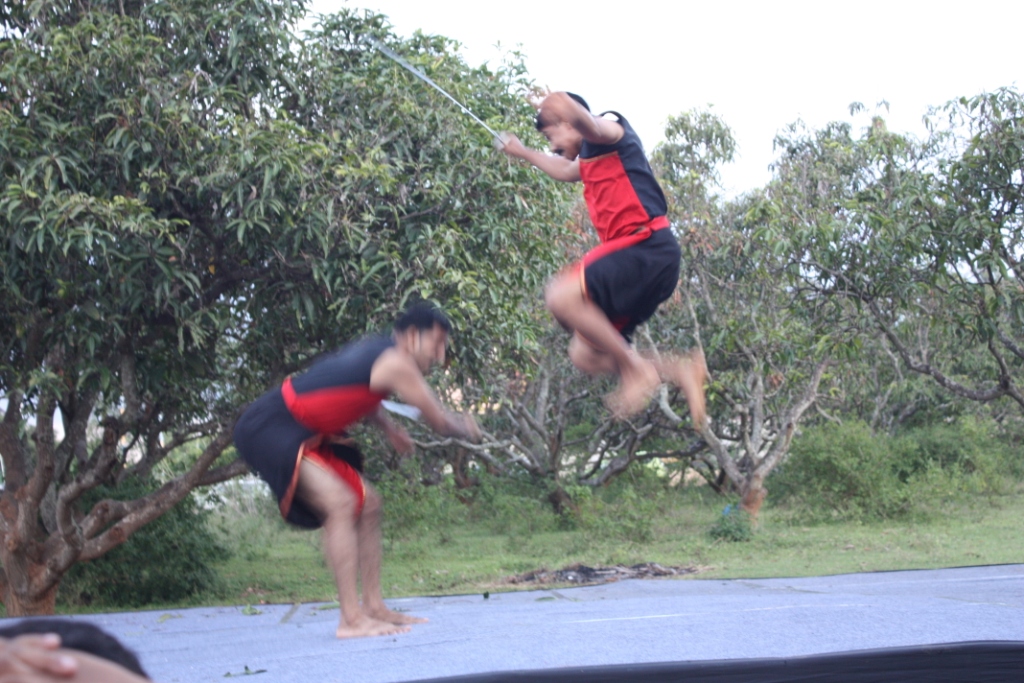
IMG_2246On the other hand, Indians are a vastly more flamboyant bunch, and Kalaripayattu is extremely impressive to watch and in terms of the physicality required to perform the techniques.  The Indian art isn’t about simplifying or cutting away the unnecessary. One has to get in progressively better shape as one advances to be able to perform techniques that require one leap higher, move faster, and be stronger. The Indian art isn’t about paring away excess, it’s about making such an impressive physical display that the opponent wonders whether one is just a man, or whether one might not be part bird or lion.


It might sound like I’m saying that the Japanese martial art is more realistic than the Indian one. Not really. Each of them is unrealistic in its own way. It’s often pointed out that the Japanese trained left-handedness out of their swordsmen, but that’s only one way in which Japanese martial arts counter individuation.  Given what we see in terms of how “southpaws” are often more successful in boxing, MMA, and street fighting, eliminating left-handedness seems like an unsound tactic at the individual level. There are undoubtedly many practitioners of traditional Japanese martial arts who can dominate most opponents who fight in an orthodox manner, but who would be thrown into complete disarray by an attacker who used chaotic heathen tactics. Consider that the only thing that kept the Japanese from being routed (and ruled) by the Mongolians was two fortuitous monsoons. The samurai were tremendously skilled as individual combatants, but the Mongolians could—literally—ride circles around them in warfare between armies. Perhaps, a more relevant question is whether Miyamoto Musashi would have defeated Sasaki Kojirō if the former had followed all the formal protocols of Japanese dueling instead of showing up late, carving his bokken from a boat oar, and generally presenting a f*@# you attitude. Who knows? But as the story is generally told, Musashi’s disrespectful and unorthodox behavior threw Sasaki off his game, and it was by no means a given that Musashi would win. Some believed Sasaki to be the more technically proficient swordsman.


All martial arts are models of combative activity apropos to the needs of a particular time, place, culture, and use.  And—as I used to frequently hear in academia—all models are wrong, though many are useful. (Sometimes, it’s written: “All models are lies, but many are useful.”)


[FYI: to the readers who say, “The martial art I practice is completely realistic.” My reply: “You must go through a lot of body-bags. Good for you? I guess?”]

6 Science Books That Martial Artists Should Read

When one has a passion for an activity,  it’s easy to get tunnel vision and miss out on the many avenues of information by which one might improve oneself.  I’ve done many posts on martial arts books, but I thought it might be useful to do one about books that aren’t about martial arts per se, but which have none-the-less contributed to my thinking as a martial artist.


1.) On Killing: The Psychological Cost of Learning to Kill in War and Society by LTC Dave Grossman
OnKillingWhat it’s about? Psychologically, it’s a lot harder to kill another human being than one might think. Even when one is a combatant in a just war, the reluctance to kill–even one’s sworn enemy–is intense. Grossman examines the roots of this reluctance, what methods have been employed to get soldiers over it, and what the cost of doing so is.

The book also goes into a topic one might find surprising: video games. Not to give too much away, but military researchers discovered that getting infantrymen to kill required conditioning them to shoot targets that look human. This resulted in moving from bulls-eye targets to silhouettes, pictures of humans, and even Firearms Training Simulators (i.e. FATS, systems that run shoot / no-shoot scenarios on a screen, like an interactive movie.) It turns out that shoot-em-up video games may contribute to a child’s conditioning to be willing to shoot another human being.

Why it’s a good read for martial artists? Martial arts vary radically in realism and relevance to combative situations, but it’s easy for students of the martial arts–even martial arts that seem “hardcore” and self-defense oriented–to have unrealistic notions about the realities of combat. As François de La Rodefoucauld said, “One cannot answer for his courage when he has never been in danger.” By reading this book one might, perhaps, begin to rethink one’s assumptions, and change how one prepares to defend oneself and others.

Further reading on related topics:  I’ve heard good things about the works of Rory Miller–particularly Facing Violence and Meditations on Violence, but I haven’t gotten around to reading his books yet. If you have, please feel free to comment with your thoughts.


2.) The Rise of Superman: Decoding the Science of Ultimate Human Performance by Steven Kotler
RiseOfSupermanWhat it’s about? Kotler examines a state of mind that is widely call “flow,” and how extreme athletes are tapping into flow to achieve unprecedented advances in performance. There are a number of ways by which this state of mind can be defined, e.g. neurochemically (i.e. a neuro-cocktail of serotonin, anandamide, endorphins, dopamine, and norepinephrine), neuroanatomically (transient hypofrontality), neuroelectrically (high theta / low alpha wave–i.e. between meditation and resting wakefulness), or psychologically (intense concentration on a challenge that’s just beyond one’s present skill level.)

Kotler proposes that risk is an important trigger for entering a deep state of flow, and that this is why extreme athletes are proving so much better at achieving these states (and translating them into radically increased performance) than many other groups who seek to master flow.

Why it’s a good read for martial artists? It should be noted that not only is flow not a newly discovered state of mind, but it sounds a lot like the state of mind that martial artists have sought for centuries in the practice of their arts–often in conjunction with disciplines such as Zen or Vajrayana Buddhism. What is new, which makes this book worth reading, is an understanding of the science behind flow states. By moving beyond the hazy mix of truth and falsehood embodied in systems of spirituality, one may be able to find a way to more reliably increase one’s performance.

Further reading on related topics:  Flow in Sports: The Keys to Optimal Experiences and Performances is a book that is co-authored by the granddaddy of flow research Dr. Mihaly Csikszentmihalyi.


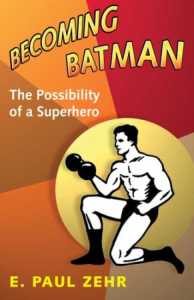
3.) Becoming Batman: The Possibility of a Superhero by E. Paul Zehr
Becomingbatman

What it’s about? (Arguably, this is a martial arts book, but I’m including it because one wouldn’t get that from the title or blurb.) This book’s central question is whether a real life person could achieve the level of crime-fighting bad-assery that is the Batman, and–if so–what combination of genetics, training, and conditioning would be required. It also addresses what would be the cost in terms of wear and tear on one’s body and how long one could be expected to maintain said abilities. (Also, for the martial artists of feminine persuasion, how Batgirl or Catwoman might fair in combat against Batman.)

Why it’s a good read for martial artists?   There is tons of great information relevant to martial artists about the toll of extreme practice and regular fighting on one’s body (e.g. concussions, broken bones, etc.), what the limits of human performance are, by what means those limits are approached, and how realistic it is to have an unreciprocated policy prohibiting lethal weapons.

Further reading on related topics: Actually, if you know of any books on related topics, I’d love to hear about them. There are a number of such books, but they’re on textbook pricing (i.e. insanely expensive.)


4.) Extreme Fear: The Science of Your Mind in Danger by Jeff Wise
ExtremeFear

What it’s about? This book is about the mental and physical effects of mortal peril, and why some people’s performance excels under dire threats while other people just let themselves die while cowering in a fetal ball. The book asks what we can all learn from those people who manage to keep their heads about them when death seems certain.

In the interest of full-disclosure, as of this writing I’ve not completed this book. I just started it and am only in the second chapter. However, so far it’s been both informative and interesting.


Why it’s a good read for martial artists? Much like On Killing, I think this book may be valuable because there are many martial artists with daydream-induced misconceptions about how they will perform in dangerous situations. This book may help one evaluate one’s true state of preparedness, and discover how to go about making changes to improve one’s level of preparedness for a worst-case scenario.

Further reading on related topics:  If you want a scholar’s account, the book Anxious by Joseph E. Ledoux may be more your style. (Wise is a popular science writer.) I see that Ledoux is cited a lot in books I’ve been reading as of late, but I can’t say I’ve read any of his books yet. However,  I know he’s widely regarded as one of the foremost experts on fear. It looks like his book isn’t so much on mortal peril as Wise’s book, and covers all kinds of anxiety and fear.


5.) Faster, Higher, Stronger: How Sports Science is Creating a New Generation of Superathletes–and What We Can Learn from Them by Mark McClusky
FasterHigherStrongerWhat it’s about? The super-long subtitle says it all. It’s about how athletic performance is being improved by bringing scientific methods to the study of sports, and–as the second half of the freakish subtitle suggests–it explains how amateurs can put this information to good use. There are some methods used by elite athletes that aren’t at all suitable to the run-of-the-mill martial artists (e.g. don’t consume mass quantities of baking soda.) However, there are other approaches to nutrition and training that are readily translated to amateurs without much downside.

Why it’s a good read for martial artists? You may or may not think of yourself as an athlete. I can hear some martial artists saying, “I don’t practice a sport, I’m a martial artist. I deal in lethal combat, not games. yada, yada, yada…” Maybe so, but fitness, nutrition, and conditioning matter. If you want to be able to hold your own against more skilled opponents, you need to improve your capabilities and capacities. Fitness matters. If you think technical proficiency will get you through any situation, you haven’t run up against someone who is both technically skilled and highly fit–and when you come up against said person, your disillusionment will be swift.

Further reading on related topics:  As with the Becoming Batman book, most of the books on this subject are textbooks and are outrageously priced. If you know of other books in this vein, I’d love to hear about them.


6.) Buddha’s Brain: The Practical Neuroscience of Happiness, Love, and Wisdom by Rick Hanson et. al.
BuddhaBrainWhat it’s about? This book turns the lens of modern science on the serene, immovable state of mind that martial artists have historically sought out through Buddhist and yogic systems. It discusses how Buddhist practices help people to be more cognitively effective and less prone to emotional manipulation or disturbance.

Why it’s a good read for martial artists?  If one reads the works of warriors–ancient and modern, one will discover that the greatest warriors place a premium on the importance of the mind.

Consider the famous swordsman Miyamoto Musashi. Musashi was exceedingly successful in defeating his enemies by making them angry. He would show up late and behave disrespectfully, and he would make his own mind imperturbable. This allowed him to easily defeat warriors who were considered at least his equal in terms of technique.

Further reading on related topics: There are many books that look at similar questions.  Zen and the Brain is probably a better book in terms of the amount of information / insight provided, but it’s a much more daunting read. I wouldn’t put the latter in the category of “pop science” as much as just “science.”  (Zen and the Brain is also a much older book.)


These are my recommendations, I’d love to hear about yours in the comments section.


3 Levels of Movement Coach

I.) New teachers and coaches often over-rely on their personal experience. In other words, one may think that the skills that came easily for one will be a piece of cake for one’s students as well. Conversely, such a teacher tends to be more sympathetic and lax when it comes to skills that kicked his or her own ass. This may work for some students, but it’ll be way off the mark for others. There’s a risk of pushing students too hard on skills that may be dangerous for them, and / or not helping them achieve a breakthrough that they are capable of because of one’s own baggage.


II.) The next level of coach recognizes that there are different body types. Such teachers put this knowledge to use in determining what skills present greater or lesser risk for a student given the strength, power, speed, flexibility, etc. associated with such a body. This coach will recommend modifications and capacity building exercises based on the student’s body type.


III.) Then there is the coach or teacher who can see the individual idiosyncrasies of a given student’s body and make recommendations based the unique conditions, strengths, and weaknesses of a particular person.

BOOK REVIEW: Becoming Batman by E. Paul Zehr

Becoming Batman: The Possibility of a SuperheroBecoming Batman: The Possibility of a Superhero by E. Paul Zehr

My rating: 5 of 5 stars

Amazon page

[Note: This book is about sport and exercise science, particularly as they pertain to the martial arts. If you’re a martial artist or are interested in fitness and movement arts at the extremes of human capacity, you’re in the right place. If you’re interested in the comics and an overview of topics including how many billions Bruce Wayne needs and what technologies Batman must master, those aren’t questions addressed in this book. Such readers may find the book delving into depths they aren’t interested in on biological science. There are articles on the web that deal with topics like the “Cost of being Batman.”]

Next summer an eagerly awaited movie entitled Batman v Superman: Dawn of Justice hits theaters. Who knows how much screen time will involve the fight between the titular characters, but the same battle has played out a number of times in the comics, and its appeal is clear. What are the limits of human capability given training, technology, and sufficient smarts? Can a man really defeat an alien that’s faster than a bullet and more powerful than a locomotive? A popular fanboy mantra is, “I like Batman, because I could be Batman. Batman has no superpowers.” So, yes, if you were a billionaire, genius, with the physique of a Greek god, and knew 127 martial arts, you too could be Batman. Or could you? That question is at the heart of Zehr’s book.

Becoming Batman is arranged into sixteen chapters divided among five parts. It begins logically with the question of whether Bruce Wayne needs to begin at any particular point to achieve success in transforming himself into Batman? (At the extreme, one probably can’t imagine Bruce Wayne becoming Batman if he was born with one leg a foot longer than the other and with a Quasimodo hump, but given a Bruce who is starting out “average,” what are his limitations.) In other words, how much does genetics come into play. In the first part, Zehr introduces a character, Bob Wayne, who doesn’t appear in the comics. Bob is Bruce’s twin, and is used throughout the book for comparison purposes, i.e. to convey what Bruce Wayne would look like if he didn’t train fanatically to be Batman. The question of how much of Batman is innate and how much is painstaking built by exercise and training is critical to determining how many of those fanboys really could be Batman.

There a series of chapters explaining the mechanism by which stressors result in a stronger, faster, more powerful, and more resilient Batman. The idea is that Mother Nature doesn’t over-engineer. The only way one gets stronger muscles is by overloading them, which triggers a process of rebuilding them bigger and better than before. Wolff’s Law defines the same concept for bones, i.e. bone density increases in response to increased loading. (Incidentally, the same is true of the mind. A more agile mind is achieved only by working it, and zoning out in front of the television results in a dumbening.)

The next section shifts from generic exercise science to questions of Batman’s martial arts training. What kind of martial arts (or arts) would Batman practice? There is an often quoted statement in the comics to the effect that Batman had mastered 127 martial arts. (This is ridiculous, but it does spur the intriguing question of how many systems does Batman need to learn to have a well-rounded skill-base without being a dabbler? Many will say one art—the right one–is enough, others will say that–given the varied cast of villains he must defeat–Batman needs a broader skill-set than any existing art provides.) More to the point, how many hours does one need to practice a technique to ingrain the movements into one (e.g. neurologically it takes repetition to optimize efficiency.) This is among the questions discussed in this book.

The fourth section deals with the ravages of being Batman, and how much any human could be expected to endure. In this section, one will learn about the cumulative toll of concussions, the likelihood of Batman avoiding broken bones and other injuries that would necessarily sideline his crime fighting, and the effect that working the night shift would have. (The latter might seem trivial in comparison to the former two topics, but—in fact—it’s not. It’s well established that night workers have higher incidence of some cancers and other ailments. Furthermore, as Bruce Wayne has to keep appearances up, it means not only fighting circadian rhythm issues, but also frequent sleep deprivation—the hazards of which are even clearer and occur in short order.)

There are a number of interesting topic that aren’t don’t pertain to the core question per se, but which are interesting for fans of the Batman canon and the character’s mythos. Famously, Batman doesn’t use guns or lethal force. This raises the question of how realistic it is to regularly fight hardened knaves and miscreants without killing them. One can only knock out so many of Gotham’s baddies before one doesn’t get up.

There’s a chapter about what a fight between Batman and Batgirl would be like. While strength would definitely be to Batman’s advantage, there are advantages that an equally skilled female fighter might bring to the fight? How would Batgirl (or Catwoman) need to fight to put those advantages to use? Finally, for those of us who are no longer spring chicks, there are chapters about how Batman could expect to age, and how long he could keep performing at a level at which he could defeat his enemies.

I enjoyed this book and found it both educational and interesting. It should be clear that Batman is just a teaching tool used to explore the limitations of the human body and its ability to endure a life of fighting. That said, references to the Batman comic books and movies makes for a readable text. Perhaps what I like most about this book is that most of the books that address these subjects are textbooks that are sold on the textbook pricing model (i.e. we have a limited but captive audience so let’s make them pay top dollar.) This is one of the few books that takes on these topics at the readability and pricing model of a popular science book.

I recommend it for those interested in the science of performance, martial arts, and injury.

View all my reviews

Tsukahara Bokuden Defeats a Braggart

[Note: There are many versions of this story, and these events have even been attributed to other warriors. The tale was likely passed around orally before it was written down myriad times in myriad different ways (most famously in the Kōyō Gunkan.) The details of the story aren’t important; it’s the overall moral of the story and that remains the same from one version to the next.]

Bokuden Boat

Tsukahara Bokuden listened to the braggart nauseating the ferry passengers with graphic details of his “exploits.” Bokuden would have happily ignored the young samurai, but the cocky youth seemed eager to take offense at the lack of interest in his tales of hacking people to bits and was looking for a fight. The other passengers on the boat were all commoners: an elderly man who was probably a craftsman or a small business merchant, and a mother with her young child.

“Do you doubt me? Do you have the audacity to call me a liar,” The young man said, having not received a suitably enthusiastic response to his stories. And he stood, one hand on his scabbard and the other brushing his sword’s hilt.

Tsukahara Bokuden said, “Easy, young man. No one is calling you a liar. These good people are just not used to such bloody stories.”

The young samurai turned to eye Bokuden, who had appeared to be napping in the back earlier. The braggart asked, “And who are you to challenge me?”

“I didn’t challenge you. I merely explained these people’s lack of enthusiasm for your yarns. But if you must know, I am Tsukahara Bokuden,” he replied, hoping his name might give the bragging samurai pause. Bokuden was well-known, having traversed Japan in musha shugyō (sometimes related to the European “knights errantry,”musha shugyō was a time in a samurai’s life–particularly in times of relative peace–when he traveled the land engaging in matches with individuals from other schools to increase his skill and notoriety–i.e. if he didn’t get killed, which was not uncommon, even when the fight was with wooden swords.)

“I’ve never heard of you. What’s your style?” the cocky samurai asked.

“Mine is the School of No-Sword,” replied Bokuden.

“I’ve never heard of that school, but it sounds weak,” the braggart said.

“I assure you, the technique is quite powerful,” Bokuden said.

“Are you suggesting that you could defeat me with this so-called ‘no sword’ technique?” the braggart said, his hand tightening on his scabbard.

“I said nothing of the sort. I would just like to enjoy the remainder of the ferry ride in peace,” said Bokuden.

“Are you scared to have a match to see who’s style is better?” the cocky youth asked.

“Not in the least, but I see no benefit in it either,” Bokuden replied.

“I’ve had enough of your lip, old man, prepare to defend yourself,” said the young samurai.

Bokuden sighed, “If you insist upon a match, let us at least do so where these good people’s lives will not be in peril. Surely you’ll agree that it would do no great honor to the samurai class if we were to injure or kill innocent bystanders.”

At this the braggart just harrumphed, “Who cares, but I’ll take you on wherever you wish.”

Tsukahara Bokuden said to the oarsman, “Sorry to trouble you, but would you mind diverting to drop us on that outcrop so that we can spare these people the swinging blades.”

The oarsman was readily agreeable. He didn’t want two samurai fighting on his ferryboat any more than Bokuden did.

He rowed them to a stony outcrop that jutted up out of the water. The uneven rocky ground wasn’t ideal for a match, but it would spare the other passengers and would provide a challenge.

When the boat’s bow ground up against the rock, the young samurai jumped out, twisting around in air, and landed on the rock. The braggart held his scabbard and hilt at the ready for a swift draw. The young man was eager to do battle, and it was clear that he was annoyed with Tsukahara Bokuden’s slow movement. The older swordsman took out both of his swords and asked one of the passengers to hold the swords. The oarsman and the passengers were surprised by this disarming behavior, but they’d heard him call his school the “school of no-sword.”

Tsukahara Bokuden then moved up to the boat’s bow as if preparing to move ashore.

“Might I borrow your oar, young man?” Bokuden said to the oarsman. The oarsman nodded and handed Bokuden the long oar with two hands, and with his head bowed. The general assumption was that the older samurai wanted to stabilize the boat against the rock so he could pass ashore smoothly.

Taking the oar, Bokuden drove one end into the outcrop, and grabbed the other pushing the boat away from the rock. The boat glided out from the rock in an accelerating fashion.

Lunging toward the water’s edge, the perplexed braggart called out, “What on earth are you doing, old man?”

To which Bokuden replied, “I’m defeating you with the school of no sword.”

By the time the young samurai could remove his swords and tug away his outer garment, Bokuden had rowed out to deep waters and returned the oar to the oarsman.


DAILY PHOTO: In the Clinch


Taken in August of 2014 at the Rangsit International Boxing Stadium

Taken in August of 2014 at the Rangsit International Boxing Stadium

IMG_1434 IMG_1542 IMG_1579