Our 2014 Mysore Dasara Gold Card Experience

IMG_1722A small group of friends, my wife, and I were in Mysore for the last day and a half of Dasara (Vijayadashami) festivities. We purchased the Gold Card tickets in order to have assigned seating to both the Jumboo Savaari Processional and the Torchlight Parade on the last day, as well as for free access to some of Mysore’s tourist attractions. As this proved to be a learning experience, I’ll provide some of our lessons learned so that they might help future visitors.

There is a page providing information about the Gold Cards on the official Mysore Dasara website, as well as relevant information amid the FAQ‘s (Frequently Asked Questions.) However, this left some questions unanswered. While the best way to get such questions answered is probably through the official Enquiries page or a call to the Deputy Commissioner’s office, some of these questions might not occur to one until one is in the thick of things, and the answer that one receives might not be helpful. So this post will be an unofficial, ancillary FAQ.


In 2014, there were two means by which to directly purchase tickets. One could go to the Deputy Commissioner’s Office in Mysore and purchase the tickets for the 7500Rs face value (roughly $122USD) or one could purchase them online through Ticket Genie for face value plus about 650Rs in charges (about $11USD.) (Plus, there may have been more costs associated with payment by credit card and with getting the ticket in hand.)

Question 1: I, like you, am a cheap skate who doesn’t live in Mysore and doesn’t want to pay rupees 650+  in fees, is there a cheaper way to acquire the Gold Cards?

We used Skyway Travel as an expediter and spent well under half of the online fees (i.e. 300Rs.) to get the tickets. Granted we would have incurred a little additional cost if we’d had to have Skyway deliver the tickets, but, as the office was located on a nearby street, there was no further costs. Even if we’d had to have them delivered, it would have remained much cheaper than the online route–especially as it sounds like one would still have such an additional charge with the online approach as well. Furthermore, Skyway gave us a nifty Mysore map and guidebook, both of which came in handy. Lest you think I’m a shill for Skyway, I will say that there may be other companies that would serve as expediters, and some may be cheaper. However, as they will undoubtedly want money up front, I wouldn’t go with a super cheap entity whose reputation is unknown.

Besides the Jumboo Savaari and Torchlight Parades, there’s a list of tourist attractions that the Gold Card holder may have entrance to. This list is on both the website and the pamphlet that you should receive with your Gold Card.

Question 2: Is the list of attractions that comes with the card all-inclusive?

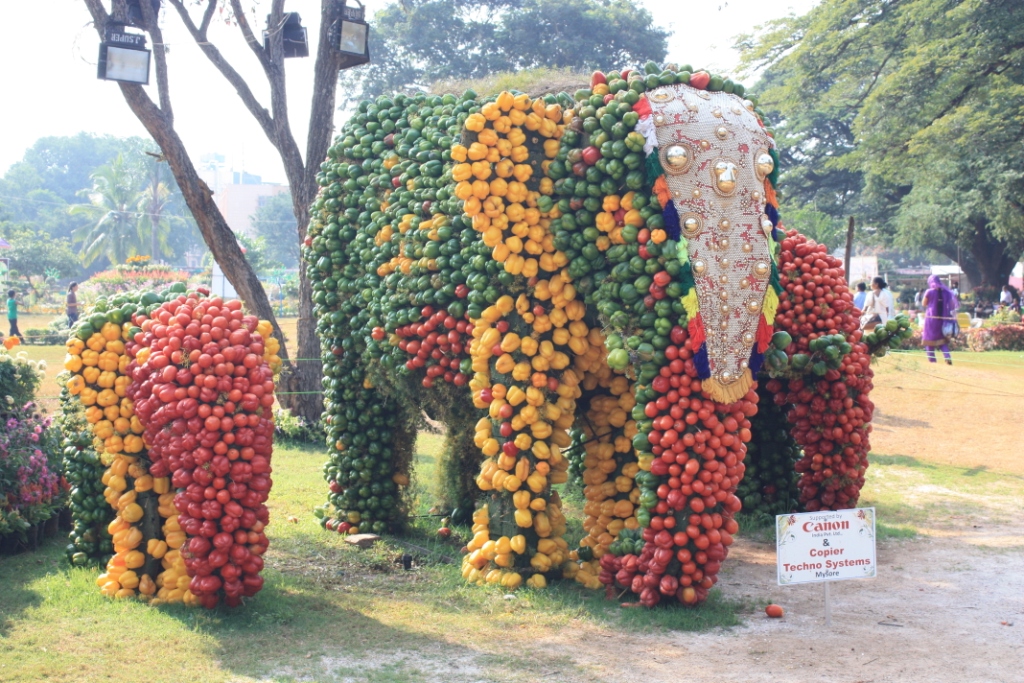
No. We found that our cards got us into a flower show that wasn’t specifically listed on our pamphlet. The actual wording introducing the list is “Free entry into tourist places.” So, in short, it’s worth giving it a try whether the location/event in question is listed or not. There are a lot of events going on just for the days of Dasara that one can learn about on the Mysore Dasara website. Also, please note that one listed attraction may not be available to you and that is the actual Mysore Palace. If you’re just going for the last couple days, the Palace will likely be closed for preparations. Fortunately, we had already seen the Palace and most other major Mysore tourist attractions on previous visits.

Question 3: Many tourist attractions require a separate fee be paid for those who have cameras (at least for cameras that appear to be “professional” to the cashier who usually isn’t a photographer and uses the crude formula: clunky and/or lens sticks out = professional.) Are camera fees included?

Short answer: Yes, or so it would seem. At our first stop, the aforementioned flower show, we were asked to pay the camera fee. We paid it, having no knowledge about whether it was or wasn’t covered. Our second stop was the Zoo, and there we didn’t have to get a ticket for the camera. (We’d been ushered in through a side entrance and really didn’t want to go back to the ticket window. It was more inconvenience than cheapness that had kept us from paying the fee.) At the Zoo, the ticket taker asked for my camera’s ticket, but when we showed our Gold Card, she spoke to her boss and was told to let us through. So the correct answer is that you may be asked to pay the camera fee, but you can probably talk your way out it by waving your Gold Card around.

The brochure and / or the back of the Gold Card itself told us start times for the parade and what number of gate to enter, but this still left questions.

Question 4: What time should I get to the gate for the Jumboo Savaari and Torchlight Parade?

Our brochure said the Jumboo Savaari started at 11am, and the travel agent suggested we should get there plenty early because we might not get in if we waited until 11am. Both pieces of information proved to be incorrect. I can’t really answer Question 4. Are you the type of person for whom having the best possible seats is of the utmost importance? If so you want to get there on the early side. Are you the type of person who sees red if you’re kept sitting around for hours while you twiddle your thumbs? If so, plan on showing up late.

What I can tell you is the actual timeline of happenings. It was 10:30 when they began checking tickets and letting Gold Card holders in through the gate. It was about 1pm when the parade went wheels up. Know thyself and show up accordingly.

For the Torchlight Parade we showed up right around the published start time, and–while our seating options were limited to low seats with a camera stand in front of us (the latter didn’t matter because we didn’t look to the front but toward the center of the arena, which was laterally.)  This event was begun with a military parade, and–while I won’t say it started with complete military  precision–events began soon after the published start time.

Question 5: What time do the events end?

Both the Jumboo Savaari and the Torchlight Parade ran a little over 2 hours from the time they actually started (which, in the case of the Jumboo Savaari was well after the published start time.)

Question 6: They gave us a gate number to go to, but we have no idea which gate that is?

For the Jumboo Savaari, we were told to got to Gate 4. This turned out to be the gate on the South side, which is where one would normally enter if one were purchasing tickets to the palace. This is probably the norm as the procession exits the north gate and you will be toward the very beginning of the parade.

I guess this leads to the ultimate question.

Question 7: Were the Gold Cards worth it?

If you haven’t seen the Mysore tourist attractions, you can get a lot of value out of the Gold Card if you have enough time. We’d seen most of the ongoing attractions and were only there for a short time–such that we couldn’t take advantage of many of the events that occurred  earlier in the week on subjects like art, film, yoga, and food.

We did visit the flower show and the Zoo, but, otherwise, it was all about the Jumboo Savaari and the Torchlight Parade. I was happier with our seats for the former than the latter. (This is not entirely because we got there early for the former and not for the latter.) The Gold Card seats for the Jumboo Savaari are right at the beginning of the parade route. There were multiple rows per tier, and so if you didn’t get in a front row, your view may have stunk–particularly if you were vertically challenged. If you stand up you will anger those behind you and possibly to the police monitoring the stands.

For the Torchlight Parade some portions, like the motorcycle stunt team, could be clearly viewed from the Gold Card holder’s portion of the stands, but the dance numbers were centered in the middle of the stadium and Gold Card holders couldn’t see that well. They did have big screens, but they weren’t that big or that close, and if I wanted to watch it on TV I’d buy the video that they seem to have been producing. (That was part of the problem is that the dance acts were densely clustered in front of the cameras, and from the ends it was hard to see.)

So it comes down to whether one is happy with what one does see. And what will you see?

This and this and this and this and this.

IMG_3154IMG_1714IMG_1736IMG_1749IMG_3024IMG_3032


And this and this and this and this.


IMG_1848 IMG_1921 IMG_2059 IMG_2131


And this.

IMG_2924And this.IMG_2158


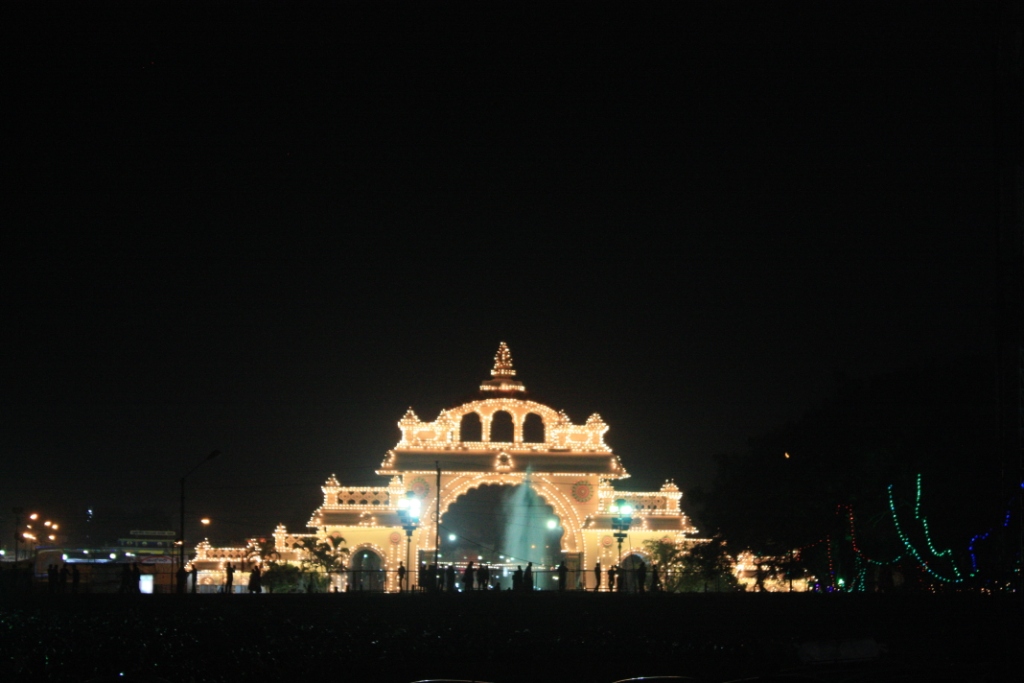
DAILY PHOTO: Mysore Palace by Night

Taken on October 3, 2014 in Mysore.

Taken on October 3, 2014 in Mysore

The Mysore Palace is usually only lit up on Sunday evenings. However, during the 10-day festival of Dasara (Vijayadashami), they light it up every night. This was taken on the penultimate day of festivities.

DAILY PHOTO: Dasara Flower Show Gazebo

Taken on October 3, 2014 in Mysore

Taken on October 3, 2014 in Mysore

IMG_2753

I just got back from attending Dasara (a.k.a. Dussehra or Vijayadashami) festivities in Mysore. Dasara celebrates Rama’s victory over Ravana, as well as Durga’s defeat of Mahishasur. There was a flower show about a block from the palace, and this gazebo was the centerpiece. The bottom pick was part of the floor of the gazebo.

BOOK REVIEW: The Bhagavad-Gita Translated by Barbara Stoler Miller

The Bhagavad GitaThe Bhagavad Gita by Anonymous

My rating: 4 of 5 stars

Amazon page

The Bhagavad-Gita is a philosophical poem, the title of which is translated as “Song of the Lord.” It’s often read as a stand-alone work, but it’s included in the sixth book of longest known epic poem, entitled the Mahabharata.

In The Bhagavad-Gita, Krishna teaches the warrior-prince Arjuna about sacred duty (dharma.) The setting is the battlefield at Kurukshetra as a war is about to get underway. Arjuna asks his charioteer, Krishna, to halt the vehicle between the opposing armies. Arjuna is struck with a crisis of conscience. He doesn’t want to fight and kill the men on the opposing side–some of whom are related to him by blood and others of whom are well-respected elders. Arjuna can see no virtue in the war.

Krishna, after briefly mocking what he describes as Arjuna’s newly developed cowardice, goes on to offer his explanation of why it is that Arjuna should fight. The first argument is that nobody really dies because consciousness is reborn. This makes sense if you believe in reincarnation… otherwise, not so much. A concise restatement of this argument is presented in the 11th teaching: “I am time grown old, creating world destruction, set in motion to annihilate worlds; even without you, all these warriors arrayed in hostile ranks will cease to exist. Therefore, arise and win glory! Conquer your foes and fulfill your kingship! They are already killed by me. Be just my instrument, the archer at my side!”

Another of Krishna’s argument is that if Arjuna fails to fulfill his duty he will be thought less of by others. This is an odd argument to make as Krishna makes a more compelling case for ridding oneself of ego, whereas this seems to be saying that one should put what others think of one above doing what one believes is right. That sounds a lot like succumbing to ego rather than eliminating. In the 12th teaching, in fact, Krishna tells us that the best of men are “Neutral to blame or praise…” This suggests that perhaps one shouldn’t be moved by what others will think of one.

At the core of Krishna’s argument is that one cannot escape the Karmic cycle by engaging any acts but those that are selfless. Like the reincarnation argument. One may find this logic compelling or not depending upon whether one believes in Karmic theory. Karma is the idea of cause and effect. If you do good, you’ll receive good effects and if you do bad you’ll experience bad effects. Ultimately, however, the goal is to break free of the Karmic cycle and, in theory, the only way to do that is to engage in acts that are selfless—hence doing your sacred duty. If your driver isn’t God, it’s not entirely clear how you know what your sacred duty is, at least not by way of this work. (Presumably, God talks to kings and princes, and kings and princes tell the unwashed masses what they are supposed to do. If you happened to have already done away with such a system—as most of the planet has—you may have trouble with this logic.) However, if one takes the lesson to be that one should not be consumed with personal gain when one acts, one has an argument of more general appeal.

Another argument is that devotion to God is all important, not a man’s actions in any absolutist sense. From the 9th teaching, “If he is devoted to me, even a violent criminal must be deemed a man of virtue, for his resolve is right.”

It should be noted that Krishna delivers a number of lessons beyond the need to comply with one’s dharma, and, in my opinion, many of these ancillary lessons are more compelling than Krishna’s explanation of why Arjuna must fight.

One such lesson is to concern oneself with the journey and not the destination. Krishna states it as such, “Be intent on action; not the fruits of action…” Furthermore, there are a great many teachings that will be familiar to Buddhists, such as the need for non-attachment and moderation.

The poem contains lessons of Samkhya (e.g. discussion of the three gunas) and Yoga. It describes concepts from the three original forms of yoga (predating yoga as a fitness activity by centuries): those being of action yoga (karma yoga), knowledge yoga (jnana yoga), and devotional yoga (bhakti yoga.) While The Bhagavad-Gita predates the formulation of eight limbs of yoga as described by Patanjali, it does address certain among them in varying detail. Early on, it speaks about pratyahara—withdrawal from the senses—in considerable detail. There are also references to pranayama (breath/energy control exercises) and most of the yama and niyama are listed among the virtues in the latter part of the teachings. Of course, samadhi (liberation / yoga’s 8th limb) is a central concept in this work.

While The Bhagavad-Gita remains widely cited and relied upon for guidance to this day, it’s not without its controversial elements. In the fourth teaching, Krishna explains how he created the caste system. Of course, Krishna might not have intended it to be the stain it became.

The Miller translation that I read has a few nice ancillary features. There is an introduction that offers background and context for those who have little knowledge of Indian history or mythology. There’s also a glossary that goes into detail about terms that are frequently used in the work. It’s not that there are Sanskrit words mixed into to the text. The glossary explains what the English words should be taken to mean in the context of the Hindu worldview.

What is most intriguing, however, is the afterword which is entitled, “Why Did Henry David Thoreau Take the Bhagavad-Gita to Walden Pond?” Of all the thinkers that have cited The Bhagavad-Gita, the use of Thoreau and Emerson as examples raises intriguing questions. The Thoreau of Civil Disobedience and the Emerson of Self-Reliance would seem to be as far from the message of The Bhagavad-Gita as possible. Krishna is telling Arjuna to ignore his conscience, and just do what God tells him to do—be a selfless instrument of destruction. Thoreau and Emerson both preached that one’s conscience should always be one’s ultimate guide. Thoreau went to jail because he refused to pay taxes that would support the war with Mexico. I suspect Krishna would say to Thoreau, “Hey, I’m throwing this war, and you’d damn well better do your part.” However, there are ideas in The Bhagavad-Gita that work with the American Transcendentalist philosophers. The idea of removing self-interest and egotism as a way to eliminate delusion before one makes one’s own decision is a consistent suggestion.

I have mixed feelings about The Bhagavad-Gita. Like many (most?) sources of religious doctrine, I think the central message of The Bhagavad-Gita is just another means by which to keep the masses under the control of an elite—and, specifically, fighting the wars of the royalty. However, I–like Thoreau and Emerson—also see a great deal of insight into how to be a better person in this poem.

I think The Bhagavad-Gita is worth a read, regardless of how you may ultimately feel about its message. It offers a concise summary of key ideas in Indian philosophy and psychology. It will give one a better understanding of the Indian worldview, and may teach you something about how to live in the process.

View all my reviews

DAILY PHOTO: Kalari Kids

IMG_2572 IMG_2303 IMG_2318 IMG_2591

These are a few more pics from the Kalari Gurukulam‘s demonstration on Sunday night. These are a few of the kids from the youth classes.

Yesterday, I posted a few of the adult senior students here.

DAILY PHOTO: This is Kalaripayattu


IMG_2244 IMG_2281

IMG_2557The Kalari Gurukulam put on a demonstration in Chikkagubbi yesterday. Here are a few photos from the event.

TRAVEL TIP: Know Your Country’s Go-to Collision Avoidance Device

Bangalore

Bangalore traffic

It took me several months to master the art of crossing streets in India. Pedestrian crossing signals are as rare as gold crappers, and as useful as wings on a goat. There are many streets that one can’t cross in one fell swoop between the hours of 8am and 11pm. So, if you don’t want to spend the day trapped on your block like a jittery puppy, you need to plunge into traffic and take it one lane at a time.

Fearlessness. That’s the key–pure and simple. One will have crosstown buses whizzing past on either side. In the military, during Basic Training, we got inoculations via cattle vaccination-guns. It was an assembly line of shots. Take one step forward get a shot, one more step and get another shot. The clinic staff had a lot of recruits to inoculate that were standing between them and their morning coffee. The warning was, “Take one step and stand perfectly still.” Because as soon as you stopped, they would  “shu-shunk” that shot into your deltoid. If you wavered, the gun wouldn’t make a nice solitary puncture, but rather would gouge out a slit. Or so we were told. At any rate, the advice to a Bangalore pedestrian is the same, “Step onto the dashed line and remain perfectly still, because if you cringe, you’ll get a truck mirror up side the cranium and you’ll die.”

I traveled to Thailand this past month. I’ve been to Thailand on a couple previous occasions, but not with the implicit rules of Indian traffic ingrained in me. My first official act in Bangkok was to almost cause a multi-car pile up accident. Why? Because Thai people do this strange thing when a  pedestrian wanders into the street or an intersection in front of them, they apply the brakes. Now every Indian knows that the proper device to employ when someone crosses into traffic in front of one is the horn. As a matter of fact, the horn is the go-to Indian driving tool for almost every eventuality. It wouldn’t occur to most Indians to apply the brakes and certainly not to make a lane change for an encroaching pedestrian or other driver. If the pedestrian doesn’t get out of one’s way, you simply lean into the horn, putting all your body weight into it.

Now, it may sound like I’m giving Indian drivers a hard time. However, it occurred to me that either system works as long as everybody is on the same page. Those who’ve experienced roundabouts will tell you that they are at least as safe–and probably more so–than crossroad intersections. Even though roundabouts seem terrifying for novice drivers, they have a prevailing logic that is sound. By the same token,  it may be that the Indian approach is at least as safe. (It certainly makes a pedestrian more cautious.) The Thai approach, which is widespread though most of the world, is at once more polite but less trusting than the Indian approach.


BONUS TRAVEL TRAFFIC ADVICE: Anywhere in the developing world, always look both ways when crossing one-way streets. The prevailing view is that lane directives are optional for scooters and small motorcycles.


Thai Yoga & Hatha Yoga: Compare and Contrast

During my recent trip to Thailand, I attended Thai Yoga (a.k.a. Rusie Dutton, i.e. “ascetic exercises”) classes at the Wat Po Temple. As a yoga practitioner, I took note of the similarities and differences between Thai yoga and the Hatha Yoga of India. It’s no surprise that Thai Yoga would display the influence of India. Indian influence from olden times can be seen throughout Thailand. The roots of Thai Massage (a.k.a. Thai Yoga Bodywork or Nuad Bo Rarn) itself are attributed to Shivago (also, written/pronounced Chivako), a north Indian doctor in the Buddha’s community of followers.

One can plainly see the influence of Hatha yogasana (postures)  in these Thai exercises, but the details vary. I’m interested in how movement systems (e.g.  martial arts) with a common ancestry diverge over time in response to the unique needs of a different culture. I believe that not only the new system evolves, but there’s also a continuing evolution in the original line. One can, therefore, end up with systems that look little alike over the course of several generations.

The degree to which the Thai Yoga poses vary from Hatha Yogasana varies. In the Thai Yoga class we did a simple lateral bend with interlocked fingers that was identical to a  Sivinanda Yoga pose named tiryaka tadasana.

Lateral Bend (tiryaka tadasana)

Lateral Bend (tiryaka tadasana)

Balancing poses made up much of the Wat Po Thai Yoga sequence. This makes sense as the course was aimed at practitioners of Thai Massage and balance is important in this massage system because there are techniques that involve standing on one foot as one applies pressure with the other fort or in which one must stand to apply stretches. (Obviously, it’s bad for business to step on the recipient in an uncontrolled fashion or to topple onto them.) There were poses that were reminiscent of Natarajasana (Shiva’s Dancer pose), Vrksasana (tree pose), and Utthita Hasta Padangusthasana (hand to big toe pose). Each of these varied in the details. The most prevalent Thai variation was bending the support leg to lower one’s center-of-gravity. In Hatha Yoga, it’s usually taught to keep the support leg as straight as one can manage (this both contributes to the stretch and can prevent loading the tendons.)

NATARAJASANA: There were two variants of this pose practiced at Wat Po. Both folded the torso more forward than one would typically see in Hatha Yoga, as well as bending the support leg more.  The first version (palm on front knee) is as such:

Version 1 from Thai Yoga (Palm on Knee)

Version 1 from Thai Yoga (Palm on Knee)


The second version has the front hand up in a manner similar to the Hatha version, but the torso isn’t kept upright and the support leg is deeply bent.

Thai Version 2 (hand out front)

Thai Version 2 (hand out front)


In contrast, the Hatha version is more upright.

Natarajasana

Natarajasana


VRKSASANA: There are two variants of tree pose in the Thai Yoga. In both the ankle is kept on top of the thigh and the support leg is bent. Version one is as follows:

Vrksasana1_Thai_Front

Version 1 begins and ends in Pranamasana (hands in prayer pose) With hands out to the side in between.

Version 1 begins and ends in Pranamasana (hands in prayer pose) but hands are taken out to the side in between


Version 2 includes a wrist stretch with the balance pose. One puts fingers on thigh facing upward and the squat folds the wrist back.

Version 2 with wrist stretch.

Version 2 with wrist stretch


The Indian version:

Vrksasana_hatha_front


UTTHITA HASTA PADANGUSTHASANA: There are also two variations of this pose. Note the bending of the support knee. Version 1 holds the foot with the same side hand and places the opposite palm on the knee.

Version 1 from front

Version 1 from front

Version 1 from side.

Version 1 from side


Version two holds the extended foot with both hands.

Version 1 from the front.

Version 1 from the front

Version 1 from the side

Version 1 from the side


For comparison, the Hatha Yoga version:

Utthita Hasta Padangusthasana from side

Utthita Hasta Padangusthasana from side


UTKATA KONASANA: There are three variants of a pose that is usually called Goddess pose or Utkata Konasana.  The difference here primarily deals with how the hands are positioned, but given the many variants within Hatha Yoga for hand position, this can be seen as a virtually identical pose.

Thai version 1 of Godess pose.

Thai version 1 of Goddess pose

Thai version 2 of Goddess pose

Thai version 2 of Goddess pose

Thai version 3 of Goddess pose

Thai version 3 of Goddess pose


Goddess pose with hands in Chin mudra.

Goddess pose with hands in Chin mudra.


VIRABHADRASANA: There is a series of five lunge poses that are reminiscent of the Virabhadrasana (Warrior). I’ve dropped the first one because it requires a photo taken from a back angle becuas it involves pulling one’s wrist behind one’s back.

Thai Version 2 hand on front knee

Thai Version 2 hand on front knee

Thai version 3 twist

Thai version 3 twist

Thai version 4 looking back

Thai version 4 looking back

Thai version 5 taking aim

Thai version 5 taking aim

Virabhadrasana I

Virabhadrasana I


BOOK REVIEW: The Moor’s Last Sigh by Salman Rushdie

The Moor's Last SighThe Moor’s Last Sigh by Salman Rushdie

My rating: 5 of 5 stars

Amazon page

The Moor’s Last Sigh tells the tale of three generations of an Indian family that built its fortune in the spice trade. This isn’t the type of book that would usually float to the top of my stack. I read it because I was traveling to Kochi (Cochin), and it came recommended because much of the first part of the book is set there. (The same recommendation might be received by someone traveling to Mumbai because the latter half of the book is set in that city; granted, there are a lot more stories set in Mumbai [Bombay] than Kochi.) Ultimately, I was pleasantly surprised by this book, despite its soap opera like tone.

The book does read like a soap opera, at least until it gets into the narrating character’s story. There are strong women characters in this male-dominated environment of an Indian family business, though they tend to fall into the categories of “petty bitch” or “prima donna” or both. In the first generation there is a matriarchal character who dominates the family by manipulation and cruelty. In the second generation, the female lead—a strong-spirited, independent artist—falls in love with a Jewish employee of the family. Those familiar with marriage as practiced by the Indian elite will recognize how this inter-sect wedding with an underling might result in no small grief. The resulting marriage produces two female children and a boy. The latter would be nothing but a source of bliss, but for a birth defect that results in a malformed arm. While his mother smothers him with love and attempts to display a progressive spirit that’s beyond biases against such infirmities, under the surface there is the need to come to grips with the fact that handicapped children aren’t supposed to happen in high-caste families. The man with the infirmity is the narrator and overall protagonist of the book. He—as seems inevitable—will eventually fall for a woman of which his mother does not approve.

Beyond the soap opera pettiness, there are genuine intrigues that unfold in the latter half of the book. However, the pettiness of narcissistic people is the root of the protagonist’s ultimate trial.

While Rushdie builds characters in the manner we expect of literary fiction, he doesn’t abandon story. There is a narrative arc that unfolds over the course of the novel. Surprises are revealed and twists unfold.

This is the first Rushdie novel I’ve read. I’ve always intended to read The Satanic Verses to see what all the hullaballoo was about, and the readability of this work makes me even more interested in following through. You know a writer has to be good to inspire a country to take out a hit on him.

I’d recommend this for more than just people visiting Kochi or Mumbai—though it will be particularly interesting for those who are. If you’re interested in the lifestyles of the rich and famous in India more generally, you’ll find this work enlightening. In general, it will appeal to those who like their literary fiction with a bit of a storyline—and if you like the low drama of bitchiness, all the more so.

View all my reviews

DAILY PHOTO: Sacred Pool at Hampi

Taken in October of 2013 in Hampi.

Taken in October of 2013 in Hampi.