BOOK REVIEW: Escape from North Korea by Melanie Kirkpatrick

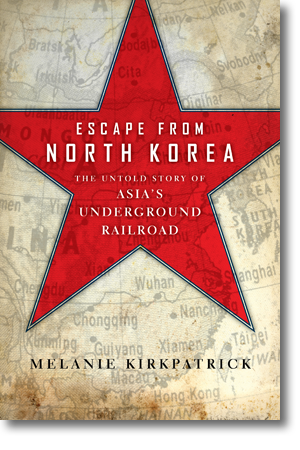
Escape from North Korea: The Untold Story of Asia's Underground RailroadEscape from North Korea: The Untold Story of Asia’s Underground Railroad by Melanie Kirkpatrick

My rating: 5 of 5 stars

Amazon page

Escape from North Korea is the most intriguing non-fiction book I’ve read in recent months. Kirkpatrick offers a glimpse into the operations of a modern-day underground railroad, one whose stories—sadly—are often no less chilling than those associated with its US Civil War namesake from 150 years ago.

The 17 chapters of this book are arranged into six parts. The organizational logic of the book takes the reader from the germ of an idea to flee all the way to settling into life in a free country, with all the trials and tribulations that are experienced in between. It begins as a story of one person who decides to escape, and who must virtually always get across the border into China on his or her own. Once across the border, there is help to be had if the refugee can find it before he or she gets caught by the Chinese and repatriated or is exploited by nefarious individuals. Danger is ever-present, occasionally even once the individual gets to South Korea.

Chapters 3 through 7 were particularly interesting because they looked at various classes of escapee, some of which one might not realize existed. It starts with the classic defectors, similar to those one might associate with the USSR—political, military, sporting, and artistic figures. This was the main class of refugee until people began starving in the 1990’s due to nation-wide famine.

Next is a chapter on brides for sale. Many North Korean women end up forced into slave marriages. China has a dearth of eligible women due a bias against female children, particularly combined with its one-child policy. Some women are lured across the border under false pretenses, but others, finding themselves fugitives in China, end up being exploited due to their vulnerability. Each bride fetches about $1,200 to $1,500 ($500 to $800 from the wholesaler to the retailer.) There’s also a chapter devoted to the children of such marriages, and particularly the cases in which the mother is repatriated and the child ends up orphaned because children born in China will not be taken by the North Koreans and frequently the fathers want nothing to do with the children. Pregnant women repatriated to North Korea are often forced to abort pregnancies involving Chinese fathers.

One of the most intriguing chapters was on the North Korean lumberjacks residing in Siberia. This profit-sharing deal goes back to the Soviet days. When the Soviet Union imploded, however, the arrangement was kept with some worker rights installed on paper to appease Russia’s newly developed human rights watchdogs. One might wonder how the Kims—fearful of dissidents as they are—would let a group live outside the country on a remote site that’s hard to guard. The answer is that all the lumberjacks had to have both wives and children at home to serve as hostages. Still, some decide to make the break.

There is also a chapter about the Prisoners of War from the Korean War who were trapped on the wrong side of the border.

I’m fairly well-read on the subject of North Korea, but, like most Americans, the bulk of this has to do with Pyongyang’s nuclear program. I, therefore, found some of the stories of the regime’s depravity to be beyond the pale. A sampling of such stories includes:
-guards severely beating a prisoner and then having other prisoners bury the victim alive

-the warden in a state-run orphanage having orphans fight each other for bigger food servings

-a family that killed themselves rather than be repatriated to North Korea

-individuals, such as Ri Hyok-ok, who were executed for distributing bibles

-North Korea’s provision of family information on trans-border family members as a profit-making scheme

-Kim Jong Il pulling a Pol Pot and shutting down the universities and colleges and sending students to work on farms and in factories for months in 2011 because he was afraid that the Arab Spring might be infectious

-Kidnapping foreigners on foreign soil, which North Korea has even admitted to openly.

Sadly, the woeful tales aren’t limited to the North Koreans. Kirkpatrick devotes a considerable amount of space to chastising the Chinese for repatriating North Koreans. Under international law, which China ratified, refugees shouldn’t be sent back to their country of origin if it’s likely they will be punished. China claims that individuals are economic migrants and not political refugees, and it compares them to Mexicans crossing onto American soil—without addressing the fact that Mexicans are not sentenced to hard labor or killed when they are returned to Mexico. The Chinese might also point to Hwang Jang-yop, the author of the North Korean Juche (self-reliance) policy, as an example of a “true” political refugee that they didn’t repatriate, but allowed to migrate to South Korea (where the North Koreans tried to assassinate him in Seoul several times.)

There’s even some disappointing behavior on the side of the US. In 2006, an American consulate employee in China not only turned away several North Korea refugees, but–by speaking openly over an unsecured line–got a conductor on the Underground Railroad arrested.

The end of the book contains an interesting description of how the Kims are beginning to lose the war on keeping the information age out of North Korea. From balloon drops to radio broadcasts, North Koreans are beginning to get true information about both the outside world and their own leadership. Lest one think that no one could possibly believe the propaganda out of Pyongyang, even in the absence of information inflows, there’s a story about an immigrant to America who had a hard time coaxing his family out because they believed that America was out to kill North Koreans. This father’s story of the good life in sunny Florida didn’t entirely convince them, and ultimately they had to be coaxed to their new home in stages. It’s telling that the cellphone was only introduced in North Korea in 2008. While cellphones aren’t that useful for the railroad because they can’t call outside the country, they do allow for some spread of information inside.

One might think that once a North Korean gets to freedom, everything is hunky-dory, but Kirkpatrick discusses the problems that most North Koreans have adjusting to life in South Korea. As workers, North Koreans tend to lack initiative. They just want to be told what to do, and will do no more. It’s not that they’re inherently lazy; they come from a world in which initiative is not rewarded but is often punished.

While it may be hard to believe, most of the emigrants have trouble coping with the massive amount of choice available in their new homelands. Having an entire aisle of the market devoted to laundry detergent overwhelms them. Apparently, a few—very few—have even snuck themselves back into North Korea where all they have to do is do what they’re told, eat what they can, and maybe starve to death.

I think this is an important book that should be read by anyone interested in world affairs. North Korea is truly unique in the world. One telling line from the book was, “Even during the Communist era, Russia was more liberal and prosperous than North Korea.” The continuance of the Kim Dynasty is an unstable proposition, and it’s impossible to know when it will fall and what damage will be done internationally when it does.

View all my reviews

The Most Intense Blockbuster You’ll Never See

REV_Kirkpatrick-designAmong the Kindle Daily Deals yesterday was a book entitled Escape from North Korea: The Untold Story of Asia’s Underground Railroad by Melanie Kirkpatrick. It was well-timed to a news story about a Korean War Veteran, Merrill Newman, whose video statement as a prisoner of the DPRK was released the same day. Anyway, I bought the book and I’m hooked. The stories it contains are a mix of chilling and thrilling.

As I began reading, I wondered why no one had made a major Hollywood blockbuster based on an escape from North Korea. It’s a journey fraught with peril. There’s so much to go wrong from being shot in the back crossing the Tumen River to being repatriated to being double-crossed by smugglers to falling into the hands of traffickers or other predators. Adding to the challenge is the fact that most North Koreans are severely undernourished, and each is on his or her own for the first part of the trip–getting across the border. Furthermore, it’s not uncommon for North Koreans to stick out physically because they’re unusually small and, as pointed out by one of Kirkpatrick’s sources, prone to bad hair and split ends.

I know these are words that writers despise but the screenplay practically writes itself.

Then I remembered, oh yeah, this will never be a movie because China’s government would be one of the villains, and Hollywood isn’t in the business of making films that PO the Chinese any more. Why is China the villain? Well, it’s not the main villain. That distinction, of course, goes to the Kim dynasty, presently personified by Kim Jong Un–who has been the biggest bastard yet when it comes to escapees. China’s policy is one of repatriation. It would be kinder for China to just execute the North Koreans themselves. One of the stories early in the book is about an entire family that was to be sent back who–having eaten their first decent meal in a long time–decided to die full and committed suicide while in Chinese custody. Lest one think that this is a Communist thing, Kirkpatrick points to Vietnam as one of the countries that quietly helps North Korean escapees get to safety. Like the democracies that do so, Vietnam keeps this on the down-low to avoid cheesing off the Chinese, but at least they do it.

Why would such a movie be good? Because everybody needs to know what’s going on, and movies are the surest injection point into the public consciousness. There have been books and documentaries about this for years, but I don’t think most people realize how bad it is.

I should point out that there have been films on the subject. The Crossing, made in South Korea, is probably the most well-known feature film on the subject. It’s about a father who crosses the border to get medication for a wife, but ends up stuck on the other side of the border during which time his wife dies and his boy becomes–for all intents and purposes–an orphan. This film is apparently based on a true story.

And there have been a number of documentaries on the subject. The Defector: Escape from North Korea is one of the best.

This is the book trailer for the Kirkpatrick book.

Can India Compete With China?

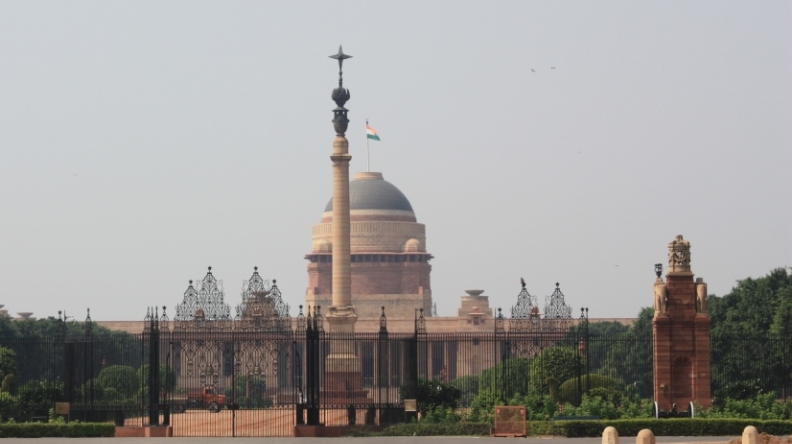
IMG_0131There’s perennial hope in the West that India will succeed. Having won the Cold War, advocates of democracy and rule of law aren’t eager to replay it and have a Communist country win–not even one that yields to market forces in large part.  Citizens of democratic nations want reaffirmation that democratic rule and rule by law, not men, is the superior paradigm. We acknowledge that such a system is rarely easy, but live with the words of Winston Churchill ringing in our ears:  

Democracy is the worst form of government, except for all those other forms that have been tried from time to time.

When I found out that I was moving to India, I read all that I could find on India in magazines I subscribed to, such as Foreign Affairs, National Geographic, and Wilson Quarterly. Needless to say, there was a lot to read. Besides India’s nuclear programs, both energy and weapons, I hadn’t followed its role in the world. These articles took me on a roller coaster ride. If one went back many years, no one expected much of India. Then, a few years back, massive enthusiasm blossomed that India was going to rocket off and leave India in its dust. Then I got to the most recent articles, which did yet another turnabout–saying that India’s growth had been ephemeral and no one should expect much from the country in the near future.

India has a number of advantages. Almost everyone who is capable of publishing is fluent in the de facto international language of business and academic publication–namely English. India has as abundant a supply of cheap labor as anywhere. Indians have a culture that values education. They are building a first-class university system by, in part, having sent students to the very best of academic institutions globally. Their universities are attracting foreign students. This, in combination with such a big population, has given them the potential to build impressive student bodies.

So, why isn’t India competitive? The first thing that should be stated is that things are never as simple as they appear in aggregate. In some domains, India is competing quite nicely–and not just with China. Here in Bangalore, it’s apparent that large IT companies see big advantages in doing business in India.

I made a recent trip to Hampi and was amazed to see how successful India was in building up wind power generation in central Karnataka. India is 5th in installed wind capacity overall. Many democracies have difficulty getting traction with wind because the public views the turbines as an eyesore.

Still, India has its problems. Political and Economic Risk Consultancy (PERC) surveyed business leaders about Asian bureaucracies and found India to be the worst bureaucracy in Asia.  On a 1 to 10 scale, where 10 is the worst possible, India rated a 9.21. This isn’t a surprise in the least. It seems to be common knowledge that business leaders who move to India do so in spite of India’s governance, not because of it.  India’s bureaucracy hasn’t embraced the IT-revolution. It’s interesting being in Bangalore, where IT-companies are state-of-the-art, and being asked for the same copies of documents a half-dozen times because the information is only stored on non-networked PC hard-drives–and paper files are collected but don’t seem to be organized in any way.

An ethos of corruption is ubiquitous in India. Police officers have been known to sit in parks and solicit “admissions fees” from tourists. I’m pretty sure I saw a shakedown in progress this past week when our car went through a toll booth on a toll road we had already paid for and two guys standing outside in front of the toll-taker insisted that our driver pay for the toll that he had already paid not ten minutes before. Being from a country where corruption is punished severely, I’m ignorant of the process of bribes. (I suspect this is why I’ve had so little success in getting anything done that involves the Indian bureaucracy.) For a less anecdotal experience, one can turn to the “Corruption Perceptions Index,” which places India in the bottom half among all nations.

One may wonder how a democracy retains a culture of corruption. Usually, citizens of a democracy get fed up and start voting their disapproval. At the Bangalore Literature Festival, I heard an interesting policy panel featuring a politician, a retired general, and a policy pundit. It was said that there is a high degree of apathy among the Indian middle class. Indian voter turnout rates are generally below 60%. There’s a belief that those most capable of affecting change are relatively happy and, thus, unwilling to rock the boat. I don’t know how true this is, but it seems that India is having trouble defeating some of the problems that wither on the vine in the face of a politically active public.

It also seems that there is a segment of the population who are completely cowed. This is a legacy not only of colonial repression but also of caste repression. While castes have been done away with, there remains a large segment of the population who are accustomed to doing just as they’re told without questioning and without making moves to get ahead.  Perhaps, because they believe they exist in a world in which there’s no getting ahead.

India’s abundance of cheap labor may be a curse as well as a blessing. While cheap labor has brought in foreign direct investment, it has also contributed to a business culture that doesn’t seem to value increased productivity. As an example, if one goes into a small shop in Chicago or Copenhagen or even Beijing, it’s likely that a single salesperson will show one merchandise, ring it up, and bag it. If it’s a big store, there may be a two person interaction–salesperson and cashier. In an Indian store, a salesperson will show one merchandise, a clerk will write up an invoice, one will take that invoice to a cashier, that cashier will take one’s money and hand one a carbon-copy of the “paid” stamped invoice and direct one to a pick up window, a bagger will bag your purchase, and  a “checker” will check your receipt and hand you the bag. I love specialization as much as the next economist, but this is a Rube Goldbergesque approach to retail operations.

If India wants to be a first-rate power, it needs to take on corruption, bring its bureaucracy into the 21st century, and its population needs to realize they can have a more satisfying life than waiting around for someone to need them for a momentary job. The citizenry needs to value good governance, and businesses need to figure out how to increase productivity.

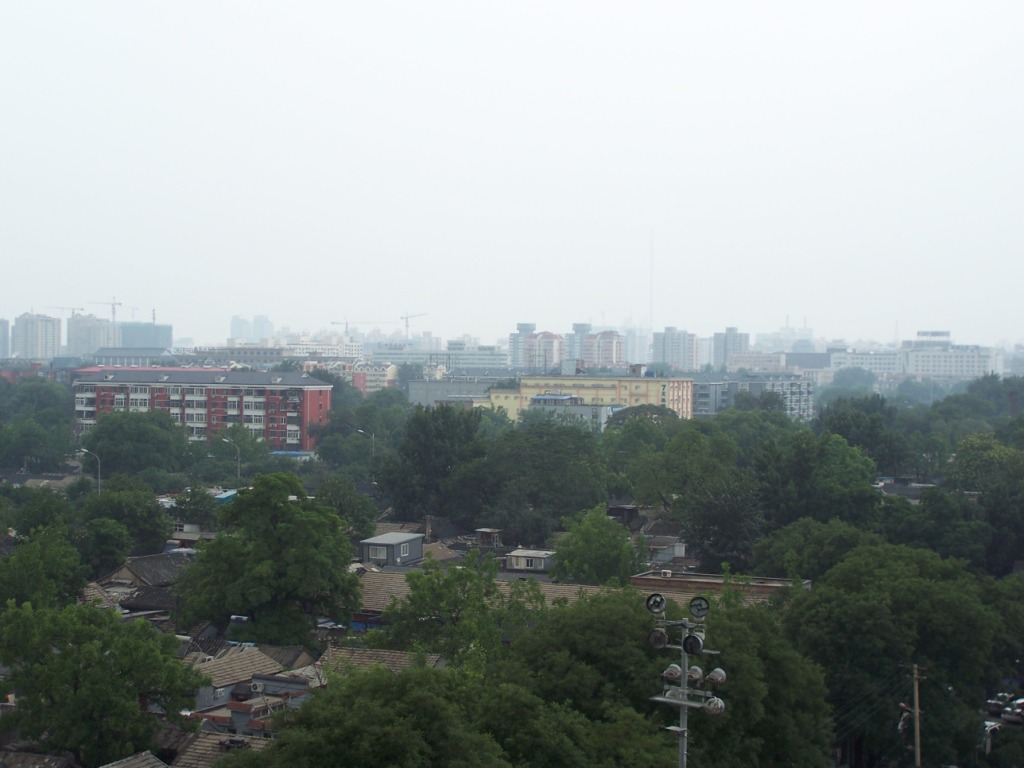
DAILY PHOTO: Beijing from the Drum Tower

Taken in the summer of 2008 in Beijing China.

Taken in the summer of 2008 in Beijing China.

DAILY PHOTO: Soviet T-62 in Beijing

Taken in July of 2008 in Beijing's Military Museum

Taken in July of 2008 in Beijing’s Military Museum

BOOK REVIEW: Ip-Man Portrait of a Kung Fu Master by Ip Ching, et. al.

IP Man: Portrait of a Kung Fu MasterIP Man: Portrait of a Kung Fu Master by Ip Ching

My rating: 3 of 5 stars

Amazon page

Ip Man led an interesting life. The master of Wing Chun Kung Fu lived through tumultuous times that included the Boxer Rebellion, the Sino-Japanese War, and China’s Communist revolution. After the Japanese occupation he served for a time as a police chief. Coming from a wealthy family, he experienced a riches to rags fall when the Communists took over. He had to move from his home in Foshan to Hong Kong. His use of kung fu was not restricted to the training hall, but, rather, included a few real world altercations. A couple of films have been made(loosely) about his life.

All that being said, this book doesn’t do a great job of capturing the life of this intriguing man. To be fair, the book isn’t really a biography proper–though the title might lead one to believe it was. However, it’s not entirely clear what the book is. Its fifteen chapters are each built around a principle and use vignettes from Ip Man’s life to illustrate how the Grandmaster lived virtuously. This makes the book seem more like treatise on martial arts philosophy and/or strategy. However, some chapters do a better job of making clear what the actual principle is and how the events of Ip Man’s life exemplify them than do others. In some parts it does a great job but in others it’s only lackluster.

There are some fascinating stories about the man’s life in the book, but they are generally told in a lifeless manner. In part this may be done on purpose as we are told that Ip Man eschewed embellishment and favored humility, but it makes the reading experience less than gripping. It’s also probably that some of the details were lost when Ip Man died in 1972. This lack of detail leaves one at times wondering. Throughout most of the book we get a picture of Ip Man as a virtuous warrior. However, there is one vignette in which we read about the Grandmaster picking a fight with a man by taunting him with humiliating insults about the man’s appearance. Ip Man does this to teach his student a lesson in courage. His lesson notwithstanding, this behavior paints Ip Man as anything but virtuous–rather than a humble martial arts master he becomes a pathetic bully. The author, Ip Man’s son Ip Ching, suggests that this might have been a setup for the student’s benefit, but with the prior assent of the bullied man. At any rate, there was no fight because the bullied man backed down–whether because it was staged or out of genuine fear remains unknown.

For some readers the most surprising omission will involve a lack of any mention of the man who was far and away Ip Man’s most famous student, namely Bruce Lee. There may be a number of reasons for this omission, including a desire to prevent the teacher’s story from being overshadowed by his student’s fame. However, most readers would probably like some inkling of how the ill-fated superstar came to train with Ip Man and what he learned from him. In fact, the only reference to the entertainment aspect of kung fu is a picture caption that shows Shek Kin, the villain “Mr. Han” from Enter the Dragon, at Ip Man’s funeral.

I would recommend this book only for those that have a particular interest in martial arts. It does offer tidbits of interesting events from Ip Man’s life as well as a few great life lessons. It benefits from being a concise book, and thus is not a major time investment to read. However, I don’t know that–short as it is–it would hold the interest of the general reader. Hopefully, someone will take on a more extensive English-language biography of this fascinating man’s life while there are some key people still alive to be interviewed about his life story.

View all my reviews

DAILY PHOTO: A Walk in the Park

Taken in the summer of 2008 in a small park in Beijing's Central Business District

Taken in the summer of 2008 in a small park in Beijing’s Central Business District

Beijing has workout equipment all over the place–mostly in parks, but sometimes just by the side of the road. One sees the same sorts of things in Bangkok, and even Phnom Penh has exercise equipment on the river front strip of park.

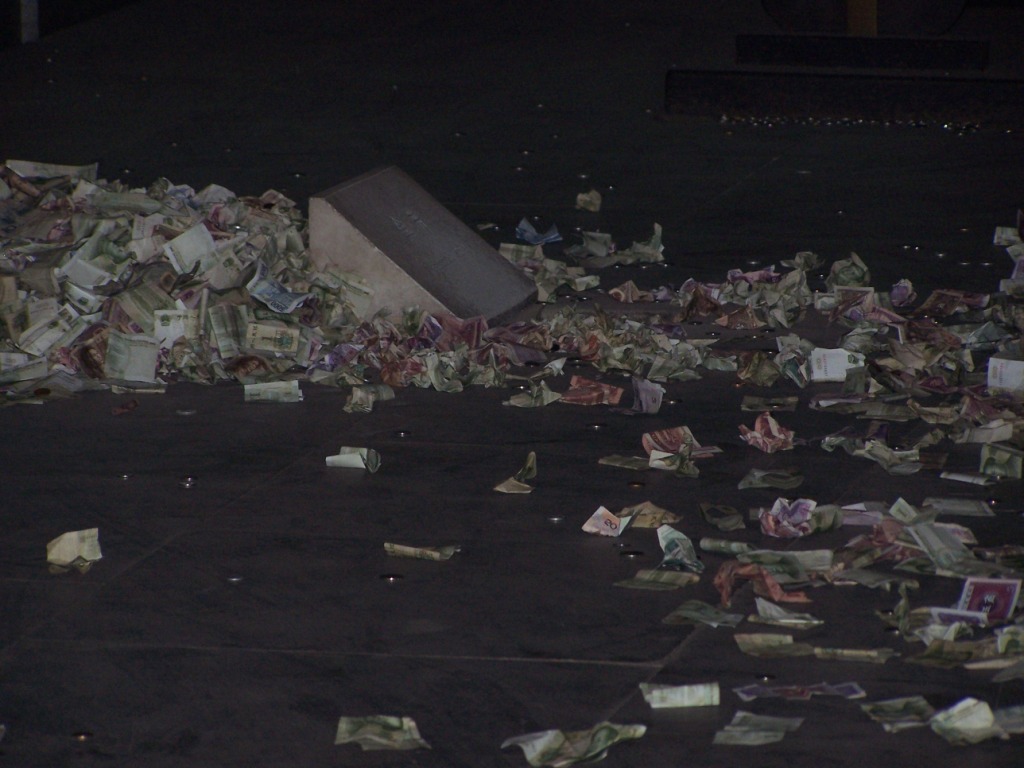
DAILY PHOTO: Cash Offerings in the Ming Tombs

Taken in the Summer of 2008, outside Beijing

Taken in the Summer of 2008, outside Beijing

This didn’t turn out so well because in the Ming tombs it’s dark as… well, a tomb. However, it was interesting to see all this cash piling up on the floor. This is the Ding–or Dingling–tomb

DAILY PHOTO: Dining in the Forbidden City

Taken in the summer of 2008 in the Forbidden City (Beijing, China)

Taken in the summer of 2008 in the Forbidden City (Beijing, China)

If you were a concubine in Imperial China, this is the kind of room in which you might take your meals.

DAILY PHOTO: Wind-up Bird

I caught this little bird mid-hop in Beijing, ironically near the Olympic sporting venue called “the Bird’s Nest.”
Taken in Beijing in the summer of 2008 near the Olympic venues

Taken in Beijing in the summer of 2008 near the Olympic venues