BOOK REVIEW: Sikhism: A Very Short Introduction by Eleanor Nesbitt

Sikhism: A Very Short IntroductionSikhism: A Very Short Introduction by Eleanor Nesbitt
My rating: 4 of 5 stars

Amazon page


I picked up this book before a trip to Amritsar. While Sikhs are arguably the most visually distinct religious adherents, it’s one of the least understood world religions with respect to internal aspects like beliefs and practices. And a major religion, it is. With 23 million followers, it’s between the fifth and eighth most widely practiced religion in the world (depending upon whether one aggregates traditional religions in China or Africa.)

This book offers a 150 page overview of what it means to be Sikh, and it explains it not only in religious, but also in cultural, political, and historical, terms. If one needs deep insight and great detail about Sikhism, this may not be the book for you. But it gives one the big picture quite nicely, and with a scholar’s balanced view (as opposed to that of a theologian.)

There are eight chapters in the book. The first chapter introduces one to Sikhism. Besides the basics, this chapter discusses what makes Sikhism a distinct religion, and how it has been influenced by other religions—most significantly Hindu and Islam, in that order. It also discusses what it means to be Punjabi, in contrast to what it means to be Sikh. To understand the subject of the second and third chapters, one has to know how the leadership of this religion unfolded. There were ten human teachers (Guru), and then a book of scriptures assumed the mantle of Guru. The second chapter is about the human Gurus (and mostly about the first one—Guru Nanak, with a little about the next four, and almost nothing about the last five.) The third chapter is about the Guru Granth Sahib, which is the book of scriptures that has served as the religion’s guide since the early 18th century.

Chapter four discusses Sikh religious practices–including the five K’s that serve to give Sikhs such a distinct physical appearance. The 5 K’s are: kesh (uncut hair), kanga (comb), kirpan (sword), kachh (cotton breeches), and kara (steel braclet.) While only the Khalsa (i.e. the community of initiated) necessarily practice all of these, it’s common to see at least some of these features among the community at-large. The wearing of turbans, beards (though often not completely uncut), and steel bangles are ubiquitous in Punjab. The chapter also delves into turbans, ethics, symbols, and the controversial question of vegetarianism (some Sikhs are and some aren’t.)

The fifth chapter offers a history of Sikhism over the past few centuries from the era of the Maharaja Ranjit Singh in the early 19th century to the dire events of early 1980’s (there was a massacre of Sikhs by government forces in 1982 and in 1984 Indira Gandhi was assassinated by Sikh bodyguards, leading to yet more violence.) Chapter 6 discusses the topic of Sikhs abroad. While Punjab is consider the Sikh homeland, there are Sikhs around the world—but particularly in a few areas where there numbers are sufficient to constitute a community—e.g. in the United Kingdom. Chapter 7 investigates the theory and practice of Sikhism with regards to a few key issues of life on the Indian subcontinent including: the caste system, gender, and attitudes toward other religions. (In many regards, Sikhism is comparatively progressive, but practice hasn’t always followed the scripture—e.g. high girl child infanticide rates.) The last chapter considers the future of Sikhism moving forward.

There are graphics of several types throughout the book—most notably black-&-white photographs. There are a few helpful ancillary features including a “Further Reading” section, a timeline, and a glossary of terms.

I found this book useful, and would recommend it for anyone seeking background on Sikhism.

View all my reviews

BOOK REVIEW: The Discourse Summaries by S.N. Goenka

Discourse SummariesDiscourse Summaries by S.N. Goenka
My rating: 4 of 5 stars

Amazon page


I began reading the summaries before I attended the Vipassana meditation 10-day course. While most of one’s days are spent in meditation, each evening they play video-taped discourses by S.N. Goenka, with each running for an hour to an hour-and-a-half. As the title suggests, this book consists of edited transcripts of those talks. As the course is known for being challenging (approximately 10 hours/day in meditation, noble silence [no talking–or even acknowledging–anyone but the teacher and staff], and no distractions [no phones, no books, no journals, no i-Pods, etc.]), reading the discourses was a way to mentally prepare for the course. (Though I’d already read a book call “Equanimous Mind” by an individual who’d completed the course.)

Let me provide background for those unfamiliar with Vipassana meditation. It’s nominally a Theravadan Buddhist practice, but its religiosity is stripped to a minimum and it’s presented in a largely secular manner. That doesn’t mean that a scientifically-minded skeptic such as myself isn’t occasionally left scratching his head and thinking “that’s not right.” However, it’s repeatedly emphasized that one should take what is of value to oneself and leave the rest behind, and so while there are a few notions mentioned during the discourses that aren’t supported by evidence, one needn’t believe anything controversial to benefit from the practice. (e.g. Karma and reincarnation are mentioned, but if one doesn’t believe those are likely realities, it doesn’t change the effectiveness of the meditation.)

Moving on, Theravadan Buddhism is the branch that is most commonly practiced in Southeast Asia. (It’s sometimes called Hinayana, but—as I learned during a discourse—that’s considered a derogatory term by many Theravadans. “Hinayana” means “lesser vehicle” in contrast to Mahayana’s “greater vehicle,” and the implication is that it’s a path by which only a more select group can achieve enlightenment. One can readily see why this would be objectionable to Vipassana practitioners as they emphasize that the practice is available to everybody [one need not even identify as Buddhist] and that the practice is the heart of the path to enlightenment.) Vipassana meditation involves systematically scanning one’s body for sensations and acknowledging them without attaching positive or negative thoughts and labels to them. The idea is to train oneself to not mindlessly react to sensations, nor to mindlessly attach values to them.

There are eleven discourses, corresponding to the days over which one is at meditation center. However, the new information is mostly in the discourses from days one through nine. The last two discourses consist of a review and a discussion of to how to keep one’s practice going—should one choose to do so.

The discourses present two types of information. On one hand, they provide a primer on Buddhist philosophy regarding the path to enlightenment. For example, Goenka explains the Four Noble Truths and the Eight-fold Path. The Four Noble Truths describe human suffering, its causes, and the path to moving beyond this suffering. That path brings one to the Eight-fold Path which describes eight areas in which one must properly align one’s approach in order to eliminate said suffering.

On the other hand, the discourses provide information about the meditational practices and the logic that informs them. During the first few days of the course, one focuses on respiration and related sensations over a progressively smaller area around and on the nose. Then, on the fourth day, one gets into the Vipassana practice as mentioned above (scanning the body for sensation), but one practices several variations of this over the last few days of the course. It seems that one practices these different ways both because one becomes capable of more challenging approaches and because not everybody experiences the same types of sensations, and so some methods work better for some types of sensations than others. To give an example, on day one might scan one arm at a time, but then one shifts to scanning both arms simultaneously.

There are no graphics and the only ancillary matter consists of a list of Pali quotations as well as a Pali term glossary. (Pali is the language in which the Buddhist scriptures were originally written.) However, there was really no need for either graphics or notations.

I found these summaries were worth reading even having gone through the course and heard the discourses at the center. For one thing, there’s a good amount of information packed into the lectures. While it’s not hard to understand, there’s a high density of information content. For another, Goenka was a charming and humorous individual, so it’s not boring to watch the taped discourses even if one has previously read them.

I would definitely recommend reading the Discourse Summaries if one is considering taking the Vipassana course.

View all my reviews

BOOK REVIEW: Doctor Strange: Way of the Weird, Vol. 1 by Jason Aaron

Doctor Strange, Vol. 1: The Way of the WeirdDoctor Strange, Vol. 1: The Way of the Weird by Jason Aaron
My rating: 4 of 5 stars

Amazon page


This is the first arc of a multi-arc story. The Volume consists of “Doctor Strange” (2015), #1-5.

Something even more mysterious and odd than usual is afoot. An unprecedented number of trans-dimensional beings have taken up residence on Earth. Magic begins to go on the fritz. The Sorcerer Supreme of other dimensions are being executed. A mysterious enemy, with powers based in technology, threatens the very existence of magic–not only in our universe, but throughout the multiverse. Magicians are constantly under attack in the world of Doctor Strange, but in this case the killing of magicians is just collateral damage in a battle of bigger stakes.

A new character, Zelma Stanton, is introduced. She’s a young librarian who seeks out the help of Doctor Strange because she has grown a nefarious looking toothy maw at the top of her skull—some kind of previously unseen mind maggot. In treating her for said maggots, the wild and weird creatures are set loose upon Strange’s Sanctum Sanctorum. Doctor Strange hires Stanton to reorganize his library. She provides a straight-man of sorts, a muggle’s eye reaction to the weird world of Doctor Strange.

The theme of this story is that there’s always a cost associated with the use of magic. This idea (which, stated differently, is also the central premise of economics—i.e. no free lunches) is an important rule for any literary world containing magic, because free lunches drain all tension from a story. In this case, it’s not just a principle sitting the background, its ramifications are explicit.

I enjoyed this book. I found the story premise intriguing and the dialogue well-written. The artwork was easy to follow and suitable strange. The art was imaginative. It can’t be easy to convey weirdness on a grand scale, but Chris Bachalo seemed to make it work.

I’d recommend this book for fans of Doctor Strange and others who like fantastical fiction.

View all my reviews

BOOK REVIEW: Black Panther: A Nation Under Our Feet, Vol. 1 by Ta-Nehisi Coates

Black Panther: A Nation Under Our Feet Vol. 1 (Black Panther (2016-))Black Panther: A Nation Under Our Feet Vol. 1 (Black Panther by Ta-Nehisi Coates
My rating: 5 of 5 stars

Amazon page


This book contains the first arc of a three arc story written by Ta-Nehisi Coates, a 2015 National Book Award winner. The volume contains “Black Panther” (2016), #1-4, and—as a bonus—“Fantastic Four” (1961) #52, which is the edition in which the Black Panther was introduced.

The premise is that Wakanda is on the brink of coming apart at the seams, and there are nefarious forces afoot trying to spur a revolution. A mysterious woman, Zenzi, uses mind control unleash people’s rage. This results in an episode of violence that is the inciting incident for the story. But Zenzi isn’t working alone; she has a powerful ally named Tetu, who can control elements of nature.

Some background maybe useful for those unfamiliar with this character and / or who haven’t seen “Captain America: Civil War”–the movie in which Black Panther / T’Challa was introduced to the Marvel Cinematic Universe (MCU.) First, Wakanda is a fictional African nation. It’s quintessentially African with respect to culture, but it’s the most technologically advanced nation in the world. It achieved this first-world modernity and wealthy in large part because it possesses most of the world’s vibranium—a much desired, but fictional, metal. Vibranium can absorb huge amounts of energy and only become stronger. The metal is most famously known for being the material from which Captain America’s shield was made, but it crops up in Marvel stories quite frequently.

Second, the superhero Black Panther is the protector of Wakanda (though in some books—not this one—he does get drawn into global affairs) and is the alter ego of the Wakandan king, T’Challa. This duality is particularly relevant in this story line. On the one hand, the Black Panther must battle Zenzi and Tetu who are working together to bring the nation down. On the other hand, as King, T’Challa is forced to recognize his responsibility for the health of the nation, and he must be a good leader and not just a good fighter. There are the makings of an inner battle that must be fought concurrently with the battle against the enemies of the state. At the end of Volume #4, T’Challa is forced to face this through the words of a trusted maternal advisor.

In addition to the main plot in which the hero fights to keep the nation from collapsing, there are a couple of subplots. One involves an ex-member of the royal guard (i.e. the all-female Dora Milaje) using stolen technology to rescue her lover, another ex-member of Dora Milaje who was sentenced to death for killing a corrupt tribal leader. The two go on a spree of rescuing Wakandans. Another subplot involves T-Challa’s sister being trapped in a limbo between life and death called the Djalia—the plane of memory.

A word on the “Fantastic Four” comic book included: In it, T’Challa woos Reed Richards (Mr. Fantastic) into bringing the Four to Wakana by way of the gift of a flying car—a technology that seemed only slightly more feasible in 1961 than it does today. (Yes, I wrote that the way I meant it. In those days anything seemed possible. But after decades without a household jet-pack, we’ve become a more technologically pessimistic people… or is it just me?) Once in Wakana, the Black Panther battles the Fantastic Four, using not only his athletic prowess but also a series of technologies tailor-made against their powers. This makes it seem like the Black Panther was introduced as a villain, but he’s hunting them for the challenge rather than out of ill-will.

As would be expected from an award-winning author, this arc is well-written and sets up a fascinating story. As this is a comic book, I should also talk about the artwork, which was done by Brian Stelfreeze. However, I don’t know what to say beyond that I liked it well enough. I’m not particularly competent to speak on the subject–other than to say that it was generally easy to tell what was going on in the frames, and the action seemed to be well conveyed. I can’t speak at all to coloring as I read the Kindle edition in black & white (Not that I’d have anything interesting to say on the subject.)

I’d recommend this comic. There’s plenty of butt-kicking, but there’s also a thought-provoking tale of political intrigue.

View all my reviews

BOOK REVIEW: The Stationary Ark by Gerald Durrell

The Stationary ArkThe Stationary Ark by Gerald Durrell
My rating: 4 of 5 stars

Amazon page


If you’re like me, you have mixed feelings about zoos and aquaria. On the one hand, it’s an awe-inspiring experience to see the mighty, ferocious, and odd creatures that don’t make it into one’s backyard (for those who even have yards.) On the other hand, one has to wonder whether the creatures on display are as miserable as one would be in their shoes. (i.e. Figurative shoes. I do know that other animals don’t wear shoes… Except for horses… but I digress.)

In this book, Gerald Durrell examines the question of what makes for a zoo that’s good for the animals as well as for its human visitors. Most of us are sophisticated enough to realize that straight-up anthropomorphization (projecting human thought processes onto animals) isn’t a sound way to get to the bottom of an animal’s experience. Animals seem much more resilient than humans, but they aren’t infinitely tolerant. While one can’t conduct a “zoo resident satisfaction survey,” there are means by which to gain insight into the animal’s state of well-being, including: its health, its appetite, and its sex drive / reproductive success.

Durrell had the experience of opening a zoo, and was himself dismayed by what he saw at many of the zoos he visited. In some cases, they were designed for optimal viewing but didn’t give adequate consideration to the well-being of the animals. However, some zoos genuinely tried to act in the best interest of the animals, but they missed the mark by projecting human thinking onto animals–instead of examining the evidence for what conditions positively (or negatively) impact the animals’ health, appetite, and sex drive.

This short book (less than 150 pages) consists of seven chapters. The first chapter presents the challenges Durrell went through in trying to open a new and different kind of zoo. Chapters 2, 3, 4, and 6, respectively, examine the issues that must be taken into account with regards to enclosures, feeding, mating, and sick animals. Obviously, these chapters don’t cover the entirety of the subject in detail, but rather combine generalities with a few interesting (and often humorous) examples from specific species. Chapter 5 gets into the challenges of keeping records in a zoo that isn’t just about entertainment but is also focused on conservation and education. The last chapter sums up Durrell’s arguments for how Zoos can be of benefit to animal species other than humans.

There are no graphics, notations, or bibliography. It’s not that kind of book, but is rather an extended essay. It does feature both humor and insight in good measure.

I’d recommend this book for those who want to better understand what features of a zoo are good (or bad) for the animals, and how zoos might be restructured to advance their roles in conservation and education.

View all my reviews

BOOK REVIEW: How to Read Darwin by Mark Ridley

How to Read DarwinHow to Read Darwin by Mark Ridley
My rating: 4 of 5 stars

Amazon page


Few scientific ideas have succeeded so brilliantly and elegantly as Darwin’s theory of what he called “descent with modification” but which we know as evolution—least of all not in the wet and squishy sciences. Darwin realized that if a biologic system had three characteristics, one would end up seeing a wide variety of species, but with common characteristics such that one could discern how a species evolved from common ancestors. (BTW: this is invariably what we see in the world.) The three characteristics are: 1.) variation within the population (i.e. members aren’t carbon copies but have varying characteristics); 2.) inheritance (characteristics are passed from parent to child); and 3.) some individuals produce more offspring than others. Under such conditions, those with variations that allowed them to survive better in their particular environment would produce more children (i.e. natural selection.)

Ridley’s book offers readers an outline of the work of Charles Darwin that’s more extensive than Cliffs Notes but less daunting than the original works written in mid-19th century prose. (Darwin is generally credited as being quite readable for a scientist of that era, but it’s still a large lump of work.) Of course, the book is presented not as an alternative to reading the three major works of Darwin addressed herein (i.e. “On the Origin of Species…,” “The Descent of Man…,” and “The Expression of Emotion…,”) but rather as a preparatory guide.

The question arises as to why one should bother reading such a book if one intends to read Darwin anyway. One reason is to help put Darwin’s discoveries in the context of his time. For example, while Darwin knew of heredity, he didn’t have an understanding of genes and genetics. In other words, a neophyte looking back may not know where to put Darwin’s discoveries amid the important scientific ideas that came before and after. Another reason is to see how the critical claims that have arisen since Darwin’s time are dealt with. Darwin’s theory immediately came under attack (and has continued to) because it is inconsistent with the literal interpretations of most major religions’ creation myths, and, adding fuel to the fire, everything we learn has supported evolution to the detriment of creation myths.

The book consists of ten chapters. The bulk of these chapters (Ch. 1 through 6) lay out the argument made in Darwin’s most influential work, “On the Origin of Species by Means of Natural Selection.” These chapters explore what Darwin described as “one long argument” for natural selection, but in doing so address vital concepts like hybridism, biodiversity, and geological succession. These chapters also discuss the case for Evolution, and the charges that have been leveled against it.

Chapters 7, 8, and 9 describe the ideas of Darwin’s “Descent of Man,” which examines both human evolution and sexual selection. The last chapter introduces the reader to the topic that Darwin took up in his 1872 book on “The Expression of Emotions in Man and Animals.” This is an early look at what has continued to be an intriguing field of study, namely what is the evolutionary advantage of conveying emotion and why are we so good at reading other people—or, at least, capable of being good at it.

This book is one in a series of brief summaries of the ideas of important scientists, philosophers, and influential (sometimes infamous) thinkers. Other volumes cover the works of Freud, Hitler, Nietzsche, the Marquis de Sade, Wittgenstein, Foucault, Heidegger, Jung, Marx, Derrida, Machiavelli, and Shakespeare.

The book has no graphics and not much by way of ancillary matter. It does present a timeline of Darwin’s life and achievements, and has a “for further reading” section. Each of these features is just a couple of pages.

I found this book to be concise and readable. It’s only about 100 pages, and doesn’t get into supporting detail (that’s what reading the original work is for.) It does pull key paragraph length excerpts from the source material to discuss ideas in the modern context. I’d recommend this book for someone who intends to read Darwin, who has read Darwin but was left with a lack of clarity, or—even—someone who wants to understand the gist of the argument but doesn’t have time for hundreds of pages of 19th century prose.

View all my reviews

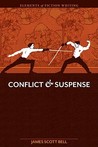
BOOK REVIEW: Conflict & Suspense by James Scott Bell

Conflict and Suspense (Elements of Fiction Writing_Conflict and Suspense (Elements of Fiction Writing_ by James Scott Bell
My rating: 4 of 5 stars

Amazon page


This is a book about the stuff that keeps readers reading. Without conflict there is no hindrance to a character achieving his or her goal, and thus no story. Suspense is a lack of clarity about what comes next that spurs the reader to keep exploring. Bell defines conflict and suspense, and then explores the various means by which these crucial features are conveyed in stories. I say in stories, but Bell is predominantly speaking to novelists with this book.

The book is divided into two unequal parts. The first, and larger, consists of fourteen chapters about conflict. The first few chapters describe conflict and how it is set up. Then Bell examines how the many dimensions of writing can be manipulated to fire up the tension, including: point of view, openings, subplots and flashbacks, dialogue, theme, style, and even editing. Chapter 14 suggests some tools that writers may employ to help them ratchet up the conflict.

The second, and shorter, part (8 chapters) delves into the topic of suspense. The organization follows a similar progression. First, Bell describes suspense through many potent examples. Second, he moves onto examine the various means by which suspense can be created. With respect to the latter, Bell suggests ways in which dialogue, setting, and style can be presented in order to create cliff-hangers. The last chapter pulls everything together to advise writers on the how to create stories that maximize conflict and suspense. This is in part a summary of the book, but it looks at the process more and the dimensions of writing less, and therefore offers something new as well.

Readers of Bell’s other guides may be familiar with the LOCK formulation that he uses in his “Plot & Structure” book. LOCK is an acronym for Lead (an intriguing opening), Objective (a goal of dire consequence), Confrontation (the battle for the objective), and Knock-out Ending (a conclusion that satisfies.) I mention this because one may find synergy in reading other books in the series. LOCK is not as central a concept here as in the “Plot & Structure” book, but it’s nice to have a common mechanism by which ideas are conveyed.

There’s not much by way of ancillary material. There are a few simple black and white graphics / diagrams. However, there is one nice feature in the form of an Appendix that analyzes conflict for two novels: “To Kill a Mockingbird” and “Silence of the Lambs.” These were good choices both because they represent literary as well as commercial fiction, and because they both have popular movie adaptations. The latter comment might seem like sacrilege to the “the book always beats the movie” crowd. However, using movies as examples—as Bell does here and there—offers the advantage that the average reader will have seen a higher percentage of good movies than they’ve read good books. This is even true for most us who read a ton because relatively few (if any) great movies come out each year and the history of cinema is much shorter.

I both enjoyed and learned from this book. Bell uses many excellent examples to support the ideas that he’s presenting, and this makes the book readable and easily digestible. I’d recommend it for writers of fiction who seek to put more zip into their creations.

View all my reviews

BOOK REVIEW: Low Back Pain ed. by Jeffrey N. Katz, M.D. [A Harvard Med School Guide]

Low-Back Pain: Healing Your Aching BackLow-Back Pain: Healing Your Aching Back by Harvard Health Publications
My rating: 5 of 5 stars

Amazon page


This guide is one in a series put out by Harvard Medical School. It’s the second one that I’ve read, and I found them both to be beneficial reads. The first was on the health benefits of tai chi chuan (a Chinese martial art / system of health exercise [qi gong.])

Harvard Medical School’s willingness to report findings about unconventional approaches and self-care was part of the appeal of this book. When I first developed lower back problems, I went to the doctor, was diagnosed with arthritis via x-ray, and all I got was an offer for pain killers. To me this was much like going to the mechanic because the check engine light came on, only to be told that all they could do for me is unplug the pesky indicator light. At any rate, that’s why this kind of book can be useful, because one can’t always expect a given doctor within the modern medical establishment to be on top of treatments not involving drugs or surgery. This isn’t to denigrate those options, often times they are the best or only option, and they are covered in this guide as well. However, back pain is one of those rare areas in which sometimes the best option is outside medical norms. Much as many doctors hate having information thrust in front of them by patients, at least Harvard Medical School may garner more respect than a WikiMD post. There’s even a box talking about the mind-body connection, and options in that domain.

Low back pain is both extremely common and often still poorly understood. That’s because there are so many problems that can cause similar symptoms. [I guess this shouldn’t be a surprise because our pelvis had to rotate through evolutionary changes to take us from quadrupedal to bipedal. It makes sense that our nerves and blood vessels might be routed in such a manner as to cause troubles.]

While this guide is short, it does take on a range of issues, including: who’s most at risk, how the spine works [and doesn’t], what the basic categories of back injury are, how one’s specific ailment may be diagnosed, how to evaluate treatment options, what one can do on one’s own to help heal a problem back while preventing future injury, what medicines may be prescribed, what surgical options may be offered, and advice on facilitating a recovery.

As far as ancillary features are concerned, there are a number of line drawings. This artwork is generally either anatomical drawings used to show how the spine works or is injured, or show exercises that one can use to strengthen the back. There are a few pages each of resources and glossary. The resources are not so much printed resources (there’s only one of book, and that one is authored by the editor of this guide,) but rather organizations and even websites.

I found this guide to be informative and helpful. I would recommend it for anyone who has low back problems, or who might benefit from learning more about them (e.g. yoga teachers.)

View all my reviews

BOOK REVIEW: Subliminal by Leonard Mlodinow

Subliminal: How Your Unconscious Mind Rules Your BehaviorSubliminal: How Your Unconscious Mind Rules Your Behavior by Leonard Mlodinow
My rating: 4 of 5 stars

Amazon page


If one tries to detect lies using conscious analysis, one stinks—wrong as often as right. However, if one distracts the conscious mind so as to produce what is often called a hunch, one performs much better. This is because not only is there is another mind below one’s conscious mind, but it’s better at many tasks than is our conscious mind. This will be hard news for many readers to take because they are reading and comprehending it with their conscious minds—a conscious mind that thinks it’s better than sliced bread when it comes to things that are awesome. Mlodinow’s book is about the many aspects of this mind that we generally don’t have access to (unless one is skilled in lucid dreaming or is conscientious in the hypnagogic state [on the edge of falling into sleep]—topics the author doesn’t get into.) It’s about why humans evolved to have subliminal mental operations, how they benefit us, and how they sometimes fail us.

Ideas about what the unconscious mind is have varied over the ages, though its existence has long been recognized. Ancient traditions often attributed the unconscious to the supernatural causes like a collective consciousness. Mlodinow begins his book with a chapter entitled “The New Unconscious,” presumably to distinguish it from Freud’s conception and to emphasize the wellspring of results that have come about during the last couple decades of brain research.

The second chapter deals with our sensory experience and the role that unconscious elements play in shaping it. People tend to overestimate the extent to which they experience a high-fidelity and high-resolution display of the world, and underestimate the degree to which the brain fudges to make it seem so. Facial recognition, which is one of the most fundamental of human skills, is a centerpiece of the discussion.

The third chapter discusses memory. Again, the underlying theme is how the brain can make mistakes as it tries to cobble together a story with a combination of information we have, blank spots, and guesses. One may be surprised to discover how poorly one is able to describe the details of things that one sees—if not every day—at least thousands of times in a lifetime.

The next chapter examines how our unconscious plays into our social life. The concept of a “theory of the mind” is at the center of this discussion—and it may not be what you think. Theory of the mind is the ability to figuratively see the world through the eyes of others, to understand justifications for what others have done, and to anticipate what they will do in the future. We also learn about oxytocin and vasopressin, the so-called “love hormones,” whose presence corresponds to our fond feelings for others.

Chapter five continues the discussion of the previous chapter along a specific line of discussion—that of reading people. We are wired to make sense of the facial expressions and non-verbal behavior of other people and this chapter explores that ability as well as its limits. Chapter six describes how we draw quick and unconscious conclusions about people on the basis of how they look, feel, and smell. By way of example, I’ll offer a case from another book I read recently (I don’t believe Mlodinow refers to this particular study, but I may be mistaken) in which a mock interview was set up. Right before their interview meetings, some of the individuals were asked to hold either a hot or cold coffee (or nothing.) It turned out that whether a subject had held a beverage (and what kind) had a profound influence on the interviewers’ feelings about that subject (i.e. the degree to which an interview subject was seen as a cold or warm person had as much to do with an unconscious evaluation of a handshake as it did the conscious interpretation of the individual’s personality.)

The next couple chapters (7 and 8) explain the crucial role of the unconscious mind in categorizing things and people, how that skill has been essential to our survival, and how this sometimes gets us in trouble (e.g. racism.) Chapter 9 delves into the role of emotions, and what the author calls “emotional illusions.” Sometimes we make a decision because we have an emotional experience associated with the decision scenario, but being in an emotional state that is unrelated to the decision still affects the decision.

The last chapter is about how our attachment to self can influence decisions. You’ve probably read about studies showing 90+ percent of the population think they are better than average at something. Also, you may remember from Psychology class a discussion of the self-serving bias (attributing positive outcomes to one’s awesomeness, while blaming external forces for negative outcomes.) This chapter deals in these types of phenomena.

The book has a few relevant black-and-white graphics as well as annotations / citations.

I found this book to be interesting, but not unlike many books that are presently available. I thought it could have ventured into more novel and interesting territory. There are actually a number of books that focus on how we are wired, and the glitches that result. Sometimes our evolutionary programming served us well under hunter-gatherer conditions, and sometimes it still serves us most of the time–but fails us on occasion. There are a number of books that discuss this–often using the same or similar examples as Mlodinow (e.g. consider Eagleman’s “Incognito.”) However, the ways in which the unconscious mind can be interacted with, such as lucid dreaming, are now being scientifically studied, and so there exists a capacity to move beyond the blooper reels of the mind—though that topic is certainly a popular subject, both of scholarly study and pop science books such as this one.

If you are looking for a book on how the unconscious mind both benefits and deceives us, this is a good choice. Mlodinow has a sense of humor and writes complex subjects in an easy to comprehend fashion. However, if you’ve read up on the subject, you might not find much new here.

View all my reviews

BOOK REVIEW: Inside Jokes by Matthew M. Hurley, et. al.

Inside Jokes: Using Humor to Reverse-Engineer the MindInside Jokes: Using Humor to Reverse-Engineer the Mind by Matthew M. Hurley
My rating: 4 of 5 stars

Amazon page


This book examines the science of why we find funny what we find funny. Most people probably feel about this as did E.B. White who said, “Analyzing humor is like dissecting a frog. Few people are interested and the frog dies of it.” Still, while analyzing humor may not be as fun as reveling in it, it’s fascinating to scientifically inquiring minds.

Humor is universal (not the humor of a specific joke, but the experience of somethings being humorous.) A skilled science fiction writer might conjure up an alien race that is credibly humorless. But it defies credulity that even the remotest of aboriginal Earthling wouldn’t giggle or guffaw at the sight of an off-course ball careening into an unsuspecting man’s crotch. Humor’s universality begs certain questions. First and foremost, one expects there to be some evolutionary advantage to a sense of humor. That evolutionary mechanism is precisely what Hurley, Dennett, and Adams attempt to demonstrate in this book. The authors suggest that the pleasure associated with humor is a reward for recognizing an incongruity, and they go into great deal to fill in the details needed to explain the panoply of things people find funny, while suggesting why alternate explanations are inferior.

While there’s a lot of frog-killing academic analytics and needlessly messy scholarly language, this book does offer a vast collection of examples of humor to support and clarify the authors’ points. So, unlike many books on evolutionary and cognitive science, this book does have a built-in light side. WARNING: there’s also a discussion of why some attempts at humor fail. This means one is also subjected to a number of puns, elementary school jokes, and comedic misfires that show the reader why sometimes humor implodes.

The book starts by building a common understanding of what humor is. It turns out that this isn’t simple because people find many different kinds of things funny–from caricatures to wordplay. (And, whatever the initial evolutionary purpose of humor, our species has run with that reward system to places that couldn’t have been readily anticipated.) Next, the authors discuss the many varieties of theories of humor that have been raised. This subject has been studied for some time, and thinkers have suggested that humor’s pleasure derives from a number of different causes from feeling superior to recognizing surprise–just to name a couple. After considering the competition, Hurley et. al. start laying out the basis of a cognitive / evolutionary explanation. In chapter five they describe 20 questions they think must be dealt with, and–in the last chapter (13)–they give their responses as a summation of the book’s main points. Along the way, the authors take on important related questions such as why humor sometimes fails, what others will see as the weakness of their argument, whether a robot could be humorous, and why we laugh. The last point opens another can of worms. Even if one concludes–as the authors have–that humor is a reward system for recognizing incongruities, the question of why there is an advantage to spontaneously announcing that recognition still arises.

There’re are a few graphics in the book, mostly these are cartoons and humorous photos that serve as examples. The book is published by MIT Press, so all the usual scholarly features of notes and citations apply.

I found this book to be thought-provoking, and the plentiful examples of jokes made it enjoyable to read as well. I’d recommend it for those interested in the science of the mind. It’s a bit dry in places for readers looking for light reading about humor.

View all my reviews