


Be fearful. Since I don’t play the usual lottery, the only kind I could win is the kind that they use to draft people for fighting alien invaders.
PROMPT: Lottery
Reply

Be fearful. Since I don’t play the usual lottery, the only kind I could win is the kind that they use to draft people for fighting alien invaders.
What will your life be like in three years?
I have no idea. That’s the beauty of life, and the curse of living during period in which technology will soon grow completely beyond our control. Life might be an ever-better version of what it is now, or I might be living in a cave trying to stay out of the way of the war between Skynet and our would-be Alien overlords. Or I might be farming in a world that has EMP’d itself back to the Stone Age to avoid being overtaken by technology. Nothing is certain but that change will come.
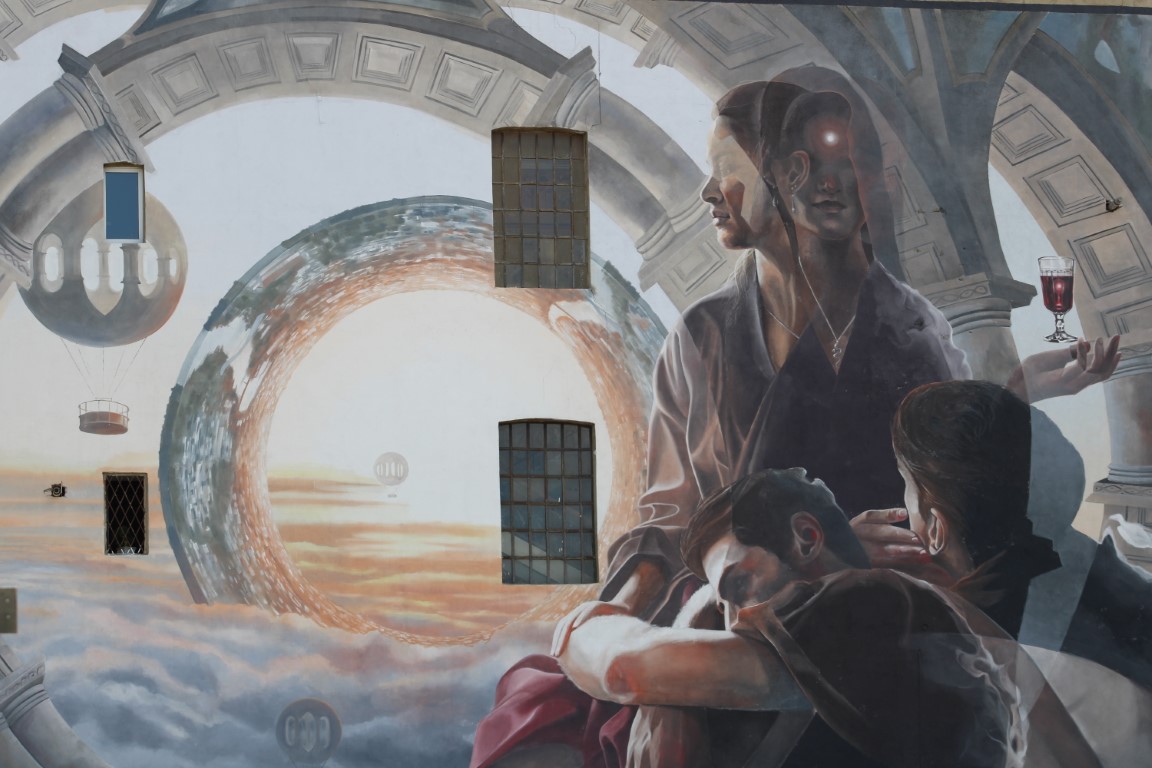
The chatter of little people
   Breaks on my purpose
 Like the water-drops which slowly wear the rocks to powder.
   And while I laugh
 My spirit crumbles at their teasing touch.
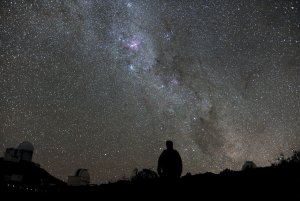
Source: European Southern Observatory (via Wikipedia)
Let me step up on my soapbox,
tell you about a paradox.
Said a scientist named Fermi,
“Why’ve no aliens made the journey
to bring us a nice fruit basket
or just tell us how fantastic
it is having us in the neighborhood.”
Scientists have racked their brains
considering competing claims:
“Life is hard and smarts is harder.”
“They can’t stock a trans-galactic larder.”
“They’ve come here, but are to small to hear.”
“They are shy, out of wisdom or of fear.”
Or, simply, “They all blow’d themselves to hell.”
I, too, have had reason to ponder
why aliens stifled the urge to wander
into our little neck of the wood,
and I fear we don’t come off so good.
What if, I ask you, heaven forbid
they think of us as the smelly kid?
Are we the seatmate who won’t shut up
about his robotic barbershop startup?
Do humans come across as the kind
to ask a stranger if they wouldn’t mind,
helping us move and antique armoire
or lending us their new flying car?
So when considering whether we’re alone of device or luck,
consider the competing hypothesis that we really suck.
My rating: 5 of 5 stars
Dawn is the story of a woman, Lilith, who awakens in the custody of aliens. This is no run-of-the-mill alien abduction. Lilith is one of a small number of human survivors of nuclear holocaust. The aliens are akin to a merchant ship that comes upon the survivor-baring life rafts of a sunken cruise ship—or at least they appear to be. They offer rescue, the hope of survival, and a promise to allow human survivors to rebuild their society in a low-radiation area of Earth when they are sufficiently trained in the necessary survival skills.
However, for Lilith the situation is not akin to shipwreck rescue because there’s a stark in-group / out-group conflict to get over. And it features the most challenging and terrifying out-group imaginable—an intelligent alien race. Lilith instinctively fears and distrusts the aliens. She discovers that she’s been awakened and put back in stasis on more than one occasion. While Lilith’s fear turns out to be unfounded, her distrust proves sound. The aliens genuinely want to help the humans and mean them no harm, but they do have their own plans and see a means to benefit from their interaction with humanity. While the aliens don’t lie, they do withhold information, only gradually doling it out as they see fit. As Lilith’s fear subsides and her trust–at least in a limited sense–grows, this restricted information is a constant source of tension between Lilith and her alien handlers.
While Lilith is initially terrified and completely incapable of interacting with the aliens, she does by gradual turns accept the truth of the situation and begins to interact with the aliens, trying to discover their end-game. Her (relatively) calm and open-minded nature was—in part–why she was chosen. She’s to be a liaison between other newly awakened human survivors and the aliens. She and the humans she has already awakened will be the only beings that the newly awakened humans will see until they are deemed ready by the aliens. Of course, this makes Lilith distrusted among her fellow humans. Most of them are frozen in a Cold War mindset and think they are under the control of the Russians, refusing to believe the “nonsense” about aliens.
The heart of this novel is about Lilith being unwillingly cast as both Uncle Tom and Judas Goat to her fellow survivors. She has powers, albeit limited, granted to her by the aliens, and these only make her more suspect. These include the ability to awaken humans from stasis and to reconfigure the area in which they live, but it also includes rapid healing and enhanced physical capacities. These are given her so she can hold her own against the hostile newly awakened. The aliens know there will be physically violent individuals because they experienced it firsthand. In fact, they are hoping that using Lilith as an intermediary will ease this proclivity. However, it does nothing of the kind, and instead makes Lilith and those who are close to her targets for the rest.
This book is sci-fi because it’s futuristic, speculates about alien life, and proposes a world in which amazing technological advances have been made. However, if there was a genre called psych-fi (psychological fiction), it might be more apropos. The heart of this story is about fear and trust, and how people treat in-group and out-group people and those seen as crossing over. It also addresses the issue of the dissolution of in-group characteristics and the innate fear that creates. What if humanity does not survive, but rather some race that is in large part human, but also inhuman?
Warning to the squeamish, there’s a recurring theme of attempted rape in the book. In the first case, this is visceral and believable. However, there’s a straining of credulity when people later are coming straight out of stasis and succumbing to their most base prurient urges. Sex is a powerful driver, but in such a situation it would seem that more immediate survival drivers would dominate. In other words, it has to be the rare horn-dog who wakes up from a 300 year stasis aboard an alien vessel, and the first thing he thinks of is getting his freak on.
I enjoyed this book and found it quite thought-provoking. The concept hooked me from the start. Butler’s use of language can be beautiful, but she doesn’t go overboard with elaborate language that distracts or bogs down the story.
This book could be enjoyed not only by fans of science fiction, but by those who like a good story in general and, in particular, those who like to think about what makes people tick.
It should be mentioned that this is the first book of a trilogy. The other books are Adulthood Rites and Imago, respectively. The entire trilogy, often called the Xenogenesis trilogy, can be purchased in one volume entitled Lilith’s Brood.

What if the world that we know
is just a two-bit reality show
or some high-def video game?
Wouldn’t it be terrible lame,
if we were the toys of an alien race
of underachievers from deep outer space?
What if our planet currently resided
on a beat-up, old card-table–lopsided,
in the basement of a strung-out dude
who sat around in a cloud in the nude?
What if all of the wonder and foreboding
is just the result of some skillful encoding?


 Tiger Riding for Beginners