POEM: The Patience of a Rishikesh Cow


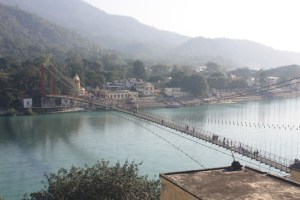
Feeling the steel bridge’s dampened spring underfoot.
Built for a handful of pedestrians,
but currently saddled with 60 —
along with six scooters,
one 125cc motorcycle
and a cow.

The cow is the most capable of insisting that a path
be cleared, and of clearing it.
Yet, in this city of sadhus,
it’s the only one not trying to crawl up anyone’s back.
Though it’s far more intimidating than the sickly, hoarse horn of the motorcycle —
drawn out in the way of terminally ill batteries.

The cow steps when a void opens and stands stoically when there is none.
Time seems to be a different experience for it than for its fellow travelers.

The bovine’s simple cortex knows one rule:
“If you can’t get where you’re going,
the only win is found in being satisfied where you are.”

And now I pray,
“Lord, grant me the patience of a Rishikesh cow.”

POEM: Dueling Grace of the Sun

The early morning sun warms the silvery shafts of a eucalyptus to a buttery yellow.

That seems a fine bit of grace,

until I see a hawk whose brown cowl is glowing gold in the same light,
as it perches watchfully on the one corner of a dilapidated building
that receives rising rays.

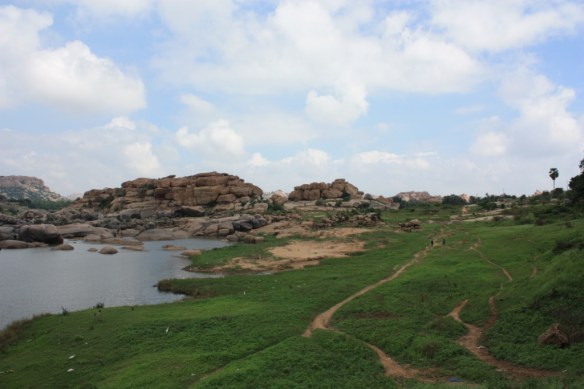
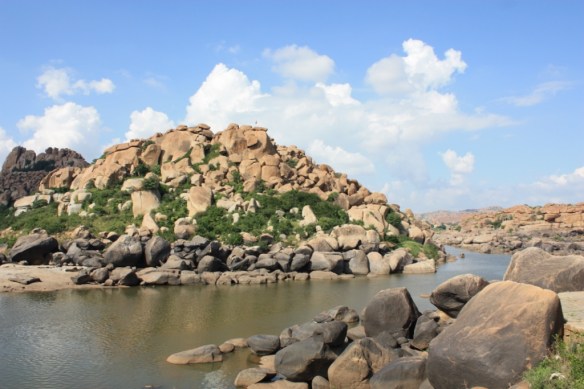
DAILY PHOTO: Tungabhadra River

Taken in November of 2013 in Hampi

POEM: Strange Country


There’s a strange country
tucked away in the mind.

One can stumble into it
without expecting to;
Have you been there?

I remember pounding a drum to echolocate reality.
But the spongy landscape swallowed all sound.

A spastic second of fury and neural fireworks seized me
before I was overcome by the sadness
that terror was my go-to response
in the face of the unfamiliar.

What if I’d decided to be exhilarated?

Could one rise from the dead of living?

And so it came to be that the strange country cracked open,
giving birth to a world anew.
And leaves and rocks glittered with a cleansed glow.
And familiar country was suffused with an aura of novelty.

DAILY PHOTO: Observation Hill, Amboseli N.P.

Taken in May of 2017 in Amboseli National Park

DAILY PHOTO: Little Winter Scene, Pecs

Taken in December of 2014 in Pecs, Hungary.

POEM: A Mythical Child of the Corn

Whenever I tell anyone that I grew up on a farm,
I get a certain reaction,

“REALLY?”

As if, of all the lies I could tell, that’s the one I’d pick.

You believed me when I told you I’d met the original Hamburglar,
but not that I grew up on a farm?

[Incidentally, I did meet A Hamburglar, but I’m pretty sure it was a sweaty teenager with limited job prospects.]

I don’t really think these people think I’m a liar.

Perhaps they thought farms are like Conestoga wagons and cave paintings,
quaint reflections of simpler bye-gone days.

Maybe they thought their corn chips were grown in petri dishes in a subterranean factory.

[Bad example. Maybe corn chips are manufactured that way, but I’m pretty sure somewhere there is a hose through which good old Hoosier-grown corn is fed in; maybe it’s just defective kernels that weren’t salable to the makers of feed for hulking Angus cattle, but still…]

Anyhow, I suspect they are just excited to come across someone so rare — if in a workaday way.

It’s nothing like meeting Neil Armstrong or Beyoncé,

but rather like meeting the guy who did Neil Armstrong’s tire alignment or who cleans Beyoncé’s fish tanks.

A mundane superstar.

A mythical child of the corn.

BOOK REVIEW: The Ministry of Utmost Happiness by Arundhati Roy

The Ministry of Utmost HappinessThe Ministry of Utmost Happiness by Arundhati Roy
My rating: 5 of 5 stars

Amazon page


This is a well-crafted and engaging novel, but it’s not about the utmost of happiness. That may be apparent to most readers by the juxtaposition of bureaucracy and happiness, which seems to fit together like “the cross-fit box of pleasure” or “the playground of misery.” Perhaps, a line from one of the characters in the first one-third of the book offers insight into the book’s true perspective on happiness. That first bit of the book revolves around the life of a hijra (i.e. intersex and transgender people — in her case hermaphroditic.) At any rate, one of the other hijra tells the main character that the reason that god invented hijra is to see what happens with people who can only be miserable [I’m paraphrasing.] Ostensibly, this character means that people who have no choice but to live and create sub-communities at the periphery of society, and who never feel completely at home in their skins can’t be truly happy.

While the first one-third of the book features this hijra, Anjum, the latter two-thirds explores a quartet of characters who were friends in college. At the center of this group is Tilo, a female who is the object of the affection of the other three — all men. One of the others is a diplomat who becomes a raging alcoholic. The reader is led to believe the alcoholism is more because of the stress of what he’s exposed to on the job than because of an addictive personality. He is also Tilo’s landlord for a time. One is a well-known reporter and the son of a high-ranking diplomat. He will be married to Tilo for a time. The last, Musa, is an architect who ends up becoming an insurgent in Kashmir. While Tilo holds all three men in warm regard, it’s only the latter that she truly loves. Most of the story revolves around events that happen in Kashmir when Tilo goes to see Musa during a particularly heart-rending time in the modern history of that place.

The book brings these two character arcs, Anjum’s and Tilo’s, together as the result of an abandoned baby that Tilo snatches, presumably in an ill-considered attempt to right the worst of the wrongs she learned about in Kashmir. Anjum, whose desire to be a mother we see from an experience with a child she’d earlier come into the charge of, becomes a partner in Tilo’s venture.

The book is largely about how people go about living after being exposed to the worst life has to offer. Besides Tilo and Musa’s experience of tragedy in Kashmir, Anjum is caught up in riots in Gujarat in the wake of the Godhra train burning, and we learn that the abandon baby’s story is tied into the Maoist insurgency of the Northeastern states.

This book hooked me. I found it thought-provoking as well as gripping. I would highly recommend it for readers of fiction.

View all my reviews

DAILY PHOTO: Japanese Covered Bridge, Hoi An

Taken in December of 2015 in Hoi An.

Built in the 1590’s by the Japanese to connect the Japanese and Chinese quarters.

BOOK REVIEW: Superhuman by Rowan Hooper

Superhuman: Life at the Extremes of Our CapacitySuperhuman: Life at the Extremes of Our Capacity by Rowan Hooper
My rating: 4 of 5 stars

Amazon page


There are mounds of books out on the science of maximum human performance, be they on mind-hacking, sports & exercise science, or some combination thereof as applied to a particular pursuit. Hooper creates his niche by way of a broad and varied selection of topics, including: language learning, singing, running, achieving longevity, and sleeping. For the reader who is interested in the topic of how top performers in a given domain achieve that supernormal performance, it makes for an interesting read. However, it may leave some readers scratching their heads as to who the book is aimed at. It should be noted that several of the topics addressed are of much more broad-ranging appeal than those I mentioned (e.g. focus / attentiveness, bravery / courage, and resilience.)

The book is divided into three parts on “thinking,” “doing,” and “being,” respectively. The four chapters in the first part investigate the heights of intelligence, memory, language, and focus. The chapter on language deals with how some people are masterful polyglots, speaking many languages, as opposed to the harder to investigate question of how someone becomes William Shakespeare. Throughout the book, there is a mix of stories and interview insights from those who are peak performers as well as discussion of what scientific studies have found. The former makes up the lion’s share of the discussion, and the central question with of science is how much of peak performance is genetic and how much is built.

Part II, on doing, has three chapters, exploring the topics of bravery, singing, and running. This is where one really sees the book’s diversity. Books like Amanda Ripley’s “Unthinkable” address the question, among related questions, of why some act heroically, and there are a huge number of books on how to be the best runner or singer one can be, but not a lot of books take on all three questions in one section. The book on singing focuses on opera singers who belt out their tunes largely sans technology – i.e. there’s no Milli-Vanilli-ing L’Orfeo. The chapter on running gives particular scrutiny to endurance running.

Part III investigates why some people live longer, are more resilient, sleep better (or do well with less sleep,) or are happier. Since Buettner’s “National Geographic” article on “blue zones” (i.e. places where a disproportionate percentage of the population live well beyond the average human lifespan,) there’s been a renewal of interest in what science has to say about longevity. As mentioned, the chapter on sleep covers the topic from multiple vantage points. Everyone needs sleep, but some perform best with ten or more hours of sleep while others are extremely productive on four hours a day, and some can cat-nap periodically through the day while others need a single extended and uninterrupted period of sleeps. Wisely, Hooper doesn’t simply take on the question of why some people are happier than others in the book’s last chapter, but rather he asks the more interesting question of why some people who have every reason to be morose (e.g. paralyzed individuals) manage to be ecstatically happy.

The book has a references section, but there isn’t a lot of ancillary matter (i.e. graphics, appendices, etc.) It’s a text-centric book that relies heavily on stories about Formula-1 racers, opera stars, ultra-marathoners, and other extraordinary individuals while investigating the subject matter.

I enjoyed this book. I am intensely interested in optimal human performance across a range of skills and characteristics. So, I guess when people inevitably ask who the book is directed at, it’s directed at me and others with this strange fascination. If you have that interest, it’s for you as well.

View all my reviews