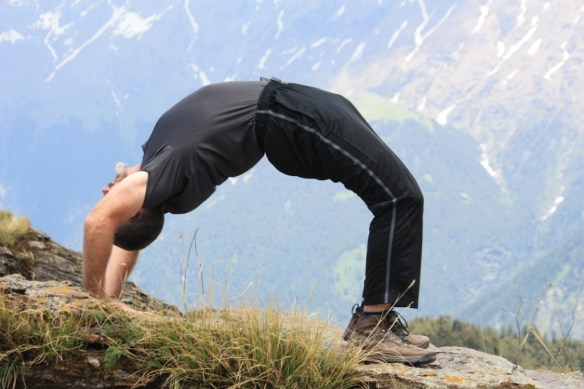
Chakrasana (Wheel Pose) in Himachal Pradesh
There are a few challenges that I observe regularly regarding back bends. Back bending poses can be difficult for a number of reasons, running from spinal processes (the bony projections on the back of a vertebrae) that simply won’t allow much range of motion to anxiety that may prevent practitioners who have the range of motion from performing these poses because of fear of falls or injury.
5.) Range of motion in the shoulders in Wheel pose (Chakrasana): The most frequent difficulty I see with wheel pose is an inability to get the hands under the shoulders when one lifts up into the pose. In the picture above, notice how one can see the face (or at least the nose and chin) forward of the arms. Often the head is well inside the arms, and this means that one is trying to hold oneself up with an unfavorable alignment. Physics isn’t on your side. Parents who’ve tried to hold a baby with a poopy diaper at arm’s length will know how heavy an otherwise light child can be when cantilevered out from the shoulders. Same idea with trying to do wheel pose with hands that aren’t under the shoulders.

Bhujangasana (Cobra Pose); note: navel on floor and arms bent

Urdhva Mukha Svanasana (Up Dog); Note: weight is all on tops of feet and palms, i.e. thighs / knees are off the ground
4.) Mixing up Cobra pose and Up Dog: This is probably the most common back bending problem that I see. Practitioners straighten out arms in Cobra pose (with thighs resting on the mat.) Why is this a problem? Because, unless the individual has the spine of a Beijing acrobat, the practitioner will have a huge kink in his or her back and one spinal process will be ramming into the spine below it. One needs to lengthen the spine as one stretches it in order to avoid kinks (all the bending coming at one point with a great deal of pressure at that spot.) One can straighten the arms in up-dog because the spine is elongating downward by virtue of the legs hanging rather than resting.
A major cause of this problem seems to be that individuals with hyper-kyphosis (excessive rounding of the chest region of the spine) have great difficulty lifting up their chest because they are working against that excessive rounding. (And increasing numbers of people have this condition.)
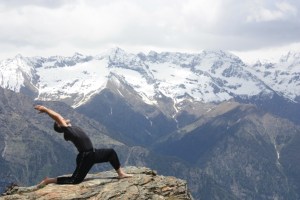
“Ears between the arms,” the constant refrain.
3.) Excessive neck bending: If an individual doesn’t have a large range of motion in her spine or is anxious about back bends, many times she will tilt her head back to create the impression of back bending. This can cause undue strain on the neck, not to mention delusions of spinal flexibility.

Vrischikasana (Scorpion pose)
2.) Don’t forget the psychology: I must admit, I’ve only ever taught scorpion pose in kids’ classes, but I’ve taught it in quite a few such classes. Kids love it as much as adults find it terrifying. As I’ve mentioned several times, some practitioner’s problem with back bends is rooted more in anxiety than anatomy. What I’ve come to realize is that it’s important to treat both of those causes with respect and compassion.
This may be an extension of my realization that it’s important to treat with compassion those whose weakness is strength, just as does one whose weakness is weakness. “Weakness is strength?” That doesn’t seem to make any sense. But the first “weakness” I’m referring to is yogic weakness — i.e. having a turbulent mind. Yogic weakness can result from weakness in terms of being frail and fearful of injury, but it can also result from delusions of grandeur and other mental handicaps that result from being strong.

Bactrian Camel in Nubra Valley
1.) Go to the Himalayas, and try a camel: The options abound.
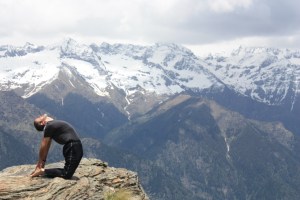
Ustrasana (Camel pose)
Share on Facebook, Twitter, Email, etc.


