
Taken in November of 2018 in Udaipur


 The Book Thief by Markus Zusak
My rating: 5 of 5 stars
One might think that a book narrated by Death and set in Nazi Germany during the Second World War would be bleak from cover to cover. But one would be wrong. “The Book Thief” heaps hope and humor upon the reader, saving tragedy for the final course – besides a few sprinkles throughout. It’s not that the story lacks a tension born of many close calls and morally compromised situations, but it’s a very human story – with the appropriate mix of blemishes and beauty.
The protagonist is a girl named Liesel who is sent to live with foster parents during the first year of World War II. Traveling to meet her new family, her brother dies, leaving her alone with new parents in a new city on the doorstep of the most lethal war in human history. In the cemetery, after her brother’s impromptu funeral, Liesel finds a fallen book and keeps it. It’s the first of several books she will “steal,” acts that will define her but which are comic sins in the shadow of the mass murder in progress. Fortunately, Liesel’s foster parents are salt of the earth folk. They aren’t wealthy or erudite, but they offer Liesel a loving home. It’s a little harder to see this affection in her foster-mother, who has a stern and gruff exterior — in contrast to her papa who is endearingly sympathetic.
The story is about this family, and others in the neighborhood, trying to get through life under a regime they recognize as tragically absurd, but which is terrifying none-the-less. Besides surviving, characters like Liesel’s papa try to do the right thing whenever they can, in whatever way won’t get them killed. Life gets harder as the war wears on. Liesel’s papa is a house painter, an occupation that is not a year-round occupation in Germany. Liesel’s mother does laundry, a luxury that most can’t afford as the war rages. On the other hand, this doesn’t make them worse off than most of the others on Himmel Street, which is – figuratively speaking – on the wrong side of the tracks.
While this is an engaging story, Death as narrator is the feature that really makes this book exceptional to me. Much of the lightness and humor comes from the fact that the narrator is not grim, but rather has humor and a stilted form of humanity about him. From a narrative perspective, Death offers a unique point of view, but it’s the circumvention of expectations that comes from the fact that Death can recognize the tragedy of what is unfolding before him. He’s not emotional about it in the way a human would be, but neither does he ignore the brutality and absurdity of it. The other factor that catapults this book beyond the realm of run-of-mill war story, is how the desire for literature and learning — which would usually be lost in a war story’s struggle for survival – is given a prominent role.
I enjoyed this book immensely. It’s an intensely human story, neither saturated in sorrow nor ignoring the horrors of war and genocide. I highly recommend it for fiction readers.
 It’s Not Magic by Jon Sands
My rating: 4 of 5 stars
This is a collection of (mostly) prose and free verse poetry. The content is largely autobiographical in nature. Sands was one of five winners of the 2018 National Poetry Series award, winning with this title.
My own impression of “It’s Not Magic,” is that it started stronger than it finished. I can’t say whether that was because it’s truly more brilliant up front, or whether I just tired of its approach and tone. If you’re accustomed to poetry which shows you the universe larger and louder than life, and in which one has to strain to glimpse the poet, that’s not what you’ll find here. This is a kid jotting about things that happened in his life and insights he’s had. I credit the work that it’s not so angsty that it takes one out on the ledge. It’s cleverly cynical in places, and in places it’s reminiscent of Beat poetry.
I don’t know how useful recommendations are for this type of work. I think some will love it, and for others it will be just, “meh!” Hopefully, I’ve given some insight into which category you are likely to fall, but – if not – I understand.

Taken in June of 2011 on Stone Mountain

the carcass of an ancient inn
rests in a valley green
weary voyagers would long trudge
by the time it was seen
through a pass and round a bend
shaded by stark snow-caps
caravans moved by sight and coots
without a guide or maps
I heard the Buddha from the banks
of a river gently flowing.
Long before throngs swelled his ranks,
in the days of heaven knowing.
I sought the ferryman to cross,
to hear more than a faint mumble.
I felt missed words as a great loss,
and was made both mild and humble.
But, having missed that wise sermon,
my own truth I must determine.

Taken in the summer of 2008 in Tokyo

Taken in the summer of 2011 in Budapest
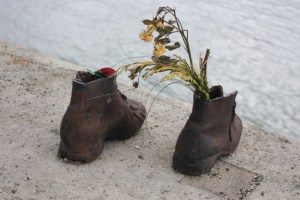 On a moonlit midnight —
between the bands of rain —
stretched a mile of murder.
Marched through the night
to keep day roads clear for troops,
Fascists sought to free themselves
of the ugly evidence of their crimes.
But sweeping the weary and woebegone
under the rug is not a rapid task,
and so a mile of murder
mass migrated towards the morn.


