BOOK REVIEW: The Great God Pan by Arthur Machen

The Great God PanThe Great God Pan by Arthur Machen
My rating: 5 of 5 stars

Amazon page


This speculative fiction novella mixes horror and sci-fi in a genre-bending work of intrigue. When I started the book, I was surprised to learn that it was from the last decade of the 19th century. The opening chapter, which is what I credit as science fiction, presents an argument that reality as we know it is just a veneer beyond which we cannot experience, and it’s stated not unlike what one would hear in today’s cutting-edge science and philosophical discussions. (e.g. It wasn’t greatly removed from what one might hear from Donald Hoffman, for example.) The mad scientist of the opening chapter proposes that he can, with “minor” neurosurgery [to the extent there is such a thing,] open the doors of perception to make available what lies beyond our reality. We are left to think that he has only succeeded in a lobotomization.

The rest of the book is more the Victorian Era horror that one is likely to hear the story described as. We are introduced to a series of mysteries that will gradually be tied together and related back to the book’s opening. A gentleman is approached by a beggar who – it turns out – was his classmate and should have been a well-to-do landowner, but who reported being ruined by having fallen in with the wrong woman – a not unusual story until one delves into the particulars. We further learn that a man had been found dead at this couple’s property before the woman disappeared. Later there are a series of murders that have a certain demographic of society all atwitter.

Despite the shortness of the work, it does present jumping perspectives (not within chapters, but between them.) However, it’s not hard to follow, though it’s a bit jarring when the first PoV change hits because it involves a new cast of characters and it isn’t clear how the events tie together. The reader who sticks with it will be benefited by the shift.

This book was widely panned in its day, more for its shocking sexuality than its horror elements. However, it should be pointed out that the author uses strategic ambiguity for this matter, so there is no graphic sexual content. For example, one character may whisper in another’s ear the acts of depravity, but the reader is left to fill in the blanks according to the twistedness of their own particular psyche. For readers who enjoy the freedom to fill in the blanks, this is an interesting approach – others might not like the withholding of detail.

I enjoyed this book. It’s readable, despite the era from which it came. As I said, in some sense, it’s ahead of its time. The non-linear plotting builds the up the intrigue nicely. I’d highly recommend it for readers of weird stories, horror, or speculative fiction.

View all my reviews

POEM: Cave Days

Stars framed by the dropped rock chasm in the cave roof.

A smoky man and smoky woman sit,

staring up at that rhomboidal field of stars —

a window to the infinite.

They can’t imagine by what means the picture has changed,

when they awake in the middle of the night.

But neither can they grasp how tongues of flame eat wood and glow heat,

and yet they’ve learned to spark fire.

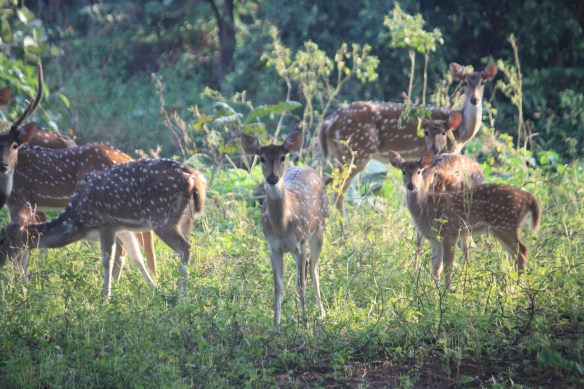
DAILY PHOTO: Spotted Deer, Gir NP

Taken on November 29, 2019 at Gir National Park

DAILY PHOTO: Sea Wall, Diu Fort

Taken December 1, 2019 in Diu.

565CE030-023E-4FDA-88FD-42BEFBCA26A2

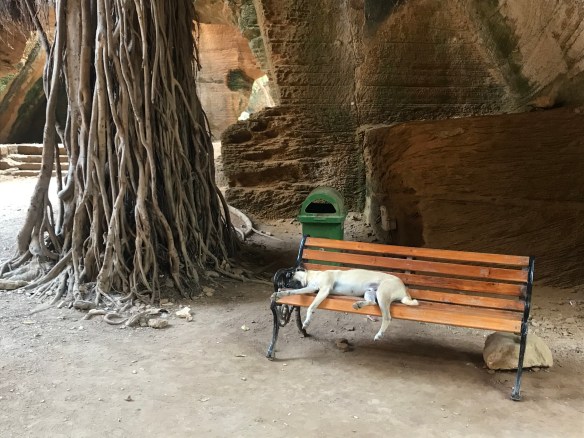
DAILY PHOTO: Dog on a Bench, Naida Caves

Taken on November 30, 2019 in Diu.

4C45FED3-0A4D-404B-B500-E317500908EE

DAILY PHOTO: Laxmi Parque, Diu

Taken November 29, 2019 in Diu.

3F6A6DFA-A13F-4E25-8792-A9BF88858C41

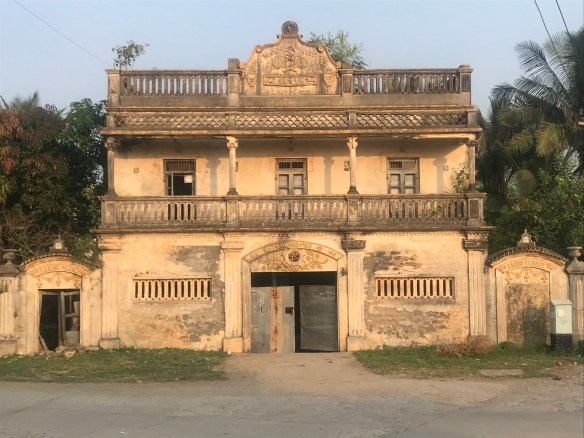
DAILY PHOTO: Temple Gate, Kolar

92927D0D-ED06-424D-A73F-97CD549C4141Taken in Kolar in October of 2019.

My Year of Discovering How Weird the Mind Gets, Pt. XI [Chanting]

Some people swear by the mind-altering properties [and other benefits] of chanting mantras. I’ve been reading a review copy of Kulreet Chaudhary’s “Sound Medicine,” a book whose play-on-words title says it all. It’s about the way sound is either shown or speculated to have health effects. (Full-disclosure: Some of the speculation gets a bit out there.)  Chaudhary is both a medical doctor and an Ayurvedic practitioner, and has an outlook akin to that of Deepak Chopra.

Chanting has never been my thing. I’ve learned about it and done some in yoga training, but I can’t say it ever resonated [no pun intended] with me. However, in the spirit of investigation, this month I did a few one hour and half-hour sessions of chanting. I kept it very basic, chanting AUM as I was taught with equal parts of A – U – and – M.

While I can’t say that I’m sold that chanting is the ultimate practice that achieves outcomes unachievable through other means, I will say that after these sessions I do feel a sense of calm and clarity. I can certainly see why mantra chanting has appeal for so many people, even though I also believe that, sadly, it’s sometimes oversold as something supernatural and the discussions about it are needlessly complicated.

DAILY PHOTO: Jáki Kápolna, Budapest

Taken in the summer of 2011 in Budapest.

BOOK REVIEW: A Stranger Truth by Ashok Alexander

A Stranger Truth: Lessons in Love, Leadership and Courage from India's Sex WorkersA Stranger Truth: Lessons in Love, Leadership and Courage from India’s Sex Workers by Ashok Alexander
My rating: 5 of 5 stars

Amazon page


In 2003, Ashok Alexander left a prestigious job at the advisory firm McKinsey and Company to head up the Gates Foundation’s HIV/AIDS prevention program for India. He had no experience in public health and faced an HIV prevention challenge on a scale and of a nature that hadn’t been seen before. This book describes his experiences — and sometimes those of others in Avahan (the Indian HIV Prevention program.) However, the emphasis isn’t on patting himself and his team on the back so much as pointing out the lessons they learned from the high-risk populations they served – mostly sex workers, but also their clientele, as well as intravenous drug users.

The nineteen chapters of this book are arranged into two parts. The first part (Ch. 1 thru 11) explores Alexander’s travels around the country to meet with various high-risk groups and learn about their needs. The second part (Ch. 12 thru 19) takes a deeper dive into the building of Mysore’s program, Ashodaya, which became a global educator on HIV prevention.

Part one offers insight into bits of India that most of us never see. When I mentioned that the problem in India wasn’t just it’s large size, but also the peculiar nature of the environment, that can be seen throughout these chapters. What do I mean by the peculiar nature? In India, not only is prostitution rarely practiced in brothels, but sex workers are largely indistinguishable from the general population. The biggest portion of the group is women in saris who look like much of the female population. Also, the societal stigma is great, which creates all the more incentive to not let your work be known. For these reasons, just finding the at-risk population was challenging, they were dispersed and hid in plain sight. There were also problems of thinking that ranged from politicians who wouldn’t admit there was potential for massive HIV / AIDS in India because they insisted that Indians don’t engage in any of the “immoral” acts seen elsewhere in the world, to johns who honestly believed that drizzling lime juice on one’s manhood would prevent infections.

Among the most intriguing chapters in part one are those that reveal the issues with long-haul truckers (the single biggest demand-side high-risk population), intravenous drug-users in the golden-triangle adjacent states of the Northeast (i.e. Manipur and Nagaland,) and one that explained the unique cultural traditions of the transgender populations in India. There’s also a chapter (Ch. 6) that discusses the leadership traits that were found among the sex workers.

Part II, which dealt with the Mysore program, also had its fascinating elements. Two of the chapters discussed the life stories of two particular sex workers (one female and the other male) who worked in the Ashodaya program. There was also a chapter that dealt with the discussion of violence. That might seem like a diversion, but apparently violence and lack of prophylaxis go hand-in-hand, and had to be dealt with together.

The book has an Appendix of general information on HIV / AIDS and its occurrence in India. Other than that, a few maps and annotations are the extent of the ancillary matter.

I found this book fascinating — if heartbreaking in places. As someone who’s lived in India for over six years, there was a great deal of insight offered into segments of the population of which I had little awareness. Even learning about the trucking industry (divorced from the sex work / HIV angle) was intriguing. I’d highly recommend this book if one is interested in the topics of: leadership, public health, or the unseen side of India. The author uses a narrative approach throughout to great effect.

View all my reviews