Balance & the Value of Learning to Fall

I saw something sad in the park this morning. A boy was trying to learn to ride a bicycle, but I could see that he never would — not with his present approach. Why? He had one training wheel, and the bike was leaning about 15-degrees off vertical as he struggled to use the bicycle as a tricycle. I could see that the metal arm that supported the training wheel was starting to bend from the strain — thus making the lean ever more pronounced. [Incidentally, with two training wheels, I think he might rapidly learn to ride because he’d experience tipping from one side to the other, through the balance point.]

I’ve told yoga students before that there are three timelines for learning inversions (upside-down postures, which all require one’s body to learn to balance 180-degrees out of phase with the balance we all mastered as toddlers.) The first timeline is if you are willing to learn break-falls (i.e. how to safely land when — not if, it will happen — one loses balance.) If so, one can learn any inversion (that one is otherwise physically capable of performing) in an afternoon. Second, if one gets near (but not up against) a wall, and only uses the wall when one is falling towards over-rotation, then one can learn the inversion in a month — give or take. Finally, one can lean up against the wall for a million years and one will not spontaneously develop the capacity to independently do the posture. Why? Because one’s center of gravity is outside one’s body, which means one is in a perpetually unstable state, and one cannot stabilize into a balanced position from a state of falling (and leaning is just falling with a barrier in the way.)

Finding balance requires that the body be able to adjust toward any available direction to counteract the beginning of a fall in the opposite direction. I was fortunate to have studied a martial art that required learning break-falls from the outset, this made learning balances (not just inversions, but also arm balances, standing balances, etc.) much easier because there was no great concern about falling. I knew my body could fall without being injured.

Without falling there’s no learning balance, and if you only fall into the under-rotated position, you are still not learning to achieve stable balance. At some point, you will need to experience the dread fall towards over-rotation.

Time to ditch the training wheels.

BOOK REVIEW: A Very Irish Christmas by Various

A Very Irish Christmas: The Greatest Irish Holiday Stories of All TimeA Very Irish Christmas: The Greatest Irish Holiday Stories of All Time by Various
My rating: 5 of 5 stars

Amazon.in Page

Out: September 14, 2021

This anthology contains fourteen previously published pieces by prominent Irish authors, including: Joyce, Yeats, and Colm Tóibín. It’s mostly short fiction, but there are a few poems as well as a couple of excerpts from longer works. All the pieces are set around (or reference) Christmas, but the degree to which that plays into the story varies a great deal. The anthology is very Irish, but not always very Christmassy. Meaning, if you’re expecting a collection of pieces like Dickens’ “A Christmas Carol” where the joy or melancholy of the season is front-and-center throughout and the holiday, itself, is a pivotal story element, you won’t find that in a number of these selections. Often, the season is just an element of ambiance or of short-lived emotional resonance.

That said, the selections are all artfully written and each is intriguing in its own way. In the case of Joyce’s “The Dead” the appeal is the evocative language and creation of setting (though the piece does have more explicit story than, say, “Ulysses.”) Whereas, for pieces like Keegan’s “Men and Women” or Trevor’s “Christmas Eve” the point of interest might be the story, itself. Besides the Irish author / Christmas reference nexus, the included works cover a wide territory including contemporary works (keeping in mind the authors are mostly from the 20th century) and those that hearken back to days of yore. Some are secular; while others are explicitly Catholic.

I enjoyed this anthology, finding it to be a fine selection of masterfully composed writings.

View all my reviews

Yellow Cosmos [Haiku]

butterflies land,
but don't loiter, upon
buttery petals

March of the Myna [Common Meter]

A Myna bird comes marching in;
it'll soon rule the roost.
It seldom fails to have its way
anyplace it's introduced.

The goggle shapes around its eyes
make its stare more intense,
but compare it to a raven;
you'll see it's pure pretense.

Like kudzu and cockroaches,
they can't help but run amok.
Should they come to your neighborhood -
well, that's just your luck.

DAILY PHOTO: Wat Khao Rang & Its Big Ole Buddha

Taken at Wat Khao Rang in December of 2014

BOOK REVIEW: Hipparchus by Plato

HipparchusHipparchus by Plato
My rating: 5 of 5 stars

On-line

In this Socratic dialogue about “lovers of gain,” Socrates and an unnamed friend debate whether pursuing gains can be wicked. Usually, the title of a dialogue is the name of Socrates’ philosophical sparring partner, but, herein, Hipparchus is a historical figure who Socrates cites as the reason he wouldn’t hornswoggle his friend, quoting “Walk with just intent” and “Deceive not a friend” as credos that he, Socrates, lives by.

The friend tries a number of approaches to argue the loathsomeness of lovers of gain. Recognizing the starting premise will be that a gain is a good, the friend argues that such people (presumably greedy / materialistic types) purse valueless gains. Socrates attacks that as an oxymoron. Next, the friend argues that lovers of gain seek gains that no honorable man would pursue. Again, Socrates argues that a gain is a good and all humans seek good. Since the friend doesn’t want to call the lovers of gain fools (i.e. unable to recognize a gain when they see it,) the friend is stuck. The third approach is to argue that a wicked gain could be considered a loss. This is also swiftly rebutted. The last tack is to argue that some gains are good, while some are evil, which runs afoul of the same argument.

This isn’t one of the best dialogues – in fact, many question whether it was written by Plato. That said, it brings up a few ideas that are worthy of consideration. It felt very much like a conversation I once heard in which a young woman argued, “No one should have that much more than they need.” Which drew the response, “You realize that 90% of the world would say you have tons more than you need?” Which resulted in the instigator walking off in a huff. If you want to engage in debates about the virtue (or vice) of wealth acquisition, this might be a good place to begin your reflection.

View all my reviews

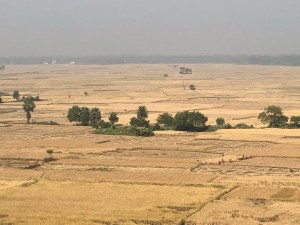
DAILY PHOTO: Rice Field in Rural Thailand

Taken in October of 2012 near Chiang Mai

BOOK REVIEW: Lovers by Plato

LoversLovers by Plato
My rating: 5 of 5 stars

B&N Page

Alternately titled “Rival Lovers,” “The Lovers,” or, simply, “Lovers,” this is one of the Socratic dialogues whose authorship by Plato is in doubt. While it follows the general approach of Plato’s dialogues, it does present a few anomalies, and so some experts include it while others do not.

In the dialogue, Socrates questions two youths, one athlete and one scholar, on the nature of philosophy, whether it is honorable, good, useful, and of what its study should optimally consist. The dialogue opens with Socrates questioning the athlete about what two other young men are discussing, when the athlete suggests that it’s just navel-gazing, Socrates asks the athlete whether he believes philosophizing to be a shameful endeavor. He does, and Socrates ends up spending most of his time questioning the scholar, who has a more flattering view of philosophy.

The scholar proposes that philosophy is learning, and that the philosopher should learn about all subjects – being the intellectual equivalent of the all-around athlete from athletics. Socrates challenges this by suggesting that the philosopher cannot be both useful and a generalist as the scholar claims because then the philosopher will always be of secondary value to the expert. Socrates seems to be setting up that there must be some expertise of philosophy about which the philosopher would be the first-tier expert. In other words, if philosophy is a worthwhile endeavor, there must be some reason that people would seek out a philosopher, rather than someone else. The dialogue ends abruptly, and does not engage in this question. (The ending is one of the reasons why authorship is in question, but it’s not the only Socratic dialogue to set out food-for-thought and leave it on the plate.)

Despite the unclear authorship, I found this dialogue to be worth a read.

View all my reviews

BOOK REVIEW: Cocaine Coast by Nacho Carretero

Cocaine Coast: A Luis Bustos Graphic NovelCocaine Coast: A Luis Bustos Graphic Novel by Nacho Carretero


Amazon.in Page

Out: September 28, 2021

This is a graphic novelization of a journalistic account of smuggling in Galicia, a jagged coastal region of rocky inlets to the north of Portugal. This region’s entrance into smuggling began not with illicit drugs, but rather with cigarettes that were bootlegged to evade taxation. However, it wasn’t long before it was discovered that this supply chain could be exploited for illegal drugs, notably Columbian cocaine. The Columbian cartels would become a major player in the region and Galicia would become the single biggest entry point for cocaine into Europe.

This mix of graphic novel and journalism is a bit strange, but it does have its advantages. For example, maps and drawings of the coast offer a sense of how geography played into smuggling operations. The art combines a gritty style optimal to the narco- world, but with some beautiful layouts. And, the art does a good job of conveying the changing time periods, as this book covers decades of activity.

I found the book intriguing, with many insights into the hidden world of narcotics smuggling in a location that is famed for its natural beauty. There is a prose appendix that is also compelling. It discusses the response to the book (by criminals, police, and the general public, alike) and what impact that response had (and / or didn’t have) on smuggling in the region. If you’re curious about the business of narcotics trafficking, you’ll likely find this an interesting read.

View all my reviews