The Midnight Circus was not as it seemed. It was bright colors: motion-blurred. It was the tinny monotony of music box-style tinkling tunes & organ tones. One could even make out the scent of fried foods and cotton candy, among the many other [uncircus-like] odors. But there was also the story a mind wrote to dance sensory facts into sensory fictions; that was where the falsity lie. If one opened one's eyes, letting them focus: there'd be sparking wires, & flames licking ever closer. The shrill organ tones would become screams. The summer night's humid heat would become third degree burns. The circus smells would become dust and death and acrid burnt combustibles. So, he didn't open his eyes to war or his impending demise, but let his mind march into that big musty, canvas tent, surrendering to its irreality.

Category Archives: War
Mustard Gas Memories [Tanka]
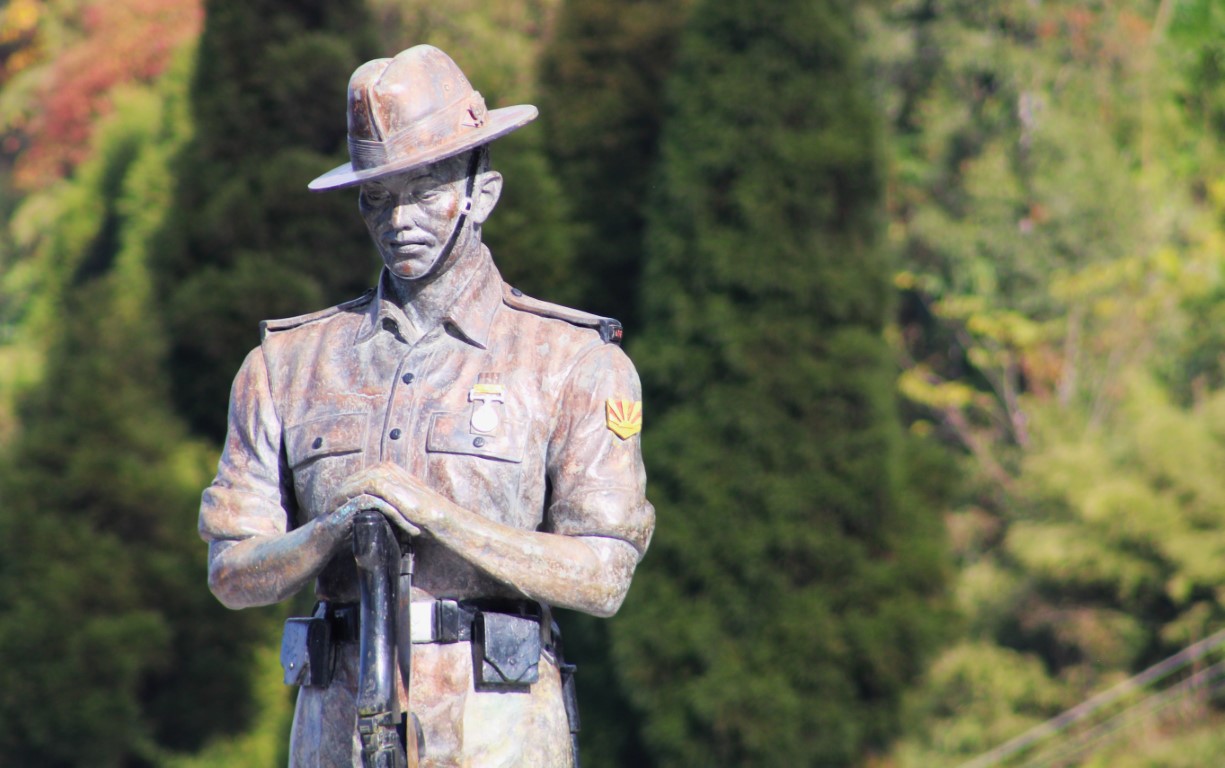
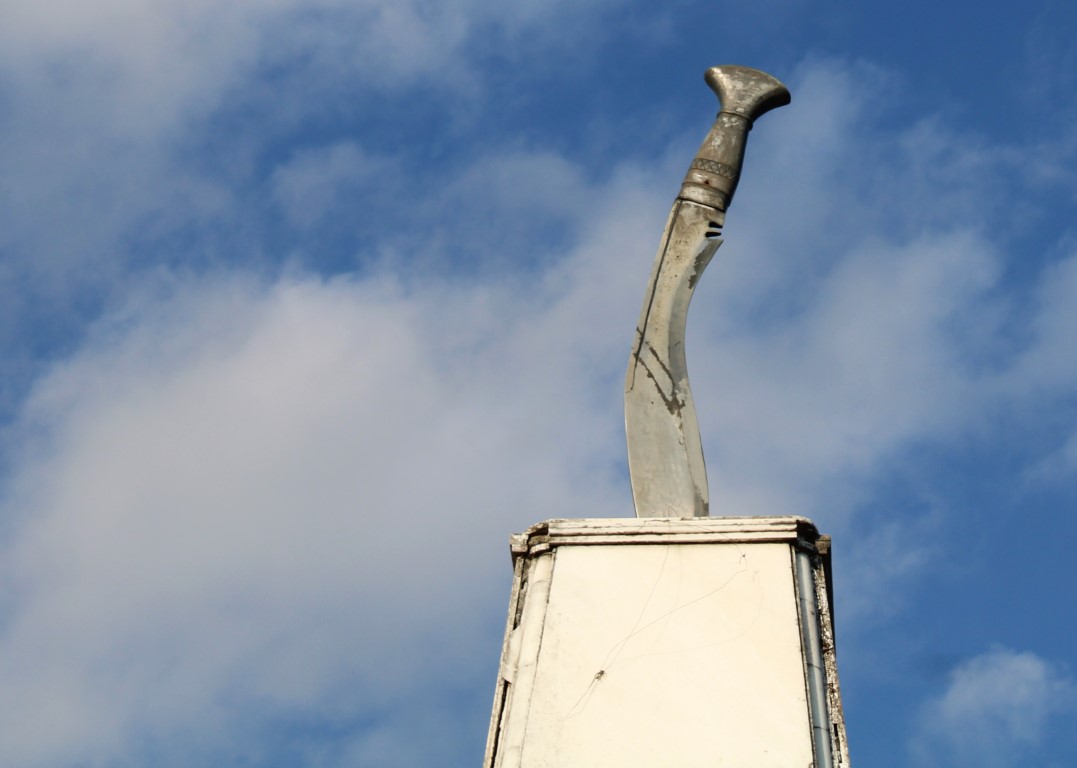
DAILY PHOTO: Gorkha Monuments
BOOK REVIEW: A Farewell to Arms by Ernest Hemingway
A Farewell to Arms by Ernest HemingwayMy rating: 5 of 5 stars
Amazon.in Page
This novel is set in Italy during World War I. The protagonist, Frederic Henry (like Hemingway, himself) volunteered to drive an ambulance in Italy during the war. The story is informed by, if not based upon, Hemingway’s personal experiences. Central to the story is a romance between Henry and a British nurse named Catherine Barkley. Their tentative flirtations deepen when Henry is wounded and spends a considerable amount of time at the hospital while recuperating. Barkley becomes pregnant with Henry’s child in the middle of the war. Henry returns to service for only a short time before he finds himself in the midst of a chaotic retreat from the swift advance of the Austrians and Germans. This retreat continues to go sour for Henry, leading to a flight for his life as he attempts to get back to Catherine so that he can get them both (plus the unborn child) to safety.
There’s a [variously-attributed] quote about war being: “long periods of interminable boredom punctuated by sheer terror.” This book captures that feel, but even during the moments of quiet from the opening through Henry’s rehab to the weeks hiding out in the Swiss mountains, Hemingway keeps the story engaging by shining a light into the protagonist’s psychology – and, occasionally, through wit. Then there are the thrilling moments like the shelling that wounds Henry or his various narrow escapes.
I found this book to be highly engaging. It has some beautiful language, exemplified by the famously well-composed opening paragraph, mixed with the taut suspense of life in a war zone. If you’re interested in war stories or classic American literature, it’s a must-read.
View all my reviews
BOOK REVIEW: Power Born of Dreams by Mohammad Sabaaneh
Power Born of Dreams: My Story is Palestine by Mohammad SabaanehMy rating: 4 of 5 stars
Amazon.in Page
Out: October 7, 2021
This graphic novel reflects upon the Israel-Palestine conflict through the lens of the author’s (artist’s) time in prison. At first, I found the story to be an evocative personal account of life in prison, but as the story continued it felt progressively less personal and more propagandistic. The central theme is that Palestinians feel imprisoned by circumstance, regardless of whether they are actually in a jail or not.
Still, it’s not the kind of work that will constructively advance a dialogue. It will rub those who sympathize with Israel the wrong way because it’s far from an unbiased account of events, vilifying the Israelis while glorifying (or failing to acknowledge) the Palestinians who engage in violence. This bias is particularly notable in the back matter, which presents accounts that seem journalistic, but which selectively present information to make it appear that all fault lies exclusively on one side.
To be fair, the author spent time in jail for (as best I could learn from the internet) what sounded like consorting with unsavory characters. [Which reeks of Soviet-style “justice,” but the book doesn’t really delve into the reason for his imprisonment, and – even if it did – I’m not sure that I’d trust that it’s the complete truth – given the way the general narrative is presented. So, I couldn’t tell you whether the author is an artist wrongly imprisoned for expressing himself, or whether he did something that was truly and legitimately seditious.]
The art is linocut to create a chiaroscuro effect (i.e. white lines, black background) and is stylistically interesting.
I enjoyed the art and found this to be an interesting read, but I wouldn’t recommend readers take it at face value as a fair account of the conflict, but rather as one man’s personal message about the conflict.
View all my reviews
BOOK REVIEW: Dreaming Eagles by Garth Ennis
Dreaming Eagles by Garth EnnisMy rating: 5 of 5 stars
Amazon.in Page
New Edition Out: June 1, 2021
This graphic novel by the author of “The Boys” and “Preacher,” tells a story based on the experiences of the Tuskegee Airmen, and does so as a story within a story. The framing story is set in 1960’s America and finds a World War II veteran (a pilot of the Tuskegee Airmen) trying to talk his teenaged son down from getting too entangled in the Civil Rights movement — for reasons that are only revealed as he completes the telling of his experiences at war. Through flashbacks, the protagonist depicts not only the thrilling exploits of air-to-air combat over Europe and the visceral tragedies that occur when hot lead meets with aluminum high above the world, but it also shows the unique tribulations experienced by these particular military men – such as “leaders” who wanted to see them fail and widespread discrimination.
The story-in-story approach is an excellent one because it allows for a character arc in which the protagonist grows. Without getting into spoiling details, as the protagonist revisits his story, he comes away with a new and changed perspective (which is always a valuable feature in storytelling.) The frame also breaks up the history and helps maintain reader attentiveness by showing the influence the story has on the attentive son. (Young men not being famous for being interested in the life stories of their parents.) I don’t mean to suggest that the war story is not interesting. It’s full of action, heroism, and the tension of interpersonal conflict. However, for those who aren’t history buffs and are acclimated to Ennis’s more popular fare [i.e. full of superheroes and random acts of violence and titillation,] the story may feel a bit flat only by virtue of the fact that it is constrained by actual historical events.
I found the art to be well-crafted. The chaos of air combat is conveyed without being so chaotic that one can’t tell what is happening, and the graphics offer a great sense of setting and era.
This volume is definitely worth giving a read. It tells a compelling story of the combative exploits and the political / social travails of these groundbreaking and heroic pilots, while holding a mirror to the rank societal biases of the era.
View all my reviews
BOOK REVIEW: Freiheit! by Andrea Grosso Ciponte
Freiheit!: The White Rose Graphic Novel by Andrea Grosso Ciponte
My rating: 4 of 5 stars
Out: March 4, 2021
This tragic story tells the tale of a small college-centric anti-Nazi resistance group, doing so in graphic novel form. While it touches upon the story of six White Rose members who were executed, special emphasis is given to the sister-brother duo of Sophie and Hans Scholl. White Rose was largely involved in distributing leaflets to encourage others to engage in resistance activities against the Nazis. (Note: the translated text of the White Rose pamphlets is included as an appendix.) There is so much attention given to the truly fascinating question of how a bunch of fascist lunatics managed to run a country into such diabolical territory that it can easily be missed that there was at least some resistance within Germany. I, for one, was oblivious to the story of White Rose before reading this book.
The arc of the story takes the reader from the upbeat stage during which White Rose was succeeding in distributing articulate and persuasive flyers, through some of their close calls and other frustrations (e.g. the Scholl’s father being arrested), and on to the bitter end. Much of what I’ve seen previously about resisters centered on communists. One sees in White Rose a different demographic. There are a number of religious references without the “workers of the world unite” lead that would be taken by leftist groups.
I believe the author overplayed the stoicism with which the executed individuals accepted their fate. This is based upon a true story, and so this may seem an unfair criticism because perhaps that’s how it appeared in reality. However, from a storytelling perspective, it felt surprisingly devoid of emotional content [given the events provide loads of potential for it.] There is a great tragedy in young people being executed by the State for asking others to resist fascism, but as a reader I didn’t really feel an intense visceral connection to events. As I said, I suspect this had to do with the author wishing to show that the Scholls took it in all in stride, but I think some display of angst or anger might have made for a more intense reading experience. I don’t know whether it was more a textual or graphic issue that left me unmoved.
All in all, the book was an interesting insight into resistance to the Nazis in an academic environment. I did find reading the pamphlet translations themselves to be insightful. The flyers give one insight into where the student-resisters were coming from, and what buttons wished to push in others. It might have been a bit more gripping, but it was an interesting telling of events.
If you’re interested in learning more about Germans who resisted the fascists, this book provides a quick example of how (and by whom) it was done, and I’d recommend you give it a read.
BOOK REVIEW: The Photographer of Mauthausen by Salva Rubio
The Photographer of Mauthausen by Salva Rubio
My rating: 5 of 5 stars
Due out: September 30, 2020
This “graphic novel” tells the story of a Spanish photographer, Francisco Boix, who was sent to the Mauthausen Concentration Camp as a Communist during the Second World War. [Note: I only put graphic novel in quotes because it’s not a fictitious story, which “novel” implies, but graphic novel seems to be the accepted term for any graphically depicted story – fact or fiction.] Mauthausen was a camp in Austria. While it wasn’t technically one of the extermination camps, it was legendary for the death toll associated with the granite mine where many of the inmates labored. Its “staircase of death” was the location of untold fatalities, including: murders by the Nazis, suicides, and even tripping accidents that will happen when an emaciated prisoner has to carry 50 kg stones up almost 200 uneven steps with no railing day after day.
Boix, who had been a journalistic photographer previously, was assigned to work for a Nazi officer who took pictures in the camp – particularly pictures of fatalities. Boix carried equipment, set up lighting, developed negatives, and made prints. His boss, Ricken, is depicted as bizarre character. On the one hand, Ricken seems not so bad by Nazi SS standards, but, on the other hand, he has a sociopathic inclination to see death as art. Boix takes advantage of his position to make copies of the negatives with the idea that they will be evidence when the war comes to the end. At first, there is support for this plot among the Spanish Communists, who help hide the negatives away in places like the carpentry shop. However, this support dwindles when it becomes clear that the Germans will lose the war, and – thus –surviving to the end becomes everyone’s primary focus. Soon Boix is on his own to figure out how to get the photos out. He develops a plan involving one of the boys at the camp (children being less intensely scrutinized) and an Austrian woman, who is a sympathizer.
The book climaxes with the operation to get the negatives out of the camp, but resolves with the immediate post-War period when Boix attempts to generate interest in the photographs as well providing testimony at the Nuremberg Trials. Boix is portrayed as fiery and impassioned. When the others at Mauthausen just want to survive to the end, he maintains that any risk is worth it. While he is shown to have some conflict about putting a boy’s life at risk with (arguably) the riskiest step in the process, he doesn’t seem waiver. At the trials he’s outraged about the panel’s insistence on “just the facts.” He wants to freely and fully tell the story of Mauthausen, and they – like courts in democracies everywhere – wish to maintain an appearance of the dispassionate acquisition of facts.
I found this book to be engaging and well worth the read. The artwork is well-done and easy to follow. The story is gripping. While there are a vast number of accounts of events at places like Auschwitz, there aren’t so many popular retellings of events at Mauthausen. I highly recommend this book for those interested in events surrounding World War II and the Holocaust.
BOOK REVIEW: Carl Lutz (1895-1975) by György Vámos

Carl Lutz by György Vámos
My rating: 5 of 5 stars
Amazon page (only the French edition is currently showing)
Carl Lutz was a Swiss diplomat assigned to Budapest in 1944, at the time the Nazis and their Arrow Cross comrades were trying to deport the Budapest Jewry to death camps. Lutz may not be as well know as his Swedish counterpart, Raoul Wallenberg, but that’s not for lack of saving lives. Like Wallenberg, he saved thousands of Jews by issuing protective documentation, and by fudging numbers and background documents where necessary to keep more people safe.
Lutz also oversaw a facility where the people issued these documents were allowed to stay to keep them out of the city ghetto from which they might get caught up in deportations. The Swiss-flagged facility was called the “Glass House” because it was on the grounds of a factory where specialty glass had been made, and the building’s façade was covered in multiple styles of glass as a way for perspective customers to see what products were available. Unfortunately, the property wasn’t designed for residential use, let alone for providing facilities for large numbers of people. Quarters were cramped and hygienic facilities were inadequate. However, the facility did keep people alive, even though it was raided by the Arrow Cross. [For those visiting Budapest, a small museum / memorial room can still be found at this same location, and this book’s author can offer more insight.]
The book is written in a scholarly style, i.e. employing a historian’s tone. It largely follows a chronological format. The book doesn’t discuss Lutz’s life much outside the war years, but it does give the reader background about Hungary’s anti-Semitic laws and actions as well as an overview of strategic-level events. [Hungary was allied with Germany in the Second World War, but in 1944 tried to separate itself and stop deportations. This resulted in Germany taking control and handing power to the Arrow Cross Militia, which was the Hungarian fascist party — akin to the German Nazis.]
The book is concise, weighing in at only 125 pages — about 17 of which are in an appendix of documents and photos regarding Swiss efforts to undermine the Nazi’s Holocaust.
As I said, the book is written in a scholarly / historical format, rather than the more visceral narrative approach of a journalistic or popular work. Still, it does become more intense reading in the latter half — when the author is describing events concerning the Glass House, Lutz’s issuance of protective documentation, and the siege of Budapest by the Russians at the end of the war. It will certainly give readers insight into a little-known rescue effort during the Holocaust.
If you’re interested in international efforts to thwart the Nazi’s plan to exterminate the Jews, this book will clue you in on events that aren’t well-known – particularly by English readers. I highly recommend this book.