BOOK REVIEW: Inventing Iron Man by E. Paul Zehr

Inventing Iron Man: The Possibility of a Human MachineInventing Iron Man: The Possibility of a Human Machine by E. Paul Zehr

My rating: 4 of 5 stars

Amazon page

As the title suggests, this book examines whether Iron Man could exist in the real world. As with Michio Kaku’s book Physics of the Impossible, answering the question involves defining the various meanings of “impossible.”

One way to parse the question is, “Is Iron Man possible today given the existing state of technology?” In and of itself, this question is of limited interest because the answer is, “no.” There’s certainly a demand, and so if Iron Man could exist given current technology, he probably would. That’s not to say it isn’t interesting to learn about what technologies are holding us back and where the cutting edge of relevant technologies lies—both of which are addressed by the book.

Still, a more interesting inquiry is, “Will Iron Man ever be reality given the physical laws that we know to govern the universe?” While more intriguing, it’s also a harder question to definitively answer. It’s impossible to foresee all the technological developments that might come along to answer the seemingly insurmountable challenges (e.g. Tony Stark’s inevitable Traumatic Brain Injury (TBI).) The book deals with the critical question of what challenges would have to be overcome for Iron Man to be reality.

As Zehr suggests, the appeal of Iron Man is that he’s considered to be among superheroes for the common man. Like Batman, the sufficiently bright and diligent nerd may fantasize that, “That could be me.” You or I can’t be Superman or Wolverine, but given enough money, smarts, and training we could be Batman, or—even better—pilot the Iron Man suit. Put in this light, the book may seem like just another frivolous attempt to capitalize on the popularity of superheroes to sell books. However, there’s actually a great deal of food for thought packed in the book. Like others, I read the book because its title is Inventing Iron Man and not Neuro-motor control of a self-propelled armor system or some other suitably scholarly title.

Dr. Zehr has the bona fides to delve into this topic. He is a Professor who investigates questions of how the nervous system controls movement. That subject may not constitute the sum total of critical concerns, but it’s one of the most important challenges. For Iron Man to move the way he does in the movies and comic books, Tony Stark’s impulses to move have to be transmitted seamlessly to the servo-motors that move the suit. From dodging Col. Rhodes’ (i.e. War Machine’s) punches to ducking RPGs, Stark can’t be quick enough if he has to manually steer the device. Then, of course, there’s the issue of feedback. Any neophyte meditator who’s had his or her foot fall sound asleep will know how difficult it is to walk surefootedly when one can’t feel anything through one’s foot.

[Iron Man 3 spoiler commentary in this paragraph.] One of the most damning challenges for making Iron Man a reality is the high probability of severe concussions. Let’s say you make the suit out of a material that is virtually indestructible? This may be possible. However, the pilot’s mushy brain is still sloshing around inside that impenetrable armor. One can remotely pilot the suit in order to negate this (as has been done in the comic books and the third movie), but—at that point—is it still Iron Man? I know from a writer’s perspective it’s a lot harder to maintain tension if there’s nothing human on the line. In the third movie about 30 autonomously piloted suits get wiped out and the viewer doesn’t care—the only source of tension is that Tony Stark is without armor half the time.

Some of the most interesting discussions are about where the current state of the art lies with respect to: a.) direct mind control over mechanical systems; b.) a “flying suit”; and c.) robotic movement enhancers. Zehr conducts interviews with those engineers and technologists involved in such technologies, and finds out where we are presently. Letter “a” above seems to be the least developed of the three technologies, but they are all active lines of research.

I enjoyed this book and found it interesting. I think anyone who is interested in the state of technology and its limits will find it a nice pop-sci introduction to the subject. The use of superheroes as a pedagogic device may be overdone, but it continues to work because we are fascinated by the edge of possibility, and that’s what superheroes represent.

View all my reviews

Can India Compete With China?

IMG_0131There’s perennial hope in the West that India will succeed. Having won the Cold War, advocates of democracy and rule of law aren’t eager to replay it and have a Communist country win–not even one that yields to market forces in large part.  Citizens of democratic nations want reaffirmation that democratic rule and rule by law, not men, is the superior paradigm. We acknowledge that such a system is rarely easy, but live with the words of Winston Churchill ringing in our ears:  

Democracy is the worst form of government, except for all those other forms that have been tried from time to time.

When I found out that I was moving to India, I read all that I could find on India in magazines I subscribed to, such as Foreign Affairs, National Geographic, and Wilson Quarterly. Needless to say, there was a lot to read. Besides India’s nuclear programs, both energy and weapons, I hadn’t followed its role in the world. These articles took me on a roller coaster ride. If one went back many years, no one expected much of India. Then, a few years back, massive enthusiasm blossomed that India was going to rocket off and leave India in its dust. Then I got to the most recent articles, which did yet another turnabout–saying that India’s growth had been ephemeral and no one should expect much from the country in the near future.

India has a number of advantages. Almost everyone who is capable of publishing is fluent in the de facto international language of business and academic publication–namely English. India has as abundant a supply of cheap labor as anywhere. Indians have a culture that values education. They are building a first-class university system by, in part, having sent students to the very best of academic institutions globally. Their universities are attracting foreign students. This, in combination with such a big population, has given them the potential to build impressive student bodies.

So, why isn’t India competitive? The first thing that should be stated is that things are never as simple as they appear in aggregate. In some domains, India is competing quite nicely–and not just with China. Here in Bangalore, it’s apparent that large IT companies see big advantages in doing business in India.

I made a recent trip to Hampi and was amazed to see how successful India was in building up wind power generation in central Karnataka. India is 5th in installed wind capacity overall. Many democracies have difficulty getting traction with wind because the public views the turbines as an eyesore.

Still, India has its problems. Political and Economic Risk Consultancy (PERC) surveyed business leaders about Asian bureaucracies and found India to be the worst bureaucracy in Asia.  On a 1 to 10 scale, where 10 is the worst possible, India rated a 9.21. This isn’t a surprise in the least. It seems to be common knowledge that business leaders who move to India do so in spite of India’s governance, not because of it.  India’s bureaucracy hasn’t embraced the IT-revolution. It’s interesting being in Bangalore, where IT-companies are state-of-the-art, and being asked for the same copies of documents a half-dozen times because the information is only stored on non-networked PC hard-drives–and paper files are collected but don’t seem to be organized in any way.

An ethos of corruption is ubiquitous in India. Police officers have been known to sit in parks and solicit “admissions fees” from tourists. I’m pretty sure I saw a shakedown in progress this past week when our car went through a toll booth on a toll road we had already paid for and two guys standing outside in front of the toll-taker insisted that our driver pay for the toll that he had already paid not ten minutes before. Being from a country where corruption is punished severely, I’m ignorant of the process of bribes. (I suspect this is why I’ve had so little success in getting anything done that involves the Indian bureaucracy.) For a less anecdotal experience, one can turn to the “Corruption Perceptions Index,” which places India in the bottom half among all nations.

One may wonder how a democracy retains a culture of corruption. Usually, citizens of a democracy get fed up and start voting their disapproval. At the Bangalore Literature Festival, I heard an interesting policy panel featuring a politician, a retired general, and a policy pundit. It was said that there is a high degree of apathy among the Indian middle class. Indian voter turnout rates are generally below 60%. There’s a belief that those most capable of affecting change are relatively happy and, thus, unwilling to rock the boat. I don’t know how true this is, but it seems that India is having trouble defeating some of the problems that wither on the vine in the face of a politically active public.

It also seems that there is a segment of the population who are completely cowed. This is a legacy not only of colonial repression but also of caste repression. While castes have been done away with, there remains a large segment of the population who are accustomed to doing just as they’re told without questioning and without making moves to get ahead.  Perhaps, because they believe they exist in a world in which there’s no getting ahead.

India’s abundance of cheap labor may be a curse as well as a blessing. While cheap labor has brought in foreign direct investment, it has also contributed to a business culture that doesn’t seem to value increased productivity. As an example, if one goes into a small shop in Chicago or Copenhagen or even Beijing, it’s likely that a single salesperson will show one merchandise, ring it up, and bag it. If it’s a big store, there may be a two person interaction–salesperson and cashier. In an Indian store, a salesperson will show one merchandise, a clerk will write up an invoice, one will take that invoice to a cashier, that cashier will take one’s money and hand one a carbon-copy of the “paid” stamped invoice and direct one to a pick up window, a bagger will bag your purchase, and  a “checker” will check your receipt and hand you the bag. I love specialization as much as the next economist, but this is a Rube Goldbergesque approach to retail operations.

If India wants to be a first-rate power, it needs to take on corruption, bring its bureaucracy into the 21st century, and its population needs to realize they can have a more satisfying life than waiting around for someone to need them for a momentary job. The citizenry needs to value good governance, and businesses need to figure out how to increase productivity.

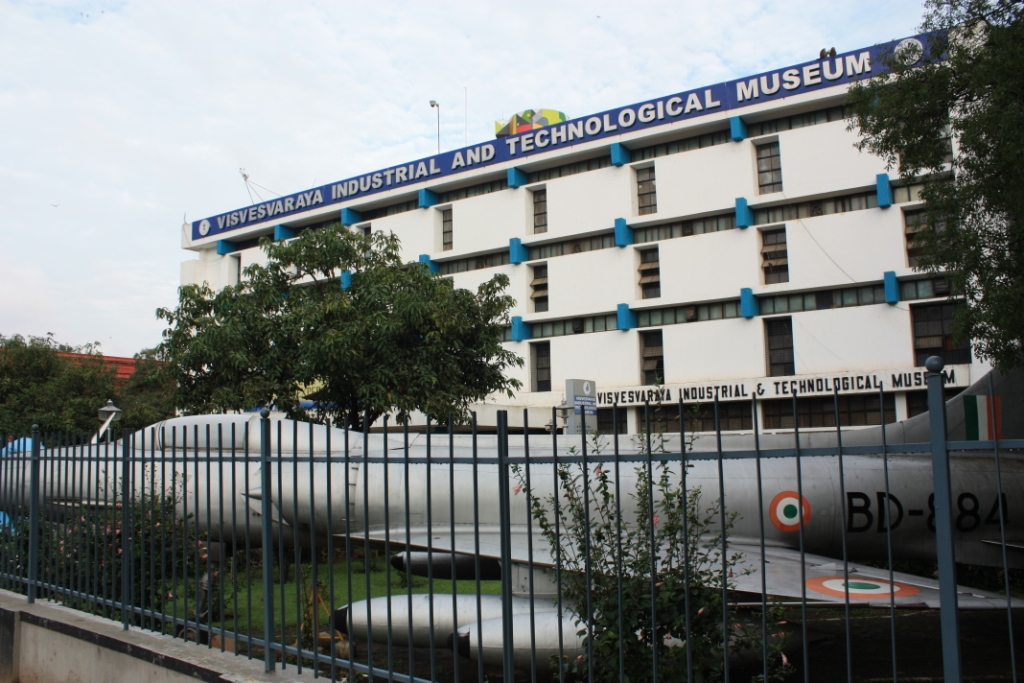
Visvesvaraya Industrial and Technological Museum

The plane is the HF-24, India's first indigenous figher jet (circa 1960's)

The plane is the HF-24, India’s first indigenous fighter jet (circa 1960’s)

I visited the Visvesvaraya Industrial and Technological Museum last week. I wasn’t sure what to expect. The admission fee is only 30 rupees (less than 50 cents in USD terms.) I ended up being pleasantly surprised. It took me back to childhood visits to Chicago’s Museum of Science and Industry. Granted it’s neither on the scale of the windy city’s museum nor as well-maintained, but it’s largely interactive and has some fascinating–if often retro–displays. It’s great for kids or adults who’d like to revisit the science that they’re forgetting, and to do so in a way that’s entertaining.

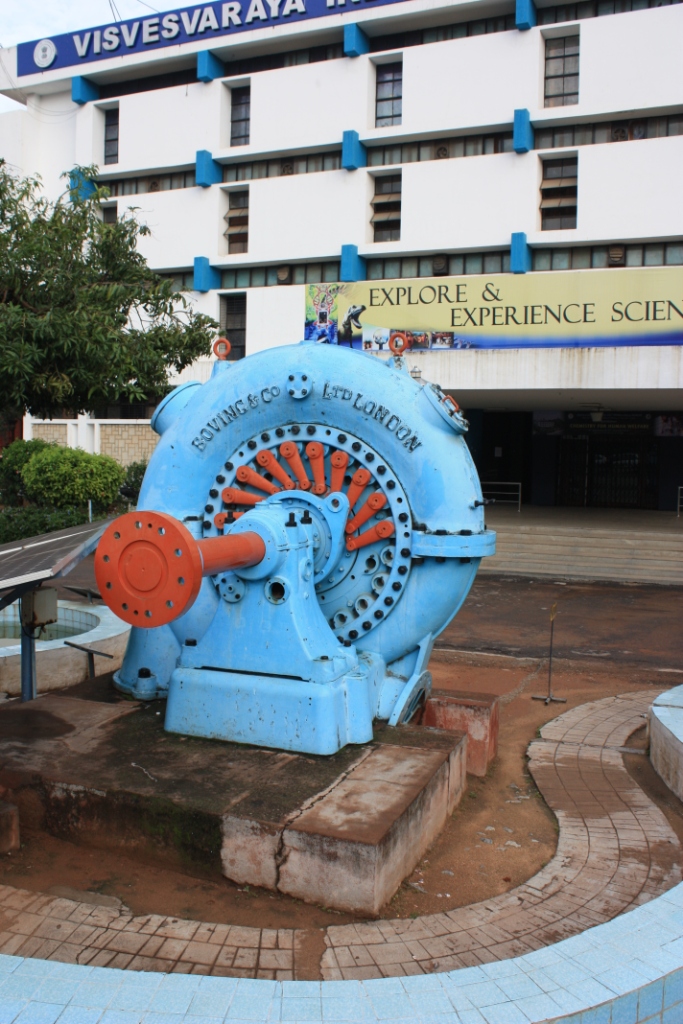
The museum consists of five exhibit halls and a few other stand-alone displays both inside and outside the building. Outside one will see an old locomotive, a copy of India’s first indigenously-built fighter jet, an Archimedes water drill, and a big steam turbine. One’s visit inside, unfortunately, begins inauspiciously with a solitary animatronic T-rex that looks a bit dog-eared.

Also on the ground floor, the first exhibit hall one visits is the Hall of Engines. This covers steam power, gasoline engines, turbines of various forms, as well as displays of human and animal powered technology. There are hand-crankable cut-away scale models that allow one to see how the various engine designs work. There are also cut-aways of some full-sized engines. Overhead there are a series of wire tunnels through which billiard-size balls circulate, having been hand-cranked up into the track by various mechanisms. This, I believe is intended to demonstrate gravity power, which it does in a whimsical Rube Goldberg-esque sort of way. There’s also a video on simple machines that looks like it was initially made for 1950’s school children in America.

There are two exhibit halls on the first floor (that’s the second floor to Americans), one that deals with electricity and another called “Fun with Science” that’s all hands-on exhibits intended to spark the interest of school-aged children. The former covers the basic science of electricity as well as looking at the various generation methods, including nuclear, wind, solar, hydroelectric, and fossil fuels.  The latter has interactive exhibits of the kind found in many a science or children’s museum. I would say the exhibits here are largely geared toward middle school and high school students. There is a small exhibit on the top floor that is aimed at young elementary school age students.

The second floor has a biotechnology exhibit hall as well as one that deals with space. The biotech hall covers basic biology, agriculture, and even beer brewing. The space hall discusses the history of space technology and particularly focuses on India’s Chandrayaan-1 moon-orbiting mission. (If you didn’t know that India had orbited the moon and delivered an impactor to the lunar surface, you are in good company. I had no idea either. But this was back in 2008-2009.)  Anyway, it was good to see some Indian focus. As I was traveling through the exhibit halls up to this point, it occurred to me that there wasn’t a great deal for the school children passing through this museum to take national pride in. There was a lot of material about discoveries made in places like Germany, America, and Japan, but not a lot of segments on contributions of national scientific heroes as one would expect at such a museum.

The third floor has a full-sized exhibit hall dedicated to electronics and computer technology, and part of one hall that is split between a small “Science for Children” exhibit geared toward young children (pre-school and the younger elementary grades) and a temporary exhibit on chemistry. The chemistry exhibit is the most reading-oriented exhibit, except for a couple of models and a touch screen interactive periodic table, it’s pretty much a poster exhibition. The hall of computers and electronics has many interesting exhibits, such as a cylinder supposedly containing the 42 million transistors that it takes to make up one Pentium 4 processor.

There’s a nice poster exhibit about the 2012 Nobel Prize Winners. I assume this will be updated sometime next month after the new winners have been announced.

All and all, I’d say this museum is a bargain at several times the price.

IMG_0189

The IT Revolution & Crises of Self-Importance

Source: Ed Poor at Wikipedia.en

Source: Ed Poor at Wikipedia.en

If you’re as old as I (no, I’m not Wilford Brimley old by any stretch), you remember the days when you couldn’t count on getting a hold of another person instantaneously. Incidentally, the phrase “get a hold of” is apropos. Think of other times one might use those words. If one were a practitioner of judō (i.e. a judōka), one might use that phrase when talking about seizing an opponent in anticipation of throwing them.

Herein lies an intriguing irony. The person calling is dominating the called. That is, they are writing a check on one’s time that they believe to be cashable whenever the hell they please. Therefore, one might expect the person receiving random calls at random times to suffer a diminution of self-esteem. They are, after all, at the beck-and-call of some localized bit of humanity. However, on the contrary, the perfection of the electronic-leash has spawned a growing field of narcissists.

The reasoning that drives this plague of narcissism is as follows, “I am so important that some–albeit tiny–part of the universe is at risk of collapse if I’m not ready to spring into action at a moment’s notice. In other words, I am a localized superman[/superwoman.]”

The thing is, you’re really not. The deflating truth is that none of us is so important that any portion of the universe will collapse if we are unplugged from the hive for a few hours– try it.

Now, you may be saying, “Look, I have my phone on all the time, and I talk on it much of the day, but I’m not one of those loud people whose conversation lays waste  to the solitude of people around me everywhere I go.”

The thing is, you really are. Those annoying bastards that you “hurrumph” at when you’re not on the phone–that’s you when you are on it. You make a connection at a distance and, like all others, become oblivious to your immediate environment. At best you are a destroyer of solitude; at worst you are a danger to yourself and others.

Was the Fukushima-Daiichi Incident the Final Nail in Nuclear Energy’s Coffin?

Today is the two-year anniversary of the tsunami that swamped parts of eastern Japan. Among the ongoing effects of this event was a re-chilling of attitudes toward nuclear energy–undoing a thaw that some swore was imminent. The tsunami hit the Fukushima-Daiichi plants and knocked out generators that were needed to run the coolant pumps with the power lines down. In the days after the disaster, the release of radioactivity and explosions of built up hydrogen presented some of the most prominent news stories.

Japan obtained about a third of its energy from nuclear prior to the event. All reactors were shut down in subsequent months, at no small cost to their economy. Eventually, a couple of plants were brought back on-line, providing only a fraction of the electricity of the country’s full fleet of 50+ nuclear plants.The Japanese had plans to add another 15 plants to their reactor fleet at that time, plans that have since vanished.

Even China, the world’s most prolific builder of nuclear plants as of late, had a brief moratorium on nuclear power plant (NPP) construction. However, China seems to have regained its ardor for nuclear power. France, of course, won’t be dissuaded either. However, for much of the rest of the world, doubts remain.

Pictures may be worth a thousand words.

Source: International Atomic Energy Agency (IAEA) Power Reactor Information System (PRIS)

Source: International Atomic Energy Agency (IAEA) Power Reactor Information System (PRIS)

Source: IAEA PRIS

Source: IAEA PRIS

Source: IAEA PRIS

Source: IAEA PRIS


The Nuclear Renaissance and International Security

Edited by Adam N. Stulberg and Matthew Fuhrmann

2013, Available Now

Buy this book

ONLINE RESOURCES
Contents

Contributors

Introduction

TODAY’S RANT: Puny Machines

When the machines rise up against humanity, I will be high on their list of Homo sapiens to put through the chipper-shredder.

You may be asking, “How can such an unimportant person make such a self-important statement?”

Here’s my confession: I have killed more than my fair share of consumer electronics. Let it be known for posterity that these were all cases of manslaughter–or, I guess, machineslaughter. I never once had malicious intent, nor did I ever engage in premeditation. Furthermore, in a way, I mourned the loss of these machines more intensely than I did the death of granny.

Let me say, in my defense, machines are weaklings. The good news is that I don’t worry about them taking over just yet because you can always take out a marauding terminator with a can of soda–and even make it look like an accident.

The rant part of this post has to do with the divergence between what is advertised, and what is true.

Below is a video that Lenovo has put on YouTube to show how robust their computers are.

Here was my experience, avoiding the lunging paw of a hyper cat, I spilled a drop of milk the size of a quarter onto the upper mouse buttons. This killed my mouse instantaneously (I’m aware of the irony of me killing a mouse while my cat looked on in horror.) My entire laptop died a few weeks later from what I assumed to be related causes.

Your Experience May Vary

Your Experience May Vary

Since my last machineslaughter, I’ve  quelled my killing spree by implementing three simple rules.
1.) I don’t eat in the same room as my computer.
2.) I don’t drink within 12 feet of my computer.
3.) I must close the computer any time I leave the room, if a cat is present. (This is not so much to save the laptop as to prevent the cat from composing a witty coded email such as, “a;oreanrpwipfvchaqewutheiuancvpiwe. wpn2qeyt028hnfqv-,” and sending it out to my entire email list with his butt.)

Do I resent having to walk on eggshells around consumer electronics? A little. I’d like to be able to listen to my transistor radio while taking a bath. (Research notes: Do radios still have “transistors?” Do they still make radios?)

However, what I really resent is the manufacturer making it seem like its product is indestructible when, in fact, it’s really pretty puny.

That said, I like the fact that people are tougher than the forces of robopocalypse by virtue of the fact that we can get wet.  (Of course, by that logic, fish should be our gods.)

Until next time, keep your can of Coke at the ready (but don’t drink it, that stuff will kill you.)

TODAY’S RANT: Invisible Conversants

Proposed addition

Proposed addition

A few years back, I was leaving an office building when I saw a man ranting full-bore. He was gesticulating wildly, delivering karate chops to the air with vicious intent, pulling at his hair. What was even more disconcerting was the potty mouth on this guy; he weaved together a chain of expletives that would make a mafia don blush. Yet, I could recognize his words as one half of a conversation, though there was no one else to be seen. He would pause and respond, and I could vaguely imagine what the invisible conversant would have said to invoke such a response.

I, of course, concluded that this poor soul should be committed to an asylum.  I was wondering if I should call the guys with the straight jackets to bring their rubber-lined van when the man swung around to pace the pavement in the other direction and I saw the BlueTooth headset clinging to the side of his head.

I then realized that this man was not certifiable.  He was just a rude douche-bag with a bad temper.

In the good old days, when someone was talking to an invisible conversant, you knew that they had an imaginary friend speaking in their ear. While this didn’t necessarily make them a danger, it did put one on notice that voice in their head might just be saying, “Get stabby.”

Today, I think we are being desensitized by miniature wireless headset technology. Now instead of assuming the someone chatting up an invisible conversant has gone around the bend, we assume that they are communicating with a real, live, flesh-and-blood person. This may be to our own peril.

What I’m suggesting is that Bluetooth headsets be made more conspicuous. They should be in bright neon colors, and should have a flag viewable by people from all directions. The flag would indicate that they aren’t hearing the voice of Beelzebub in their ear telling them to have a nice killing spree.

Just a suggestion.

It’s only going to get worse, when the first people start getting surgically grafted cell phones.