BOOK REVIEW: The Bhagavad-Gita Translated by Barbara Stoler Miller

The Bhagavad GitaThe Bhagavad Gita by Anonymous

My rating: 4 of 5 stars

Amazon page

The Bhagavad-Gita is a philosophical poem, the title of which is translated as “Song of the Lord.” It’s often read as a stand-alone work, but it’s included in the sixth book of longest known epic poem, entitled the Mahabharata.

In The Bhagavad-Gita, Krishna teaches the warrior-prince Arjuna about sacred duty (dharma.) The setting is the battlefield at Kurukshetra as a war is about to get underway. Arjuna asks his charioteer, Krishna, to halt the vehicle between the opposing armies. Arjuna is struck with a crisis of conscience. He doesn’t want to fight and kill the men on the opposing side–some of whom are related to him by blood and others of whom are well-respected elders. Arjuna can see no virtue in the war.

Krishna, after briefly mocking what he describes as Arjuna’s newly developed cowardice, goes on to offer his explanation of why it is that Arjuna should fight. The first argument is that nobody really dies because consciousness is reborn. This makes sense if you believe in reincarnation… otherwise, not so much. A concise restatement of this argument is presented in the 11th teaching: “I am time grown old, creating world destruction, set in motion to annihilate worlds; even without you, all these warriors arrayed in hostile ranks will cease to exist. Therefore, arise and win glory! Conquer your foes and fulfill your kingship! They are already killed by me. Be just my instrument, the archer at my side!”

Another of Krishna’s argument is that if Arjuna fails to fulfill his duty he will be thought less of by others. This is an odd argument to make as Krishna makes a more compelling case for ridding oneself of ego, whereas this seems to be saying that one should put what others think of one above doing what one believes is right. That sounds a lot like succumbing to ego rather than eliminating. In the 12th teaching, in fact, Krishna tells us that the best of men are “Neutral to blame or praise…” This suggests that perhaps one shouldn’t be moved by what others will think of one.

At the core of Krishna’s argument is that one cannot escape the Karmic cycle by engaging any acts but those that are selfless. Like the reincarnation argument. One may find this logic compelling or not depending upon whether one believes in Karmic theory. Karma is the idea of cause and effect. If you do good, you’ll receive good effects and if you do bad you’ll experience bad effects. Ultimately, however, the goal is to break free of the Karmic cycle and, in theory, the only way to do that is to engage in acts that are selfless—hence doing your sacred duty. If your driver isn’t God, it’s not entirely clear how you know what your sacred duty is, at least not by way of this work. (Presumably, God talks to kings and princes, and kings and princes tell the unwashed masses what they are supposed to do. If you happened to have already done away with such a system—as most of the planet has—you may have trouble with this logic.) However, if one takes the lesson to be that one should not be consumed with personal gain when one acts, one has an argument of more general appeal.

Another argument is that devotion to God is all important, not a man’s actions in any absolutist sense. From the 9th teaching, “If he is devoted to me, even a violent criminal must be deemed a man of virtue, for his resolve is right.”

It should be noted that Krishna delivers a number of lessons beyond the need to comply with one’s dharma, and, in my opinion, many of these ancillary lessons are more compelling than Krishna’s explanation of why Arjuna must fight.

One such lesson is to concern oneself with the journey and not the destination. Krishna states it as such, “Be intent on action; not the fruits of action…” Furthermore, there are a great many teachings that will be familiar to Buddhists, such as the need for non-attachment and moderation.

The poem contains lessons of Samkhya (e.g. discussion of the three gunas) and Yoga. It describes concepts from the three original forms of yoga (predating yoga as a fitness activity by centuries): those being of action yoga (karma yoga), knowledge yoga (jnana yoga), and devotional yoga (bhakti yoga.) While The Bhagavad-Gita predates the formulation of eight limbs of yoga as described by Patanjali, it does address certain among them in varying detail. Early on, it speaks about pratyahara—withdrawal from the senses—in considerable detail. There are also references to pranayama (breath/energy control exercises) and most of the yama and niyama are listed among the virtues in the latter part of the teachings. Of course, samadhi (liberation / yoga’s 8th limb) is a central concept in this work.

While The Bhagavad-Gita remains widely cited and relied upon for guidance to this day, it’s not without its controversial elements. In the fourth teaching, Krishna explains how he created the caste system. Of course, Krishna might not have intended it to be the stain it became.

The Miller translation that I read has a few nice ancillary features. There is an introduction that offers background and context for those who have little knowledge of Indian history or mythology. There’s also a glossary that goes into detail about terms that are frequently used in the work. It’s not that there are Sanskrit words mixed into to the text. The glossary explains what the English words should be taken to mean in the context of the Hindu worldview.

What is most intriguing, however, is the afterword which is entitled, “Why Did Henry David Thoreau Take the Bhagavad-Gita to Walden Pond?” Of all the thinkers that have cited The Bhagavad-Gita, the use of Thoreau and Emerson as examples raises intriguing questions. The Thoreau of Civil Disobedience and the Emerson of Self-Reliance would seem to be as far from the message of The Bhagavad-Gita as possible. Krishna is telling Arjuna to ignore his conscience, and just do what God tells him to do—be a selfless instrument of destruction. Thoreau and Emerson both preached that one’s conscience should always be one’s ultimate guide. Thoreau went to jail because he refused to pay taxes that would support the war with Mexico. I suspect Krishna would say to Thoreau, “Hey, I’m throwing this war, and you’d damn well better do your part.” However, there are ideas in The Bhagavad-Gita that work with the American Transcendentalist philosophers. The idea of removing self-interest and egotism as a way to eliminate delusion before one makes one’s own decision is a consistent suggestion.

I have mixed feelings about The Bhagavad-Gita. Like many (most?) sources of religious doctrine, I think the central message of The Bhagavad-Gita is just another means by which to keep the masses under the control of an elite—and, specifically, fighting the wars of the royalty. However, I–like Thoreau and Emerson—also see a great deal of insight into how to be a better person in this poem.

I think The Bhagavad-Gita is worth a read, regardless of how you may ultimately feel about its message. It offers a concise summary of key ideas in Indian philosophy and psychology. It will give one a better understanding of the Indian worldview, and may teach you something about how to live in the process.

View all my reviews

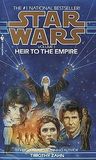
BOOK REVIEW: Heir to the Empire by Timothy Zahn

Heir to the Empire (Star Wars: The Thrawn Trilogy, #1)Heir to the Empire by Timothy Zahn

My rating: 4 of 5 stars

Amazon page

Heir to the Empire is set about five years after the first movie trilogy (by release date, i.e. after Return of the Jedi.) It features many of the principal heroes of the first trilogy including: Luke, Leia, Han Solo, Chewbacca, Lando Calrissian, R2-D2, and C-3PO. Obviously, gone are most of the bad guys from the movies, but in their place has risen Grand Admiral Thrawn—a master strategist who seeks to revive the Empire. Thrawn is portrayed more as a brilliant military man than a dastardly villain. This doesn’t mean he can’t be cold and villainous, but he also brings in a measure of intellect and rationality not seen in the movie universe. While it would appear that Luke is the last of the Jedi Knights, or the first of a new line if one prefers, that turns out to be not entirely true.

I enjoyed this book. I bought it during a Kindle sale on what Amazon considered to be the best Star Wars books. While I’d seen the movies, I hadn’t read any of ancillary works, and so I Googled to find out which of the books on Amazon’s list were considered by fans to be the best. Zahn’s Thrawn trilogy, and particularly this first installment, seemed to be on every fan’s list.

One of the great plot devices used in this book is a creature whose mere presence can nullify the force. This strips Luke’s powers away through a critical piece of the book. Yes, the introduction of this creature is deus ex machina, but it’s deus ex machina that challenges the protagonist–rather than making life easier for him–so it’s alright by me. Because Luke is the last of the known Jedi, he’s essentially a Superman among mere mortals, and so the book might have become tedious if Luke weren’t stripped to his native intellect and courage devoid of superpowers. Instead, he has to escape from the planet on which these creatures reside and help rescue Han and Lando in the process without any supernatural abilities.

As mentioned, this is the first book of a trilogy, and, therefore, it leaves many major issues unresolved. Multi-part series usually have less satisfying endings than a stand-alone book, and I can’t say it’s not true of this work. However, this first book of the Thrawn trilogy does contain a clear climax and a definitive tactical (battle-level) resolution.

The book intersperses chapters from the hero’s point of view (PoV) with those from the Thrawn’s ship. This book begins with a chapter from the enemy’s PoV, and so for Star Wars neophytes—such as myself—one enters into a whole new territory in which it’s not quite certain when or where one is in the Star Wars universe. However, in subsequent chapters Luke, Leia, and Han are introduced and we learn that Han and Leia are married and that Leia is pregnant, and this gives one insight into the timeline of the book. We also learn that while the Empire seems to have been destroyed, the Republic is on weak footing and is having trouble reestablishing itself.

The book introduces us to a couple of new characters that I understand will become established in the expanded Star Wars universe. The most intriguing and important of these is Mara Jade, the right hand woman of the most powerful smuggler in the known universe. We soon learn that Mara despises Luke Skywalker and wants nothing more than to dance on his grave. However, we don’t learn until much later why it is that she hates him, and we learn after a time during which the two are forced together by circumstances. Mara Jade is a force to be reckoned with. While she might not be a match for Luke the Jedi, she is more than a match for Luke stripped of his powers. It seems clear that Zahn is building a relationship between Luke and Mara with their interaction in this book. Luke is oblivious to why Mara dislikes him, or even who she is until he is explicitly told, but events force them to spend time together under trying circumstances.

All in all, I liked this book. I found it readable, and thought that it did a good job of maintaining tension throughout.

View all my reviews

BOOK REVIEW: Gone Girl by Gillian Flynn

Gone GirlGone Girl by Gillian Flynn

My rating: 5 of 5 stars

Amazon page

This book is about the perils of adopting a false face when dating. At first Nick and Amy seem like the perfect couple, but that’s because Amy is donning the guise of “Cool Girl” and Nick is playing the part of the romantic. When the facades crack apart, so does their marriage. Then Amy goes missing under mysterious circumstances.

This isn’t the type of book that would normally call to me, but I read it because I kept seeing references to it and had to see what the hullaballoo was about. I must say, however, the book did not disappoint. I found Gone Girl hard to put down. Flynn does an outstanding job of carefully revealing information—and sometimes planting false flags—so that one is kept thinking throughout the book. To the characters in the book—besides Nick–it increasingly looks like Nick killed his wife, but to the reader it’s more of a roller coaster ride. At first we can’t believe he’s responsible, then we discover he’s not who he appears, then we learn who Amy really is, and so on.

The organization is alternating chapters from the point of view of the two leads, Amy and Nick. This is why we can’t believe Nick is a murderer at first, because we are seeing his point of view, but then we realize that it’s a limited point of view, and Nick isn’t particularly forthcoming about his peccadilloes and vices. In fact, Nick’s penchant for lying is a major factor in his deepening crisis. Nick’s problem is that he can’t stand to not be liked, particularly by women. Amy’s problem stems from having parents who wrote a book series called Amazing Amy that portrays a character that is a thinly veiled version of her—except perfect in every way. This leads to a condition in which Amy needs to appear perfect, even if she realizes that perfection is illusory.

If the reader has a point of dissatisfaction with this book, I believe it will be with the ending. I, myself, have mixed feelings on the subject. On one hand, the ending seems unbelievable and maybe a little flat. On the other hand, it’s an unexpected ending, and I think any ending that wasn’t completely unexpected would come across as a letdown after all the twists, turns, and reveals of the book.

I’d recommend this book for anyone who likes a good story. As I said, it’s highly engaging and readable.

FYI – there is a movie version coming out on October 3, 2014.

Here’s the trailer:

View all my reviews

BOOK REVIEW: The Ocean at the End of the Lane by Neil Gaiman

The Ocean at the End of the LaneThe Ocean at the End of the Lane by Neil Gaiman

My rating: 4 of 5 stars

Amazon page

As the title suggests, The Ocean at the End of the Lane takes place in a world in which the supernatural and spectacular lay camouflaged amid the most mundane of settings. The story is about a boy’s interaction with a tri-generational household of women who I’ll—controversially—call “good witches.” The characters explicitly gainsay the title of “witch,” but for lack of any better term with which to describe these ladies other than “a trio of females with supernatural abilities and benevolent purpose,” I’ll call them good witches.

In particular the boy befriends the youngest good witch, a girl who physically appears not much older than he, but whom he comes to realize seems much older. It’s the girl who refers to the pond on her family homestead as the “Ocean.” The girl introduces the unnamed boyish male lead to a supernatural parallel universe, but—in doing so—unwittingly gets the boy tangled up in peril. The boy tracks a portal into his world through which a malevolent creature can slip through. The shape-shifting creature becomes his nanny. However, he is the only one in his family who can recognize the creature’s true nature, and it will do anything to keep the boy from ruining its new gig.

The good witches become the boy’s protectors, and powerful protectors they are. But they aren’t omnipotent, and the forces arrayed against them are formidable as well. Among the morals of the story are that the more powerful enemy of one’s enemy is not only not necessarily one’s friend, but may spell one’s doom. The book also speaks to the rashness of youth running headlong into trouble, and the value of wisdom and experience to find solutions.

This book is short and highly readable. It’s appropriate for young adult readers, but can be enjoyed by adult readers as well. The ending is slightly too deus ex machina for my taste, but overall it’s an intriguing book.

View all my reviews

BOOK REVIEW: The Moor’s Last Sigh by Salman Rushdie

The Moor's Last SighThe Moor’s Last Sigh by Salman Rushdie

My rating: 5 of 5 stars

Amazon page

The Moor’s Last Sigh tells the tale of three generations of an Indian family that built its fortune in the spice trade. This isn’t the type of book that would usually float to the top of my stack. I read it because I was traveling to Kochi (Cochin), and it came recommended because much of the first part of the book is set there. (The same recommendation might be received by someone traveling to Mumbai because the latter half of the book is set in that city; granted, there are a lot more stories set in Mumbai [Bombay] than Kochi.) Ultimately, I was pleasantly surprised by this book, despite its soap opera like tone.

The book does read like a soap opera, at least until it gets into the narrating character’s story. There are strong women characters in this male-dominated environment of an Indian family business, though they tend to fall into the categories of “petty bitch” or “prima donna” or both. In the first generation there is a matriarchal character who dominates the family by manipulation and cruelty. In the second generation, the female lead—a strong-spirited, independent artist—falls in love with a Jewish employee of the family. Those familiar with marriage as practiced by the Indian elite will recognize how this inter-sect wedding with an underling might result in no small grief. The resulting marriage produces two female children and a boy. The latter would be nothing but a source of bliss, but for a birth defect that results in a malformed arm. While his mother smothers him with love and attempts to display a progressive spirit that’s beyond biases against such infirmities, under the surface there is the need to come to grips with the fact that handicapped children aren’t supposed to happen in high-caste families. The man with the infirmity is the narrator and overall protagonist of the book. He—as seems inevitable—will eventually fall for a woman of which his mother does not approve.

Beyond the soap opera pettiness, there are genuine intrigues that unfold in the latter half of the book. However, the pettiness of narcissistic people is the root of the protagonist’s ultimate trial.

While Rushdie builds characters in the manner we expect of literary fiction, he doesn’t abandon story. There is a narrative arc that unfolds over the course of the novel. Surprises are revealed and twists unfold.

This is the first Rushdie novel I’ve read. I’ve always intended to read The Satanic Verses to see what all the hullaballoo was about, and the readability of this work makes me even more interested in following through. You know a writer has to be good to inspire a country to take out a hit on him.

I’d recommend this for more than just people visiting Kochi or Mumbai—though it will be particularly interesting for those who are. If you’re interested in the lifestyles of the rich and famous in India more generally, you’ll find this work enlightening. In general, it will appeal to those who like their literary fiction with a bit of a storyline—and if you like the low drama of bitchiness, all the more so.

View all my reviews

BOOK REVIEW: The Beach by Alex Garland

The BeachThe Beach by Alex Garland

My rating: 5 of 5 stars

Amazon page

I imagine the elevator speech for this book being, “Lord of the Flies done Paul Theroux style.” While that may or may not sound appealing, this is one of the most gripping novels I’ve read recently.

The Beach will have its greatest appeal with travelers because understanding the mindset of a traveler versus that of a tourist (vagabonds versus regular folk, if you prefer) is essential to being able to feel the realism in the behavior of the book’s characters. (If you don’t know the difference between a traveler and a tourist, it’s safe to say that you are a regular person who travels as a tourist.) Like Moby Dick, this is a book about all-consuming obsession, but the obsession is in finding and protecting the traveler’s paradise. (Such a paradise is partially defined by a complete lack of tourists.) Unlike Moby Dick, The Beach isn’t rambling, and it maintains tension throughout.

The story beings on Khao San Road in Bangkok, a familiar haunt for backpackers and other low-budget world travelers. The protagonist, Richard, has just gotten in to Bangkok and checks into a hostel. Rooming next to Richard is a Scottish man named “Daffy” who seems to be a complete lunatic and who keeps talking aloud to himself about a “beach.” Owing to the accent, Richard first thinks Daffy is talking about a “bitch,” but soon realizes the man’s obsession is with a patch of sand. Richard has a brief and unusual interaction with Daffy, who throws a lit joint onto Richard’s bed. In the morning, Richard finds a meticulously hand drawn map on his door with “the Beach” prominently labeled. When he goes to see why the crazy stranger left it for him; he knocks on Daffy’s ajar door to find the man has committed suicide.

The beach is on one of the small islands that are kept off-limits as part of the Thai National Parks system. Richard teams up with a French couple who was also staying next to him. While Richard had heard their amorous sounds through the thin walls on the night he met Daffy, he didn’t meet the couple until they were all called in to talk to the police about Daffy’s suicide. For some reason Richard is unwilling to tell the police about the map, but he does tell the Frenchman. The map leads them to the island. It isn’t easy to get to. Once on the island, they discover they must get through a grove of marijuana guarded by heavily armed locals to get to the fabled beach.

It turns out a small community of travelers has already set up on the idyllic beach. As with any group, some people get along well and others rub each other the wrong way. We get the best insight into those individuals who become the friends and enemies of Richard, and many of the others are the novel equivalent of movie extras. At first, all is well on the island. Richard and the French couple have to do work a few hours a day on the fishing detail, but otherwise they are living in their Eden. However, as things begin to go wrong—and they do go frightfully wrong—Richard and others begin to be confronted by the question of what they are willing to do to protect the Beach, and how will their personal moralities be twisted in the process.

Garland uses a couple of interesting techniques in the book. First, Richard is plagued by dreams featuring Daffy, and later–as the burden of secrets to which he is party piles up—he begins to have hallucinations of Daffy during the day. In both cases, it seems that the dreams and hallucinations are an attempt to help him work out the mysteries of the Beach. No one on the island will tell him about Daffy, and he is desperate to know what drove the man mad—or whether he was always like that. There’s one character, Jed, who goes off every day and no one seems to know where he goes or what he does. Eventually, Richard comes to be in on some of these secrets (e.g. becoming Jed’s partner), and the burden of knowledge doesn’t improve his state of mind. In the end, Richard seems to realize that he is the new Daffy, and what drove Daffy into madness will surely do the same for him if he doesn’t get off the island.

Second, Garland uses what—for lack of a better term—might be called foreshadowing. However, it’s not so much a matter of subtle hints as a bold statements such as [paraphrasing], “It’s too bad _________ would die, especially in the way he did.” This should have seemed ham-handed, but there’s always enough mystery about what will come next that the these tips were like lighter fluid to intensify one’s reading so one could find out what would happen next and how.

I whole-heartedly recommend this novel, and think it’s one of the best pieces of travel-oriented writing that I’ve read. It’s a page-turn from beginning to end.

View all my reviews

BOOK REVIEW: Batman: Arkham Asylum by Grant Morrison

Batman: Arkham Asylum - A Serious House on Serious EarthBatman: Arkham Asylum – A Serious House on Serious Earth by Grant Morrison

My rating: 4 of 5 stars

Amazon page

This is the third, and probably last, installment in my “Happy 75th Anniversary, Batman” series of reviews. Batman: Arkham Asylum is an attempt to convey a nightmare on the page, and it succeeds both graphically and narratively. It’s quite different from other Batman comics in style and content. It takes the dark nature of the Dark Knight’s mythology to the extreme.

There are two story-lines woven together in Batman: Arkham Asylum. The main line involves Batman entering an Arkham Asylum being run by the inmates. There he finds himself pitted against his foes: the Joker, Two-Face, Scarecrow, and others. The other is the 19th century tale of Amadeus Arkham’s descent into madness.

As is common in the Batman mythology, psychiatrists are portrayed as walking the razor’s edge between sanity and insanity. For those who don’t read comic books, this is most readily exemplified by the character of Dr. Crane / Scarecrow in the first film of the Nolan trilogy, Batman Begins. I’m not sure whether the point is to create enemies that are so strong they can bend doctors to their will, or if there is a general disdain for psychiatrists—as one might see a dislike of lawyers in other stories.

Among the nightmarish elements of this work is the fact that Batman’s face is never seen clearly. The Dark Knight is always a vaguely and/or surrealistically silhouetted. There’s a mix of sharpness and haziness in the graphics. The Joker gets his own crazy scrawl font. The graphics are as creepy and strange as can be. On my low-end Kindle, the work was in black and white, which worked well. I did look at the sample pages, and the color version uses a lot of sepia and crimson.

Batman: Arkham Asylum asks us to consider whether Bruce Wayne / Batman is sane or just a lunatic with a moral code.

View all my reviews

BOOK REVIEW: Batman: The Dark Knight Returns by Frank Miller

Batman: The Dark Knight ReturnsBatman: The Dark Knight Returns by Frank Miller

My rating: 4 of 5 stars

Amazon page

A couple of reviews ago, I covered Frank Miller’s Batman: Year One, which imagined the first year of the Dark Knight’s venture into crime fighting. The Dark Knight Returns is Miller’s take on the other end of the Caped Crusader’s career. It begins ten years after the last sighting of the Batman. Commissioner Gordon is on the verge of retirement, and there’s a mix of new and old threats rising.

There are four parts to this work. The first, also entitled The Dark Knight Returns shows the rise of a powerful gang of thugs called “The Mutants.” The way this gang’s leader is drawn makes him look like he truly is an altogether different species, but it’s his filed teeth and his bulky physique that account for his appearance. The main battle is with the “rehabilitated” Harvey Dent (a.k.a. “Two-Face,” an inappropriate moniker as his face has been fixed and his flighty psychiatrist ensures the community that Dent’s mind is fixed as well.) We see Bruce Wayne’s concern about the deteriorating state of Gotham and his eventual return to crime fighting, which is instigated by a freakish bat flying through his [closed] window. Wayne takes the bat as a sign from the universe that the Batman is indeed needed. Dent engages in a terroristic plot which the Dark Knight must try to foil.

As was the case in Batman: Year One, the story of Commissioner Gordon plays out in parallel with that of Bruce Wayne / Batman. However, in the third book, Gordon has retired and it’s the new Commissioner, Ellen Yendel, who shares the spotlight. Yendel, unlike Gordon, promptly issues an arrest warrant for Batman.

Book Two is called, The Dark Knight Triumphant, and it’s in this episode that Batman comes up against the leader of the Mutants. As in Batman: Year One, Batman arrives to the fight as an underdog. However, as would be expected, the nature of his underdog status is completely different. In Year One, Batman is a supreme physical specimen, but is green to crime fighting. In The Dark Knight Returns we see a battle-hardened veteran Batman who is a spry geriatric, not up to fighting young, mutant thugs. However, as with the former comic, the Dark Knight does redeem himself. Many of the Mutants, being fair-weather friends to their leader, form a cult of Batman in the wake of the Dark Knight’s victory over their former boss.

Besides broadening the readership demographic to retirement community dwellers, another new demographic is appealed to with Carrie Kelley, the new Robin. There are references early in the book to the profound effect that the death of Jason Todd had on Bruce Wayne. Be that as it may, Batman seems quick to bring this young girl into harm’s way given the lingering wound of Jason Todd.

Book Three, Hunt the Dark Knight, pits Batman against his ultimate nemesis, the Joker—who like Dent—has been sprung in no small part due to his lunatic psychiatrist. Miller continues the popular Batman comic disdain for psychiatrists, who are portrayed as a small nudge away from becoming bat-shit crazy (pun intended.) While the battle against the Joker provides this chapter’s crime fight, Commissioner Yendel’s war on Batman is a major part of the storyline. We also discover that time has not been as kind to Selina Kyle as it was to the men of this series. (i.e. Gordon is old but distinguished, and Batman has pretty much the same preternatural physique that he did as the young batman.)

The Dark Knight Falls is the last section, and it’s the most famous for the battle between Batman and Superman. Earlier in the book there’s a foreshadowing call from Clark Kent to let Batman know that the Superman will be out-of-town for a while. Appropriate to the 1986 issue date of this comic, a Cold War crisis is the event consuming Superman’s time. These Cold War tensions result in a nuclear missile launch that Superman diverts, but the Man of Steel hasn’t read up on the Electro-Magnetic Pulse (EMP) effect. [Incidentally, Miller didn’t read up on the use of nuclear weapons as an EMP either, or—at least—he gets it completely wrong. Perhaps, he just figured that his readers wouldn’t know the difference–and he’s probably right. At any rate, I’m not deducting stars for bad science.] The power outage caused by the EMP results in looting and societal chaos. Batman quells this with the help of the cult of Batman mentioned previously. However, this doesn’t go over smoothly with some, which results in Superman’s invasion of Batman’s Gotham turf, and the ultimate battle.

I enjoyed this work more than Batman: Year One in part owing to the serious enemies that the Dark Knight must vanquish. I’d agree with the common view that this is a must-read for those interested in the canon of the Caped Crusader.

Also, if you aren’t a comics fan but are wondering how Batman and Superman could end up fighting–as per the upcoming Batman v Superman: Dawn of Justice movie–this might give you some insight. [Though I wouldn’t expect that movie to follow this work in any of the vaguest ways.] Also, there are other Caped Crusader versus Man of Steel interpretations out there, though this is probably the most famous.

View all my reviews

BOOK REVIEW: The Simpsons and Their Mathematical Secrets by Simon Singh

The Simpsons and Their Mathematical SecretsThe Simpsons and Their Mathematical Secrets by Simon Singh

My rating: 4 of 5 stars

Amazon page

It will come as no surprise that television comedy writers are disproportionately Ivy League educated individuals. What may come as a surprise is that a number of comedies—particularly animated series—have a large number of technically and mathematically educated individuals on their writing staffs. Mathematicians, computer scientists, engineers, and physicists regularly work in hidden humor that only a math geek could love—or get—into episodes of The Simpsons and Futurama. Singh’s book explores the subtle mathematical references and humor that swoosh over the heads of most viewers.

While the title doesn’t mention Futurama, it should be noted that there are four chapters devoted to that series. (This in contrast to the 14 chapters dedicated to the much older show, The Simpsons.)

Let’s assume that nerds can be categorized into three sets: nerds, super-nerds, and mega-nerds. This book takes as its core demographic the largest of these groups, run-of-the-mill nerds. How does one define these three apparently arbitrary designations? A mega-nerd would see the humor in the equation scrawled on a blackboard in the background as he (or she) watched an episode of The Simpsons. (All Hail, King of the Nerds!) A super-nerd wouldn’t get many of these jokes as he (or she) watched, but he would freeze-frame the scene, and would have enough mathematical skill to decipher the cryptic jokes. A regular nerd misses the joke altogether, but is interested enough to take the time to read an explanation of these obscure references. (These categories are contrasted with the typical TV viewer, who doesn’t get the joke, but is blissful in his ignorance.)

While much of the book is devoted to these series’ mathematical gags—which range from the elementary to the arcane—Singh offers interesting insight into the writing process on shows with a team that mixes traditional writers (English and Literature majors) with mathematical types. One of the most interesting behind-the-scenes questions is why mathematical writers work so well for the The Simpsons? Futurama, being a science fiction series–and thus aimed at the geek/nerd nexus, isn’t so much a surprise, but Homer and his family don’t have any motive to be particularly mathematical—with the possible exception of the occasional reference by brainy Lisa. The chapters are arranged by various mathematical themes, such as prime numbers, pi, statistics, topology, etc.

There are some ancillary sections that deserve mention. First, there are a series of “quizzes” that consist of jokes with the set ups written as the question and the punchline serving as the answer. These jokes get progressively more complicated—starting with crude elementary school jokes (e.g. “Why did 5 eat 6?”) and ranging to the truly obscure (e.g. “What’s big, grey, and proves the uncountability of the decimal numbers?” The answer, if you’re wondering, is “Cantor’s Diagonal Elephant.”) Second, there are five appendices that are used to go into more mathematical depth on some of the topics under discussion. This is written as a book for the masses, and so attempts are made to minimize and simplify equations. There are equations and graphic representations, but they’re kept at a relatively elementary level of mathematics.

I enjoyed reading this book and would recommend it for anyone who—like me–kind of likes mathematics, but finds it more palatable with a spoonful of sugar. In this case, the sugar is the discussion of the humorous scenes of these two comedies.

View all my reviews

BOOK REVIEW: Warrior Pose by Brad Willis / Bhava Ram

Warrior Pose: How Yoga (Literally) Saved My LifeWarrior Pose: How Yoga (Literally) Saved My Life by Brad Willis

My rating: 5 of 5 stars

Amazon page

It may strike one as hokey that this book has one author, but two names on the byline. But, it’s apropos of an autobiography describing the fundamental transformation of a man.

Part I is the story of Brad Willis, a journalist on the rise. Willis goes from stumbling into a reporter job at one of the smallest markets in the country to being the Asia bureau foreign correspondent for NBC (National Broadcasting Corporation, one of the largest American television networks.) There’s no mention of yoga in this part of the book. It’s the story of a driven journalist covering major world events. Willis made a name for himself reporting from Soviet occupied Afghanistan in the 80’s. He tells harrowing tales of covering the drug war in Latin America, the Desert Storm Gulf War, and human trafficking in Thailand. He was also one of the few American journalists to visit North Korea. There was nowhere he wouldn’t go for the story, and he took serious risks along the way. His highly driven nature is the one point of consistency throughout the book. Willis is not a man to do anything half-assed, be it following a story or pursuing the yogic path.

Then Willis’s world was torn asunder by health problems, and this is the subject of the second part of the autobiography. First, a fall caused a hairline fracture in one his vertebrae that became crippling when Willis refused to take time off from work or to do anything for it. He couldn’t be diverted from his on-the-go foreign correspondent’s pace. Considering the dangerous places Willis traveled, it’s ironic that he initially broke his back on vacation at a Caribbean resort while closing a window during a storm. When the deterioration of his vertebrae made work untenable, he underwent a surgery that failed and left him “permanently disabled.”

Then Willis was diagnosed with a cancer in his throat that spread from his tonsils into lymph nodes. On top of the ailments themselves, Willis’s health rapidly declined because he became dependent on painkillers and other prescribed medications, and—against advisement—he began to drink alcohol in conjunction with these meds. Not only did he become hooked on the medications and alcohol, he became dependent on a back brace, a cane, and a lethargic lifestyle that kept the body from healing itself. Yoga is only briefly mentioned in passing in this part of the autobiography.

The third part is about Willis’s transformation into the yogi Bhava Ram, and his successful battle against cancer. After an intervention that resulted in drug rehab, he was referred to a pain center at Scripps that employed alternative therapies. (As an aside, the book is in part an indictment of a healthcare system in which this Pain Center both helped many people and was completely unsustainable because insurance companies could reject claims on the basis of the treatments being unconventional—but because it was staffed by medical professionals it was too expensive for most people to afford without insurance. Willis points out that there was never a rejection of any claim for any of the expensive medications or surgery that failed to helped him, but the Pain Center that put him on the road to good health went under due to failure to pay.) The Pain Center was the key to his turn around. After progressing with physical therapy, biofeedback, and—most uninsurable of all—Jin Shin Jyutsu, Willis is introduced to Yoga.

The final part charts Willis’s pursuit of yoga both through a series of teachers as well as any books that he can get his hands on. He voraciously reads up on the subject, and begins a sadhana (personal practice) that is marked by all the drive he had earlier given to his journalism career. The practice starts out rough. His muscles have atrophied, his spine curved, and he gained a tremendous amount of weight on a steak, potato, and beer diet mixed with a sedentary lifestyle. However, over the period of a couple of years, well beyond when he had been told he would be dead, he transforms his body and his mind through an intense daily practice and an adjustment of his world view.

I’d recommend this book for anyone. It will definitely be of interest to yoga practitioners—though don’t be surprised that yoga doesn’t come into play until the final quarter of the book. It could also benefit individuals with serious health problems as a way to reconsider how they approach health and treatment. Willis points out that falling into the role of victim was one of the main killers. He inherited a bad situation through an accidental fall and a case of cancer that he believed was attributable to his experience in Iraq (i.e. related to depleted uranium shells.) However, it was only when he stopped gorging on food, alcohol, and self-pity that he made a turnaround.

Even if I wasn’t interested in yoga and alternative approaches to healing, I would’ve found this to be an intensely engaging read. Willis’s journalism career gave him a unique insight into some of the major world events of the 1980s and 90’s. Willis builds lines of tension and sustains them. One wonders what will happen to his marriage to a woman who married one man (a confident and successful foreign correspondent in Hong Kong) and found herself in a marriage with another—first a lethargic addict and then a man who sunk himself hook-line-and-sinker into to the yogic lifestyle. One wonders whether his cancer remission will hold. One wonders whether he can keep clear of the pain meds and stick to the life of a yogi. I haven’t read a book that caught me this much by surprise in some time. I hadn’t heard of this book before I bought it, and didn’t have particularly high expectations (it was on sale on Kindle or I probably never would have picked it up), but I quickly became hooked.

View all my reviews