BOOK REVIEW: Just So Stories by Rudyard Kipling
Just So StoriesJust So Stories by Rudyard Kipling
My rating: 4 of 5 stars

Amazon page


“Just So Stories” is a collection of 12 children’s stories. The theme that runs through the dozen stories is that they are mostly tall-tale answers for questions that children might have. All but two of them focus on animals and nature, and the two divergent stories deal with the origin of written language. Since it’s such a small collection and the titles tend to synopsize the stories, I’ll include the table of contents below, which may give one greater insight into the nature of the stories.

1.) How the Whale Got his Throat
2.) How the Camel Got his Hump
3.) How the Rhinoceros Got his Skin
4.) How the Leopard Got his Spots
5.) The Elephant’s Child
6.) The Sing-Song of Old Man Kangaroo
7.) The Beginning of the Armadillos
8.) How the First Letter Was Made
9.) How the Alphabet Was Made
10.) The Crab that Played with the Sea
11.) The Cat that Walked by Himself
12.) The Butterfly that Stamped

The edition that I have (i.e. 2006 Scholastic Junior Classics Edition) has a number of black-and-white graphics (block print and line drawn style)—one or two per story. Given the genre, I imagine most editions have some kind of pictures, but your edition’s graphics may vary. A number of the stories include short poetry—usually at the end. The poetry is part of the original Kipling product and so are likely included in all unabridged editions.

I’d recommend this book for those looking for short stories that are relatable to young children.

View all my reviews

BOOK REVIEW: The Hidden Life of Trees by Peter Wohlleben

The Hidden Life of Trees: What They Feel, How They Communicate—Discoveries from A Secret WorldThe Hidden Life of Trees: What They Feel, How They Communicate—Discoveries from A Secret World by Peter Wohlleben
My rating: 5 of 5 stars

Amazon page


I picked up this book because it was on one of those “Best Science Books of 2016” lists, and it turned out to be the most important book I read last year. Like most of humanity, I’ve been guilty of thinking about trees largely as objects. Don’t get me wrong. Like others, I never forgot the basics of biology and always remembered that trees are alive because they grow, reproduce, and whatnot. I’ve also never failed to realize that without trees to suck up carbon dioxide and exude oxygen, we couldn’t exist—though I’ve probably not been sufficiently grateful. Still, because of the molasses-like time flow of trees, their immobility, and the fact that many can live for decades after someone chainsaws off a limb, it’s possible to feel they have more akin with rocks than with we members of the animal kingdom. (Note: trees don’t always respond as well as people think to random “trimmings.” As will be a recurring theme, our misunderstanding of this has a lot to do with time perception. If your dog’s head was in the way of the TV screen, and you cut it off with a chainsaw. You’d immediately realize that you’re a homicidal maniac and an idiot because the dog would be dead right then and there. When there’s a branch in front of your window and you hack it down, the tree may stay green for a couple of years [a blink on its time scale] and by the time it dies you’ll have completely forgotten that it was your action that lead to its demise.)

The author, Peter Wohlleben is a German forester, and this book was originally released in German before being translated to English (as well as other foreign languages.)

Wohlleben systematically dismantles the barriers between trees and us by showing the many ways in which they’re more like us than we could possibly fathom at a mere glance. The subtitle’s dual question of “What They Feel, How the Communicate” reflects just a couple of aspects of how trees are more like us than we realize. There are also chapters that investigate how trees share from strongest to weakest, and how the tough love parenting strategy of trees produces robust offspring. (Experience of time may be the way in which humans have the most trouble relating to trees. We believe there is benefit in virtually everything coming to us faster, whereas trees benefit greatly from growing slowly. Slow growth makes for sturdier trees.)

Moving back to that question of communication, one may be dubious that trees communicate because we can neither hear them nor see their gestures. But not only do trees communicate with other trees, some species communicate with members of the animal kingdom as when a tree under attack from insects releases a scent that attracts birds that feed on the attacking insects.

Wohlleben does a great thing by showing us how trees should be more relatable to us than we imagined. However, the lesson needn’t stop there. One might also take away a broader lesson that we shouldn’t assume that our frame of reference maps to the sum of reality. That maybe we should have sufficient humility to recognize the impressive intelligences of species we view too simplistically. There have been a number of books that have come out in recent years that have noted the ways in which monkeys, ravens, owls, and even octopi are much more astute than we give them credit for. Seeing this extended to the plant kingdom takes the discovery to a new level of mind-blowingness.

This book consists of 36 short chapters, each of which deals with a specific topic of interest (e.g. forest etiquette, social interdependence, climate effects, hibernation, illness, and how trees survive under challenging conditions—droughts, introduction of competitors, etc.) There are a few graphics throughout the book, mostly line drawings of trees with the species identified. The book does have notes. However, it’s really set up more like a book of short essays by a naturalist than it is your usual work of popular science.

I’d highly recommend this book for anyone who breathes oxygen.

View all my reviews

BOOK REVIEW: The Devils of Loudun by Aldous Huxley

The Devils of LoudunThe Devils of Loudun by Aldous Huxley
My rating: 5 of 5 stars

Amazon page


In 1634, a parish priest named Urbain Grandier was tortured to exact a confession that he’d engaged in sorcery and made a pact with the devil. There was plenty of reason to believe that Grandier was a less than virtuous fellow (e.g. that he knocked up the teenage daughter of his best friend in Loudun), but no evidence of the crimes that he was actually accused of–and that the Church insisted he cop to despite his steadfast denials. However, there was some potent circumstantial evidence in the form of a case of mass hysteria by members of a convent of Ursuline nuns that was attributed to demonic possession at the time.

Huxley tells this fascinating story in great detail. At some points, perhaps too much detail. The writing style can come across as pretentious, needlessly complicated, and slow-moving at times. (For example, there are frequent quotes and snippets of poetry in French–and a few in Latin—and many of these were not translated to English in the edition that I read. Apparently, the assumption was that the reader would have a basic competency in these languages.) However, when it comes to the climax of the story, the book is as gripping as they come. Having been presented with great insight into Father Grandier, we know him to be a deeply flawed man. He’s like the priests and bishops of a Marquis de Sade novel, lecherous and libertine. Yet, he manages to become a sympathetic character as he shows virtue of sticking to his guns in denial of being in league with Satan long after the truth of his vices has been admitted. In essence, when juxtaposed to his inquisitors, he becomes the lesser of two evils.

I also don’t fault that Huxley delves into analysis, because there is a fascinating question at the heart of the event—one that deserves to be batted around. What made this group of nuns behave in such an un-nun-like fashion? There was writhing, foul language, wardrobe malfunctions, etc. Today, it’s impossible for a rational skeptic to write these events off as demonic possession. However, while the Mother Superior, Sister Jeanne of the Angels, clearly had an axe to grind against Grandier (for issues regarding organizational leadership and not so much for womanizing the townies), that also seems unsatisfactory as a cause for these sisters to behave as they did. There have been a number of cases of pretended possession, but generally these were individuals—e.g. Martha Broissier. There seems to be some fascinating psychology at work in this case.

The book is arranged in 11 longish chapters, largely following a chronological progression of events. The edition that I have has some interesting appendices as well as a bibliography. There isn’t much in the way of graphics, but as the book reads like a novel one doesn’t expect there to be.

I’d recommend this book for those who are interested in history or psychology. It’s fascinating in both domains. While I thought the book could have been a little clearer and more concise, it’s still quite readable and the heart of the story is highly engaging. I was also reading the book as a general interest reader. A scholarly reader might appreciate Huxley’s thoroughness more.

View all my reviews

5 Books to Improve Mind-Body Performance

It’s the time of year when people think about how to be better, fitter, and smarter; so I thought I’d drop a list of books that I found helpful and thought-provoking.


If you’re interested in learning more about any of these books, the hyperlinks take you to my review in GoodReads, and from GoodReads you can get to Amazon page.


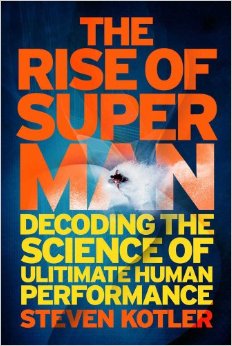
1.) THE RISE OF SUPERMAN by Steven Kotler: How do extreme athletes achieve Flow when one false move will kill them?

RiseOfSuperman


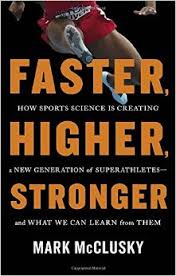
2.) FASTER, HIGHER, STRONGER by Mark McClusky: How do elite athletes squeeze the most out of the potential of the human body?

FasterHigherStronger


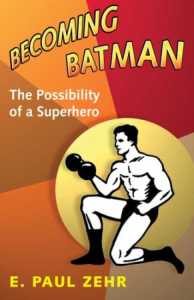
3.) BECOMING BATMAN by E. Paul Zehr: What would it take, physically and mentally, to become the Caped Crusader?

Becomingbatman


4.) FLOW by Mihaly Csikszentmihalyi: How does one achieve that state of relaxed and confident concentration in which we perform our best called Flow?

flow


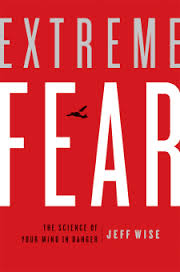
5.) Extreme Fear by Jeff Wise: How does one overcome anxiety and fear to perform one’s best?

ExtremeFear

BOOK REVIEW: The Dharma Bums by Jack Kerouac

The Dharma BumsThe Dharma Bums by Jack Kerouac
My rating: 5 of 5 stars

Amazon page


What one needs to know to get a feel for this book is neither a summation of events nor the description of some crisis that sets up those events; instead, one simply needs to know who dharma bums were. This may or may not be self-evident, despite the fact that it’s essentially what the two words crammed together suggests. Dharma Bums were members of the Beat Generation (i.e. Beatniks, the 1950’s predecessor counter-culture to the hippies) who followed (or were enamored by) Buddhism, and who eschewed a materialistic lifestyle—which is to say they worked only when they needed to in order to put bread on the table or when they found it [autotelicly] satisfying to do so.

The book is literary fiction and places more emphasis on character than plot, and–furthermore—the events of the book read as though loosely autobiographical. Therefore, the happenings of the book are as scattershot as real lives tend to be.

The book begins with Ray Smith (the fictional counterpart to the real Kerouac) hopping a freight car in the manner of Jack London’s “The Road” (not to be confused with Cormac McCarthy’s “The Road,” nor Kerouac’s own “On the Road”)

The book then spends time with a series of characters who map to real life members of the Beat Generation. The most important of these individuals (besides Smith / Kerouac) as far as the book is concerned is Japhy Ryder who represents the Zen poet Gary Snyder. Ryder is a mentor to Ray Smith. First, Ryder’s knowledge and practice of Buddhism is much more advanced than Smith’s—though they occasionally disagree because Ryder is a Zen Buddhist and Smith has an affinity for a more mainstream sect, Smith learns much about Buddhism and Eastern philosophy from Ryder. Second, Ryder is a mentor in sharing various life lessons with Smith, including introducing him to mountaineering. A short expedition up a mountain is among the most memorable parts of the book.

I’ll mention one other of the characters, Alvah Goldbook, who stands for Allen Ginsberg. Ginsberg may be the most famous of these individuals (other than Kerouac, himself) today, owing largely to his poem “Howl.” Ginsberg is more agnostic where Buddhism is concerned. He enjoys ideas from it but doesn’t jump in feet-first in the manner of Smith—let alone Ryder. There are a number of well-known beatniks who feature more or less prominently (e.g. Neal Cassady and Philip Whalen.)

The book’s end features Smith working alone as a fire lookout on another mountain—Kerouac readers later learned that this was the aptly named Desolation Peak. Japhy’s hand can be seen in this as well, as he recommended the job to Smith.

This is a book for the thinking-person. There is really only one dramatic event that stands out in my mind as the source of tension one normally seeks in a novel. The joy of the book comes from joining the characters in bouts of philosophizing, in the creative use of language, and in reflecting upon an approach to life that exists outside the conventional.

I’d recommend this book. Personally, I enjoyed it more, and found it more thought-provoking, than “On the Road,” which I suspect is the work for which Kerouac is more known and which is also a good read.

View all my reviews

BOOK REVIEW: Alice’s Adventures in Wonderland and Through the Looking-Glass by Lewis Carroll

Alice's Adventures in Wonderland & Through the Looking-GlassAlice’s Adventures in Wonderland & Through the Looking-Glass by Lewis Carroll
My rating: 5 of 5 stars

Amazon page


These are two separate children’s books, but the edition I read is one of several in which they are bundled together. Besides the fact that each is only a little over 100 pages, they are conveniently bundled because they share the same lead character, Alice, and take place in similar (arguably the same) alternate realities: Wonderland and the Looking-Glass World. These are worlds in which strange events are common place and there’s little compulsion to behave logically– worlds in which imagination rules and reality only provides a subconscious shaping of events.

In the former book, Alice enters the alternate world by tumbling down the rabbit hole and in the later she does so by stepping through a mirror (i.e. a looking-glass.) Each of these books follows Alice from her entry into the alternate reality, through a series of adventures, and then back to the real world.

Not much of a review is necessary because even though—given you are reading a review—you probably haven’t read the books yet, you will be familiar with many of the characters and references from widespread appearance in pop culture. I already mentioned the tumble down the rabbit hole, as does Morpheus (Laurence Fishburne) in “The Matrix.” That movie also references chasing the white rabbit, as does a famous song by Grace Slick. You’ve also probably seen or heard references to the grin of the Cheshire Cat and the frenetic behavior of the Mad Hatter. “Through the Looking-Glass” features several well-known characters from English nursery rhymes (e.g. Tweedledee & Tweedledum as well as Humpty Dumpty.)

It’s also not so important to get into plot because the stories are purposefully chaotic and exist in a world of loose logic. The strings of causality are not so strong, but it’s on purpose. It’s supposed to be a strange and surreal world, and it achieves great success in this regard. Events don’t have to make sense; they just have to be imaginable. This doesn’t mean that there is no flow or transitions between the adventures in these books. There is. It’s more easily recognized in “Through the Looking-Glass” in which a game of chess provides an underlying structure for the unfolding of events.

I’d recommend everybody read these books. While I referred to them as “children’s books,” I also agree with Neil Gaiman’s point that that is a nonsense term. So one shouldn’t think one missed the boat and there is no going back.

View all my reviews

BOOK REVIEW: A Burglar’s Guide to the City by Geoff Manaugh

A Burglar's Guide to the CityA Burglar’s Guide to the City by Geoff Manaugh
My rating: 5 of 5 stars

Amazon page


This is a book about how people exploit the architecture and infrastructure of cities to abscond with other people’s property. Manaugh shows us both how the masterminds of burglary think outside the box “Ocean’s Eleven” style, as well as how the dim dull-wits and junkies botch burglaries in hilarious ways. In the process, the author also shines a light on the ways in which the law enforcement community has had to update its technological and tactical capabilities to counter these threats.

The book contains seven chapters. The first chapter lays the groundwork, particularly through discussion of the aforementioned extremes. On one hand, there is George Leonidas Leslie, an architect turned bank robber who would build accurate mockups in order to accurately rehearse robberies, and–on the other hand–there is the guy who used a ghillie suit disguise in a rock and mineral museum (which, not unsurprisingly, featured barren rock displays [down-playing vegetation] such that the guy stuck out like a guy in a ghillie suit in a rock display.)

Chapter 2 details what Manaugh learned about burglary and the fight against it through his interviews with law enforcement, and—in particular—the Los Angeles Police Department (LAPD) helicopter unit.

The next chapter focuses on how different types of buildings are violated by burglars, and apartment burglaries are prominent in the discussion. This isn’t just about how they breach the building, but how they discover when no one will be home.

Chapter 4 is entitled “tools of the trade” and it reflects upon the skill-set that Hollywood suggests is associated with burglars—i.e. lock-picking and safe-cracking–but which constitute a less common set of tactics than one might think. Burglars usually favor the messier / quicker approach of busting walls and locks.

Chapter 5 deals with a number of issues under the rubric of “inside jobs” but one of the most intriguing is its discussion of those who don’t break in at all, but rather who hide inside the target building awaiting closing time.

The penultimate chapter is about that ever-present concern of burglars, the getaway. And sometimes the secret is what Black Widow says in “Captain America: Civil War”: “The first rule of being on the run is walk, don’t run.” The final chapter is a wrap-up, including a conclusion to the George Leonidas Leslie story that was brought up in the first chapter.

There are notes and citations at the end of the book. There are no graphics. I think this book could have benefited from graphics. However, the author displayed such skill with language and story-telling that I didn’t seem to notice (or care) at the time of reading. I suspect Manaugh didn’t want to present too much detail for fear of being seen as an actual manual for crime, which this clearly is not.

I found this book fascinating, and think you would enjoy it if you have any interests in cities, security, civil engineering, architecture, or just have a healthy curiosity about how buildings and cities work.

View all my reviews

BOOK REVIEW: Altitude Illness by Stephen Bezruchka

Altitude Illness: Prevention and Treatment (Mountaineers Outdoor Expert)Altitude Illness: Prevention and Treatment by Stephen Bezruchka
My rating: 5 of 5 stars

Amazon page


I picked this book up after my third, and most recent, trek at high altitude. On each trek, I felt the altitude at some point along the trail, but the most troubling and persistent issue for me has been sleep disruption—what I learned in the book was called periodic breathing. That was one of several useful lessons I learned from this book.

Altitude illness is an odd affliction. There’s a clear logic to what is happening inside your body. There’s a lack of sufficient oxygen to get said oxygen distributed throughout your body by way of your body’s business as usual operations. Homeostasis is out of whack, and the body does a number of things at once to rectify the problem. Because of this, in practice the ailment is actually a range of disparate illnesses that can seem to act in an arbitrary manner. Different people feel altitude in different ways. Some have no problems if they acclimate a few days, but others hit a ceiling beyond which they can’t travel no matter what. One’s level of fitness has little to do with how well on acclimatizes. For some, like myself, it can be a nuisance, but for others it can turn into a threat to survival in a flash.

This book is a concise introduction to altitude illness that covers: acclimatization / adaptation [ch. 1], the various forms of altitude illness [ch. 2], prevention [ch. 3], diagnosis [ch. 4], treatment [ch. 5], the effects of altitude given common preexisting conditions [ch.6], and a guide to preparing for a high altitude jaunt [ch.7.] In addition to the chapters mentioned above, there are two final chapters that make for nice features. Chapter 8 presents case studies of various true instances of altitude afflictions. The cases not only make for interesting reading, but also may help one connect the dots as to what is happening with oneself or someone in one’s party. The last chapter is a frequently asked questions (FAQ) collection that helps to summarize and restate issues addressed in the main chapters. The FAQ may also help one find needed information more quickly, rather than having to flip through the entire book while someone is having trouble.

There are some graphics in the book. Most of the graphics are photos of high or extreme elevation environments—and mostly the latter. (fyi: The book calls 12,000 – 18,000 feet [3660m to 5490m] high altitude, and over 18,000ft [5490m] is extreme altitude.) There are also several tables and a line drawing or two. There’s a short bibliographic section that is nicely divided into two sections, one for health care professionals and the other for lay readers.

I found this guide to be useful and well-presented. It’s well organized, concise, and easy to navigate (bullet points are frequently used to good effect.) This is the kind of book that is meant to help you get to the information you need quickly. There’s not a lot of use of the narrative approach beyond the case study chapter and a few anecdotes in the chapters to liven the discussion. I don’t mean to make is sound dry, but it’s a book with a purpose and that purpose isn’t entertainment. The lack of extraneous information and the keeping of blocks of text small is a good idea for this kind of guide. Having said all that, it’s quite readable by a layman. Jargon is explained and there is a glossary. (There are only a few medical terms—e.g. edema (fluid build-up), ataxia (incoordination), and syncope (fainting)that one needs to be concerned with repeatedly.)

If you will be traveling at altitude (and remember that may not be high or extreme elevations, some people have problems at as low as 6000ft [1800m.]) I’d highly recommend this book. I’d further recommend one re-read it on subsequent high elevation travels. It’s a short book and is broken up into tight subsections.

View all my reviews

BOOK REVIEW: Brain Rules by John Medina

Brain Rules: 12 Principles for Surviving and Thriving at Work, Home, and SchoolBrain Rules: 12 Principles for Surviving and Thriving at Work, Home, and School by John Medina
My rating: 4 of 5 stars

Amazon page


As the title suggests, this is a book of guidance about how to get the most out of one’s mental life. Medina goes a mile wide, looking at twelve areas in which one can improve the performance of one’s brain, including: exercise, attention, memory, sleep, stress management, sensory integration, and visual acuity. It also has chapters that explain how evolution and gender affect the way in which one’s brain operates.

After an Introduction that sets up the premise of the book, there are twelve chapters. The first chapter explores the well-documented connection between exercise and mental performance, and offers insight into what type of exercise has been shown to be most helpful to the brain. The second chapter pertains to our brain’s evolutionary history. The conscious mind housed in the cortex is but the top floor of a multi-story enterprise, and understanding this has important ramifications for how one gets the most out of one’s brain. Chapter 3 explores the way brains are wired, which turns out to be flexibly and diversely. By flexibly, I mean that brains can be rewired by way of what is called neuroplasticity on the proviso that neurons that fire together wire together. By diversely, I mean that each individual’s brain is a bit different, and these differences can explain how someone gifted in one domain may be an idiot in other aspects of life. The next chapter deals with attention and explains why humans suck at multi-tasking (despite thinking they are the bomb) and why an extended ability to concentrate is essential to success.

The next two chapters both deal with memory, but with different types of memory—each having its own unique considerations. The first, chapter five, describes the peculiarities of short-term memory, that part of the memory that can hold a finite amount of data points at the forefront of our minds for a limited period. Chapter six deals with long-term memory, the part that holds vast stockpiles of information for extended periods (sometimes across a lifetime) but with lower fidelity and accuracy than we generally believe. While the rule offered for both forms of memory is simple—i.e. repetition is key—there is much to consider in the details. For starters, there are many other ways to divide up memory other than with respect to the short-term / long-term dichotomy (e.g. procedural v declarative) and differences in the way these types of memory work affect how they are both optimized.

The influence of sleep on mental performance is the subject of chapter seven. There is a vast pile of research on this subject, including a number of famous cases of extreme sleep deprivation—some of which are touched upon herein. It’s true that there is a great deal of variation in how people sleep (e.g. morning v non-morning people, and those who can power nap and those who can’t.) However, one thing remains unambiguous and that’s that we need sleep and must have full cycles of it in order to not suffer mental degradation. Chapter 8 is about how stress can kill mental performance. Of course, not all stress is the same. When one feels in control, short bursts of stress can be just the motivator one needs, but when feeling out of control stress can become crippling.

Chapters 9 and 10 are both about the senses. The first, nine, explains how one can obtain synergistic outcomes in a multi-sensory environment, and the second focuses on vision—arguably our most dominant sense. Our sensory experience is much more a product of the brain (and much less a pure representation of the outside world) than we tend to believe.

Chapter 11 reports on the gender differences that have been discovered with respect to brains. Before anyone lights a torch or sharpens a pitchfork, this isn’t the old “boys do math and girls do language” line. The differences are more nuanced, and it’s not clear in every case that the differences matter—or how. E.g. Men have bigger amygdala (involved in emotional response) and produce serotonin more quickly. While it’s not clear that these differences make a big difference, it’s know that men and women use their amygdala differently in times of stress, men activate the right amygdala and tend to remember more of the gist of events while women trip the left and remember more emotional details. The last chapter is about our human proclivity to explore, but it focuses heavily on infancy and childhood, during which the world is novel and the impulse to explore is at its height.

Each chapter ends with a summary box that both restates the rule and offers a few bullet points of key takeaway lessons, which may either be more specific guidance or summary of relevant research findings. There aren’t many functional graphics—by functional I mean as opposed to the ornamental drawings used throughout. I only remember one brain drawing. However, the reason for the dearth of graphics may be that there is a link to a 45 minute video that one can access, and the publisher probably thought that was a much more useful way to impart graphic information. It should also be noted that in the Kindle edition that I have, the references are also on-line.

I found this book to be useful. As I mentioned, it’s a broad overview. One can get books that dive more deeply into all of the topics addressed. But this is a nice mix of popular science and self-help. It’s readable, and the summaries and concise statement of rules help make the content stick more effectively.

I’d recommend this book for those who are seeking a book that covers a lot of ground, and which offers practical guidance as to how to put scientific discoveries on the brain into use in one’s own life.

View all my reviews

BOOK REVIEW: Siddhartha’s Brain by James Kingsland

Siddhartha's Brain: Unlocking the Ancient Science of EnlightenmentSiddhartha’s Brain: Unlocking the Ancient Science of Enlightenment by James Kingsland
My rating: 5 of 5 stars

Amazon page


Kingsland builds his niche by connecting the dots between the teachings of the Buddha and scientific discoveries about meditation and mindfulness. There are many books that tell the life story of Siddhartha Gautama from various perspectives (e.g. famously the books by Hermann Hesse and Karen Armstrong.) There are also a number of books reporting the science of meditation (e.g. Herbert Benson and Sat Bir Singh Khalsa.) However, it’s not so common for the subjects to be overlapped.

There’s a reason that this middle path hasn’t been more widely studied. While Buddhism is arguably the most science-friendly of the major world religions, there’s always a gulf between spiritual and scientific thinking. The writer has to figure out how to chart a course through rocky waters. Books appealing to spiritual seekers are likely to come across as insubstantial fluff to the scientifically minded reader, and books appealing to skeptics are likely to feel materialistic and cold (and, perhaps, naive) to the spiritualist. The Buddha’s teachings about the need for the practice to be experiential, rather than faith-based, offers a unique opportunity to tread this tightrope. Furthermore, the Dalai Lama’s willingness to facilitate a dialogue between science and Buddhism has been crucial as well. One can easily set aside controversial issues like reincarnation and karmic law as they aren’t essential to the value of mindfulness.

The book consists of twelve chapters. The chapters generally begin with a story or teaching from the life of Buddha, and then go on to investigate the relevant lesson in more detail with particular emphasis on any relevant scientific discoveries that support said teachings.

The story of Buddha begins in a wealthy, high-caste household with young Siddhartha Gautama being kept from seeing the effects of aging, illness, and death. When the young Siddartha, nonetheless, sees these things, it is a powerful introduction to the concepts of impermanence and suffering that will play a central role in his future teachings. Chapter 1 starts this introduction and also offers an overview of the book. Chapter two continues it. In Chapter three, Kingsland describes a little of the known history of meditation, though its origins are lost to time.

Chapter 4 is entitled “The Second Dart” and it discusses the Buddha’s teaching of the same name—the second dart being one’s mental reaction to an event (i.e. the initial dart.) Chapter 5 investigates the question of whether there is a self—and, if so, of what manner. A core idea within Buddhism is that the self is illusory.

Chapter 6 gets to the heart of the matter by explaining the mechanism of mindfulness meditation and what has come to be known as MBCT (Mindfulness Based Cognitive Therapy)—a secular approach to the use of mindfulness to improve well-being. The next chapter tells the story of how a group of fire worshippers came to follow the Buddha after he made clear that everything (their senses, thoughts, and emotions) were aflame with craving, hatred, and delusion, and that springboards into a discussion of how mindfulness is used to reduce craving and addiction.

Chapter 8 tells the story of an attempt to kill the Buddha via an angry, drunk elephant, and the Buddha’s thwarting of the plot by way of calm and compassion. As one might have guessed, the chapter is about moderating emotions, just as the Buddha controlled his fear before the elephant.

Chapter 9 takes a jaunt into evolutionary biology to question how the mismatch between what humans evolved to do and what we do in the modern world causes mental illnesses and how mindfulness can help mitigate the problem. Chapter 10 is about metacognition, or the ability to observe and reflect upon our own mental experience—i.e. thinking about thoughts. Chapter 11 is about cognition and decision-making, and the role that meditation can play in improving our performance in this domain. The last chapter discusses the Buddhist conception of death and enlightenment. It isn’t until this point that there’s a major divergence between the Buddhist and scientific viewpoints. There is a discussion of the Buddha’s teachings emphasizing that belief in ideas from on high is not so important as experience.

Six of the chapters (2, 4, 6, 8, 10, & 11) are concluded with guided meditations to offer the reader an introduction into the basics of mindfulness. These are simple practices that many readers will already be familiar with in some variant or another. (e.g. breath awareness, bodily awareness, and mindful eating.)

There are only a few graphics (e.g. maps and diagrams—mostly of the brain) but there is no need for additional graphics. The book has references annotated.

I found this book interesting and thought-provoking. It uses the stories of Buddha as well as some stories from the present day to make the reading more engaging and approachable. The discussion of scientific research is easy for a neuroscience neophyte to follow.

I’d recommend this book for anyone interested in learning more about the science behind Buddhist practices.

View all my reviews